At an Australian property auction, a proxy bid means someone you authorise stands in the room (or on the phone) and bids for you, up to a limit you set. It is not the eBay-style system where software raises your bid automatically. In New South Wales, the person bidding for you must register before the auction and show the agent a signed letter of authority. If you live in the United States, that is how you can buy a Sydney home without being there on the day.
This guide explains the process the way we handle it at Sydney Property Buyers: who can bid for you, what paperwork is needed, where the risks sit and what to settle before auction day.
TL;DR
- Australian “proxy bidding” is bidding by a representative, who is a real person (usually a buyer’s agent) bidding live on your instructions. It is not an automatic bid ceiling on a website.
- In NSW your representative registers in the bidders record and shows a letter of authority with your name, address and ID number.
- A winning bid is binding straight away. The contract is signed on the day and the deposit is usually due on the spot, so your finance and legal checks must be done before you bid.
- Set a firm maximum and written instructions in advance, and take legal advice before anyone signs anything for you.
Table of Contents
- What proxy bidding means in Australia (and how it differs from online auctions)
- Who can bid on your behalf at a Sydney auction
- The paperwork: registration and the letter of authority
- What happens on auction day when someone bids for you
- Risks to settle before you give instructions
- What it costs to have someone bid for you
- Our perspective: why we prefer to bid for you with a plan
- How we can help if you are buying from the US
- Frequently asked questions
- Sources
What proxy bidding means in Australia (and how it differs from online auctions)
Search for “proxy bid” in the United States and you mostly find online auction sites. There, you enter a maximum and the system bids the minimum needed to keep you in front, up to your limit. Under that model, the platform’s software is your proxy.
Australian real estate works differently. Most homes in Sydney are sold at a live, open-outcry auction on the property’s front lawn, in a rooms hire or, increasingly, online with a live auctioneer. A “proxy bidder” here is a person who bids on behalf of the buyer. You will also hear “bidding by representative”, “bidding on someone’s behalf” and “telephone bidding”, and they overlap. A phone bid is simply a representative who is bidding while you listen in.
Two practical consequences follow:
- There is no automatic ceiling. Your representative decides in real time, within your instructions, whether to place each bid. You do not set a number and walk away.
- Judgement matters. Pace, timing and reading the room are part of the job. That is why most overseas buyers appoint a licensed buyer’s agent rather than a friend or relative.
Who can bid on your behalf at a Sydney auction
In NSW, a person can bid for someone else as long as they are registered correctly and hold written authority. The NSW Government says a person bidding for another person or company must register and show the agent a letter of authority, and that this includes bidding for someone on the telephone.
In practice, the realistic options are:
| Option | Strengths | Watch-outs |
|---|---|---|
| Licensed buyer’s agent | Experienced at auctions, bids to a strategy, has inspected the property and read the contract | Fee applies; agree scope in writing |
| Solicitor or conveyancer | Strong on the contract and legal risk | Many are not auction bidders by trade |
| Family member or friend in Sydney | No fee | Emotion, inexperience and a personal liability question if instructions are unclear |
| Yourself by phone or online | Full control | Connection drops, delays and no one on site to read other bidders |
If you want a detailed look at the rules around registering, our guide to auction registration in NSW walks through the steps.
The paperwork: registration and the letter of authority
This is the part that catches overseas buyers out, because the rules are specific and enforced.
What the law presumes
Under the Property and Stock Agents Regulation 2022, a bidder is presumed to be bidding on their own behalf unless, before bidding, they give the auctioneer a copy of written authority to bid for another person. Without that paper, your representative could be treated as the buyer themselves. That is a risk nobody wants.
What the letter of authority must contain
NSW Government guidance for agents says the letter must include the purchaser’s name, address and the identifying number from their proof of identity, such as a driver’s licence. If the buyer is a company, the letter goes on company letterhead and the ABN is recorded as the proof of identity, according to the NSW Government.
As a US buyer, you will usually need to supply:
- Your full legal name and residential address
- An identity document number. A foreign passport number is the usual practical route, so confirm with the agent what they will accept before the day
- A signed authority naming your representative and the specific property
- If you are buying through a company or trust, the entity details and who is authorised to act for it
The Real Estate Institute of NSW has noted that auctioneers and selling agents can be confused about the registration rules, and that a signed authority-to-bid form should identify the purchaser and their identification. Our advice: send the paperwork to the selling agent early, and ask them to confirm it is acceptable, rather than arriving with it on the day.
Your details stay private
The bidders record is not a public list. The NSW Government states that details in it cannot be shown to anyone, including the vendor. Your identity is not handed to the seller just because you registered.
What happens on auction day when someone bids for you
Here is the sequence we follow when we represent a client who is overseas.
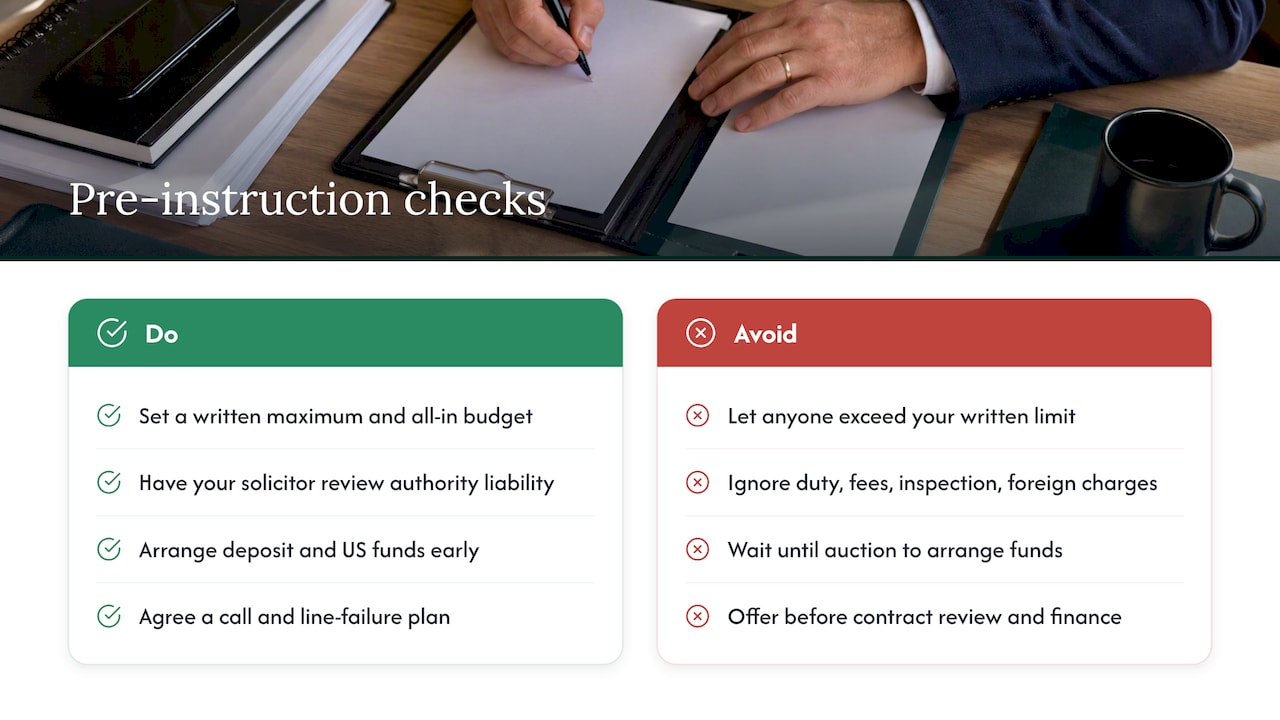
- Before the auction. The contract has been reviewed by your solicitor, building and pest inspections are done, finance is confirmed and your written instructions and limit are agreed.
- Registration. Your representative registers in the bidders record with your letter of authority and receives a bidder number.
- Bidding. Your representative bids to the plan. Usually that means bidding with confidence and with an eye on how other bidders are behaving, rather than responding to every raise from the auctioneer. Our piece on Sydney property auction bidding covers how bidding patterns work, and bidding increments explains how the size of each jump affects your budget.
- If the hammer falls on your bid. The sale is made. You are the buyer. Contracts are signed immediately and a deposit is typically paid on the spot. In NSW auctions there is no cooling-off period, which is why preparation matters so much.
- If the property is passed in. It did not reach the reserve. Your representative may be able to negotiate with the vendor straight after, within your instructions.
Who signs the contract?
This is a common point of confusion. An educational newsletter for NSW auctioneers noted in 2016 that a successful authorised bidder can sign the contract for the purchaser without a power of attorney. The same source says a registered power of attorney is needed for an authorised person to sign the transfer. Because this is a legal question that depends on your circumstances, and because it is a 2016 source, confirm the current position with your NSW solicitor. The Law Handbook is blunt on the point: do not arrange for someone else to sign the contract or rely on a nomination clause without first seeking legal advice.
Risks to settle before you give instructions
Proxy bidding is safe when it is structured. It goes wrong when instructions are vague.
Set a hard maximum, in writing. Decide the number after the building report, the contract review and a valuation, not in the heat of the moment. Write it down, and write down who is allowed to go above it (the answer should normally be no one).
Know what “all-in” means. Your maximum bid is not your total cost. Stamp duty, legal fees, inspection costs and any foreign purchaser charges come on top. As a US resident you may be a foreign purchaser under Australian rules, so ask your solicitor and the relevant state revenue office what applies to you before you fix a budget.
Understand liability. Standard written authorities used by auction houses commonly ask the buyer to indemnify the auctioneer and the proxy bidder against claims arising from the authority or the contract. One Australian proxy bidder written authority shows exactly this wording. Read what you sign, and get your solicitor to read it too.
Finance and deposit. The deposit is usually due when the contract is signed. We cover typical amounts in auction deposit percentages for US buyers. Know how your funds will travel from the US to an Australian account, and how long that takes, before the auction rather than after.
Time zones. Sydney is far ahead of US time zones, so auctions often fall in your night. Agree in advance whether you will be on a call, and what happens if the line fails. With a buyer’s agent on site, a dropped call does not end your bid.
Pre-auction offers. Sometimes a vendor accepts an offer before the auction date. If you want that option, your contract review and finance must already be done. See pre-auction offers in Sydney.
What it costs to have someone bid for you
There is no standard fee for a proxy bidder. A friend may do it for free, a solicitor may charge for time, and a buyer’s agent charges under their engagement agreement. Fee structures vary by agency, so ask for them itemised and in writing. Our guide to itemised fees and the buyers agency agreement shows what a clear agreement looks like.
At Sydney Property Buyers, the fee is paid on completion of a purchase, with a small retainer at engagement that is deducted from the final balance. We do not publish a price list, as scope and property type shape the fee, so we quote it in writing when we agree the mandate. If you want to compare agents, the 15 questions to ask a buyer’s agent is a useful checklist.
Our perspective: why we prefer to bid for you with a plan
We act only for buyers, never sellers, so every decision we make on auction day is about your interests. The biggest lesson from auctions we have run for clients is that the bidding limit is the easy part. The hard part is the discipline between the first bid and the last.
We have secured more than 100 properties for clients, and in that time we have seen overseas buyers make the same three mistakes: they leave the contract review too late, they set a number that ignores the costs around the purchase, and they give a representative a loose brief. A loose brief leads to a decision made in a hurry by someone who does not know what you will regret.
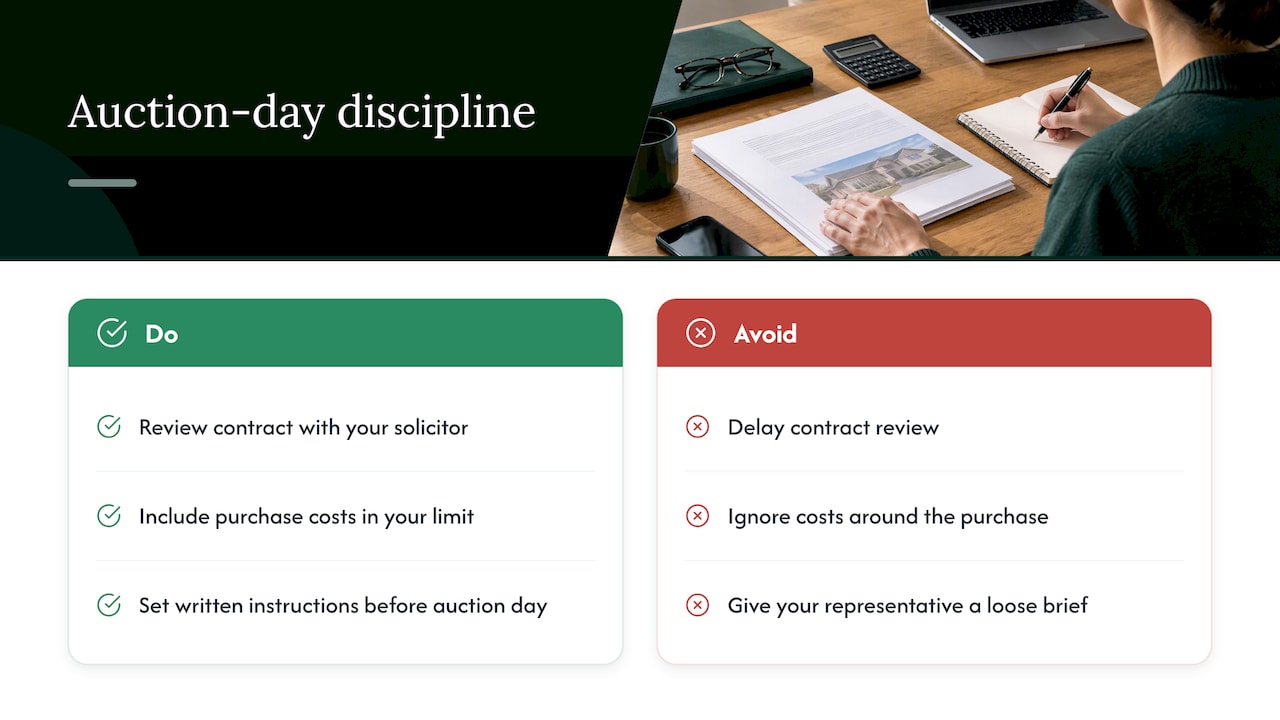
So we do the opposite. We inspect the property seven days a week, independent of open home times, read the contract with your solicitor, and agree your maximum and your instructions in writing before the day. We then bid steadily, avoid being pushed by the room and stop at your number. We also keep an eye out for properties that never reach auction: more than 30% of our purchases are secured off-market, and a quiet purchase before auction can save the stress entirely.
The best result is not always the win. Sometimes it is walking away at your number and finding the next one.
— Kristan
How we can help if you are buying from the US
If you have found a property going to auction, or you want us to find one, our auction bidding and full purchase service covers strategy, search, independent appraisal, due diligence, bidding and settlement. If you have already chosen a property and need representation, Negotiation Only is an option.

We work across the Inner West, Eastern Suburbs, Lower North Shore and Eastern Beaches. You can call 1800 676 177 or email hello@sydneypropertybuyers.com.au, and our office is at 79 New Canterbury Rd, Petersham NSW 2049 (NSW Licence 20456819). Before auction day, our auction day checklist shows the seven steps we follow with a buyer’s agent.
Frequently asked questions
Is proxy bidding legal at Sydney auctions?
Yes. NSW rules allow you to bid through a representative, provided they register in the bidders record and show the agent your written letter of authority. Without that authority, the regulation presumes the person is bidding for themselves.
Can I bid at a Sydney auction from the United States?
Yes, in two ways. You can bid by phone or online yourself, or you can appoint a representative to bid for you. Most overseas buyers choose a representative on site because they can read the auction and are not affected by time differences or connection problems.
Do I need a power of attorney to appoint a proxy bidder?
Not to bid. NSW guidance requires a letter of authority, not a power of attorney. Signing the contract and the transfer raises separate questions, so get advice from a NSW solicitor before you rely on someone else to sign.
Is shill bidding illegal in Australia?
Vendor bids are tightly regulated in NSW, and a seller or their agent cannot make fake bids to push the price up. The rules allow only certain disclosed vendor bids, and our guide to NSW auction rules explains what buyers should know.
Sources
- Buying property at an auction, NSW Government
- Auctions: responsibilities for property agents, NSW Government
- Property and Stock Agents Regulation 2022, reg 18
- Bidding on behalf of another: what are the rules? (REINSW)
- Auctions and private treaties, The Law Handbook
- Auctioneer newsletter, 2016
- Proxy bidder’s written authority
- How auction purchases change NSW contract exchange steps
Recommended
- Auction Bidder Etiquette in Sydney: A Buyer’s Guide
- Avoid Losing Your Deposit: 5 NSW Auction Rules Buyers Must Know
- Auction Registration in NSW: How to Register to Bid
- Sydney property auction bidding: how to bid with confidence