To bid at a residential or rural property auction in New South Wales, you must register with the selling agent first. You give your name and address, show acceptable proof of identity, and receive a bidder’s number. Under the NSW Government’s bidder’s guide, no number means no bid, even if you would have been the highest bidder. Registering costs nothing and commits you to nothing. What binds you is the bid that wins.
This guide is for buyers in the United States who are looking at Sydney and surrounds, and for anyone new to Australian auctions. It covers what to bring, when to register, how to bid for someone else, and what to have in place before you raise your hand.
TL;DR
- Registration is compulsory for every bidder at a NSW residential or rural auction, including phone bidders. You receive a bidder’s number to display when you bid.
- Bring a government or financial institution card showing your name and address, or two documents that together do that. Certified copies are not accepted.
- Agents must let you register at any time until the auction ends, but registering beforehand avoids a scramble while the auctioneer is taking bids.
- There is no cooling-off period on an auction purchase. Do your inspections, legal review and finance approval before you register.
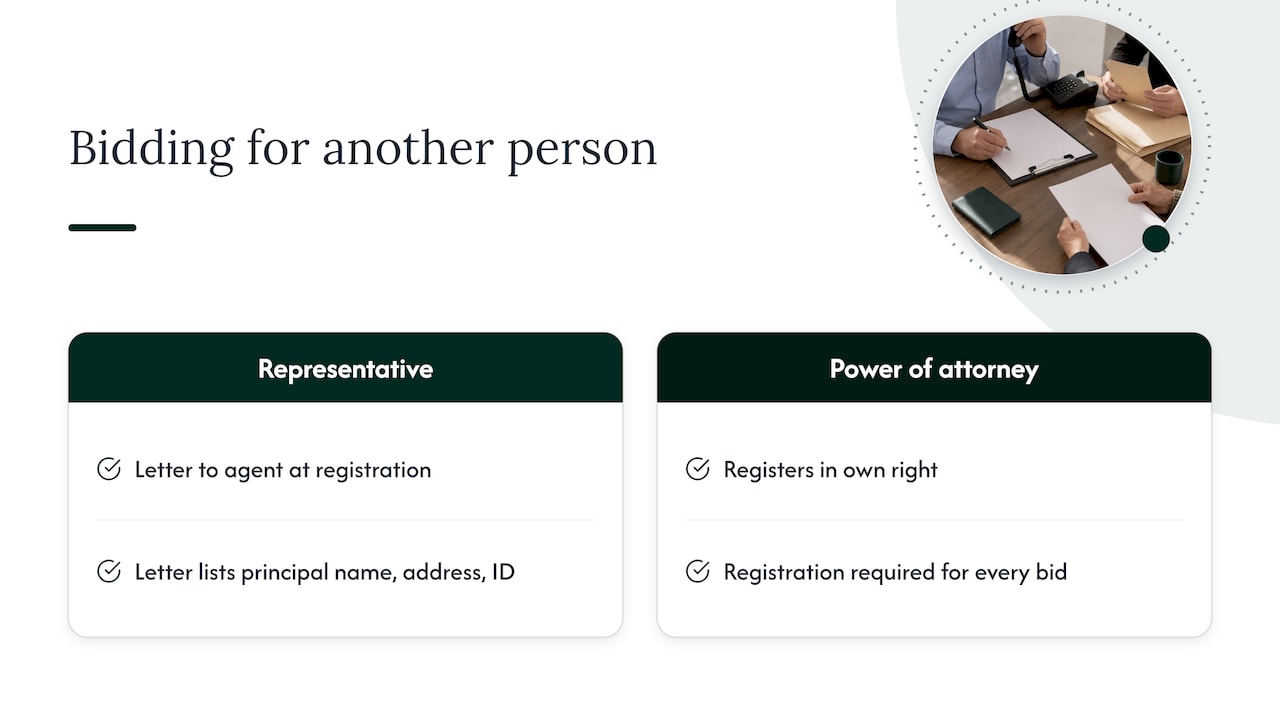
- Bidding for someone else needs a letter of authority, unless you hold a power of attorney.
Table of Contents
- What auction registration actually is
- What to bring: proof of identity
- When to register
- Bidding for someone else, or by phone
- Registered, then what? The rules that bind you
- A registration checklist you can follow
- Our perspective: registration is where your plan shows
- Where a buyers agent fits
- After the hammer falls
- Common mistakes to avoid
- FAQ
- Sources
What auction registration actually is
In the US, many people picture an auction as a paddle you pick up at the door. NSW is stricter. The rules are set out in the Property and Stock Agents Act 2002 and the Property and Stock Agents Regulation 2022, which regulate how auctions of land are run in the state.
The selling agent keeps a document called the Bidders Record. Each registered bidder is entered in it with their name, address and bidder’s number. According to the NSW Government, it is a confidential record, and the vendor cannot see it. That protects your privacy: the owner does not learn who you are just because you registered.
Two points surprise most newcomers:
- Registering does not oblige you to bid. Plenty of people register, watch, and go home.
- An agent must refuse a bid from someone who has not registered. There are no exceptions for the person who just made the highest offer.
What to bring: proof of identity
The NSW bidder’s guide sets two routes.
Route one: a single document. A card or document issued by a government body or a financial institution that shows both your name and your address. Examples listed by the NSW Government include a driver’s licence or learner’s permit, a vehicle registration paper, and a council rates notice.
Route two: two documents together. If you have no single document of that kind, you can combine two. One must show your name and be issued by a government body or financial institution. The other must show your address, for example a utility bill. If you cannot prove your address at all, a statutory declaration can fill that gap.
A few practical rules apply:
- No certified copies. Certified copies are not acceptable as proof of identity.
- Electronic copies are allowed if the agent agrees. A photo or PDF emailed to the agent can work. Agree this with the agent before auction day.
- No video-call verification. Holding documents up to the camera on a Zoom call is not permitted.
If you are an overseas buyer, ask the agent early what they will accept in your situation. The rules above are the NSW rules, and the agent applies them. Do not assume a US driver’s licence or a US utility bill will suffice, because the guide’s examples are Australian. Check with the agent well before the day.
When to register
Agents must allow you to register at any time until the auction finishes. You do not have to register at the start.
That said, leaving it late is a mistake. If you register mid-auction, you are handing over ID and waiting for the agent to complete the Bidders Record while the auctioneer is calling for bids. It is easy to miss your moment.
Our routine is simple:
- Ask the agent for the bidder’s guide and registration process when you first inspect. Agents must give potential bidders a copy before the auction.
- Send your ID in advance if the agent will accept electronic copies.
- Arrive 20 to 30 minutes early on the day, finish registration, and collect your number.
- Stand where the auctioneer can see you clearly.
Bidding for someone else, or by phone
Registration applies to every kind of bidding, including telephone bids. You cannot skip it because you are not in the room.
If you are bidding on behalf of another person, you must present a letter of authority to the agent when you register. According to the NSW Government’s guide, the letter must include the principal’s name, address and the identifying number from their proof of identity, such as a driver’s licence number. If you hold a power of attorney, you can register in your own right.
This matters for overseas buyers. If you are in the United States and cannot be in Sydney on the day, a representative can bid for you, but the paperwork must be right before the auction starts. A buyers agent can also bid on your behalf under the same rules. We cover how that works in our guide to Sydney property auction bidding.
Registered, then what? The rules that bind you
Registration is the easy part. The consequences of winning are not. NSW Government guidance on buying at auction says the successful bidder must sign the contract of sale and pay the deposit on the spot, usually 10% of the purchase price.
There is also no cooling-off period. The same guidance says this applies after the exchange at auction, and also if contracts are exchanged on the same day after the property is passed in. If you cannot complete, you will lose your deposit and may be liable for any damages the vendor suffers.
A worked example, in Australian dollars: at a winning bid of A$1,500,000, a 10% deposit is A$150,000, due on the day. That is why the order of operations matters more than the registration form.
| Before you register | Why it matters |
|---|---|
| Building and pest inspection | No cooling-off period to rely on after the hammer falls |
| Solicitor or conveyancer reviews the contract | You sign on the day, so problems must be found first |
| Finance pre-approval in writing | The deposit and settlement funds must be real |
| A fixed top price | Auction momentum is a known trap |
Our own checklists go deeper on each of these: the Sydney due diligence checklist, pre-auction building inspections, finance clauses in NSW and auction deposit percentages. For the rules that put deposits at risk, see five NSW auction rules buyers must know.
A registration checklist you can follow
- Shortlist the property and book an inspection. We inspect seven days a week, so you are not tied to open home times.
- Request the contract and have a solicitor or conveyancer review it.
- Order a building and pest report before the auction, not after.
- Confirm finance in writing, with enough cash for the deposit on the day.
- Set your limit and write it down.
- Gather ID: one qualifying card, or two documents that together show name and address.
- Contact the agent to ask whether electronic copies are acceptable and whether they will take your registration before the day.
- Register and collect your number early on auction day.
- Know the etiquette: how to signal, how to respond to the auctioneer, and when to stop. See our auction bidder etiquette guide.
Our perspective: registration is where your plan shows
Most registration problems are really preparation problems. A bidder who turns up with the wrong ID is usually a bidder who has not read the contract, either. We see the same pattern: the people who sleep well after an auction, win or lose, did the boring work first.

We act only for buyers, never sellers, so our advice does not bend towards a vendor’s price. We would rather you register and walk away at your limit than chase a result. Part of our job at auction is holding the line on that limit when the room gets loud. Our clients tend to ask us about increments too, and the answer is in our guide to auction bidding increments.
We also encourage buyers to look beyond the auction. Over 30% of our purchases are secured off-market, and an off-market or pre-auction deal never involves a bidder’s number at all. If a property you like is heading to auction, a conversation with the vendor’s agent before the date can sometimes change how you buy. See how to be contract ready for pre-auction offers and how buyers agents access off-market properties.
— Kristan
Where a buyers agent fits
You do not need a buyers agent to register. Anyone with valid ID can. The value comes from everything around the registration: an independent appraisal so you know what the property is worth, due diligence, a bidding strategy and someone to bid for you while you stay calm.
Sydney Property Buyers is a licensed Sydney buyers agency (NSW Licence 20456819), directed by Kristan Johnson, the 2024 Outstanding Buyers Agent of the Year at the Inner West Local Business Awards. Our Complete Purchase Solution and Auction Bidding service covers strategy, search, appraisal, due diligence, negotiation, bidding and settlement across the Inner West, Eastern Suburbs, Lower North Shore and Eastern Beaches. If you have already found a property, Negotiation Only is also available. Call 1800 676 177 or email hello@sydneypropertybuyers.com.au, or see properties we have secured for clients.
After the hammer falls
If your bid wins, the next days run fast: contract signed, deposit paid, then settlement. It is worth sketching the logistics early, including the move itself. A NSW moving checklist helps you place tasks on the calendar once your settlement date is set.
If you do not win, nothing is owed. Registration created no obligation. Many buyers lose a first auction and win the second, because they understand the process by then.
Common mistakes to avoid
- Assuming you can register at the last second. You legally can, but it adds stress at the worst moment.
- Bringing only a certified copy. It will not be accepted.
- Planning to prove identity over video. That is not permitted.
- Bidding for a relative without a letter of authority. The agent will not accept the registration.
- Treating the deposit as an afterthought. It is due on the day.
- Skipping the contract review. Easements, restrictions and other title issues are better found before bidding. Our easement checklist shows what to look for.
FAQ
Do I have to register to bid at a NSW auction?
Yes. For residential and rural property in NSW, you must give the selling agent your name and address and show proof of identity before you can bid. You then receive a bidder’s number. This also applies to phone bidders and to people bidding on behalf of others.
Can I register on the day of the auction?
Yes. Agents must allow registration at any time until the auction ends. It is far easier to register beforehand, because you avoid handing over ID while bidding is under way.
Can someone bid on my behalf?
Yes, with a letter of authority presented at registration. It must include your name, address and the identifying number from your proof of identity. A person holding a power of attorney can register in their own right instead.
What happens if I win and cannot complete the purchase?
There is no cooling-off period at auction. You sign the contract and pay the deposit on the day, usually 10% of the price. If you fail to complete, you can lose your deposit and may be liable for damages.
Sources
- Bidder’s guide, NSW Government
- Buying property at an auction, NSW Government
- Auctions: responsibilities for property agents, NSW Government
Recommended
- Sydney property auction bidding: how to bid with confidence
- Avoid Losing Your Deposit: 5 NSW Auction Rules Buyers Must Know
- Auction Bidder Etiquette in Sydney: A Buyer’s Guide
- Sydney Auction Day Checklist: 7 Steps With a Buyer’s Agent