At most US property auctions, the deposit runs 5–10% of the winning bid, paid on the spot or within 24–72 hours. Government and courthouse sales often push that figure higher. Under 43 CFR § 5441.1-1, certain federal land offerings require a bid deposit of not less than 10% of appraised value before bidding even begins. The National Association of REALTORS® and the U.S. Department of Housing and Urban Development both treat the deposit as earnest money applied to the purchase price, and the Cornell Legal Information Institute (LII) provides the statutory text for federal and state rules. Three things to have sorted before you register:
- How much to have ready: 5–10% of your maximum bid in certified funds, plus a buffer for buyer’s premium (often an additional 1–5%).
- Acceptable payment forms: cashier’s check or certified check at most live sales; wire transfer for many online and REO auctions. Personal cheques and credit cards are almost universally rejected.
- Timing: live courthouse sales demand immediate payment; online platforms typically allow 24–72 hours after the hammer falls.
Key takeaways
| Point | Details |
|---|---|
| Typical deposit range | 5–10% of the winning bid; government and courthouse sales often require 10% or more. |
| Accepted payment forms | Cashier’s check or wire transfer; personal cheques and cards are almost universally rejected. |
| Payment timing | Immediate at live/courthouse sales; 24–72 hours for most online and REO auctions. |
| Legal risk on default | The deposit is retained by the seller as liquidated damages under standard auction contract clauses. |
| Confirm before bidding | Call the auctioneer at least three business days ahead to verify the deposit amount and payment window. |
Table of Contents
- How is the auction deposit percentage actually calculated?
- What payment methods and timing should you expect?
- How do deposit rules differ by auction type?
- What are the legal consequences if you cannot close?
- What should you do before you register and bid?
- Where can you find sample clauses and verify the rules?
- What first-time auction bidders consistently underestimate
- Sources
How is the auction deposit percentage actually calculated?
Two models dominate US auction practice: percentage-based and flat-minimum.
Percentage-based is the most common. Zillow notes that some contracts set a floor, for example 5% but no less than a flat minimum amount, which protects the seller on lower-value lots where a pure percentage would produce a trivially small deposit.
Flat minimums appear most often in estate sales and smaller regional auctions. The terms of sale will state a fixed dollar amount regardless of the final bid. Read those terms before you bid, not after.
Where buyers trip up is the buyer’s premium. Many auction houses charge an additional fee of 1–5% on top of the hammer price. That premium is typically due at closing, not at the deposit stage, but it increases the total cash you need to have available.
Sample terms-of-sale language to look for when reviewing a purchase agreement:
- “Buyer shall pay an earnest money deposit equal to [X]% of the purchase price, due by 5:00 PM on the first business day following the auction.”
- “The deposit shall be paid by cashier’s check or wire transfer only. Personal cheques will not be accepted.”
- “In the event of buyer default, the deposit shall be retained by the seller as liquidated damages.”
What payment methods and timing should you expect?
Payment rules at US property auctions are strict, and a rejected cheque can cost you the property.
Accepted forms at most live auctions:
- Cashier’s check or certified check made payable to the auctioneer or escrow agent
- Wire transfer (confirm routing details and cut-off times in advance)
- Cash, at some smaller or courthouse sales
Treasury auction guidance confirms that certified funds are the standard; personal or business cheques are routinely excluded. Cards are almost never accepted for deposit purposes at property auctions.
Timing splits sharply by format. At a courthouse or sheriff’s sale, you pay the moment the gavel falls. There is no grace period. Online platforms and REO auctions are slightly more forgiving: Rocket Mortgage reports that winning bidders often have 24–48 hours to transfer funds, though some platforms extend this to 72 hours. New York’s Office of General Services, for example, requires a certified check for a deposit equal to a percentage of the minimum bid at the time of sale, with the balance due within a set period.
One distinction worth understanding: some auctions collect a registration deposit from all bidders upfront, which is refunded to non-winners. The successful bidder’s deposit is a separate, larger amount due after winning. Confirm with the auctioneer which model applies before you arrange your funds.
Pro Tip: Call the auction house or sale administrator at least three business days before the auction. Ask specifically: what is the deposit percentage, what payment forms are accepted, and what is the wire transfer cut-off time? Get the answer in writing, even if it is just an email confirmation.
How do deposit rules differ by auction type?
The auction format shapes almost everything about deposit requirements.
Foreclosure and courthouse sales are the most demanding. Deposits are commonly 5–10% or higher, required immediately, and failure to close can mean loss of deposit and additional penalties. Properties sell strictly as-is; there is rarely any inspection period. Some jurisdictions require the full purchase price on the day, particularly at trustee sales.
Wire transfers are usually accepted within 24–48 hours, and closing timelines run 30–45 days, though some bank-managed sales compress this to two weeks.
Estate auctions vary widely. Smaller estate sales may accept a flat-dollar deposit or a lower percentage, but the terms are set by the estate administrator and can be idiosyncratic. Always read the specific terms of sale.
Online auction platforms typically collect a registration deposit from all bidders (often a flat minimum amount–$5,000, refundable to non-winners) and then require the full earnest money deposit from the winner within 24–72 hours. Buyer’s premiums are common on these platforms.
| Auction type | Typical deposit | Payment method | Timing | Refundability | Closing timeline |
|---|---|---|---|---|---|
| Foreclosure/courthouse | 5–10%+ or full price | Cashier’s check or cash | Immediate | Non-refundable on default | Days to weeks |
| Bank/REO | 5–10% | Cashier’s check or wire | 24–48 hours | Non-refundable on default | 30–45 days |
| Estate | Flat minimum or 5–10% | Cashier’s check | Same day or next day | Varies by terms | 30 days |
| Online platform | Registration deposit + 5–10% | Wire transfer | 24–72 hours | Registration deposit refunded to non-winners | 30–45 days |
What are the legal consequences if you cannot close?
The deposit at a US property auction is not a reservation fee. It is a binding contractual commitment, and the legal consequences of walking away are serious.

Earnest money vs deposit language. In most purchase agreements, the terms are used interchangeably. The deposit is credited toward the purchase price at closing. If you close successfully, it is simply part of your payment. The risk sits entirely on the other side of that outcome.
Liquidated damages clauses are standard in auction purchase agreements. Sample purchase agreements commonly specify that if the buyer defaults, the seller retains the deposit as liquidated damages, with no further obligation to pursue the buyer for additional losses. That clause is the seller’s protection, and it is almost always enforceable.
At foreclosure sales, the consequences can extend beyond deposit forfeiture. Some jurisdictions allow the trustee or court to pursue the defaulting bidder for the difference between the winning bid and the price achieved at a subsequent resale, plus costs.
Refundability exceptions do exist but are narrow. A seller who cannot deliver clear title, or a sale that is cancelled by court order, will typically trigger a full refund. Buyer’s remorse does not.
The NAR consumer guide notes that deposits often function as earnest money applied to the purchase price, and that auctions commonly restrict financing, making verified liquid funds effectively mandatory. If your mortgage falls through after winning, the deposit is almost certainly gone.
What should you do before you register and bid?
Preparation before the auction is where most mistakes are avoided. Work through this checklist before you register:
- Confirm the deposit percentage and payment method directly with the auctioneer or sale administrator, in writing.
- Arrange certified funds in the correct amount. If the deposit is 10% and your maximum bid is $350,000, have a $35,000 cashier’s check ready, plus a buffer for buyer’s premium.
- Verify wire transfer instructions if the auction accepts electronic payment. Confirm the bank’s cut-off time and the auctioneer’s receiving account details, and consider switching from manual to automated payouts for brokers to streamline the process.
- Obtain proof of funds or pre-approval. The NAR advises that auctions commonly require this at registration, not just at closing.
- Bring valid photo ID and any registration forms the auction house requires. Online platforms often require account verification days in advance.
- Read the full terms of sale before the auction, not during it. Look specifically for the deposit percentage, payment deadline, buyer’s premium, and the default clause.
- Budget for closing costs beyond the deposit. Closing timelines at auctions can be as short as two weeks, so your remaining funds must be accessible immediately after winning.
Pro Tip: Run a funding timeline before auction day. If you are using a wire transfer, test the process with a small transfer to confirm the receiving details are correct. A failed wire on auction day is treated the same as no payment at all.
Understanding how a buyer’s agent oversees property settlement can also clarify what happens between deposit and final close, particularly on compressed timelines.
Where can you find sample clauses and verify the rules?
Knowing what contract language to look for saves time and prevents surprises.
Typical earnest money deposit clause patterns:
- Deposit amount and percentage stated as a figure of the purchase price
- Deadline for payment (commonly 5:00 PM on the first business day after the auction)
- Acceptable payment instruments listed explicitly
- Treatment on default: seller retains deposit as liquidated damages
- Conditions under which the deposit is refunded (seller unable to convey title, court-ordered cancellation)
Sample purchase agreements from auction houses typically include all of these elements in a single “Terms of Sale” or “Earnest Money” section. Print it, read it, and if any clause is unclear, ask the auctioneer before bidding.
Authoritative sources to verify the rules for a specific sale:
- NAR Consumer Guide: Real Estate Auctions for general auction norms and registration requirements
- HUD guidance for government-managed and FHA-related property sales
- Cornell LII, 43 CFR § 5441.1-1 for federal land auction deposit requirements
- Your state’s Office of General Services or auctioneer licensing board for state-administered sales
- The auction house’s own published terms of sale, which are the binding document for that specific event
What first-time auction bidders consistently underestimate
That framing misses the real risk.
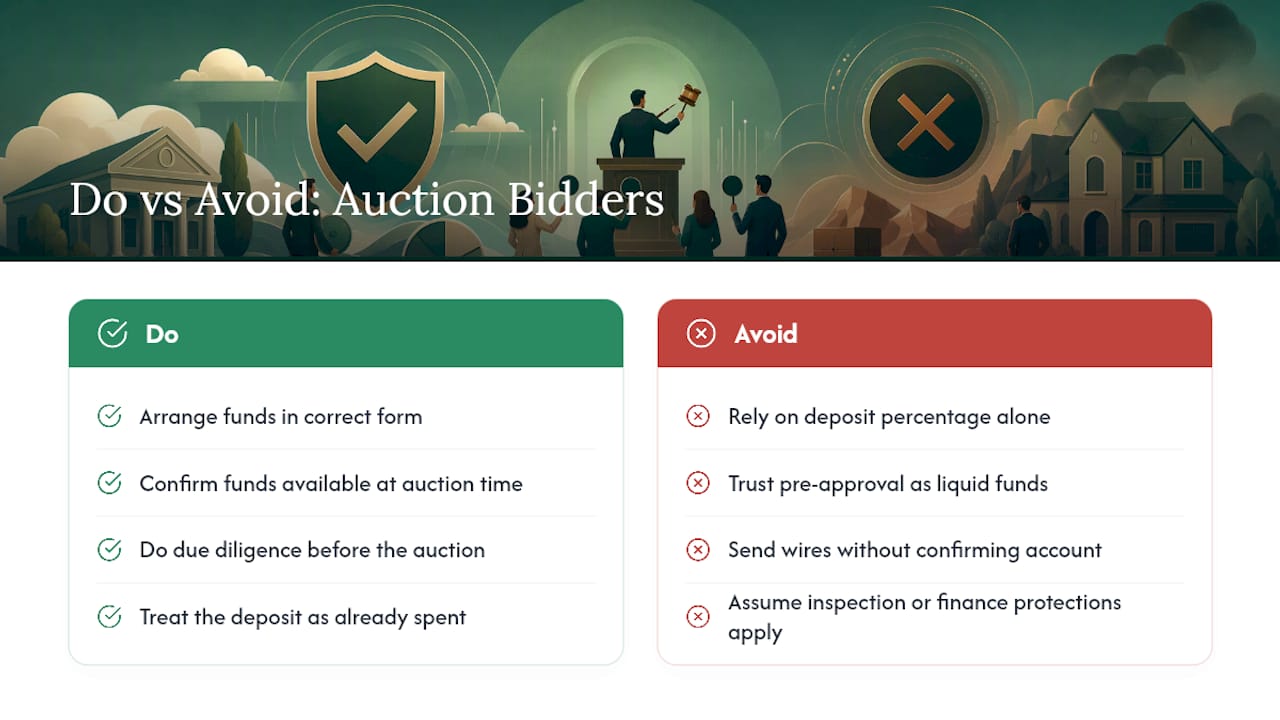
The deposit percentage is almost the least important variable. What actually determines whether a bidder gets into trouble is the gap between knowing the number and having the funds in the right form, at the right institution, at the right time. A cashier’s check drawn on a bank branch that closes at 4:00 PM, when the auction ends at 5:30 PM, is useless. A wire transfer sent to the wrong account number is useless. A pre-approval letter from a lender, at a sale that requires proof of liquid funds, is useless.
The second thing first-time bidders underestimate is the as-is nature of auction properties. The deposit is non-refundable in almost every scenario except seller default. There is no cooling-off period, no building inspection contingency, no finance clause. If you win and then discover a structural problem, you still owe the balance. The deposit is gone regardless. That is not a technicality buried in the fine print; it is the fundamental commercial logic of an auction.
What I would tell a cautious first-time bidder: treat the deposit as already spent the moment you raise your hand. If losing that money would cause genuine financial hardship, you are not ready to bid at that price point. Adjust your maximum bid downward until the deposit amount is genuinely affordable to lose, then bid with confidence up to that ceiling.
The buyers who succeed at auction are not the ones who know the most about deposit percentages. They are the ones who have done the due diligence before the auction, arranged their funds correctly, and set a number they can live with.
Sources
These are the primary references used in this article. Check the specific sale’s terms of sale first; these sources provide the framework.
Recommended
- Why clearance rates matter for Sydney property buyers
- Fixed fee vs percentage buyers agent: Sydney guide
- Our Services — Full Purchase & Negotiation Only | Sydney Property Buyers
- What does a retainer fee mean for a buyer’s agent?