Auction clearance rates are Sydney’s most immediate read on buyer demand, and the single action to take is this: track a four-week rolling average for your target suburb, then cross-check it against Reserve Bank of Australia cash rate moves and local vacancy data before you bid or make an offer. Kristan Johnson, director of Sydney Property Buyers and 2024 Outstanding Buyers Agent of the Year, uses exactly this approach to position clients for negotiation before a property even hits the open market.
Three caveats to hold in mind from the outset:
- Preliminary vs final rates: Saturday evening figures are typically 5–8 percentage points higher than the revised final rates published the following week. Never act on a preliminary number alone.
- Auction coverage gap: clearance rates track auctions only; private treaty sales, which dominate Australian transactions, are invisible in the data.
- Suburb-level variation: a city-wide figure averages suburbs at completely different points of the cycle. One suburb may clear at 90% while another sits at 45% in the same week.
Table of Contents
- How are auction clearance rates actually calculated?
- Why do clearance rates matter to buyers, and what thresholds should you watch?
- How to use clearance rates in your Sydney buying strategy
- How Sydney Property Buyers uses clearance-rate signals in practice
- Pre-bid checklist: what to verify before you bid or make an offer
- Key takeaways
- The clearance rate is a tool, not a verdict
- How Sydney Property Buyers can help you read the market and buy smarter
- Sources and further reading
How are auction clearance rates actually calculated?
The formula is straightforward: properties sold divided by properties scheduled for auction, expressed as a percentage. A Saturday with 200 homes listed and 140 sold produces a clearance rate of 70%. What counts as “sold” includes hammer sales at auction, pre-auction sales agreed in the days before, and post-auction sales concluded on the day. That last category is where interpretation gets slippery.
The timing matters. Preliminary figures land Saturday evening, before agents have reported every result. Final revised rates, published the following week, are consistently 5–8 percentage points lower once unreported and withdrawn listings are factored in. Agents sometimes delay reporting a passed-in result, which inflates the preliminary number.
Coverage is the other structural limit. Clearance rates capture auction-marketed homes only, and private treaty remains the dominant sales method across Australia. Entire suburbs, particularly those priced well below the city median, transact almost entirely off-market or via private treaty and barely register in weekly clearance data. For buyers targeting those areas, off-market listings often tell a more complete story.
Volume also shapes interpretation. A 70% clearance rate across 300 auctions signals something very different from 70% across 18. High volume combined with a falling rate means supply is rising faster than demand — a meaningful shift. Low volume with a high rate may just be noise.
Pro Tip: Always compare four-week rolling averages rather than single-week snapshots. One rainy Saturday or a long weekend can swing a weekly figure by 10 percentage points without reflecting any genuine change in market conditions.
Why do clearance rates matter to buyers, and what thresholds should you watch?
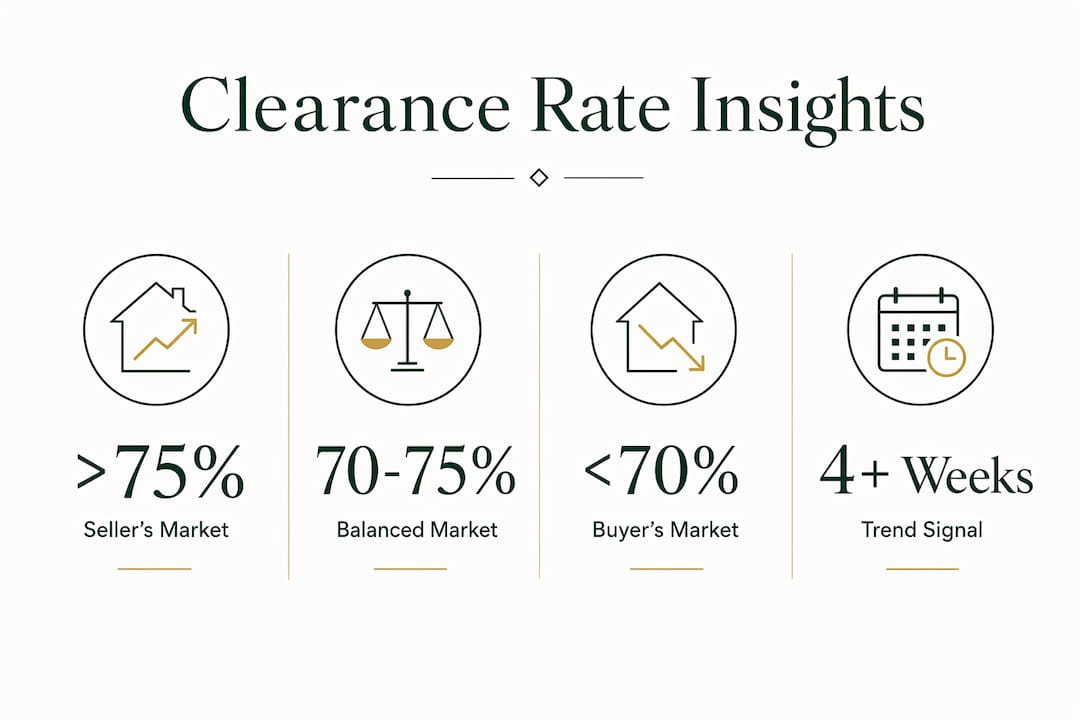
Sustained clearance-rate trends — four or more consecutive weeks at a given threshold — have historically preceded broader price movements by roughly 2–3 months. That lag is what gives buyers a window. A rate that holds above 75% for a month is telling you that competition is building and prices are likely to follow. A rate that sits below 55% for the same period suggests negotiating leverage is shifting toward buyers.

| Clearance rate | Market signal | Buyer posture |
|---|---|---|
| Above 75% | Strong sellers’ market; buyers competing hard | Prepare for competitive bidding; pre-approval critical |
| 65–75% | Balanced market; reasonable competition | Negotiate firmly but expect vendor resistance |
| 55–65% | Emerging buyers’ market | More room to negotiate; due diligence time available |
| Below 55% | Buyer advantage; properties passing in | Post-auction negotiation likely; use revealed reserve as anchor |
Sydney’s Easter 2026 preliminary clearance rate fell to 53.4%, with a final rate of 48.8% — the weakest result since April 2020. Analysts linked the drop directly to the RBA’s cash rate moves and banks passing increases on to borrowers. Buyers who had been tracking the four-week trend saw the softening coming and adjusted their negotiating stance accordingly.
The limits are real. Clearance rates are a concurrent-to-slightly-lagging indicator, not a crystal ball. They reflect auction-marketed stock only, they are subject to seasonal swings around school holidays and public holidays, and city-wide averages routinely hide extreme divergence between suburbs. A 65% city average can contain a suburb clearing at 90% and another at 40% simultaneously. Understanding what a buyer’s market actually means at suburb level is where the real analysis begins.
How to use clearance rates in your Sydney buying strategy
Use clearance rates to set your negotiating posture — cautious in a seller’s market, assertive when rates soften — then build the full picture with complementary data.
- Monitor suburb-specific four-week rolling clearance rates. City-wide figures are a starting point only. Drill into the suburbs you are targeting and track the trend, not the week.
- Cross-check RBA cash rate direction and bank lending conditions. Rising rates compress borrowing capacity and tend to soften clearance rates within one to two months, as April 2026 demonstrated.
- Check vacancy rates and days on market (DOM). Combining clearance rates with vacancy and DOM data gives a far more complete buying signal than any single figure. DOM below 30 days signals active competition; above 60 days, vendors are waiting and often willing to negotiate.
- Model your borrowing capacity and stress-test repayments at a rate 2–3% above your current approval. Markets shift; your buffer should not.
- Prepare a walk-away price before you attend any auction. Write it down. Competitive auction environments generate pressure that overrides rational calculation.
When a property passes in, the dynamic changes entirely. The vendor’s reserve becomes visible, creating a concrete anchor for negotiation. Passed-in properties often enter post-auction negotiation where buyers who have done their homework can secure meaningful discounts. Understanding auction conditions and your obligations as a buyer before that moment is not optional.
Pro Tip: When a property passes in, ask the agent for vendor feedback before making your first offer. Knowing whether the vendor is flexible on price, settlement terms, or inclusions gives you negotiating angles beyond the headline number.
How Sydney Property Buyers uses clearance-rate signals in practice
The result that matters: Sydney Property Buyers has secured over 100 properties for clients, with an average saving of approximately 9% on purchase price and more than 30% of acquisitions sourced off-market.
Here is how that translates in practice. When suburb-level clearance rates in a target area held below 60% for five consecutive weeks, the team at Sydney Property Buyers identified the trend as a meaningful signal — not a one-week anomaly. Cross-referencing with rising DOM and stable vacancy data confirmed that vendor urgency was building. The negotiation strategy shifted accordingly: lower opening offers, longer settlement conditions as leverage, and a focus on properties that had already passed in once. The outcome in one anonymised case was a purchase price well below the vendor’s original reserve.
Clearance rates are one of the clearest early signals we have that a suburb’s balance of power is shifting. Four weeks of consistent data tells us far more than any single Saturday result — and it changes how we approach every conversation with a vendor’s agent.
Kristan Johnson holds a NSW real estate licence and was recognised as the 2024 Outstanding Buyers Agent of the Year at the Inner West Local Business Awards. As a licensed buyer’s agent, Kristan brings auction bidding experience, off-market network access, and suburb-level data analysis to every client engagement.
Pro Tip: Four or more consecutive weeks at a threshold is the meaningful signal window. One or two weeks of softening may be seasonal noise; a sustained trend is a genuine market shift.
Pre-bid checklist: what to verify before you bid or make an offer
Before attending any Sydney auction or submitting a private treaty offer, work through this list:
- Finance pre-approval confirmed and stress-tested at a higher rate
- Four-week suburb clearance trend reviewed (not just the latest Saturday figure)
- Recent comparable sales pulled for the street and suburb
- Days on market checked for the specific property and the suburb median
- Vacancy rate reviewed for the postcode (SQM Research publishes free postcode-level data)
- Solicitor or conveyancer engaged and contract reviewed — Parramatta Conveyancing offers contract review services relevant to Sydney buyers
- Stamp duty modelled and settlement buffer confirmed in your cash position
- Walk-away price written down before you arrive
If a property passes in, use these prompts:
- Open with a conditional offer below the revealed reserve, citing comparable sales
- Ask the agent what settlement terms the vendor prefers — flexibility there can offset price
- Request vendor feedback on what would make an offer acceptable
- Consider off-market alternatives if the vendor’s expectations remain unrealistic; buying off-market in Sydney removes the auction pressure entirely
Key takeaways
Clearance rates are a confirmation signal, not a forecast: use four-week suburb trends combined with RBA rate direction, vacancy data, and days on market to set your negotiating posture before you bid.
| Point | Details |
|---|---|
| Use trends, not single weeks | Four or more consecutive weeks at a threshold precede price moves by roughly 2–3 months. |
| Preliminary rates are inflated | Final revised rates run 5–8 percentage points below Saturday evening figures — wait for the revision. |
| Below 60% favours buyers | Below 60% clearance signals negotiating leverage; above 70% expect competitive bidding. |
| Passed-in auctions are opportunities | The revealed reserve becomes a negotiation anchor; vendors are often motivated to deal post-auction. |
| Sydney Property Buyers | Kristan Johnson’s team uses four-week suburb trends and off-market access to secure properties at an average ~9% saving. |
The clearance rate is a tool, not a verdict
Most buyers I speak with treat clearance rates as either gospel or noise. Neither is right. The figure tells you something real about the balance of urgency between buyers and sellers in auction-marketed stock — but it tells you nothing about the private treaty sale two streets over, the off-market deal that never appeared in any data set, or the specific vendor who needs to settle in 30 days for personal reasons.
Where clearance rates genuinely earn their place is in setting posture. When a suburb has held above 75% for six weeks, walking into an auction expecting to negotiate hard is a mistake. When it has sat below 55% for the same period, paying above reserve is equally avoidable. The data does not make the decision — it narrows the range of sensible ones.
The buyers who use this well combine suburb-level clearance trends with vacancy rates, DOM, and a clear read on their own borrowing limits. They also know when to look past the auction market entirely. More than 30% of the properties Sydney Property Buyers secures for clients never appear at auction or on the public portals. Clearance rates cannot tell you about those opportunities. That is precisely why the data is a starting point, not a strategy.
How Sydney Property Buyers can help you read the market and buy smarter
Knowing that clearance rates are softening is useful. Knowing which Inner West or Eastern Suburbs street to target, what to offer, and how to structure the deal is where buyers actually save money.

Sydney Property Buyers translates suburb-level clearance data, vacancy trends, and off-market intelligence into a buying strategy tailored to your budget and timeline. Kristan Johnson’s team has secured over 100 properties for clients across Inner West Sydney, the Eastern Suburbs, Lower North Shore, and Eastern Beaches, with an average saving of approximately 9% on purchase price. More than 30% of those acquisitions were sourced off-market, bypassing the auction competition that clearance rates measure entirely.
Whether you need full end-to-end support from search to settlement or professional negotiation on a property you have already found, the agency’s services are structured around your situation. To understand exactly what a buyer’s agent does and whether it fits your purchase, start with the buyer’s agent guide. To book an initial consultation or request a suburb clearance-rate briefing, call 1800 676 177 or email hello@sydneypropertybuyers.com.au.
Sources and further reading
Key references used in this guide, all Australia-focused:
- Domain: What does auction clearance rate mean? — Domain’s plain-language explainer covering the basics of clearance rate calculation and what high or low figures signal about supply and demand.
- Realestatecalc: Auction clearance rates Australia 2026 — Covers threshold bands and their market interpretation; useful for understanding the 55–75% range in context.
- Realestatecalc: Sydney and Melbourne clearance rates crash (April 2026) — Detailed analysis of the Easter 2026 rate drop and the RBA rate pass-through effect on buyer behaviour.
- Picki: Auction clearance rates explained — Industry blog covering the auction-only coverage gap and why private treaty dominance limits clearance rate utility.
- The Conversation: What can happen when a home doesn’t sell — Academic commentary on passed-in auctions and post-auction negotiation dynamics; the most rigorous treatment of vendor motivation after a failed auction.
- Ian Reid: Understanding the auction clearance rate — Explains preliminary versus final rate revision (the 5–8 percentage point gap) and the four-week trend window as a leading indicator.
- Longview: Auction clearance rates explained — Makes the case for combining clearance rates with interest rates, vacancy, and days on market rather than relying on any single figure.
- OpenAgent: How to use auction clearance rates — Practical buyer and seller guidance on reading clearance rate trends across different market conditions.
Different source types carry different weight. Academic commentary (The Conversation) and primary market data (Domain, Realestatecalc) are the most reliable. Industry blogs offer useful practical framing but reflect the author’s perspective — read them alongside primary data rather than instead of it.
Recommended
- Why a licensed buyer’s agent matters in Sydney
- Why time on market matters for Sydney buyers in 2026
- Why missed properties frustrate buyers: the 2026 Sydney guide
- Why off-market listings matter for Sydney buyers