Conditional approval carries more weight than a standard pre-approval, because it means an underwriter has already reviewed your full loan file rather than just a loan officer running an estimate. Neither one is a guarantee of funding. Until every outstanding condition is cleared and the loan reaches clear-to-close, the deal can still fall apart.
TL;DR:
- Conditional approval signifies a deeper underwriter review and is more persuasive to sellers than pre-approval, especially in competitive markets.
- It requires specific documents such as recent pay stubs, bank statements, property appraisals, and clear title reports, which may take several days to weeks to verify.
- A conditional approval is not guaranteed; it can be rescinded if your financial circumstances change or if outstanding conditions are not satisfied before closing.
- Moving from conditional approval to clear-to-close usually takes two to four weeks, with priorities on resolving income, asset, and property-related conditions first.
- Buyer representation that maintains close communication with lenders and other parties can prevent delays and help ensure financing conditions do not cause deal failure.
Table of Contents
- Pre-approval vs conditional approval: how the definitions actually differ
- How do sellers view conditional approval versus pre-approval?
- What documents does conditional approval require?
- Can a loan still be denied after conditional approval?
- What happens between conditional approval and clear-to-close?
- How long is a pre-approval or conditional approval valid?
- How does buyer representation help you protect a conditional approval?
- Where to verify the details yourself
- Sources
Pre-approval vs conditional approval: how the definitions actually differ
Three terms get thrown around interchangeably during a home search, and mixing them up costs buyers negotiating leverage. Here’s how they actually break down, in the order most borrowers move through them.
Pre-qualification comes first and means the least. A loan officer asks you a handful of questions about income, debt and savings, sometimes runs a soft credit check or none at all, and hands you a rough number. It takes minutes and gives you a starting budget, nothing more.
Pre-approval is the step most buyers treat as their green light to start house hunting. A lender pulls your credit with a hard inquiry, verifies pay stubs, bank statements and tax returns, and issues a letter estimating what you can borrow. It’s a genuinely useful document for shopping, but it’s still an early-stage assessment. According to Rocket Mortgage, pre-approval happens before a full underwriting review begins.
Conditional approval arrives later, typically after you’ve signed a purchase contract and submitted a complete loan application. An underwriter, not a loan officer, has gone through your entire file, including income, assets, credit and the property itself, and approved the loan subject to specific outstanding items such as an appraisal or a title report.
- Pre-qualification: informal, quick, often no hard credit pull
- Pre-approval: formal letter, verified documents, hard credit pull, used to make offers
- Conditional approval: underwriter-reviewed, tied to a specific property, subject to listed conditions
The jump from pre-approval to conditional approval is where the real scrutiny starts.
How do sellers view conditional approval versus pre-approval?
A conditional approval typically carries more weight with sellers than a standard pre-approval letter, according to Empower’s analysis of conditional approval, because it signals that someone with authority to say no has already looked at the file and said yes, provisionally. In a competitive offer situation, that distinction can decide who wins the property.
- Depth of review matters more than the letter’s title. A pre-approval reflects a loan officer’s read of your documents run through automated underwriting. A conditional approval reflects an actual underwriter’s sign-off, which is a meaningfully deeper check.
- Timelines compress once conditions are the only thing standing between you and closing. Sellers know a conditionally approved buyer is closer to the finish line, so they often favour that offer even against a slightly higher bid backed only by pre-approval.
- Underwritten (or “verified”) pre-approvals split the difference. Some lenders will run full underwriting before you’ve even found a property, so the approval is property-agnostic but carries the same underwriting weight. The Lenders Network notes this type of pre-approval can function almost identically to a conditional approval in the eyes of a seller, and it’s worth asking your lender whether they offer it if you’re buying in a competitive market.
If you’re weighing your own offer strategy against how sellers actually behave, a buyer checklist comparing pre-approval and conditional approval walks through the practical side of this in more detail.
What documents does conditional approval require?
Once an underwriter has your file, they’ll list specific items that need resolving before the loan can move forward. None of this should surprise you if your paperwork is in order, but knowing the categories in advance means you can start gathering documents before the underwriter even asks.
Income and employment. Recent pay stubs, W-2s, two years of tax returns, and a verification of employment call or letter confirming you’re still on the payroll. Self-employed borrowers usually face heavier documentation here, including profit and loss statements.
Assets and down payment. Bank statements covering the past two to three months, statements for any retirement or investment accounts you’re drawing on, and, if part of your down payment is a gift, a signed gift letter plus a paper trail showing the money actually moved.
Property-related conditions. An appraisal confirming the home’s value supports the loan amount, a clear title report free of liens or disputes, proof of homeowners insurance, and resolution of any issues flagged in the home inspection.
- Income/employment: pay stubs, W-2s, tax returns, employment verification
- Assets: bank statements, investment account statements, gift letters
- Property: appraisal, title clearance, insurance binder, inspection follow-ups
Most of these items turn around within a few business days once you submit them, though appraisals and title searches often take longer and are scheduled by the lender or a title company rather than by you directly.
Pro Tip: Order your homeowners insurance quote the same week you go under contract. It’s one condition you fully control, and clearing it early takes one item off the underwriter’s list before the appraisal even comes back.
Can a loan still be denied after conditional approval?
Yes, and this is the part borrowers underestimate. Conditional approval is not a guarantee. Chase’s guidance on conditional approval is blunt about this: the approval can be rescinded if your financial circumstances change or if a required condition simply can’t be satisfied.
The most common reasons a conditionally approved loan collapses are:
- Losing your job or having your hours cut before closing
- Opening new credit, such as a car loan or a store card, that changes your debt-to-income ratio
- Making a large, unexplained deposit or withdrawal that the underwriter can’t trace
- An appraisal that comes in below the purchase price
- A title defect, such as an unresolved lien, that surfaces during the title search
Manual underwriting reviews often catch problems that automated systems and loan officers miss entirely, which is exactly why the file gets stricter, not looser, at this stage.
Protect your position by pausing any major purchase, avoiding new credit applications, and keeping your lender informed of anything unusual in your finances, even something that feels minor. If a genuine problem surfaces, communicate with your loan officer immediately. Ask whether an alternative documentation path exists, or whether the lender can grant a short extension on a specific condition rather than letting the file stall.
What happens between conditional approval and clear-to-close?
Lenders sort remaining conditions into two buckets, and knowing which is which helps you prioritise. Conditions marked PTD (prior to docs) must be resolved before the lender prepares final loan documents. Conditions marked PTF (prior to funding) can wait until just before money actually changes hands.
- Clear PTD conditions first. These typically include income verification and asset documentation, since the lender can’t draft accurate closing paperwork without them.
- Appraisal and title search run in parallel. The appraisal confirms value; the title search confirms the property can legally transfer. Both usually take one to two weeks depending on local demand for appraisers.
- Final underwriting sign-off follows. Once every PTD item is satisfied, the underwriter issues final approval and the lender generates your Closing Disclosure, which federal rules require you to receive at least three business days before closing.
- PTF conditions get cleared right before funding. These are often quick checks, like a final verification that no new debt has appeared on your credit report.
Most borrowers move from conditional approval to clear-to-close in two to four weeks, assuming no condition drags on. The Lenders Network’s breakdown of PTD versus PTF conditions is worth a look if you want the fuller mechanics.
How long is a pre-approval or conditional approval valid?
Pre-approval letters commonly expire in 60 to 90 days, though Bankrate notes that exact windows vary by lender, so check the letter itself rather than assuming a standard figure. Conditional approval is tied to the freshness of your file. If your pay stubs or bank statements go stale while you’re still shopping, the lender may ask for updated versions before proceeding.
- Refresh a pre-approval letter if it lapses before you’ve found a property or gone under contract
- A single hard credit pull for a mortgage typically anchors your rate shopping window; multiple mortgage inquiries within a short period are usually counted as one event by credit bureaus, so shopping several lenders quickly shouldn’t tank your score
- Ask each lender upfront how long their conditional approval stays valid without re-verification, since policies differ
Plan your lender shopping inside that window rather than spreading enquiries out over months, which can trigger fresh hard pulls and unnecessary underwriting resets.
How does buyer representation help you protect a conditional approval?
Coordinating a conditional approval isn’t just paperwork. It’s timing, and timing is where deals slip. Kristan Johnson, director of Sydney Property Buyers and 2024 Outstanding Buyers Agent of the Year at the Inner West Local Business Awards, has spent years watching how the gap between an accepted offer and clear-to-close is won or lost on responsiveness rather than luck.
The pattern is consistent: buyers who lose momentum after conditional approval usually aren’t dealing with bad finances. They’re dealing with slow document turnaround, an appraisal that gets scheduled late, or a title question nobody chased up quickly enough. A buyer’s adviser who stays in direct contact with the lender, the appraiser and the title company can often spot a stalled condition days before it becomes a deadline problem, and push it back on track before the buyer even realises there was a risk.
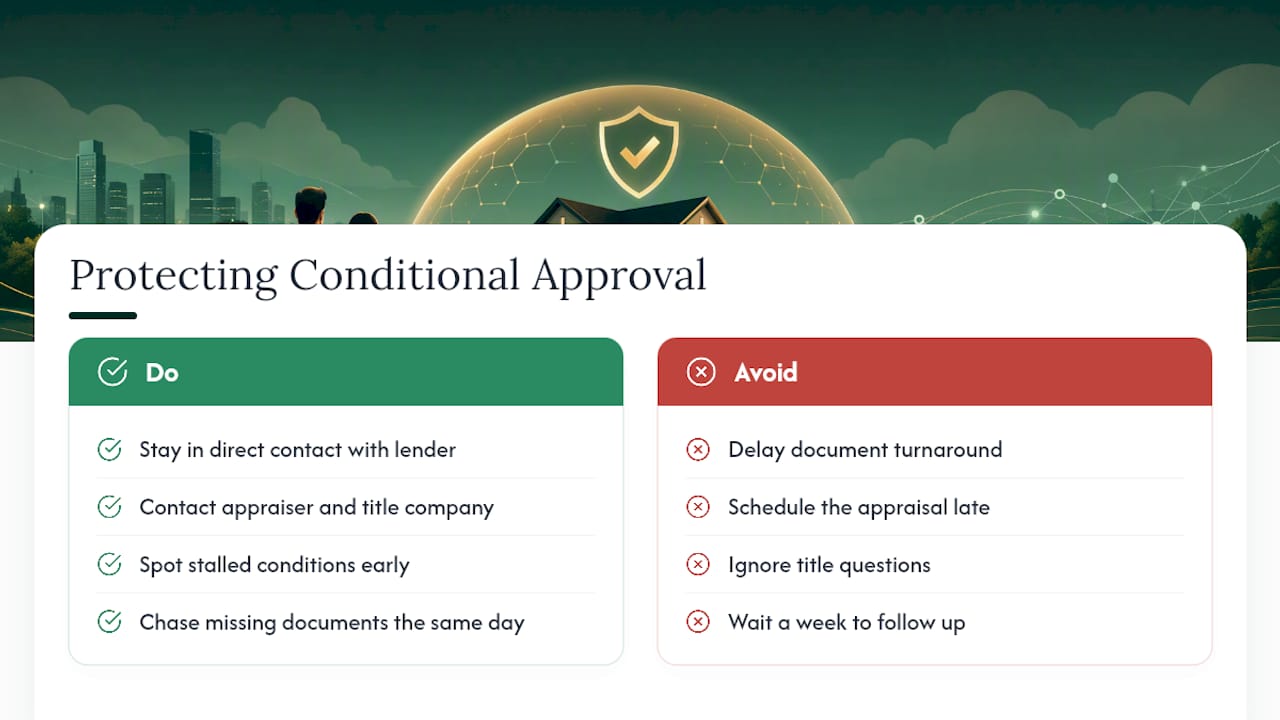
One case that stuck with me involved a buyer whose gift letter documentation was missing a single bank trail step. The lender had already flagged it as a PTD condition. Because someone was chasing it the same afternoon rather than the same week, the closing date never moved.
Full representation through Sydney Property Buyers’ services covers exactly this kind of coordination, from strategy through settlement, so financing conditions don’t become the reason a purchase collapses.
— Kristan
Where to verify the details yourself
Lender policies vary, so confirm specifics with your own loan officer. For background, HUD’s fair housing resources cover borrower protections, NMLS Consumer Access lets you verify a lender’s licensing, and First Choice Home Loans offers useful background on how wholesale lenders structure underwriting conditions.
Sources
- Conditional approval for a mortgage: What it means and what to do next | Rocket Mortgage
- What is conditional approval for a mortgage? | Chase