An auction bidding increment is the minimum amount by which a new bid must exceed the last one, and it’s set by the auctioneer, not the bidder. The one rule worth remembering: watch the increment being called, but bid to your own maximum regardless of what the jump is. Increments shift by price band, auction type, and the auctioneer’s judgement on the day, so treat any figure below as a guide, never a fixed law.
TL;DR:
- Bidding increments typically scale with the price, starting with small dollar increases for low-value lots and larger jumps as the price rises above tens of thousands.
- Auctioneers often reduce increment sizes near the estimated ceiling or reserve, signaling the auction may close soon and encouraging bids close to the sale price.
- In real estate auctions, large initial jumps tighten as the reserve is approached, and winning bids usually require an immediate deposit with no cooling-off period.
- Online auctions use automatic proxy bids that increase in the smallest necessary increment, creating irregular bid jump patterns that reflect hidden maximums.
- Successful bidding involves setting a maximum bid beforehand, using proxy bids wisely, and understanding that auctioneer discretion overrides fixed increment rules.
Table of Contents
- What are typical auction bidding increments?
- Why auctioneers set increments the way they do
- How increments differ across real estate, collectibles, vehicles and online auctions
- Bidding tactics that work with, not against, the increment
- Rules, etiquette and what happens when a bid is disputed
- A buyers agent’s view on bidding against the increment
- Where to check the rules for yourself
- Sources
What are typical auction bidding increments?
Increments almost always scale with price. A $50 lot doesn’t move in $500 jumps, and a $2 million house doesn’t sell in $10 steps. The pattern holds across most auction types, though the exact numbers are set by the individual auctioneer or platform, not by any single national rule.
Here’s a rough illustration of how bands typically work:
| Price band | Typical increment |
|---|---|
| $0 to low hundreds | Small dollar increments |
| Low hundreds to low thousands | Moderate dollar increments |
| Hundreds to thousands | Medium increments scaling with price |
| Thousands to tens of thousands | Larger increments often in hundreds or low thousands |
| Tens of thousands and above | Larger stepped rises, often set case by case |
Treat this table as illustrative, not universal. The Auctioneers Association’s practical guidance shows plenty of variation between auction houses, and even within one saleroom the increment can change mid-lot.
A few things worth knowing before you plan your bidding around any published table:
- Real estate auctions often set increments as flat dollar amounts early then drop to smaller jumps as the price nears the reserve.
- Specialist collectible and coin auctions frequently publish their own increment schedules in the catalogue, and these can differ house to house.
- Online-only platforms sometimes halve the increment that would apply in a live room, because there’s less need to keep pace with a crowd.
- Estate and vehicle auctions are the least consistent. Some run tight percentage-based steps, others leave it entirely to the auctioneer’s call.
If you’re preparing for a residential sale specifically, the mechanics of bidding with confidence at a property auction differ enough from a general goods auction that it’s worth reading separately.
Why auctioneers set increments the way they do
Increments exist to control the pace of the sale. Early in the bidding, when there’s a wide gap between the opening figure and likely value, the auctioneer pushes bids up in large steps to get to a realistic price quickly. As the bidding nears what the auctioneer senses is the ceiling, often close to the reserve or the “on the market” point in a property sale, the increments shrink. Smaller steps invite more bidders to stay in the contest rather than dropping out because a jump feels too steep.
This isn’t guesswork on the auctioneer’s part. The National Auctioneers Association describes bidding advances as a deliberate tool to keep momentum without pricing out engaged buyers, and increments are commonly rescaled as the price climbs through different bands.
Two things to watch for as a bidder:
- A sudden drop in increment size often signals the auctioneer believes the price is close to where it will sell.
- The auctioneer retains discretion to accept or reject a bid that doesn’t match the called increment, and to arbitrate if two bids land at once.
Auctioneers trained through bodies like the Certified Auctioneers Institute are taught to read the room this way, adjusting increments as a live management tool rather than following a fixed script.
How increments differ across real estate, collectibles, vehicles and online auctions
The auction type changes what you should expect the increment pattern to look like, and it changes what’s at stake if you win.
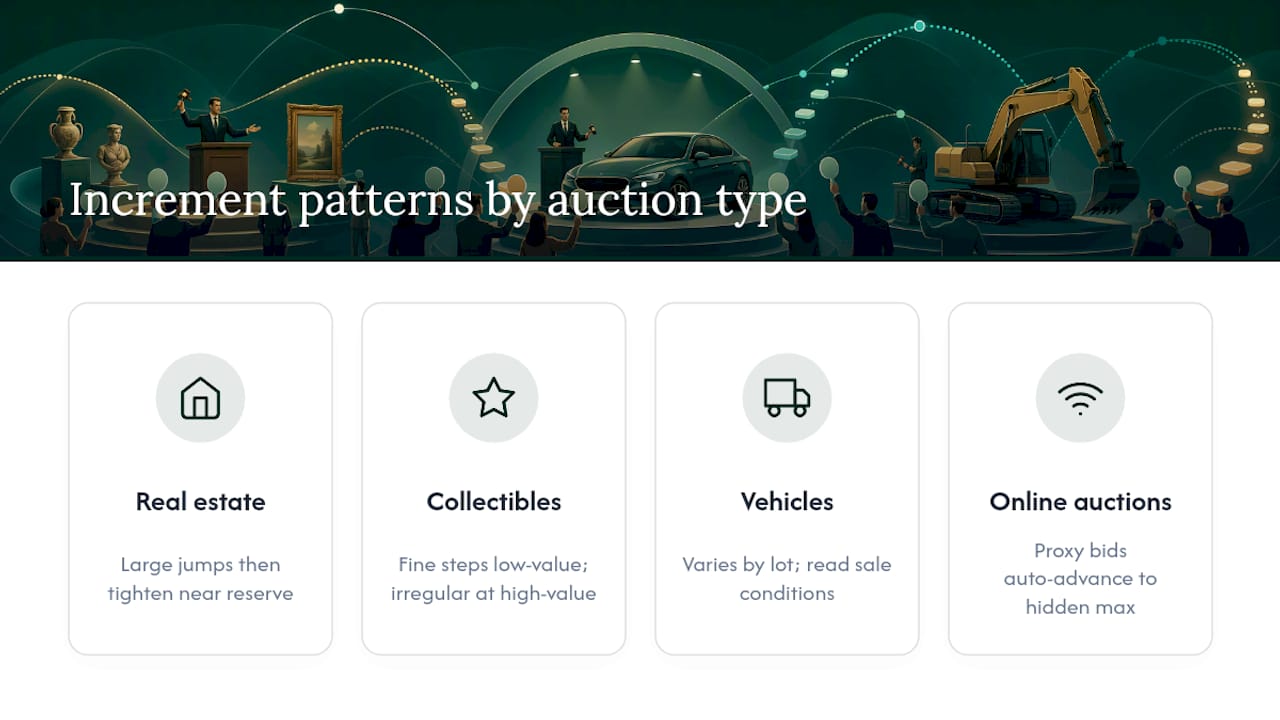
Real estate. Expect large numeric or percentage jumps at the start, tightening as the auctioneer approaches what they judge to be the vendor’s reserve. Once the property is announced “on the market,” you’re bidding against a genuine sale, and winning means signing a contract and paying a deposit that day. There’s no cooling-off period at most Australian property auctions, so know your numbers before you raise your hand.
Collectibles and coins. Lower-value lots often move in fine dollar steps, while high-value pieces jump in larger, sometimes irregular, increments set by the specialist house. Many auction houses print the exact schedule in the catalogue, so check before the sale rather than guessing.
Vehicles and estate sales. Approaches vary more here than anywhere else. Some run tight percentage increments, others leave it to auctioneer feel lot by lot. Read the conditions of sale for each item rather than assuming consistency across the catalogue.
Online-only auctions. Proxy or “max” bids advance the price automatically in the smallest increment needed to keep you in front, up to your hidden ceiling. This is why bid histories on online platforms sometimes show odd, non-round jumps. A visible bid of $1,205 usually means someone’s proxy bid stopped just above a rival’s maximum.
Bidding tactics that work with, not against, the increment
Increments aren’t just a formality to sit through. Used well, they’re a lever.
- Set a hard maximum before the sale starts. Decide the absolute ceiling and write it down. It’s far easier to stick to a number you committed to on paper than one you’re recalculating in the moment.
- Use proxy or max bidding where it’s offered. It advances in the smallest increment needed to keep you ahead, which means you never overpay simply because you were the one calling the raise.
- Try a smaller-than-suggested raise when the pace has slowed. If the auctioneer is fishing for the next bid and momentum has stalled, offering a modest raise above the last bid can sometimes be accepted, though the auctioneer is within their rights to refuse it and insist on the full increment.
- Consider a jump bid to unsettle a hesitant rival. Jumping two or three increments at once can push a less committed bidder out early, but it can also wake up interest that had gone quiet, so use it when you’re confident, not as a bluff.
- Factor in deposit obligations before you raise your hand. A winning bid at a property auction typically triggers an immediate deposit requirement, so know what you can settle on the day, not just what you can afford to bid.
Pro Tip: Decide your maximum in writing before the auction starts, then treat every increment call as background noise. The number that matters is the one you wrote down at home, not the one the auctioneer is chanting.
Money discipline matters more than any tactic on this list. Understanding the typical deposit percentage expected from US buyers before you bid means you’re not caught short the moment the hammer falls.
Rules, etiquette and what happens when a bid is disputed
The auctioneer is the sole arbiter of any dispute over who bid first or whether a bid was validly placed, and can resume bidding at the last undisputed figure if two bids appear to land simultaneously. State auctioneer association guidance, including examples from bodies such as Alabama Auctioneers, consistently frames this authority as standard practice rather than an exception.
A few procedural points worth knowing before you bid:
- Vendor (seller) bids exist in many property auctions and must be announced; they tend to keep early increments conservative rather than aggressive.
- If a lot is passed in without reaching reserve, the highest bidder is usually offered first right of negotiation afterwards.
- Winning a bid means signing a contract and paying a deposit, so check title, condition, and any special terms before you raise a paddle, not after.
- Auctioneers must be licensed in many US states; the NALLOA licensing map shows where that applies.
- US property auction participants should also be aware of federal fair housing obligations, which apply regardless of how the sale is conducted.
A buyers agent’s view on bidding against the increment
Professionals don’t fight the increment, they use it. Slowing the pace with a smaller raise, or breaking it with a sharp jump, can unsettle a rival who’s bidding on instinct rather than a plan. At Sydney Property Buyers, that’s exactly how our team applies bidding representation for clients: protecting a set ceiling while reading the room for moments where a tactical move changes the outcome. If auction day makes you nervous, that’s usually the clearest sign representation is worth the fee.
— Kristan
Where to check the rules for yourself
For the underlying framework behind the guidance in this piece, the Auctioneers Association covers general bidding practice, the NALLOA licensing map confirms whether your state requires a licensed auctioneer, and HUD’s fair housing programme page sets out federal obligations relevant to property sales. If you’re weighing up negotiation tactics beyond the auction room itself, ClosersLeague’s guide to real estate negotiation tactics is a useful companion read.
Sources
- HUD — fair housing and equal opportunity
- NALLOA — licensing state requirements
- Alabama Auctioneers (state association example)
Recommended
- Auction deposit percentage for US buyers: what to expect
- How a buyers agent handles multiple offers in Sydney