Days on market, known in Australian real estate as DOM, is the number of days a property is listed before it sells. Understanding why time on market matters for buyers is the difference between paying peak price and securing a genuine discount. Sydney’s Q2 2026 average DOM rose to 37 days, up 16% from 32 days in Q2 2025. That shift signals a meaningful change in buyer leverage across the city. Sydney Property Buyers uses DOM data as a core input when advising clients on offer timing, negotiation approach, and whether to act fast or hold firm.
Why time on market matters for buyers: the market signal you cannot ignore
DOM is not just an administrative number. It reflects the balance between buyer demand and available supply at any given moment. A property that sells in under two weeks tells you competition is fierce and negotiation room is thin. A property sitting for 90 days tells a very different story.

Australian property stock levels rose approximately 22% year on year as of june 2026. More stock means buyers have more choice, which reduces urgency and gives them room to negotiate. When supply climbs and DOM extends, the market shifts from favouring sellers to favouring buyers.
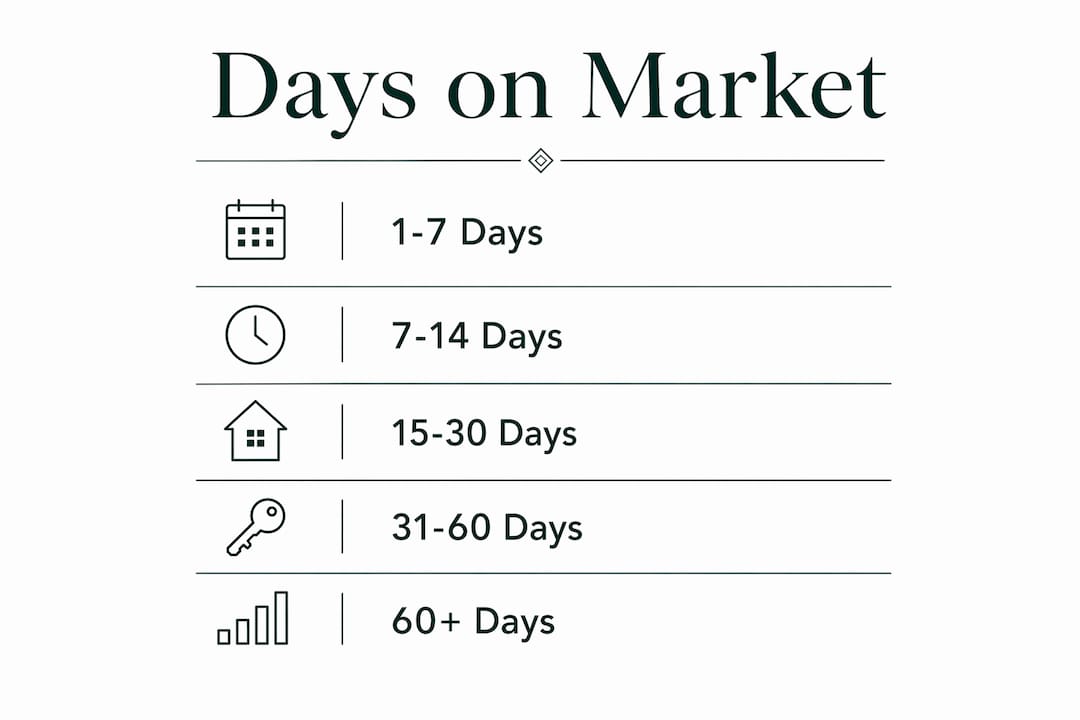
The table below shows how DOM ranges translate into practical buyer conditions.
| DOM range | Market signal | Typical buyer position |
|---|---|---|
| 0–14 days | Strong seller’s market | Limited negotiation; act quickly |
| 15–30 days | Balanced market | Moderate negotiation possible |
| 31–60 days | Softening market | Meaningful negotiation room opens |
| 60–120 days | Buyer’s market | Offers 5%–15% below asking are common |
| 120+ days | Distressed or mispriced | Significant leverage; due diligence critical |
In buyer’s markets where properties sit for 60 to 120 days, buyers regularly negotiate offers 5% to 15% below asking price. On a $1.5 million Sydney property, that represents a saving of $75,000 to $225,000.
- Short DOM (under 14 days) signals high competition and limited room to negotiate on price or conditions.
- DOM of 30–60 days suggests the seller may be open to reasonable offers below the guide.
- DOM beyond 60 days often means the seller has already adjusted expectations, even if the asking price has not moved yet.
- DOM above 120 days warrants careful investigation into why the property has not sold.
Pro Tip: Always compare a property’s DOM against the suburb median. A 45-day DOM in a suburb where the median is 20 days carries far more weight than the same figure in a suburb where 50 days is normal.
What is the ‘set-to-sell’ period and why does it matter?
The first 7–14 days of a listing are known in Australian real estate as the “set-to-sell” period. This window captures the most motivated buyers, and the offers made during it typically represent the property’s true market ceiling.
Motivated buyers who have searched for months tend to pay a premium within the first listing week to avoid missing out. They have already seen dozens of properties, they know the market, and they act decisively when something fits. Their emotional urgency is at its highest point.
The sequential psychology of this period works as follows:
- Days 1–3: The property launches. Buyers who have been searching actively receive alerts and inspect within days. Emotional engagement peaks.
- Days 4–7: First offers arrive. These buyers are the most motivated in the market and their offers reflect genuine competition.
- Days 8–14: A second wave of buyers inspects. Urgency is still present but slightly lower than the opening days.
- Days 15+: If the property remains unsold, buyers begin to question why. The psychological dynamic shifts from competition to caution.
Rejection of early offers often results in motivated buyers moving on, causing price decline and reduced emotional urgency from subsequent buyers. A seller who holds out for a higher number after week one frequently ends up accepting less than the original offer weeks later.
Pro Tip: If you are a buyer and a property has been listed for less than 10 days, treat it as a competitive situation. Prepare your finance pre-approval and due diligence in advance so you can move within the set-to-sell window if the property fits your criteria.
How does a longer time on market affect buyer perception?
Extended DOM creates a perception problem that works in buyers’ favour. When a property has been listed for 60 days or more, buyers instinctively ask: “What is wrong with it?” That suspicion, whether justified or not, reduces competition and softens the seller’s position.
Prolonged listings carry risks of price fatigue and buyer suspicion, regardless of property quality. A genuinely good property can become “stale” simply because it was overpriced at launch and missed the set-to-sell window.
“A property that sits too long stops being seen as an opportunity and starts being seen as a problem. Buyers assume something is wrong, even when nothing is. That perception alone drives prices down.”
From a buyer’s perspective, a stale listing creates several concrete advantages:
- The seller has likely already reduced their price expectations, even if the listed price has not changed.
- Fewer competing buyers means less pressure to make rushed decisions.
- Conditions such as longer settlement periods or subject-to-finance clauses become easier to negotiate.
- The seller’s agent is often more willing to facilitate frank conversations about vendor motivation.
Sydney market data shows DOM peaked in Q2 2026, with easing clearance rates and reduced buyer activity. Serious buyers remained decisive, but the pool of competing offers shrank. That combination is precisely the environment where a well-prepared buyer can secure a property below its original asking price.
Understanding what a buyer’s market means in Sydney is the foundation for reading these signals correctly.
How to use DOM data to make better purchase decisions in Sydney
DOM data is most useful when read in context, not in isolation. A single number tells you how long a property has been listed. Paired with comparable sales, suburb median DOM, and current stock levels, it tells you how much leverage you actually have.
The table below summarises how buyers should adjust their approach based on DOM and market conditions.
| DOM and market condition | Recommended buyer approach |
|---|---|
| Under 14 days, seller’s market | Move quickly; offer at or near asking; minimise conditions |
| 15–30 days, balanced market | Negotiate modestly; use comparable sales to justify offer |
| 31–60 days, softening market | Negotiate on price and conditions; test vendor flexibility |
| 60–120 days, buyer’s market | Offer 5%–15% below asking; request favourable settlement terms |
| Post-auction pass-in | Negotiate immediately; vendor is motivated and exposed |
Properties that pass in at auction enter a “Golden Window” where buyers can negotiate favourable private terms immediately after. This is one of the most underused opportunities in Sydney real estate. The seller has publicly failed to sell, their agent is under pressure, and the buyer who steps forward with a credible offer holds significant power.
In softening markets, buyers with a long-term perspective benefit by acting rather than waiting, because confidence fluctuations can reverse quickly. Waiting for the “perfect” moment often means missing the window when leverage is highest.
Knowing how to research Sydney suburbs is the practical skill that turns DOM data into a usable offer strategy. Suburb-level DOM medians, clearance rates, and stock levels all feed into a complete picture of where you stand as a buyer.
Pro Tip: Ask the selling agent directly: “How long has this property been on the market and have there been any previous offers?” Agents are not obliged to share offer details, but the question itself signals that you are an informed buyer, which changes the negotiation dynamic.
The role of a licensed buyer’s agent is to interpret these signals in real time and translate them into a specific offer strategy. Sydney Property Buyers conducts property inspections seven days per week, independent of open home schedules, which means clients receive market intelligence faster than buyers relying solely on public listings.
Key takeaways
Time on market is the single most accessible indicator of buyer leverage in any Sydney property negotiation.
| Point | Details |
|---|---|
| DOM signals leverage | Properties listed 60–120 days offer buyers 5%–15% below asking price in negotiation. |
| Set-to-sell window is critical | The first 7–14 days capture peak buyer motivation and the highest achievable offers. |
| Stale listings favour buyers | Extended DOM reduces competition and softens seller expectations, even on quality properties. |
| Stock levels amplify DOM signals | A 22% year-on-year rise in Australian stock levels in 2026 extended DOM and increased buyer choice. |
| Post-auction pass-ins create opportunity | Properties that fail at auction enter a Golden Window where buyers can negotiate from a position of strength. |
What I have learned watching DOM shape outcomes in Sydney
I have watched DOM determine the outcome of negotiations more times than I can count. Buyers who understand it act with confidence. Buyers who ignore it either overpay in a rush or miss the window where they had real leverage.
The 2026 Sydney market is running at three speeds simultaneously. Tightly held, well-presented properties in Inner West and Eastern Suburbs precincts are still selling in under two weeks with multiple offers. Mid-tier stock in transitional suburbs is sitting for 30–50 days, creating genuine negotiation room. And overpriced or poorly presented properties are drifting past 90 days, where sellers eventually capitulate.
The mistake I see most often is buyers treating DOM as a binary signal: either a property is fresh and competitive, or it is stale and discounted. The reality is more nuanced. A 35-day DOM in Newtown might be completely normal. The same figure in Mosman might indicate a pricing problem. Context is everything.
My advice is to resist the urge to wait for a property to become “obviously” stale before making a move. By the time a listing looks like a clear bargain, other buyers have noticed too. The real opportunity sits in that 30–60 day window, where the seller’s confidence has softened but the property has not yet attracted the “what’s wrong with it?” stigma.
Understanding off-market listings adds another dimension entirely. When you are buying off-market, DOM is irrelevant because the property was never publicly listed. That removes the psychological game entirely and puts the negotiation on fundamentals alone.
— Kristan
How Sydney Property Buyers helps you act on DOM intelligence
Reading DOM data correctly is one thing. Acting on it at the right moment, with the right offer structure, is another.

Sydney Property Buyers works exclusively for buyers across Inner West Sydney, Eastern Suburbs, Lower North Shore, and Eastern Beaches. The team monitors DOM trends across every target suburb in real time, so clients know whether to move fast or negotiate hard before they step into a negotiation. With an average purchase time of 54 days from engagement to settlement and an average saving of approximately 9% on purchase price, the approach is built around timing and preparation. Explore the full range of buying and negotiation services or call 1800 676 177 to discuss your situation directly.
FAQ
What does days on market mean in Australian real estate?
Days on market (DOM) is the number of days a property is listed for sale before a contract is exchanged. It is a standard metric used across Australian real estate to assess demand and seller motivation.
Does a longer time on market mean a lower price?
Properties listed for 60–120 days are commonly sold at 5%–15% below the original asking price. Extended DOM reduces buyer competition and softens seller expectations, which creates negotiation room.
What is the best time to make an offer on a Sydney property?
The set-to-sell period of 7–14 days captures the most motivated buyers and the highest offers. For buyers seeking leverage, the 30–60 day window often provides the best balance of negotiation room and property quality.
How does stock level affect time on market in Sydney?
Australian property stock levels rose approximately 22% year on year as of june 2026. Higher stock gives buyers more choice, reduces urgency, and extends average DOM across the market.
Should I buy in a softening Sydney market or wait?
Buyers with a long-term perspective benefit from acting in softening markets rather than waiting. Confidence can return quickly, and the window of maximum leverage is often shorter than it appears.
Recommended
- How to research Sydney suburbs property in 2026
- Benefits of buying off-market in Sydney: 2026 guide
- What does a buyer’s market mean in sydney?