Registered easements sit permanently on a NSW folio of title and bind every future owner of the land. If you’re buying, order a current title, the Deposited Plan and the Section 88B instrument, then talk to a conveyancer or surveyor before you exchange. Easements can restrict where you build, impose access rights on neighbours, or leave you liable for shared maintenance costs.
TL;DR:
- Most easements affect excavation, construction, or maintenance, often restricting deep footings, pools, or vegetation near underground utilities or drainage corridors.
- All registered easements are listed on the title, but the Deposited Plan and Section 88B instrument reveal their precise locations, legal terms, and maintenance obligations.
- Unexpected easements can delay or alter development plans, requiring design amendments, consent, or legal disputes, which increase costs and time.
- Conducting a full due diligence process—including title, Deposited Plan, Section 88B, and utility checks—is essential before exchanging contracts.
- Variations or releases of easements are possible through court or written agreement, but often involve complex procedures and significant legal costs.
Table of Contents
- What is an easement and how does NSW law treat the two properties involved?
- What types of easements turn up on NSW titles?
- Where do easements actually appear on the title, and what should you order?
- What do easement terms actually mean for your renovation plans?
- How do easements affect development approval and dispute risk?
- A step-by-step pre-purchase checklist for easements on title
- Can an easement be varied, released, or imposed by a court?
- A buyer-focused view on easement due diligence
- Get expert help checking easements before you exchange
- Sources
- FAQ
What is an easement and how does NSW law treat the two properties involved?
An easement is a legal right attached to land that lets someone use part of another person’s property for a specific purpose, such as a driveway, a drainage pipe, or an underground cable. The land that benefits is called the dominant tenement; the land that carries the burden is the servient tenement. Most NSW easements are private, running between two neighbouring lots, though some are granted “in gross” to a utility provider rather than to another block of land.
Easements also split into positive and negative types. A positive easement lets someone actively do something on your land (walk across it, run a pipe through it). A negative easement stops the servient owner doing something, such as building above a certain height that would block light or airflow to the dominant tenement. The Conveyancing Act 1919 and the Real Property Act govern how these rights are created and registered in New South Wales.
What types of easements turn up on NSW titles?
Four categories cause most of the headaches for buyers, and each affects a different part of your renovation or building plan.
- Right of carriageway: grants access across your land, often for a shared driveway, and can limit where you park or fence.
- Drainage and sewer easements: run pipes underground and typically ban pools, sheds, or deep footings within the marked corridor.
- Utility easements: cover electricity, gas, and telecommunications infrastructure, with underground clearance rules that restrict excavation near the asset.
- Support, conservation, and specialist easements: protect structural walls, vegetation, or heritage features, and are the type most likely to trip up a development application.
Right of carriageway issues surface constantly at auction inspections, when a buyer assumes a shared driveway is theirs alone. Drainage easements are the quiet killer of pool plans. Get the type wrong and you’ve bought a problem, not a solution.
Where do easements actually appear on the title, and what should you order?
A current title (folio of title) lists registered easements as encumbrances, but it names them without showing where they physically sit or what they require. That detail lives in two other documents.
- Order the current title through NSW Land Registry Services to confirm which easements are registered against the lot.
- Obtain the Deposited Plan (DP), which shows the easement corridor’s exact dimensions and position relative to boundaries and structures.
- Read the Section 88B instrument in full. This is where the operative terms live: who maintains the easement, what’s prohibited, and what access rights apply.
- Request imaged instruments from NSW Land Registry Services if the easement predates digital records or references an older deed.
- Run utility checks through Sydney Water’s Tap In service and BYDA (Before You Dig Australia) to catch buried assets that don’t always show cleanly on title.
A title search alone confirms an easement exists. It rarely tells you what you can and can’t do about it, which is exactly why the Section 88B instrument matters more than the title page itself.
What do easement terms actually mean for your renovation plans?
Maintenance obligations vary by instrument. Some Section 88B documents split repair costs evenly between dominant and servient owners; others leave the entire burden with whoever benefits from the easement. Read the clause rather than assume.
“No permanent structures” clauses are common over drainage and sewer easements, and they usually rule out decks, pools, garages, and anything requiring deep footings within the corridor. Clearance-depth requirements can also apply to underground utility easements, restricting excavation near cables or pipes even where no structure is planned.
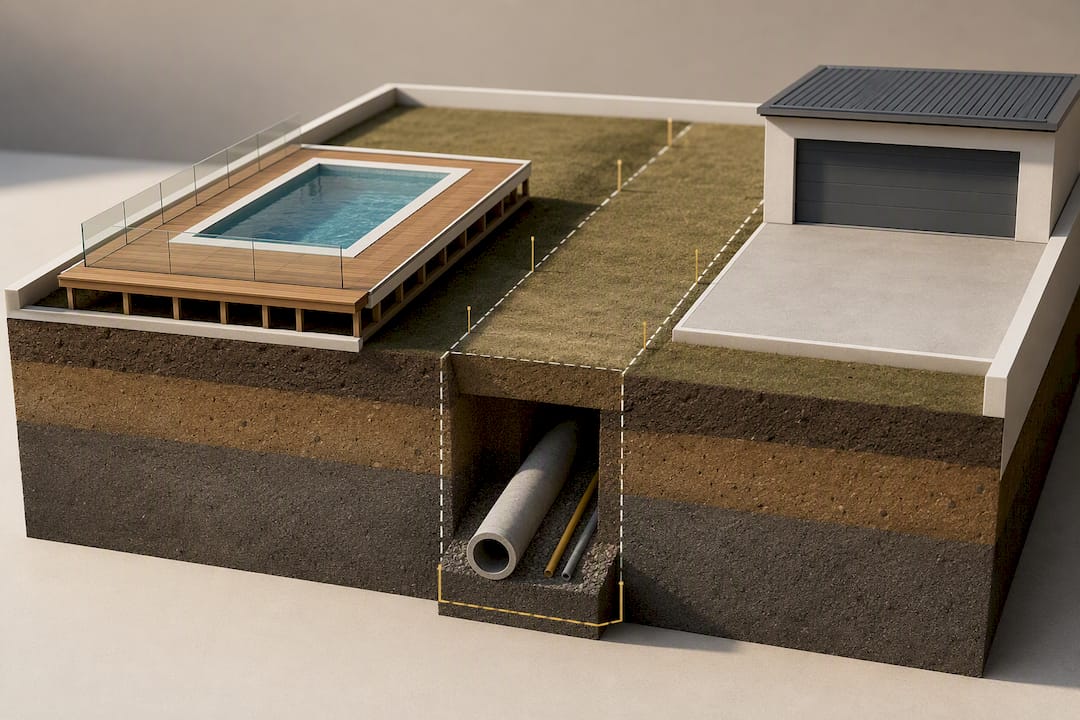
The practical test courts and councils apply is whether a proposed change causes “substantial interference” with the easement holder’s rights. This is assessed case by case rather than as an automatic ban, so a shed positioned outside the marked corridor might be fine while an identical shed inside it isn’t. Written consent from the benefiting party is worth more than a verbal assurance from the seller or agent, particularly when a development application is on the horizon.
How do easements affect development approval and dispute risk?
Councils and utility asset owners assess development applications against the registered easement terms, not against what a buyer assumes is reasonable. If a design conflicts with a drainage or utility easement, expect one of three outcomes: a design amendment, an engineering solution (such as relocating footings), or a written consent letter from the benefiting party allowing the work to proceed.
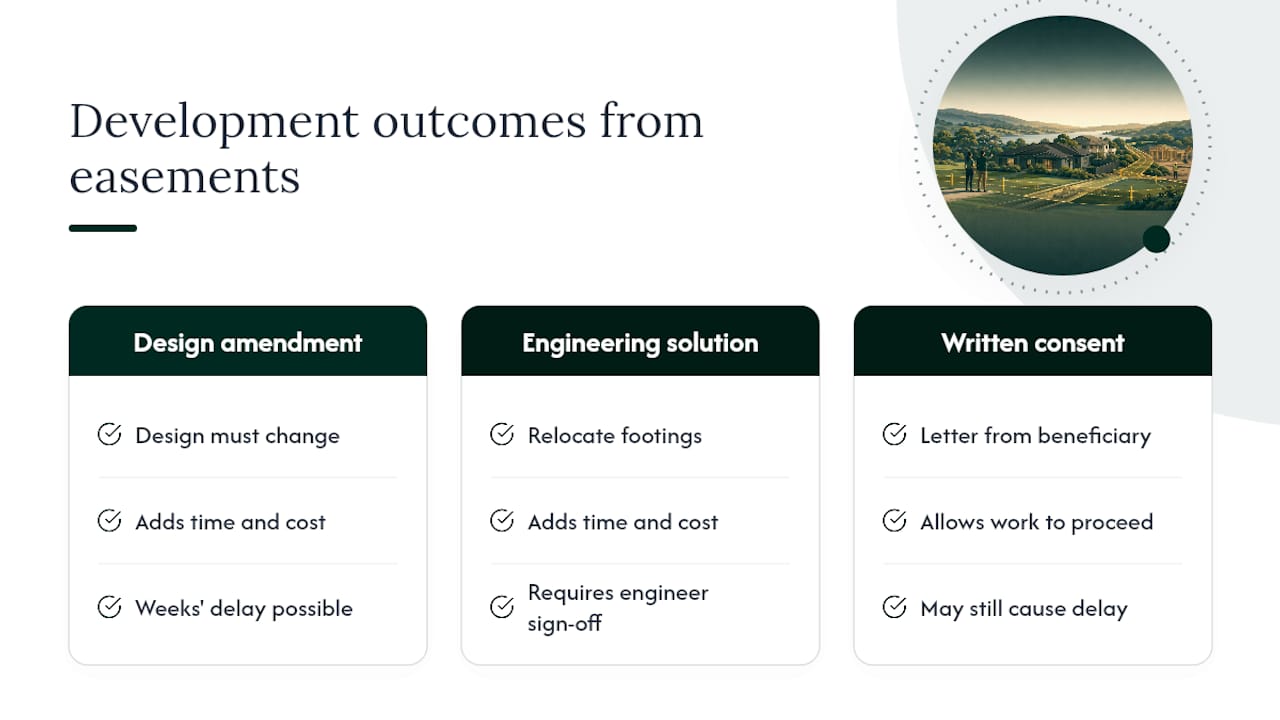
Each of these adds time and cost. Budget for delays measured in weeks rather than days if an easement sits under your proposed extension, and treat any dispute that reaches the stage of formal legal correspondence as a signal to get advice immediately rather than negotiate informally. Escalation to court is rare but expensive when it happens. A surveyor and a conveyancer engaged before exchange, not after, is the cheapest insurance available.
A step-by-step pre-purchase checklist for easements on title
- Order a current title search and imaged instruments for the property through NSW Land Registry Services.
- Request the Deposited Plan and Section 88B instrument to see the easement’s exact position and legally enforceable terms.
- Commission a licensed surveyor to verify the easement corridor on the ground, including any clearance depths for underground infrastructure.
- Run Sydney Water Tap In and BYDA searches to identify buried assets that may not be obvious from the title documents alone.
- Seek written consent from the benefiting party if you’re planning works anywhere near the easement, and get legal or engineering advice before relying on it.
- Hold off exchanging until you understand the legal and practical implications, or until a conditional clause covers an unresolved issue.
Pro Tip: If the property is on Old System title rather than Torrens title, a current title search may not show everything. Deed-based easements from decades ago can still be enforceable even without appearing on a modern folio, so ask your conveyancer for a chain-of-title check on older properties.
Strata buyers face an extra layer here too. Common property in a strata scheme can carry utility easements that affect the whole building’s levies, not just one lot, which is worth understanding before you commit to a purchase reviewed alongside a property title search.
Can an easement be varied, released, or imposed by a court?
Yes, through two main pathways. A release by deed happens when the benefiting party agrees in writing to give up the easement, which is then registered to clear the title. Where agreement can’t be reached, Section 88K of the Conveyancing Act 1919 lets the court impose or modify an easement where it’s reasonably necessary for the effective use or development of the land.
Neither pathway is quick or guaranteed. Courts weigh consent, compensation to the servient owner, and council conditions before granting relief, and legal costs can climb fast. A conveyancer, surveyor, or valuer should assess likelihood and cost before you factor a release or variation into your purchase price.
A buyer-focused view on easement due diligence
Most disputes over easements trace back to the same mistake: someone read the title and stopped there. A title search tells you an easement exists. It says nothing about whether your renovation plan survives contact with it.
Ordering the title, Deposited Plan, and Section 88B instrument together, then commissioning a survey where the stakes justify it, is recommended as standard practice on every property under serious consideration. As the agency’s director, Kristan Johnson, 2024 Outstanding Buyers Agent of the Year at the Inner West Local Business Awards, has built that discipline into how due diligence gets integrated into negotiation timing. If an easement complicates a deal, it should shape your offer and your settlement conditions before you’re locked in, not after.
— Kristan
Get expert help checking easements before you exchange
Sydney Property Buyers is the alternative to going it alone on easement due diligence in Sydney: a buyer-only agency that runs title, Deposited Plan, and Section 88B checks as a routine part of the purchase process, not an afterthought squeezed in before settlement.

Whether you’ve found a property yourself or need someone to search, appraise, and negotiate from scratch, the Complete Purchase Solution covers the full journey, including due diligence on encumbrances like easements before you’re committed. If you’ve already identified a property and just need sharp representation at the negotiating table, Negotiation Only gets a licensed buyer’s agent working for you specifically, never the seller. Both are detailed on the services page, alongside the Auction Bidding service for anyone facing an easement-affected property under the hammer.
Call 1800 676 177 or email hello@sydneypropertybuyers.com.au to talk through a specific property before you exchange, or review the full purchase process to see how due diligence fits into a typical engagement.
Sources
For primary guidance, go to the Registrar-General’s Guidelines on easements and Deposited Plans, and read Section 88K of the Conveyancing Act 1919 for the court process on imposing easements. Order your current title, imaged instruments, and Deposited Plan through NSW Land Registry Services, then run Sydney Water Tap In and BYDA searches before you exchange.
- General principles – Registrar General’s Guidelines
- NSW Property Easements: What Buyers Must Check on Title
- CONVEYANCING ACT 1919 – SECT 88K Power of Court to create easements
FAQ
Are easements shown on title in NSW?
Yes. Registered easements appear on the folio of title as encumbrances, but the title only confirms they exist. The Deposited Plan and Section 88B instrument show the exact location and enforceable terms.
How do I find easements on my property in NSW?
Order a current title search, then request the Deposited Plan and Section 88B instrument through NSW Land Registry Services to see the easement’s position and terms. Follow up with Sydney Water Tap In and BYDA searches for buried utility assets that don’t always appear clearly on title.
How can you tell if a property has an easement?
Check the current title for registered encumbrances, then cross-reference the Deposited Plan for the physical corridor. Old System land needs a chain-of-title check too, since deed-based easements can be enforceable without appearing on a current Torrens folio.
What are the main types of easements in NSW?
The most common are right of carriageway (access), drainage and sewer easements, utility easements for electricity, gas, and telecommunications, and support or conservation easements protecting structures or vegetation. Each carries different restrictions on building and excavation, so the Section 88B instrument needs reading for the specific terms attached to your property.
Can Sydney Property Buyers help check for easements before I buy?
Yes. Sydney Property Buyers routinely orders title, Deposited Plan, and Section 88B checks as part of its due diligence process across both the Complete Purchase Solution and Negotiation Only services.
Recommended
- Do This Before Exchange to Avoid NSW Property Settlement Delays
- Section 32 explained: what Sydney buyers need to know
- Before You Waive Cooling Off: 5 Checks for NSW Buyers on 66W Certificates
- Unconditional exchange: what Sydney buyers must know