Yes, most residential private-treaty purchases in NSW carry a statutory cooling-off period of five business days, extended to ten for off-the-plan contracts. Auction purchases get no cooling-off at all, and any buyer can sign it away entirely with a section 66W certificate.
TL;DR:
- Buyers must serve a written rescission notice before 5pm on the fifth business day, including weekends and holidays, or lose their right to withdraw.
- In most cases, the five-day cooling-off period is limited to private treaty residential purchases, excluding auctions, commercial properties, and large rural holdings.
- Off-the-plan contracts give buyers ten business days instead of five, starting from the later of exchange or receipt of the signed contract.
- Signing a section 66W certificate voluntarily waives cooling-off rights, but only if independent legal advice has been received and documented.
- Coordinating inspections, searches, and legal review within the five-day window often requires professional support from a buyers agent to avoid missed deadlines or rushed decisions.
Table of Contents
- What is the cooling off period in NSW property law?
- How do you calculate the five business day cooling-off window?
- When cooling-off does not apply
- How to exercise your cooling-off right (and what it costs)
- Waiving cooling-off: what a section 66W certificate actually does
- Your five-day checklist: what to actually do during cooling off
- How a buyers agent fits into the cooling-off window
- Why the standard advice on cooling-off falls short
- Get professional support before your cooling-off clock starts
- Sources
- FAQ
What is the cooling off period in NSW property law?
The right to cool off comes from the Conveyancing Act 1919, specifically sections 66S and 66W. It is automatic for eligible private-treaty residential sales, meaning you don’t need to negotiate for it or write it into the contract yourself. It simply applies unless something removes it.
This is a buyer-only protection. Vendors get no equivalent right to change their mind once a contract is exchanged, and the cooling-off clock belongs personally to the named purchaser on the contract. If you’re buying with a partner or as joint purchasers, the rescission notice needs to cover everyone named on the title.
The boundaries matter as much as the right itself. Cooling off applies to residential property bought by private treaty, that is, through a standard sale rather than a public auction. Vendors don’t get this right under any circumstances, and most auction sales are excluded outright. Commercial property and some large rural holdings sit outside the scheme too, which is worth confirming with your solicitor the moment you’re looking at anything unusual.
How do you calculate the five business day cooling-off window?
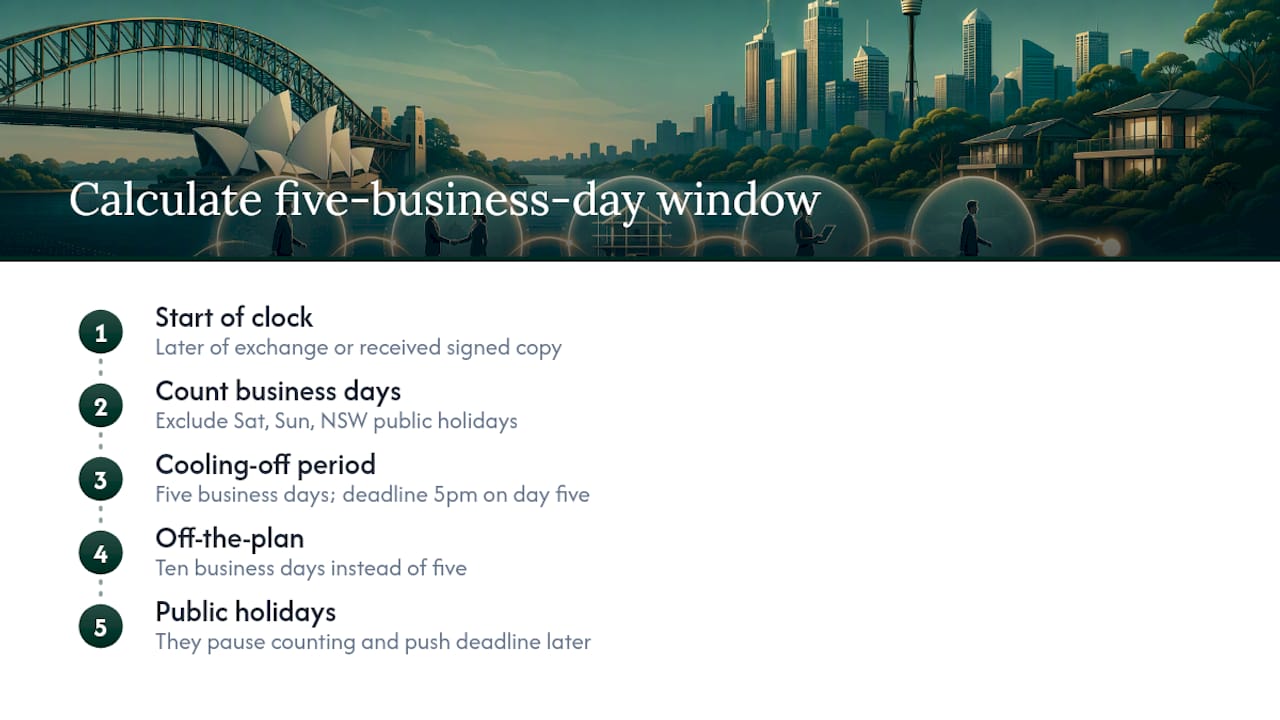
“Business days” excludes Saturdays, Sundays, and NSW public holidays. The cooling-off period runs for five business days and expires at 5pm on the fifth business day, not midnight, which trips up more buyers than you’d expect. Miss that 5pm cutoff by ten minutes and your notice is late, full stop.
Off-the-plan contracts get ten business days instead of five, reflecting the extra complexity of reviewing developer disclosure documents, strata plans, and drawings that haven’t been finalised yet. The clock generally starts on the date of exchange or when you actually receive a signed copy of the contract, whichever comes later.
Here’s a worked example. Say you exchange on a Thursday. Friday is business day one, Monday is day two, Tuesday day three, Wednesday day four, and Thursday of the following week is day five, expiring at 5pm. Throw a public holiday like Labour Day into that week and the deadline pushes out further. Always get your solicitor to confirm the exact date in writing rather than counting on a calendar yourself.
When cooling-off does not apply
Several situations remove your cooling-off protection entirely, and knowing them before you exchange matters more than knowing them after.
- Auction purchases: there’s no cooling-off period once the hammer falls at auction, or when you exchange contracts on the same day as an advertised auction, even if the property doesn’t sell under the hammer.
- Section 66W waiver: a buyer can sign away cooling-off voluntarily, usually to make an offer more competitive.
- Commercial and large rural sales: properties over a certain size used primarily for farming, or commercial premises, generally fall outside the scheme.
- Court-ordered or company transactions: sales conducted under court order, and some purchases by companies rather than individuals, can also sit outside the standard protection.
If you’re bidding at auction or considering a pre-auction offer, confirm your exact position with your solicitor straight after exchange rather than assuming the usual five-day buffer applies.
How to exercise your cooling-off right (and what it costs)
Rescinding a contract during cooling off follows a specific process, and getting it wrong can mean the notice doesn’t count.
- Prepare a written rescission notice. A verbal call to the agent doesn’t cut it; the notice must be in writing and clearly state you’re rescinding under the cooling-off provisions.
- Address it correctly. Serve the notice on the vendor’s solicitor or conveyancer, or the vendor’s real estate agent if no solicitor is on record.
- Choose a reliable delivery method. Email, registered post, or personal delivery all work, but you need proof the notice was received before the deadline.
- Confirm receipt before 5pm. Valid rescission requires the notice to arrive before the cutoff, not just be sent before it.
Pro Tip: Don’t wait until the fifth day to serve your notice. Aim to have it delivered and confirmed by lunchtime on day four wherever possible, so a bounced email or a courier delay doesn’t cost you the entire deposit.
The financial cost of rescinding is set in the statute: 0.25% of the purchase price, payable to the vendor. The deposit is refunded minus this 0.25% and any reasonable costs the vendor has already incurred, such as advertising or legal fees. There’s no grace period for a late notice; a rescission that arrives at 5:01pm is simply invalid, and you’re locked into the contract.
Waiving cooling-off: what a section 66W certificate actually does
A section 66W certificate is a legal document signed by your solicitor confirming you’ve received independent legal advice before waiving your cooling-off right. Without that advice on record, the certificate isn’t valid, and the waiver doesn’t stand.
Buyers usually agree to a 66W waiver to make an offer more attractive in a competitive market, since it lets the vendor treat the contract as binding from the moment of exchange with no five-day escape hatch. Vendors, understandably, favour buyers willing to sign one.
The risk is obvious once you say it plainly: you’re giving up your safety net before you’ve had the chance to review the contract, order a title search, or book a building and pest inspection. If a real estate agent asks you to sign a 66W certificate on the spot, insist on taking the contract to your solicitor first. Our guide on what to check before signing a 66W certificate walks through the specific questions worth asking before you agree.
Your five-day checklist: what to actually do during cooling off
Five business days disappears fast once you factor in weekends, work, and waiting on tradespeople. A rough allocation helps:
Day one: Instruct a solicitor or licensed conveyancer immediately if you haven’t already, and get them reviewing the contract, the vendor’s disclosure statement, and any section 32-style disclosure documents the same day. Book your building and pest inspection now, since good inspectors get booked out.

Days two and three: Chase finance pre-approval or formal loan approval if it isn’t locked down, and order title, zoning, and easement searches through your conveyancer. Follow up on the inspection reports.
Days four and five: Review everything with your solicitor and make the call. If something’s wrong, serve your notice with time to spare rather than at the last minute.
Common red flags that justify pulling out include:
- Undisclosed easements or encroachments that affect how you can use the land
- Zoning that doesn’t match what the agent told you
- Finance falling through despite reasonable effort
- Structural issues flagged in the pest and building report
- Vendor disclosure statements that contradict what you were told verbally
Legal advisers consistently point to getting solicitor review sorted before exchange, rather than during the five-day window, as the single biggest factor in avoiding a rushed or missed deadline.
How a buyers agent fits into the cooling-off window
Coordinating a title search, a building inspection, a finance check, and a solicitor review inside five business days is a genuine logistical challenge, particularly if you’re also working full time. This is exactly where a buyers agent earns their fee.
Sydney Property Buyers is a licensed buyers agency (NSW Licence 20456819) directed by Kristan Johnson, named 2024 Outstanding Buyers Agent of the Year at the Inner West Local Business Awards. The agency has secured 100+ properties for clients, with an average saving of around 9% on purchase price and a 5.0 Google rating, verifiable directly on the firm’s site.
Whether you’ve engaged the Complete Purchase Solution for full-service support or Negotiation Only once you’ve found a property, the agency coordinates inspections, contract review timing, and negotiation within the cooling-off window, reducing the chance a deadline slips through the cracks.
Why the standard advice on cooling-off falls short
Most guidance on this topic treats the five-day window as a safety net. It isn’t. It’s a short, unforgiving deadline that punishes anyone who treats due diligence as something to squeeze in after exchange rather than before it.
The conventional advice, “get a building inspection during cooling off”, is technically correct and practically risky. Good inspectors in Sydney get booked out days in advance, and a five-day window with a weekend in it can leave you with two or three usable days to organise an inspection, a title search, and a solicitor’s opinion. Buyers who wait until day one to start making calls are already behind.
What actually works is inverting the process: line up your solicitor, your inspector, and your finance broker before you make an offer, not after you exchange. Treat cooling off as insurance against something you missed, not the primary mechanism for checking a property. Buyers who go in prepared rarely need to use the right at all; they use the window to confirm what they already suspected.
— Kristan
Get professional support before your cooling-off clock starts
Sydney Property Buyers is the alternative to going it alone on contract review, inspections, and negotiation inside a five-day window that leaves almost no margin for error. Rather than juggling a solicitor, an inspector, and a finance broker on your own timeline, you get one team coordinating all three from the moment you exchange.

If you’ve already found a property and just need sharp negotiation or contract support before you sign, the Negotiation Only service is built for that. If you want full support from search through to settlement, including due diligence coordinated inside the cooling-off window, the Complete Purchase Solution covers the whole process. Buyers heading to auction, where there’s no cooling-off period at all, should look at Auction Bidding support to get contracts checked before the hammer falls, not after. Engagement starts with a retainer that’s deducted from the final balance at settlement, with the scope agreed upfront. Get in touch on 1800 676 177 or hello@sydneypropertybuyers.com.au to talk through your situation before your clock starts running.
This article is general information, not a substitute for advice from a qualified lawyer. Consult a qualified legal professional about your own circumstances before acting on anything here.
Sources
- CONVEYANCING ACT 1919 – SECT 66S Cooling off period – AustLII
- NSW Cooling off Period for Property Purchases: What Buyers Need to Know – GKE Lawyers
- Cooling Off Periods NSW Property Purchases Explained – Golottas Solicitors
FAQ
Is there a cooling-off period in NSW?
Yes, most residential private-treaty purchases in NSW have a statutory cooling-off period, typically five business days. Auction sales and contracts where a buyer has signed a section 66W certificate are excluded.
Do you legally have a 14-day cooling-off period?
No, NSW does not use a 14-day period for residential property. The standard statutory period is five business days, extending to ten business days for off-the-plan purchases.
How long is a typical cooling-off period?
For most NSW residential purchases, it’s five business days, ending at 5pm on the fifth business day after exchange. Off-the-plan contracts get ten business days because of the added complexity of reviewing developer documents.
What is the 20-day cooling-off period?
There is no 20-day cooling-off period under the NSW Conveyancing Act. The correct figures are five business days for standard residential contracts and ten business days for off-the-plan purchases.
What happens if I rescind a contract during cooling off?
You forfeit 0.25% of the purchase price to the vendor, and the rest of your deposit is refunded. A licensed buyers agent, such as Sydney Property Buyers, can help you review a contract early enough to avoid needing to rescind at all.
Recommended
- Do This Before Exchange to Avoid NSW Property Settlement Delays
- Before You Waive Cooling Off: 5 Checks for NSW Buyers on 66W Certificates
- Beat Gazumping in NSW, Reach Exchange in 54 Days Not Weeks
- Section 32 explained: what Sydney buyers need to know