Growth right now is concentrated in Western Sydney and the south west, with a handful of established inner pockets still outperforming on percentage terms. Suburbs worth investigating include Mount Riverview, St Marys, St Johns Park, Villawood, Camden, Ingleburn, Menai, Heathcote, Little Bay and Paddington. The ABS and property experts both point to affordability and infrastructure as the drivers behind these picks. Full stats and a self-assessment framework follow below.
TL;DR:
- Western Sydney and south-west suburbs like St Marys and Mount Riverview are experiencing the strongest recent growth driven by infrastructure projects and affordability.
- Supply constraints and demographic pressures maintain price support in established inner and middle-ring suburbs despite short-term softness.
- Suburbs with high growth often have lower rental yields, requiring buyers to match their property choice to their investment goals.
- Infrastructure delays, rate increases, and thin markets pose risks to growth-focused buyers, especially in smaller or less liquid suburbs.
- Off-market access and expert appraisal are essential for securing properties in thin markets before they are publicly listed.
Table of Contents
- Which Sydney suburbs offer the best capital growth right now?
- What is driving suburb-level growth across Sydney?
- How do you check a suburb’s growth potential yourself?
- What are the risks of chasing capital growth over yield?
- What a buyer’s agent sees that a spreadsheet misses
- How Sydney Property Buyers turns suburb research into a purchase
- Where to check current Sydney suburb figures
- Sources
- FAQ
Which Sydney suburbs offer the best capital growth right now?
Ten suburbs currently stand out for capital growth potential, based on recent price momentum, infrastructure exposure and affordability headroom. Each entry below draws on OpenAgent’s 2026 suburb data, which tracks medians, 12 month growth, five year growth and gross yield across the Sydney market. Read these as a research shortlist, not a buy list. Every figure needs checking against a live listing feed before you act on it.
Mount Riverview sits in the Blue Mountains foothills and has posted some of the strongest recent growth on the list, driven largely by buyers priced out of closer western suburbs chasing detached houses under seven figures. It suits a growth-focused buyer with a longer horizon, since the market here is thin and a handful of sales can move the median sharply in either direction.
St Marys benefits directly from its position on the western rail line and its proximity to the Western Sydney International Airport precinct taking shape at Badgerys Creek. Strong 12 month growth here reflects genuine infrastructure tailwind rather than pure speculation, and it works for buyers wanting exposure to the Aerotropolis story without paying Parramatta-level prices.
St Johns Park, out towards Fairfield, has quietly become one of the more consistent performers on the shortlist, combining family-sized housing stock with prices still well under the Sydney median. It suits owner-occupiers and long-term holders more than flippers, given transaction volumes stay modest month to month.
Villawood shares a similar profile to St Johns Park. Affordability is the whole story here: buyers priced out of Fairfield and Bankstown proper are pushing demand into this smaller pocket, which tends to produce sharper percentage gains off a lower base.
Camden, at the southwestern edge of the growth corridor, combines semi-rural lifestyle appeal with genuine urban expansion pressure as the South West Growth Area fills in around it. Five year growth figures here are solid rather than spectacular, but the trajectory is one of steady structural demand, not a short-term spike.
Ingleburn sits close to the M5 corridor and has benefited from renewed interest in established suburbs within commuting distance of both the CBD and the new Western Sydney employment precincts. It tends to suit growth-and-yield buyers looking for a middle ground, since gross yields here run higher than the inner suburbs on the list.
Menai, in the Sutherland Shire, offers a different profile again: bushland setting, strong local schools, and a buyer base that skews towards upgraders rather than investors chasing yield. Growth has been steadier than spectacular, which suits a buyer prioritising capital preservation alongside gains.
Heathcote, further south along the same rail corridor, has attracted buyers wanting Shire lifestyle at a discount to suburbs closer to Sutherland itself. Its smaller size means fewer transactions to draw a median from, so treat any single quarter’s figure with some caution.
Little Bay, in the eastern suburbs, is the outlier on this list: an established, land-constrained pocket near the coast where new medium-density stock has added supply without denting demand. It suits buyers with a higher entry budget chasing eastern suburbs exposure without Bondi or Coogee price tags.
Paddington rounds out the shortlist as the inner-city representative, a heritage terrace market where limited supply and enduring lifestyle demand have kept it resilient even as the broader Sydney market softened through 2026. It suits a buyer prioritising long-term capital growth over rental yield, since gross returns on Paddington terraces sit well below the outer suburbs on this list.
Across the shortlist, a pattern holds: smaller and outer suburbs with the strongest percentage growth typically carry thinner rental yields, while established inner pockets like Paddington trade growth momentum for lower ongoing income. Match the suburb type to what you actually need from the purchase, growth, yield, or a blend, before you get attached to a headline number.
What is driving suburb-level growth across Sydney?
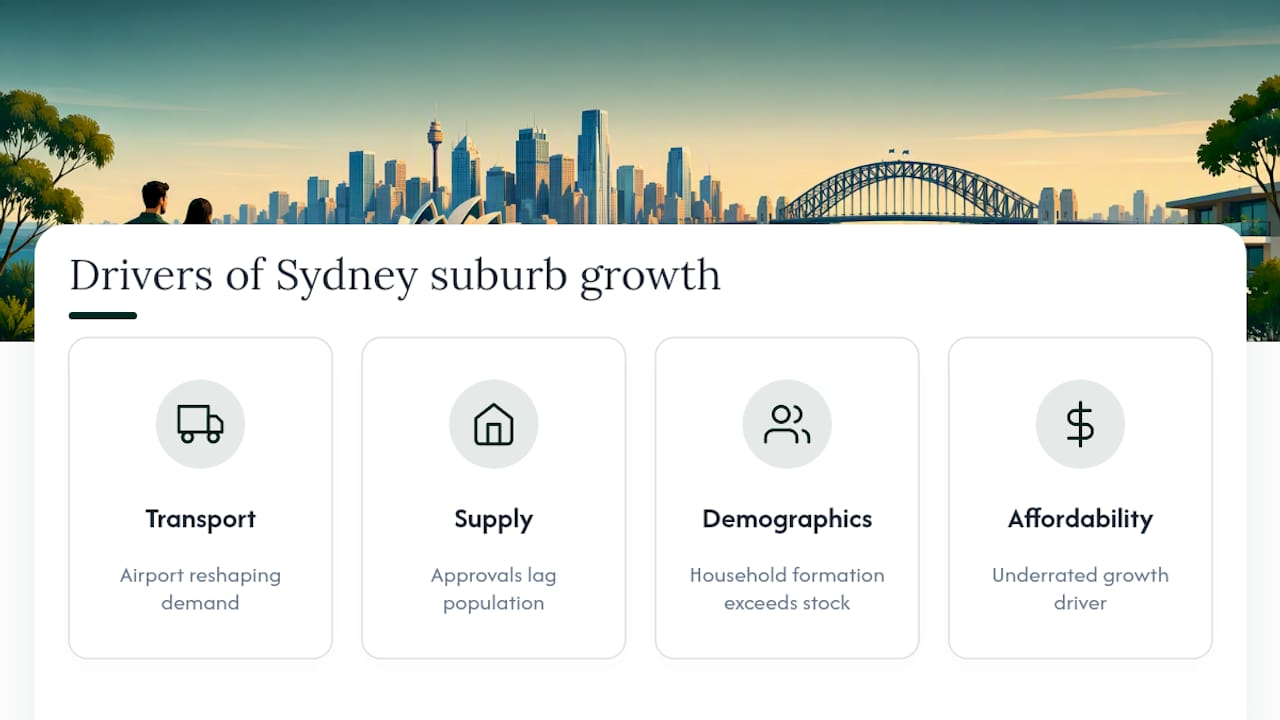
Four structural forces explain most of the movement on the shortlist above, and understanding them helps you separate a suburb with genuine momentum from one riding a short-term news cycle.
Transport and major infrastructure remain the single biggest lever in Western Sydney. The Western Sydney International Airport and the surrounding Aerotropolis and Bradfield City Centre precinct are reshaping demand across St Marys, Mount Riverview and the broader growth corridor, though some planned metro rail links aren’t expected to deliver until 2027–28. That timing gap matters: road-accessible suburbs tend to see price moves earlier, while suburbs banking on future rail need a longer holding period before the infrastructure premium shows up.
Supply constraints across established Sydney suburbs continue to underpin prices even in a softer market. Development approvals in inner and middle-ring suburbs have lagged population growth for years, which limits how far prices can fall even when buyer demand cools.
Population and demographic pressure keeps demand flowing into family-sized housing in the south west and outer west, as household formation outpaces new detached stock in those corridors.
Affordability runway is arguably the most underrated driver on this list.
Structural drivers explain the medium to long-term case for these corridors, but they don’t override near-term market conditions. New South Wales dwelling values fell 2.4% in the June quarter of 2026, a reminder that even the strongest growth story can pause for a few quarters before resuming.
How do you check a suburb’s growth potential yourself?
Before you shortlist a suburb further, run it through a five-step check that separates genuine momentum from a statistical blip.
- Pull the current median and its growth window. Look at both 12 month and five year figures, since a suburb can post a strong recent quarter off a low transaction count that won’t repeat.
- Check days on market and listings volume. A suburb where properties sell in under 20 days with rising listings volume shows genuine demand; one with volatile, low transaction counts is more prone to median swings from a single high or low sale.
- Cross-reference gross yield against growth. A suburb posting strong capital growth with collapsing yield is often nearing an affordability ceiling for that buyer segment.
- Triangulate across data sources. Compare figures from the ABS, PropTrack, and Domain or Cotality reporting rather than relying on a single index, and check the council’s planning portal for pending rezonings or major development applications nearby.
- Walk the suburb. Check local rental listings for genuine tenant demand, look at school catchment quality, note new developments under construction, and time your visit against public transport, not just a map.
Our step-by-step guide to researching Sydney suburbs walks through this process in more depth if you want a repeatable checklist for every suburb you shortlist.
What are the risks of chasing capital growth over yield?
Growth-focused buying carries real downside if you don’t account for a few recurring traps.
- Rate sensitivity: growth suburbs at the affordability edge are usually the first to soften when borrowing costs rise, since their buyer pool is more leveraged.
- Thin transaction markets: suburbs like Mount Riverview or Heathcote can show a median swing of tens of thousands of dollars from just two or three sales in a quarter.
- Infrastructure delivery risk: projects pencilled in for 2027–28 sometimes slip further, and a suburb priced on the assumption of a metro station that arrives late can underperform for years.
- Short-term softening: PropTrack’s mid-2026 data shows Sydney recording modest monthly price falls, with regional and outer markets outperforming the capital in several recent months.
- Liquidity: a growth-led purchase in a thin market can take longer to sell than expected if your circumstances change.
Mitigate these by stress-testing your budget against a rate rise of a percentage point or two, spreading risk across more than one suburb type if your capital allows, and treating any infrastructure-driven thesis as a five to ten year play rather than a two-year flip.
What a buyer’s agent sees that a spreadsheet misses
An experienced buyers agent in Sydney built their approach around a simple observation: the suburb data tells you where to look, but it never tells you what’s actually for sale. Median prices and growth percentages are backward-looking by definition. The property that actually delivers the growth thesis, the well-positioned house in St Marys or the renovated terrace in Paddington, is usually gone before it hits a public listing.
That’s where licensed buyer’s agent expertise earns its keep: independent appraisal to separate a genuine bargain from a poorly marketed dud, negotiation skill to secure it below asking, and auction bidding discipline to avoid overpaying. Off-market access matters most in exactly the thin, low-volume suburbs on the growth shortlist above, where public listings are scarce and competition for the ones that do appear is fierce.
— Kristan
How Sydney Property Buyers turns suburb research into a purchase
Sydney Property Buyers is the practical next step once you’ve narrowed your shortlist. Rather than spending weekends chasing open homes on suburbs like St Marys, Ingleburn or Little Bay, you get a licensed buyer’s agent running the search for you, including properties never advertised publicly.

Buyer’s agent services commonly cover strategy, search, independent appraisal, due diligence, negotiation and settlement from end to end, while other options suit buyers who’ve already found a suburb and property and just need sharp representation to close the deal, or specific skills like auction bidding. Inspections can be scheduled seven days a week, independent of open home schedules, which matters most in thin-market suburbs where a property can be gone within days.
If you’ve shortlisted a growth suburb from this list and want off-market access into it, get in touch with Sydney Property Buyers or explore the full range of services to see which option fits where you are in the process.

Where to check current Sydney suburb figures
Suburb shortlists date quickly, so verify any figure before acting on it.
- Australian Bureau of Statistics: quarterly dwelling value data broken down by state, useful for confirming whether the broader New South Wales market is rising or softening.
- PropTrack: monthly home price index commentary showing capital city and regional trends, useful for spotting short-term momentum shifts.
- Domain or Cotality: suburb-level median price and days-on-market reporting, useful for cross-checking a single source’s figures.
- Local council planning portals: development application and rezoning notices, useful for spotting supply changes before they show up in price data.
Treat a static suburb list, including this one, as a starting point for research rather than a final answer. Medians move month to month, and the suburb worth buying in six months’ time might not be the one topping today’s table.
Sources
- Value of dwellings falls 0.3% | Australian Bureau of Statistics
- Australian home prices fall in June, as all but one capital city record a decline
- Best suburbs to invest in Sydney 2026 | OpenAgent
FAQ
Which Sydney suburbs are booming right now?
Western Sydney and south west corridor suburbs including St Marys, Mount Riverview, Ingleburn and Camden are showing the strongest recent momentum, largely on the back of Western Sydney Airport infrastructure and affordability pressure pushing buyers further out. Established pockets like Paddington and Little Bay are also holding up well despite broader market softening.
Where is the fastest growing suburb in Sydney?
There’s no single suburb that consistently tops every index, since rankings shift depending on the time window and data source used. On OpenAgent’s 2026 figures, Mount Riverview and St Marys have posted some of the strongest recent percentage gains on the shortlist, though thin transaction volumes in smaller suburbs can inflate short-term figures.
Which Sydney suburbs are best for property investment?
The best suburbs depend on whether you’re prioritising growth or yield. Growth-focused buyers tend to look at St Marys, St Johns Park and Camden, while yield-conscious investors often find better gross returns in suburbs like Villawood and Ingleburn, where prices remain lower relative to rental demand.
Which Sydney suburbs are undervalued?
Suburbs still trading well below the broader Sydney median, such as St Johns Park, Villawood and parts of the south west growth corridor, are often flagged as undervalued given their proximity to infrastructure and transport upgrades. Because these markets are thin, a genuine bargain in these pockets is usually secured through off-market access before it reaches public listings, which is where working with a licensed buyer’s agent like Sydney Property Buyers tends to make the biggest practical difference.
Recommended
- How to research Sydney suburbs property in 2026
- 10–20 km Frontier: Where Sydney’s Gentrifying Suburbs Are Expanding
- Buyers agent suburb research methods: 2026 guide
- Eastern suburbs property buying guide: 2026 edition