Gentrification in Sydney is expanding outward from the CBD in predictable rings, not spreading randomly across the map. Research modelling this pattern points to a spill-over zone roughly 10 to 20 kilometres out, catching pockets of the Inner West, the Botany and Maroubra fringe, Auburn and Bankstown, the Ryde to Eastwood corridor, and edges of the Sutherland Shire. The sections below unpack the evidence behind that list and what it means for anyone buying now.
TL;DR:
- Gentrification in Sydney is primarily spreading outward from the CBD to areas within 10 to 20 kilometers, especially in the south, west, and northwest regions.
- Early signals of gentrification include rising socioeconomic indices, rent-price divergence, transport upgrades, and increased development approvals, which appear months before street changes.
- Predictive models suggest that gentrification has expanded from a 5-10 kilometer radius around the CBD to a broader 10-20 kilometer zone, driven by transport, development, and demographic shifts.
- Buyers should focus on multiple indicators, such as infrastructure projects, socioeconomic data, and local retail changes, to identify potential gentrifying suburbs early.
- Investing in early-stage gentrification areas offers higher medium-term capital growth, but risks include yield compression, rezoning, displacement, and community pushback.
Table of Contents
- Which Sydney suburbs are gentrifying right now?
- What signals show a suburb is gentrifying?
- What does the research actually say about Sydney’s gentrification patterns?
- What gentrification means for buyers and investors
- How to evaluate a suburb yourself
- How Sydney Property Buyers reads these signals for clients
- Ready to act on a gentrifying suburb before it’s obvious?
- Sources
Which Sydney suburbs are gentrifying right now?
Suburb-wide labels miss the real story. Gentrification in Sydney plays out at the SA1 level, meaning one street or block can be transforming while the next stays static, which is why any list below is a starting point for research, not a verdict on an entire postcode.
- Marrickville and Dulwich Hill (Inner West): long past their first wave, but SA1 pockets near the light rail corridor are still repricing on the back of café and studio clusters.
- Rosebery and Waterloo: industrial-to-residential conversion continues, with warehouse redevelopment and new retail tenancies flagged repeatedly in local buyer discussion.
- Botany and Maroubra fringe: priced out of Randwick, buyers are pushing demand into these adjoining suburbs, consistent with the spill-over pattern researchers describe.
- Auburn and Bankstown: identified in predictive modelling as likely to see gentrification expand, driven by relative affordability and transport access.
- Ryde and Eastwood corridor: metro connectivity and unit development approvals are reshaping the occupational mix in specific pockets.
- Sutherland Shire fringe: further out than the historical 5–15 kilometre gentrification band, but flagged as an emerging frontier in the same research.
- Penrith: cited in community discussion as an area attracting buyers priced out of closer options, though the signal here is earlier stage than the inner-ring examples.
Each of these is nominated by a mix of predictive machine-learning modelling, census-based socioeconomic analysis, and on-the-ground reporting rather than any single source. Treat the list as a shortlist of areas worth deeper SA1-level checking, covered in the Sydney Inner West suburb comparison, not as suburbs to buy in blind.
What signals show a suburb is gentrifying?
Gentrification leaves a data trail before it becomes obvious on the street. Watching the right indicators, in roughly this order, gives buyers a genuine head start.
- Socioeconomic index movement. A rising SEIFA rank, alongside a shift toward professional occupations in census data, is one of the more reliable early markers.
- Price and rent divergence. When rents climb faster than comparable neighbouring suburbs, demand is outpacing supply before the broader market has caught on.
- Transport upgrades. New or upgraded rail, light rail, or express bus services consistently precede visible change, according to ABC News reporting on gentrification drivers.
- Development approval volume. A jump in medium and high-rise DA approvals signals that developers already see the uplift coming.
- Retail and hospitality churn. New cafés, boutique fitness studios, and speciality retail often show up a few years before major price shifts.
- Market heat. Rising auction clearance rates and growing off-market activity both point to buyer competition intensifying.
Pro Tip: Don’t rely on one indicator alone. A single new café means little; a new café, a rezoning application, and a rail upgrade turning up in the same postcode within 18 months is the real signal.
The spill-over effect matters here too. Once a suburb gentrifies, buyers priced out push into the next cheapest suburb over, which is why frontiers tend to move in geographic rings rather than jumping across the city.
What does the research actually say about Sydney’s gentrification patterns?
A predictive machine-learning model built on tree-based methods reached a balanced accuracy of roughly 74.7% forecasting which Sydney suburbs gentrified between 2011 and 2016. That’s a meaningful result for a genuinely difficult prediction problem, though it still means roughly one in four predictions misses.
The model’s core finding: gentrification is expected to expand from a historical 5–10 kilometre band around the CBD out to 10–20 kilometres, spilling into the south, west, and north-west.
UNSW researchers behind the work point to transport access, development approvals, and demographic change as the strongest predictors feeding that model, echoing what shows up in ground-level reporting.
Earlier SEIFA-based research (Pegler and colleagues) found that 11 of 13 suburbs identified as gentrifying between 2006 and 2016 sat within 5 to 15 kilometres of the CBD, concentrated in the inner west and south-east. That historical band is exactly what the newer machine-learning work predicts will widen.
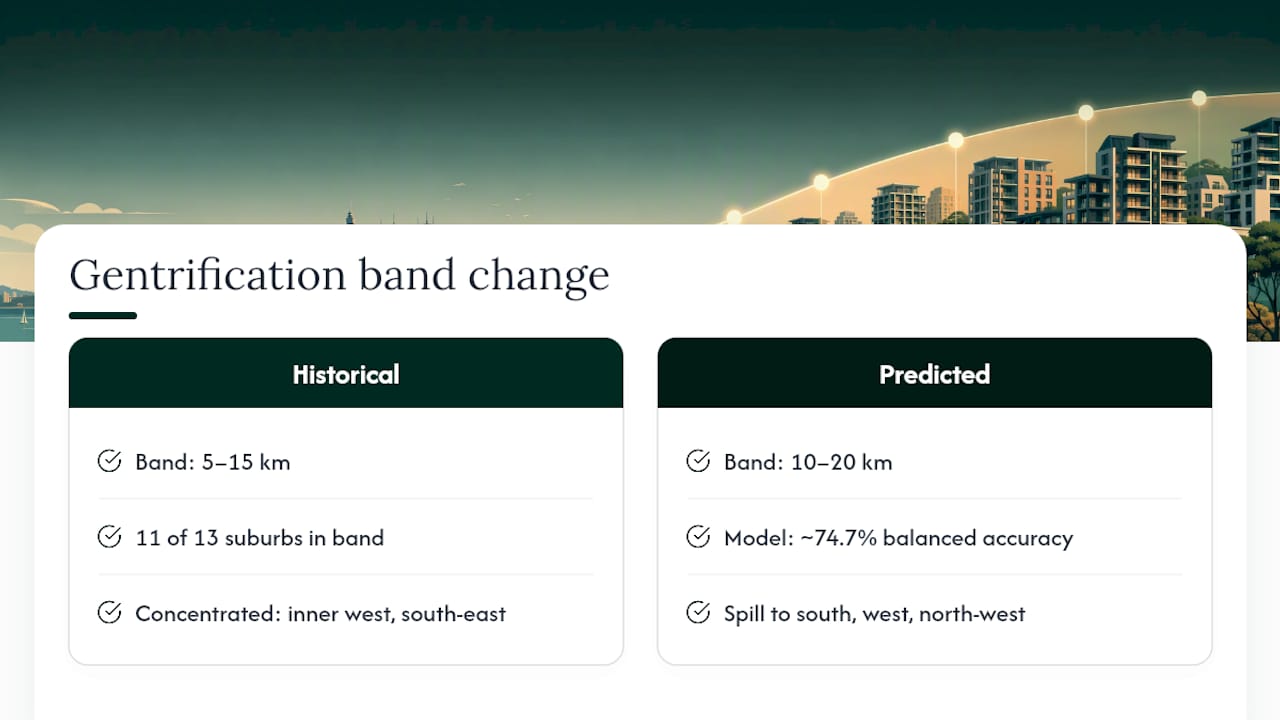
A few caveats matter. These models work at a probabilistic, area-wide level, and SA1 granularity regularly uncovers “hyper-gentrifying” pockets inside suburbs otherwise classified as stable. The Urban Displacement Project’s Sydney mapping adds a necessary counterweight, documenting how this same process displaces lower-income and vulnerable households, not just an abstract statistical trend.
What gentrification means for buyers and investors
Capital growth and rental yield behave differently depending on which phase of gentrification a suburb is in. Early-stage suburbs, where amenity change is visible but prices haven’t caught up, tend to offer the strongest medium-term capital growth. Later-stage suburbs, already gentrified, usually deliver steadier but slower growth, with yields already compressed by buyer competition.
The downside risks are real and worth budgeting for:
- Yield compression: rental yields typically shrink as capital values rise faster than rents in the early to mid phases.
- Rezoning uncertainty: local government planning changes can accelerate or stall a suburb’s trajectory with little warning.
- Community pushback: development approvals in gentrifying areas increasingly attract organised local opposition, which can delay projects buyers are banking on.
- Displacement effects: the same forces creating capital growth for owners are pushing renters and long-term residents out, a pattern the Urban Displacement Project documents in detail across Sydney.
Pro Tip: Prioritise transport-led catalysts over hospitality-led ones. A confirmed rail or metro upgrade is a far more durable growth driver than a wave of new cafés, which can just as easily signal a short-lived trend.
How to evaluate a suburb yourself
A proper check combines hard data with what you see and hear on the ground, and it’s worth doing both before committing to a suburb.
Start with the data sources:
- ABS census data and SEIFA index changes over the most recent release periods
- Local council development application (DA) trackers for approval volume and type
- NSW transport project plans and funded (not just proposed) infrastructure
- Domain or realestate.com.au price and rent trend histories by suburb and postcode
- Auction clearance rate data for the specific suburb, not just the Sydney-wide average
Then work through this sequence:
- Map SA1-level socioeconomic change rather than relying on suburb-wide averages.
- Cross-check the DA pipeline against transport funding to confirm the catalysts are real, not speculative.
- Walk the retail strip and note tenancy churn, café openings, and vacant shopfronts being filled.
- Talk to two or three local agents about buyer inquiry levels, not just recent sale prices.
- Compare your findings against neighbouring suburbs to test whether you’re seeing genuine spill-over or an isolated blip.
For buyers without the time to run this process suburb by suburb, this is exactly where a buyers agent’s suburb research methods earn their fee, particularly for accessing off-market stock before a frontier suburb becomes common knowledge.
How Sydney Property Buyers reads these signals for clients
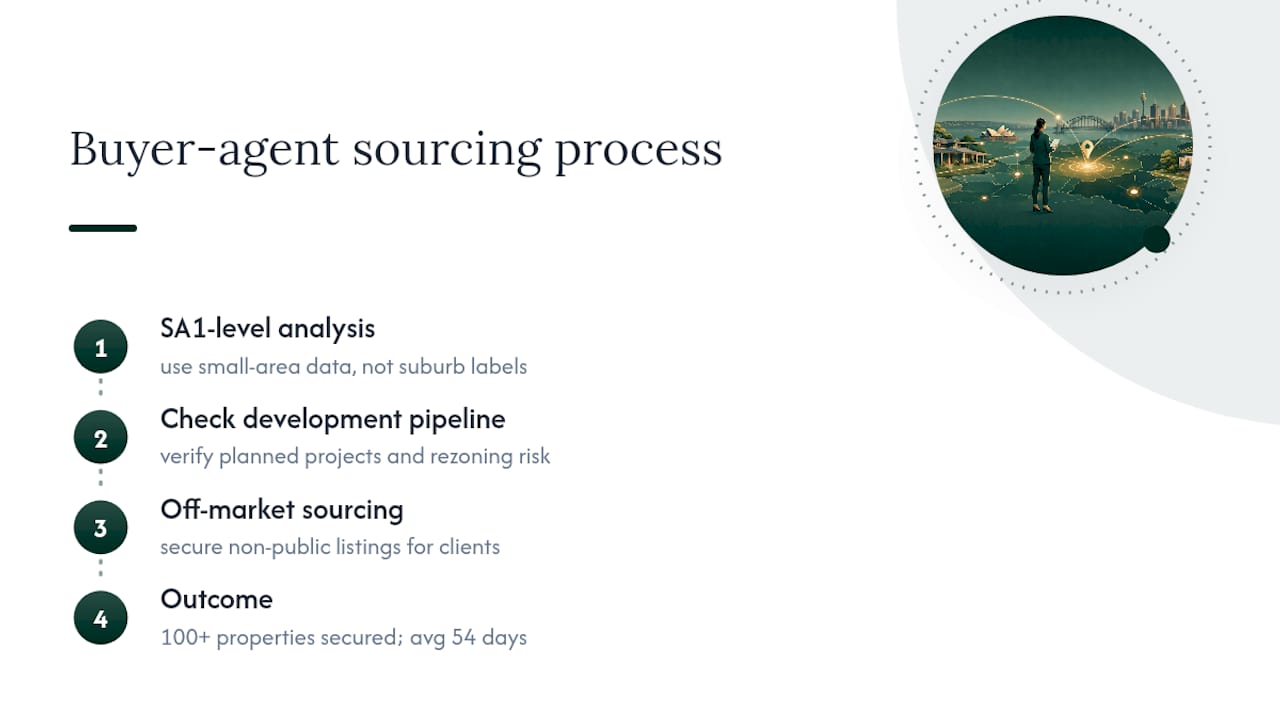
We treat suburb-wide gentrification labels with scepticism and go straight to SA1-level data, checking it against the actual development pipeline rather than headline trends. That combination, paired with off-market sourcing, is how we’ve secured more than 100 properties for clients with an average purchase time of around 54 days.
Kristan Johnson, licensed real estate agent and 2024 Outstanding Buyers Agent of the Year at the Inner West Local Business Awards, leads that process. Growth potential matters, but so does judgement: a suburb showing every gentrification signal on paper still needs a sober look at what displacement and rezoning risk mean for the people already living there.
— Kristan
Ready to act on a gentrifying suburb before it’s obvious?
Sydney Property Buyers is the alternative to searching alone through public listings in a suburb that’s already tipped off every other buyer.
For buyers eyeing an emerging pocket of the Inner West, Eastern Suburbs, Lower North Shore, or Eastern Beaches, that off-market access matters more than in a settled market, because the best-positioned properties in a frontier suburb rarely make it to a portal. Our full-service purchase process covers strategy, search, due diligence, negotiation, and settlement, while negotiation-only support suits buyers who’ve already found a property and just need an experienced hand at the table. Call 1800 676 177 or email hello@sydneypropertybuyers.com.au to talk through a shortlist before your next inspection.
Sources
- Building a predictive machine learning model of gentrification in Sydney
- Machine learning can help better predict city gentrification (UNSW newsroom)
- Is your suburb ripe for gentrification? How to tell if higher property prices and high-rises are on the horizon – ABC News
- Sydney – Gentrification and Displacement
Recommended
- 10 Sydney Suburbs Poised for 2026 Growth: US Investor Playbook
- Sydney inner west suburb comparison: 2026 guide
- How to research Sydney suburbs property in 2026
- Buyers agent suburb research methods: 2026 guide