Sydney auctions are public, fast and legally binding the moment the hammer falls. Good etiquette here means two things. First, the manners that keep you calm and credible in the crowd. Second, the NSW rules that decide what you can and cannot do. This guide covers both, in the order you will meet them: registering, standing in the crowd, bidding, and what happens if the property is passed in.
If you are reading from the United States, one difference matters more than any other. A Sydney auction is not an online bid on a listing, and there is no escrow period afterwards. You bid in person, usually on the street or in the front garden, against other buyers, and you sign the contract on the day. All dollar figures below are Australian dollars.
TL;DR
- Register before the auction with photo or address ID and collect your bidder’s number. Registering does not oblige you to bid.
- A winning bid has no cooling-off period. You sign the contract and pay the deposit, typically 10%, on the spot.
- Be visible, decisive and polite: clear bids, no side chatter, no arguing with the auctioneer. Their ruling on a disputed bid is final.
- Only one vendor bid is allowed, and the auctioneer must announce it. Any other seller-side bidding is illegal.
- Set a hard limit in writing before the day. If you hire a buyers agent, they cannot go above it without new written instruction.
Table of Contents
- Before the day: registering to bid
- The rule that shapes everything: no cooling-off
- Standing in the crowd: the unwritten manners
- What the auctioneer and vendor are allowed to do
- If the property is passed in
- A sample bidding plan
- Our view: the best etiquette is preparation
- Bidding through a buyers agent
- How we can help
- FAQ
- Sources
Before the day: registering to bid
In NSW you cannot simply walk up and bid. To take part you must register with the selling agent and be given a bidder’s number. The NSW Government’s auction guidance says you must give your name and address and show proof of identity, and that without those details you will not be able to bid.
The Bidder’s guide explains what counts as identification. A driver’s licence works, as does a council rates notice. If one document does not show both your name and address, you can combine two, such as a Medicare card and a utilities bill. The agent only needs to sight the documents, so certified copies are not required.

The selling agent must also hand every potential bidder a copy of that guide before the auction. Read it. It covers privacy, the auction conditions and how registration works.
Registering is not a promise to bid
Many first-timers hold back from registering because they think it commits them. It does not. Registration simply gives you the right to bid, and you can stand in the crowd all morning without raising a finger. The agent will note your details in the bidders record, so register early rather than in the last scramble before the auctioneer starts.
Arrive early and do your homework
Get there 15 to 30 minutes ahead. Etiquette starts with not holding up the start, and arriving early lets you register calmly, read the auction conditions and see who else is bidding. Before you go, you should have already read the contract of sale with a solicitor or licensed conveyancer, and have your finance pre-approved. NSW Government’s offer guidance lists both as steps before you commit.
If you have not had a building and pest report done, do it before auction day, not after. We explain why in our piece on building inspections before bidding.
The rule that shapes everything: no cooling-off
Auction manners are really about self-control, because the stakes are so high. The NSW Government states that a cooling-off period does not apply if you buy at auction, or if you exchange contracts on the same day as the auction after the property is passed in. The usual 5-business-day cooling-off for private treaty sales, during which a buyer can withdraw by paying 0.25% of the price, is simply absent.
In practice, if you are the highest bidder when the hammer falls, you sign the contract right there and pay the deposit, which is typically 10% of the price. Walking away costs you your deposit and can leave you liable for the vendor’s losses, according to the same government page.
That has etiquette consequences:
- Never bid as a bluff. A bid is an offer you may be held to.
- Never bid for fun. Do not nod at a property you do not want to see how high it goes.
- Bring what you need to sign. Know how your deposit will be paid and that your finance is sorted. Our page on auction deposit percentages covers what to expect, and our guide to NSW auction rules shows how buyers lose deposits.
There is a narrow exception: a vendor can agree to a buyer waiving the cooling-off period for a private sale through a 66W certificate, but that is a different situation from winning at auction.
Standing in the crowd: the unwritten manners
No rulebook covers this part. These are the habits that make you look like someone who knows what they are doing.
Dress and behave like a serious buyer
You do not need a suit, but you are in a public street, often in front of neighbours. Neat, comfortable clothes are fine. Keep conversation low and stay quiet when the auctioneer is speaking. Talking loudly through the opening remarks is rude, and you may miss the conditions or a vendor bid announcement.
Listen to the opening
The auctioneer will read out conditions, introduce the property and sometimes state whether there is a vendor bid. Those statements matter. Do not wander off to take a call during them. If the auctioneer says something you do not understand, such as a bidding rule or a registration question, ask the selling agent before the bidding starts, not mid-auction.
Stand where the auctioneer can see you
Position yourself with a clear line of sight to the auctioneer and, ideally, to your rivals. Hold your bidder’s number visibly. If the auctioneer or their spotters cannot see you, they may miss your bid.
Bid clearly and keep it simple
There is no shame in a firm, visible bid. A raised card, a clear call or a decisive nod all work, but ambiguity does not. Nervous half-gestures cause confusion and can cost you the property. Do not make sudden, wide arm movements while chatting to a friend, because you may be mistaken for a bidder.
If you want to control the pace, you can suggest a different increment. The auctioneer is in charge and decides whether to accept it, so ask politely and be ready to follow their lead. Our guide on auction bidding increments and the beginner’s page on $5,000 jumps that drain your budget go into tactics.
Keep your poker face
Other bidders and the vendor’s agent are watching your behaviour. Visible frustration, a whispered argument with your partner or a long check of your phone all signal where your limit is. Agree your maximum beforehand and have a signal with your partner or agent. Our auction day checklist lays out seven steps.
Respect the other bidders
Do not heckle rivals, comment on their finances or block their view. If you lose, congratulate the winner if you wish and leave without drama. The neighbourhood is small, and you may meet that buyer, or that agent, again.
What the auctioneer and vendor are allowed to do
A calm bidder is one who understands the rules on the other side of the table.
Vendor bids and dummy bidding
The NSW Government’s auction guidance for agents explains that a vendor is permitted a single vendor bid, made by the auctioneer and announced clearly before it is made. Any other bid made on the seller’s behalf is a dummy bid, which is illegal and can attract fines of up to $55,000. So if the auctioneer announces one vendor bid, that is lawful. Several hidden ones are not.
A related rule from the same government material: it is an offence to induce another person to abstain from bidding or limit their bidding. That is why you should never try to strike side deals with other bidders in the crowd, however friendly the chat.
Disputed bids
If a bid is disputed, the auctioneer is the sole arbiter and their decision is final. Do not argue. Raise any concern quietly with the selling agent afterwards if you think something improper occurred, and seek advice. Know before you attend that there is little recourse during the auction itself.
Price guides and underquoting
Agents are prohibited from underquoting, but NSW Fair Trading guidance also says a final price above the advertised guide does not automatically prove underquoting, because strong competition often pushes prices past early predictions. Treat the guide as a starting point, not a ceiling. Our article on the 2026 underquoting changes goes deeper.
If the property is passed in
The reserve price is the minimum the vendor will accept, and it is not disclosed to buyers. If bidding does not reach it, the property is passed in and withdrawn from the auction. According to the NSW Government, the auctioneer may ask the vendor whether they will accept a lower price, and the highest bidder typically gets first opportunity to negotiate with the seller.
The etiquette here is to stay put and stay courteous. If you were the highest bidder, tell the selling agent you wish to negotiate and keep your number in hand. Do not storm off, and do not reveal your true ceiling. If you do reach agreement, remember that contracts exchanged on the same day as a passed-in auction also carry no cooling-off. Our guide to pre-auction offers shows how being contract ready changes your position before auction day.
A sample bidding plan
This is the structure we suggest to buyers. It is general guidance, not a promise of a result.
| Stage | What to do | Why it matters |
|---|---|---|
| One week before | Solicitor or conveyancer reviews contract; finance pre-approved; building and pest report done | You cannot back out after the hammer |
| Day before | Write down your maximum price and your opening bid | Removes emotion on the day |
| On arrival | Register with ID, collect bidder’s number, read the conditions | Required before you can bid |
| During bidding | Bid clearly, steadily and without chatter | The auctioneer must see you |
| At your limit | Stop. Do not add “just one more” | Lenders value after the sale, and any shortfall is yours |
| If passed in | Ask to negotiate if you are highest bidder | You typically get first opportunity |
Our view: the best etiquette is preparation
We act only for buyers, never sellers, and we have stood beside clients at a lot of auctions. What we see again and again is that bad behaviour at auction is nearly always a symptom of poor preparation. The buyer who has read the contract, checked finance and set a number in writing rarely panics. The buyer who has not often starts bidding with their heart.
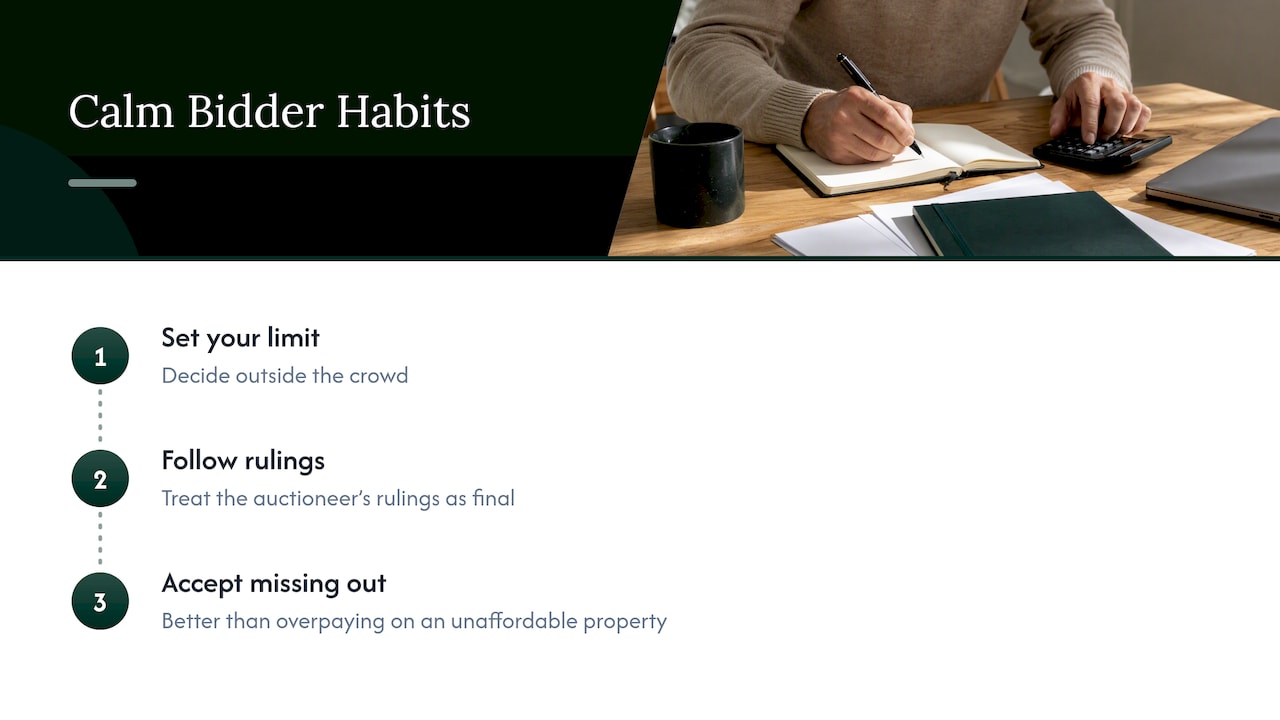
Three habits separate calm bidders from stressed ones. First, they decide their limit when they are not in the crowd. Second, they treat the auctioneer’s rulings as final and focus on their own plan. Third, they accept that missing out is a better result than overpaying on a property they could not afford.
We also think many overseas buyers underestimate how much information sits outside the auction itself. Pre-market and off-market opportunities can let a buyer avoid the crowd altogether, and over 30% of our purchases have been secured off-market. Going in with a firm plan and the right support is the real etiquette.
— Kristan
Bidding through a buyers agent
If standing in a crowd of strangers is not for you, or you live overseas, a licensed buyers agent can bid on your behalf. The NSW Government says a buyer’s agent must declare any conflicts of interest, act on your express written authority when bidding, work to obtain the best possible price, and not exceed your pre-authorised limit without explicit, updated written instruction.
That last point is the practical protection. It is your limit, in writing, and the agent bids within it. Before you sign, read the agreement carefully. Our page on buyers agency agreements and written bids explains what to look for, and why a licensed buyer’s agent matters covers licensing. You can also read our broader guide to Sydney property auction bidding.
How we can help
Sydney Property Buyers is a fully licensed buyers agency (NSW Licence 20456819) in Petersham, serving the Inner West, Eastern Suburbs, Lower North Shore and Eastern Beaches. Our Auction Bidding and Complete Purchase Solution cover strategy, search, independent appraisal, due diligence, negotiation, bidding and settlement. If you have already found a property, Negotiation Only is available too. See our services or call 1800 676 177.
FAQ
Do I have to bid if I register at a Sydney auction?
No. Registering gives you the right to bid and a bidder’s number, but it does not oblige you to make a single bid. You can watch the whole auction and walk away.
What is a vendor bid?
It is a single bid made by the auctioneer on behalf of the seller. In NSW it must be announced clearly before it is made. Any other bid on the seller’s behalf is a dummy bid, which is illegal and can carry fines of up to $55,000.
Can I change my mind after winning?
No. There is no cooling-off period for auction purchases in NSW. If you are the highest bidder when the hammer falls, you must sign the contract and pay the deposit, typically 10%, on the spot. Walking away puts your deposit at risk.
What happens if the reserve price is not reached?
The property is passed in. The auctioneer may ask the vendor whether they will accept a lower price, and the highest bidder typically has the first chance to negotiate. Any contract exchanged on the same day also has no cooling-off.
Can someone else bid for me?
Yes. A licensed buyers agent can bid for you under your express written authority. They must stay within your pre-authorised limit unless you give updated written instruction.
Sources
- Buying property at an auction, NSW Government
- Bidder’s guide, NSW Government
- Contracts and deposits when buying property in NSW, NSW Government
- Auctions: responsibilities for property agents, NSW Government
- Making an offer on a property, NSW Government
- Using a real estate agent to buy a property, NSW Government
Recommended
- Sydney property auction bidding: how to bid with confidence
- Avoid Losing Your Deposit: 5 NSW Auction Rules Buyers Must Know
- Sydney Auction Day Checklist: 7 Steps With a Buyer’s Agent
- Beginners: Stop $5,000 Jumps Draining Your Budget in Auction Bidding