A value add property is one you buy below its potential and then improve, through renovation, better management or higher rent, so that it earns more and is worth more than you paid. The skill is not the renovation. It is telling real upside from a problem that only looks cheap, and paying a price that leaves room for the work. That judgement is much easier with a licensed buyers agent who only acts for purchasers. At Sydney Property Buyers, we do that appraisal before you bid.
TL;DR
- A value add property has a fixable weakness: tired condition, below-market rent, poor management or unused space. Fix it and income and value rise.
- Institutional investors judge the result by net operating income (NOI). Sydney homes are normally priced by comparable sales, so your test is cost of works against the gap between today’s price and the finished price.
- Kitchens, bathrooms and flooring are the most common rent-lifting upgrades. Cosmetic work usually carries less risk than structural work.
- Most value add deals are won or lost at purchase: the price you pay, and what due diligence finds before the five-day cooling-off period ends.
- Properties with clear upside are often sold off-market or quietly pre-market, where a buyers agent’s network matters.
Table of Contents
- What value add property means
- The common value add levers
- What adds the most value to a rental property
- How to spot genuine upside
- Running the numbers on a Sydney value add purchase
- Why price discipline decides the outcome
- What to avoid
- How Sydney Property Buyers works on value add purchases
- FAQ
- Sources
What value add property means
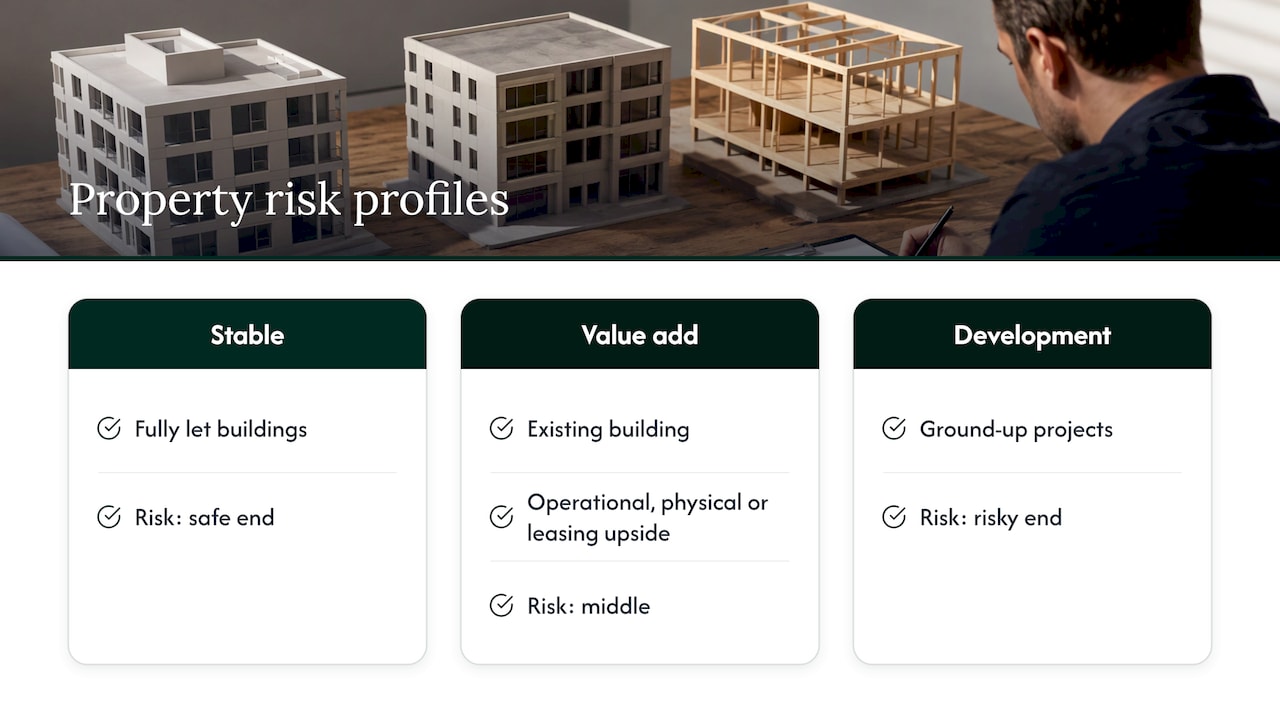
The term comes from commercial real estate, where investors sort assets into risk profiles. Stable, fully let buildings sit at the safe end. Ground-up developments sit at the risky end. Value add sits in the middle. One commercial guide describes a value add asset as one with operational, physical or leasing upside that can be captured through renovation, lease-up, repositioning, expense reduction or better management. The same guide notes that, unlike development projects, value add generally means working with an existing building rather than building from scratch.
CBRE Investment Management, a large property investor, describes value add as active management that grows net operating income, which produces both income and capital growth. In plain terms, you are paying for effort and risk as well as for bricks. The reward is meant to be higher than simply buying a finished property and waiting.
For a Sydney house, unit or small investment block, the idea carries over in simpler form. You are looking for a property where the gap between what it is today and what it could be is bigger than the cost and hassle of closing that gap.
Net operating income in one paragraph
NOI is the rent a property collects in a year, minus the costs of running it (rates, insurance, repairs, management), before loan repayments. Investors in commercial and apartment buildings value a property as NOI divided by the market capitalisation rate, the yield buyers in that market accept. Raise NOI and, at the same cap rate, the value rises with it.
The same source gives a US example. An investor buys an apartment property for US$10 million with NOI of US$500,000, spends US$1 million on improvements and lifts NOI to US$650,000. At a 4.75% exit cap rate the stabilised property is valued at about US$13.68 million. The numbers are American and the asset is large, but the logic is the one you will use on any value add purchase: a modest rise in income, multiplied by the way the market prices that income.
The common value add levers
Value add strategies fall into a short list. One property guide summarises them as higher rents, lower unnecessary expenses, better energy efficiency, adding or repositioning floor area, cosmetic updates, amenities and a stronger property brand. Institutional fund materials add curing deferred maintenance, upgrading management teams, improving appearance and functionality, and rebidding service contracts.
Translated for a Sydney buyer, the levers look like this:
| Lever | What it looks like on a Sydney purchase | Typical risk level |
|---|---|---|
| Cosmetic renovation | Paint, flooring, lighting, kitchen and bathroom refresh | Lower |
| Rent repositioning | Existing tenant paying well under market; lease ending | Lower to medium |
| Better management | Poorly run block or untidy common property, high running costs | Medium |
| Layout changes | Reconfiguring rooms, opening up living areas | Medium |
| Added accommodation | Extra bedroom, studio or secondary dwelling where approvals allow | Higher |
| Structural or approval-dependent work | Extensions, subdivision, major rebuilds | Highest |
The further down the table you go, the more you depend on council approvals, builders and timing, and the more a wrong assumption costs.
What adds the most value to a rental property
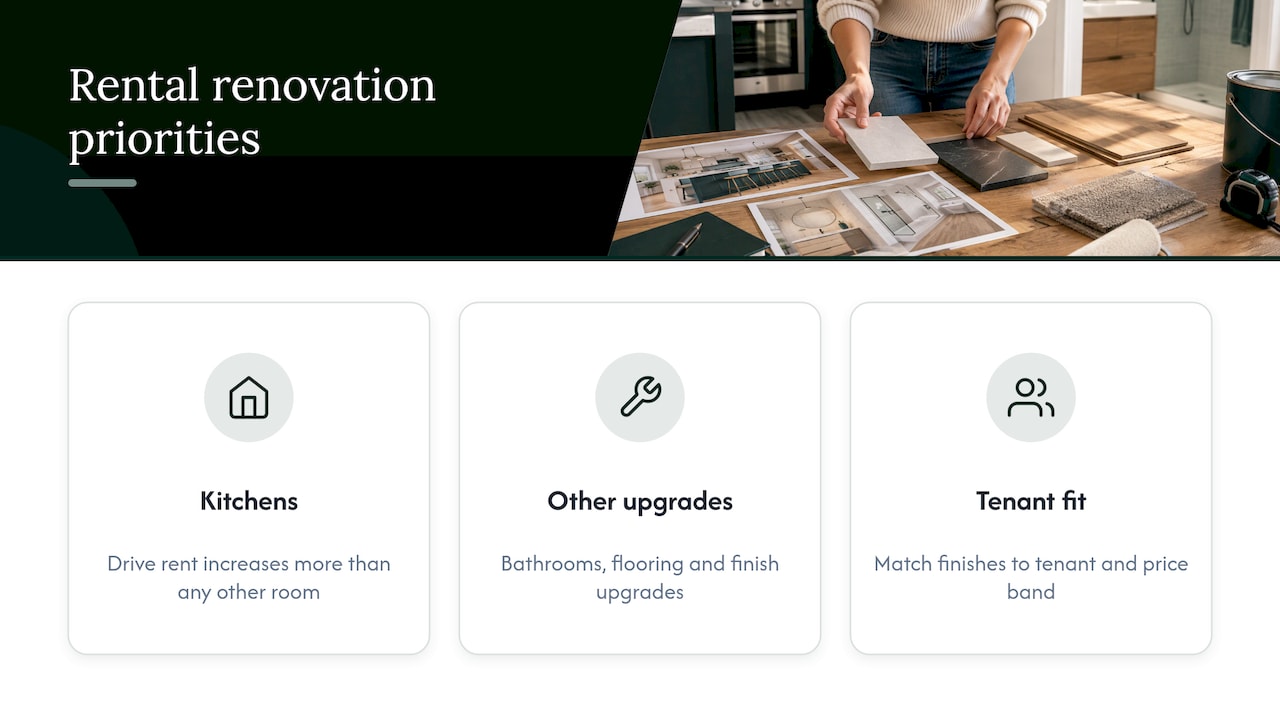
If the aim is rent, kitchens and bathrooms lead the list in the sources we reviewed. A US multifamily investor reports that kitchen renovations drive rent increases more than any other room, alongside bathroom, flooring and finish upgrades. A US property manager’s renovation guide also points to kitchens and bathrooms, citing modern appliances, cabinets, lighting, fixtures, flooring and water-saving fittings. It adds that open-plan layouts and double-glazed windows can help for some renter segments, and that results depend on the market and the property.
That last point matters in Sydney. A renovation that suits a young couple renting near a train line in the Inner West is not the same as one for a family in the Eastern Suburbs. Before you spend a dollar, check what comparable renovated properties in the street are actually achieving. Our guide to a rental appraisal before buying shows how to get that answer, and the rental yield formula turns it into a figure you can compare across properties.
Some ideas that look like value add are really just spending. A designer kitchen in a property whose street rents do not support it adds cost without adding return. Match the finish to the tenant and to the price band.
How to spot genuine upside
The best value add properties have one clear, fixable problem. A commercial guide on analysing these deals begins by identifying the specific problem holding performance back, then pricing the physical and leasing fix. That is a good discipline for any buyer. Ask these questions about every candidate.
1. What exactly is wrong, and is it fixable?
Dated interiors, a poor layout, a tenant on a below-market rent or weak management are fixable. A problem with the building’s structure, its title or its surroundings may not be. Fixable and cheap to fix is the combination you want.
2. Is the upside visible to other buyers?
If every buyer at the open home sees the same potential, competition will push the price up and take the margin with it. The better opportunities are often the ones that never get a campaign. Our guides to off-market listing sources and how buyers agents access off-market properties explain how those sales come about.
3. What can the property legally become?
Extra accommodation is one of the strongest levers anywhere, but it depends on local planning rules and approvals. In California, for example, design-build firms handle ADU design and construction for investors who want to add a second dwelling to an existing lot. In Sydney the rules are different and set by council and state planning, so confirm what is permitted on the specific lot before you put it in your numbers.
4. Are there hidden costs?
Deferred maintenance is the classic value add trap and also the classic value add opportunity. The difference is whether you found out about it before you bought. Pre-purchase inspections, a building report and a close read of the contract are the way. Read our due diligence checklist for Sydney and, if you are looking at an apartment, building defects in NSW strata, where defects often sit in common property you share and pay for.
5. Is the title clean?
Easements, covenants and restrictions can quietly block the works you are planning. The easements checklist for NSW buyers covers what to check before exchange.
Running the numbers on a Sydney value add purchase
Sydney homes are generally priced by what comparable properties have sold for, not by NOI, so the maths is more direct. Here is an illustrative example. The figures are invented to show the method and are not a forecast or a real property.
| Item | Amount |
|---|---|
| Purchase price | $1,500,000 |
| Stamp duty and purchase costs (allowance) | $90,000 |
| Renovation budget | $120,000 |
| Holding costs during works | $15,000 |
| Total cost | $1,725,000 |
| Value of comparable renovated properties | $1,850,000 |
| Margin before selling costs | $125,000 |
The margin is thin, which is the point of the exercise. Selling costs, a blown renovation budget or a softer market would erase it. Value add buyers who succeed protect themselves in three ways.
- They price the fix honestly. Get quotes, not guesses, and add a contingency.
- They test assumptions one at a time. The Cauble guide recommends stress-testing each assumption separately: rent, renovation cost, timing and finance. If the deal only works when everything goes right, it does not work.
- They buy at the right price. Every dollar saved on purchase is a dollar of margin. This is where negotiation earns its keep.
For an investor who intends to hold, the yield and growth view matters as much as the resale margin. Our article on buy and hold property explains how that strategy works, and the list of Sydney growth suburbs is a starting point for where to look.
Why price discipline decides the outcome
CBRE’s research names sourcing as one of the main return levers in value add investing, ahead of the work itself. That fits what we see in residential. A property with obvious potential attracts offers from owner-occupiers who plan to renovate, developers and other investors. If you win the auction by outbidding all of them, the upside has already been paid to the seller.
Two habits protect the margin. The first is a walk-away number set before the day, from your own cost and value figures. Our guides to auction bidding increments and bidding with confidence at Sydney auctions cover how to hold it under pressure. The second is a negotiation plan for private treaty sales. See how to negotiate a house price in Sydney and the way a building report can support your offer.
If you are an overseas buyer, particularly one coming from the US, the extra challenge is doing all of this from a distance. Our guide to buying Sydney property sight unseen sets out how that works.
What to avoid
- Off-the-plan upside. A new apartment’s promised value is a different bet from fixing an existing property. Weigh the off the plan risks first.
- Renovating past the street. Spending more than the surrounding market will pay for the finished product.
- Ignoring time. Works take longer than planned, and each month of delay costs you in loan interest and lost rent.
- Skipping the final check. Before settlement, our pre-settlement inspection checklist confirms the property is in the condition you contracted for.
Our view on value add
Most buyers who say they want a value add property are really asking one question: where is the upside that nobody else has priced in? In our experience of acting only for buyers, never sellers, the answer is rarely the renovation. It is the purchase.
That is why we work the way we do. We inspect properties seven days a week, not only at open homes, so a promising property can be assessed before the crowd arrives. Over 30% of the purchases we have made for clients were secured off-market, where there is less competition and more room to negotiate. Our clients have saved about 9% on average against the purchase price.
We also look at every property as an investment: capital growth potential and rental yield, not just how it looks. A tired house with a good street and strong rents can be a better value add than a pretty one with neither.
Value add done well is patient and numbers-driven. We would rather help you pass on five properties than pay too much for the sixth.
Kristan
How Sydney Property Buyers works on value add purchases
If you have found a property with potential and want it priced and negotiated properly, our Negotiation Only service gives you professional representation on that purchase. If you want us to find it as well, the Complete Purchase Solution covers strategy, on-market and off-market search, independent appraisal, due diligence, negotiation, auction bidding and settlement. Our clients’ average time from engagement to settlement is 54 days.

We are a licensed Sydney buyers agency (NSW Licence 20456819) acting for buyers in the Inner West, Eastern Suburbs, Lower North Shore and Eastern Beaches. See our services or look at properties we have secured for clients. You can also call 1800 676 177.
FAQ
What is a value add property?
It is a property bought with a fixable weakness, such as dated condition, below-market rent or poor management, so that improvements raise its income and value. The profit comes from the gap between the price paid plus the cost of works and the value of the finished property. It sits between buying a stable, finished property and a full development.
What are value add strategies?
The common ones are renovating, raising rents to market level, cutting running costs, improving energy efficiency, adding or reconfiguring space, and improving management. In a house or unit purchase, cosmetic renovation and rent repositioning are the most accessible. Anything that needs approvals or structural work takes longer and carries more risk.
What adds the most value to a rental property?
Sources on rental renovations most often point to kitchens and bathrooms, followed by flooring, lighting and fixtures. The right choice depends on who rents in that suburb and what comparable properties achieve. A rental appraisal for the specific property is a better guide than a general list.
Is a value add property riskier than a finished one?
It involves more work and more assumptions, so the quality of the purchase decision matters more. Risk is managed by pricing the works with quotes, completing building and contract due diligence before the cooling-off period ends, and setting a firm maximum price before you negotiate or bid.
Sources
- How to Underwrite a Value-Add Commercial Property, Solsten
- Value-Add Real Estate, CBRE Investment Management (2020)
- Net Operating Income and Cap Rate: A Guide for Real Estate Investors, Stiltsville Capital
- Value-Add Real Estate Investing: What Does It Really Mean
- CBRE Strategic Partners U.S. Value 9, L.P. (2019)
- Anatomy of a Value-Add Deal, Midwood
- 13 renovations to lure millennials to any rental property, Mynd
- How to Analyze a Value-Add Commercial Property, The Cauble Group
- ADU design and construction project example
Recommended
- Save an average 9% on Sydney property: is a buyer’s agent worth it?
- Sydney Multiple Offers: US Buyers Can Win on Terms, Not Price
- Win Sydney Property Negotiations, Advice From an Award Winning Agent
- Why missed properties frustrate buyers: the 2026 Sydney guide