Building defects in NSW strata are common enough that every apartment buyer in Sydney should plan for them. NSW government research found that about 53% of apartment buildings registered between 2016 and 2022 had at least one serious defect in the common property. Strata is the Australian term for apartment and townhouse ownership where you own your lot and share the common property through an owners corporation. This guide explains who pays for defects, which protections apply, and what to check before you buy. It is written for buyers, including overseas buyers, who are used to US condo rules.
TL;DR
- Serious defects in the common property are the owners corporation’s problem, which means they can become your levy problem after settlement.
- NSW has a 6 year warranty for major defects and 2 years for other defects. The clock starts at completion of the work, so building age matters.
- Apartment buildings of 4 storeys or more built under contracts from 1 January 2018 carry a 2% developer bond, with inspections in the first 24 months.
- Order a strata report and a building inspection, and read the committee minutes for special levies, engineers’ reports and lawyers’ names.
- Defect fights are slow, so a buyer’s best protection is to avoid the problem building or to price the risk before exchange.
Table of Contents
- What counts as a building defect in a strata scheme
- Why a defect in the building becomes your cost
- The protections NSW gives apartment owners
- Why chasing the builder rarely goes quickly
- How to check for defects before you buy
- Using defects in negotiation
- Our perspective
- Where a buyer’s agent fits
- FAQ
- Sources
What counts as a building defect in a strata scheme
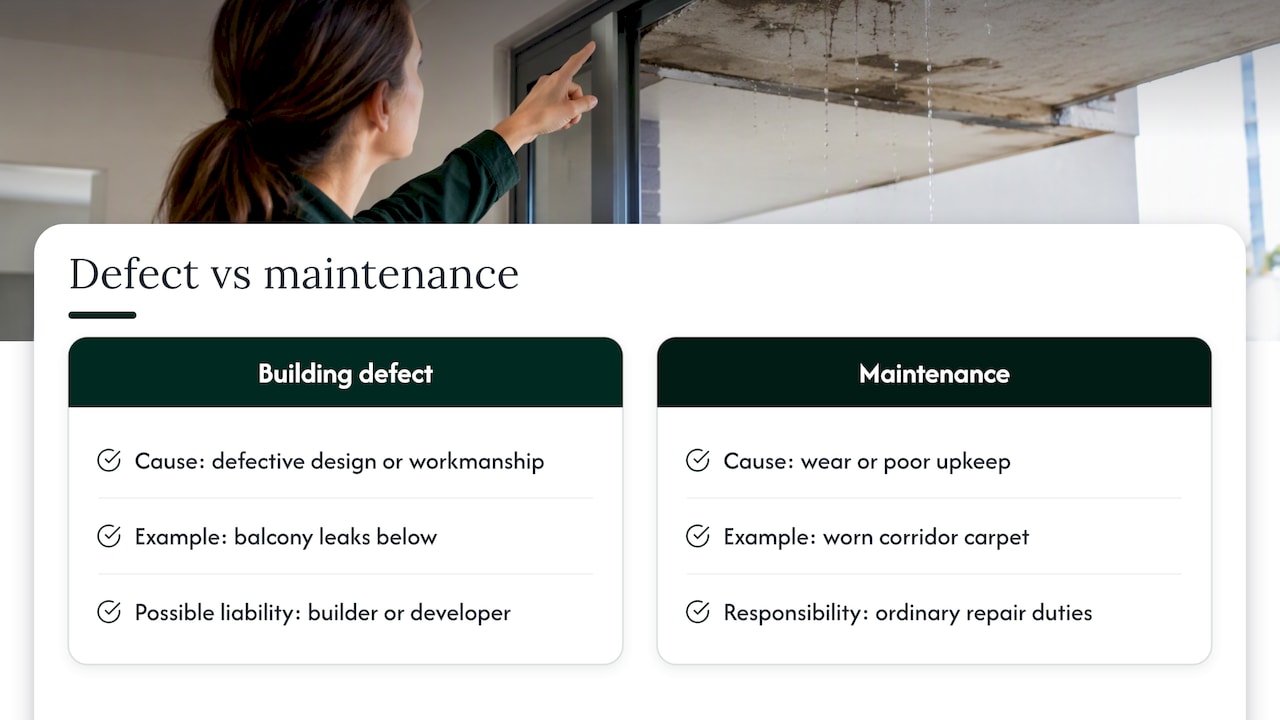
Not every flaw is a defect in the legal sense. A problem counts as a building defect when it results from defective design, faulty workmanship, substandard materials or non-compliance with the building rules. Normal wear, poor maintenance and cosmetic ageing are different issues, and they fall under the owners corporation’s ordinary repair duties.
The distinction matters because the remedy differs. A worn carpet in a corridor is a maintenance cost. A balcony that leaks into the unit below is possibly a defect with a builder or developer who may be liable.
Strata buyers also need to know who owns what. The owners corporation is responsible for maintaining and repairing common property, including roofs, gutters and structural elements, while owners fix things inside their own lot. If you are new to the model, our guide to strata schemes in Australia covers the basics.
The defects that show up most
Waterproofing leads the list. The NSW research estimates it affects around 23% of recently completed strata buildings. Typical trouble spots are balconies, planter boxes, roof gardens and wet areas. Other categories commonly seen in strata buildings include fire safety systems, structural elements and mechanical services such as ventilation and air conditioning.
A recent tribunal case shows how this plays out. In November 2025 the NSW Civil and Administrative Tribunal (NCAT) found a builder and developer jointly liable for several defects in a building’s mechanical ventilation and air-conditioning system. Defects are not only leaky balconies.
Why a defect in the building becomes your cost
In a US condo, a defect in the building envelope can lead to a special assessment. The NSW equivalent is a special levy raised by the owners corporation. When common property is defective, the owners corporation has to investigate, negotiate or litigate, and repair. It raises the money from lot owners in proportion to their unit entitlements.
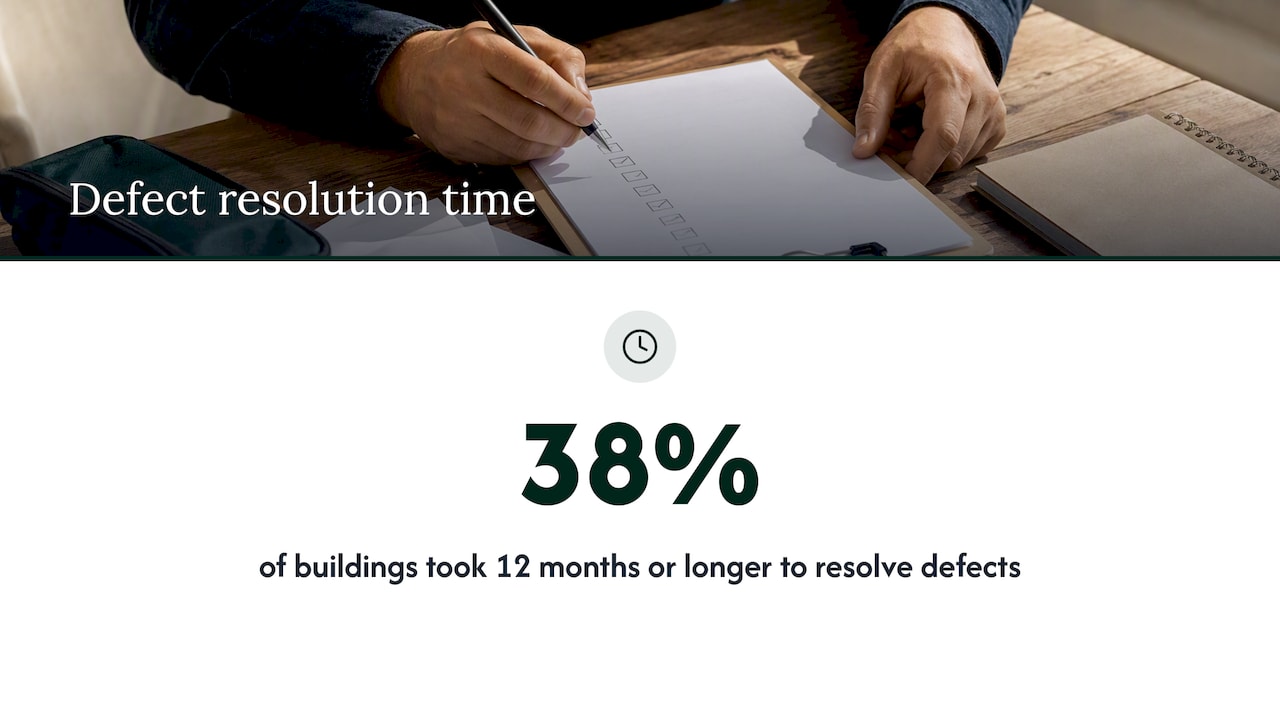
That means a buyer can inherit a historical problem. Defect resolution is slow: the NSW research found that 38% of buildings took 12 months or longer to reach a resolution. During that time, levies for engineers, lawyers and invasive testing can land on whoever owns a lot at the time, including a new buyer who settled last month.
There is also a resale effect. A building with open defect proceedings can be harder to sell, and some lenders look closely at such buildings. Ask your broker early rather than discovering this after exchange.
The protections NSW gives apartment owners
NSW has three layers of protection. None of them is a guarantee, so treat them as tools, not insurance.
Statutory warranties
Under NSW law, owners have 6 years for major defects and 2 years for all other defects, counted from the completion date of the work. If you find a defect in the last 6 months of the period, you get an extra 6 months after the period ends to start proceedings.
For common property in an occupied apartment building, NSW Fair Trading says complaints are best made by the owners corporation or its representative, such as a strata manager. As an individual lot owner you usually cannot act alone on common property defects.
Timing is decisive. Legal commentary from Bird & Bird notes that the tribunal is strictly applying limitation periods. If a claim for non-major defects arrives after the 2 year period, the owner then has to prove the defect is major, which is a much harder case. For a buyer, this means the age of the building tells you how much warranty time is left.
The strata building bond
For residential apartment buildings of 4 storeys or more (class 2) where the contract was entered into on or after 1 January 2018, developers must lodge a 2% building bond before an occupation certificate application. The bond secures the rectification of defects found in inspections within 24 months of completion.
If you are buying new, ask whether the bond was lodged and whether the inspection reports exist. The same scheme is summarised on the government’s page about buying off the plan.
The regulator
Building Commission NSW can intervene on regulated building issues, including with prohibition orders or work rectification orders. Its guidance indicates these tools work best when the builder or developer is still trading. If the company is insolvent, forcing physical rectification is severely limited. That is why the identity and track record of the developer belong in your due diligence.
Why chasing the builder rarely goes quickly
Buyers often assume that a defect means the builder will fix it. The data is more sobering. The Office of the NSW Building Commissioner reports that only about 3% of buildings resolve defects through the tribunal or courts. The most common successful route is a negotiated agreement between the owners corporation and the builder or developer.
Even in the tribunal, proof is demanding. A claim for rectification needs more than evidence that something is wrong. Bird & Bird’s analysis of the NCAT decision says the claimant needs designs compliant with the Design and Building Practitioners Act, and without them valid claims can be dismissed as too speculative. The tribunal’s preferred outcome is for the responsible party to fix the work, rather than pay damages.
The practical lesson for a buyer: a building in a dispute is a building where your money may be tied up for years. If you want to know more about the cost and content of the document that reveals this, see what a strata report is.
How to check for defects before you buy
The cooling-off period in NSW is short and many purchases at auction have none, so the checking has to happen early. Our due diligence checklist for Sydney shows how to sequence it. For defects specifically, work through these steps.
- Order an independent strata report. The NSW Government advises buyers to get a strata search report done before buying. It draws on the strata roll and records. See what a strata report costs in Sydney before you budget.
- Read the minutes, not only the summary. Defect-related levies, engineering inspections and legal action are often buried in meeting minutes and correspondence. Look for upcoming AGMs and proposed special levies. Mentions of specialist strata construction law firms are a red flag for ongoing or planned action. Our piece on why a buyer’s agent checks strata records explains what we look for.
- Commission a building inspection that covers common areas. A standard report usually covers the interior and immediate exterior of the unit. The government advises that buyers must specifically request a special-purpose report if they want common property assessed or minor defects identified.
- Check the building’s age against the warranty clocks. Find the occupation certificate date. A building 18 months old still has both warranty periods running. One 5 years old only has the major defect period left.
- Ask about the bond and inspection results if the building is a post-2018 development of 4 storeys or more.
- Research the developer and builder. If the company has gone, remedies shrink.
- Read the section 32 and contract. Our explainer on the section 32 shows which defect-related disclosures to look for.
If you plan to bid at auction, the inspection must happen before bidding, since you cannot add conditions afterwards. We explain the risks in our pre-auction building inspection guide.
Red flags worth a second look
| What you see | What it may mean | What to do |
|---|---|---|
| Special levy for legal fees or invasive testing | Active defect dispute | Get the full minutes and ask the strata manager for the stage of the claim |
| Repeated mentions of water ingress or balcony repairs | Waterproofing defects | Order a special-purpose inspection of common areas |
| Building within 2 years of completion | Both warranty periods open | Ask about the bond and the 24 month inspections |
| Builder or developer no longer trading | Weak path to rectification | Price the repair risk into your offer or walk away |
| Efflorescence, staining, cracked render | Possible moisture or movement | Ask the inspector to comment specifically on cause |
Using defects in negotiation
A documented defect is a legitimate point in price negotiation, but only when it is evidenced. A vague worry carries no weight with a vendor’s agent. A written inspection finding, a levy history and a cost estimate from an engineer or builder do.
We set out how to turn a report into a price conversation in our guide to building report negotiation, and the wider approach in negotiating a house price in Sydney. The rule is simple: separate defects that belong to the lot, which the vendor can fix or discount, from defects in the common property, which sit with the owners corporation and which the vendor cannot fix. For the second kind, the question is whether you accept the risk of a future levy, and at what price.
Our perspective
At Sydney Property Buyers we represent buyers only, never sellers, so we have no reason to soften a building’s problems. In our experience the costly mistakes with defects are rarely about a dramatic crack. They come from buyers reading a glossy strata summary and skipping the minutes, or from falling for a building’s presentation and the pressure of auction day.
Our approach is to treat the building as part of the investment case. We look at capital growth potential and rental yield, and a building in a long defect dispute weighs on both. We inspect properties seven days a week, independent of open home times, so we can look at a building more than once and at different times. Our independent appraisal also helps buyers see whether the price already reflects the building’s issues.
There is also a bias worth naming. A buyer who has fallen for a unit tends to explain away warning signs. Having someone whose only job is your side of the transaction is most useful at that exact moment.
— Kristan
Where a buyer’s agent fits
If you are buying in the Inner West, Eastern Suburbs, Lower North Shore or Eastern Beaches, we can run the full purchase for you under our Complete Purchase Solution: strategy, on-market and off-market search, independent appraisal, due diligence, negotiation, auction bidding and settlement. If you have already found a property, our Negotiation Only service puts a professional across the price conversation. You can see recent purchases we have secured for clients.
FAQ
Who pays to fix building defects in the common property of a NSW strata building?
The owners corporation is responsible for repairing common property, and it funds the work through levies on all lot owners. It may recover costs from the builder or developer through negotiation, the tribunal or the courts. Until that happens, lot owners usually carry the cost.
How long do I have to claim for building defects in NSW?
Statutory warranties run for 6 years for major defects and 2 years for other defects, from completion of the work. There is an extra 6 months to start proceedings if the defect appears in the last 6 months of the period. Because strata claims are generally made by the owners corporation, ask the strata manager about the building’s status. For your own case, speak to a NSW building and construction lawyer.
Does a standard building inspection cover strata common property?
Usually not. A standard report mostly covers the interior of the unit and its immediate exterior. If you want the common areas assessed, you need to ask for a special-purpose report and agree the scope with the inspector before they attend.
What is the 2% strata building bond?
It is a bond developers must lodge for residential apartment buildings of 4 storeys or more, under contracts from 1 January 2018, before applying for an occupation certificate. It is security for defects found in inspections within 24 months of completion. It does not cover every defect or every building.
Sources
- Serious defects in residential apartments research report, NSW Government
- Strata Building Bond and Inspections Scheme, NSW Government
- Buying property off the plan, NSW Government
- Building defect complaints, NSW Fair Trading
- Buying a strata property, NSW Government
- Strata repairs and maintenance, NSW Government
- Building Commission NSW intervention on regulated building issues
- Mixed result in major building defects case, Bird & Bird
Recommended
- Strata by-laws in NSW: what buyers and owners need to know
- What is a strata report? A buyer’s guide for 2026
- Sydney Building Inspection Before Bidding: 4 Risks for US Buyers
- Why a buyer’s agent checks strata records in Sydney