A strata report is an independent review of an owners corporation’s records, covering financials, meeting minutes, by-laws, insurance, and defect history for a strata titled property. Before you exchange contracts on any apartment, townhouse, or unit in a strata scheme, you need two things: a full strata records inspection (the Section 182 style inspection under the NSW Strata Schemes Management Act 2015) and a building and pest inspection for your specific lot.
Two documents are commonly called a “strata report,” and confusing them is an expensive mistake:
- Statutory certificate (Section 184 in NSW): A short financial snapshot confirming current levy positions and arrears for the lot. It does not show approved motions in meeting minutes that create future levy obligations.
- Full strata records inspection (Section 182 style): A forensic review of 3–5 years of records covering meeting minutes, financial statements, capital works plans, by-laws, insurance policies, and litigation history. This is the document that actually protects you.
The statutory certificate is a legal snapshot only and is not a substitute for the full inspection. Sydney Property Buyers routinely orders both for clients, alongside a building and pest report, before any exchange. Skipping the full records inspection can expose you to special levies of $5,000–$15,000 or more per lot that never appear on the statutory certificate.
Table of Contents
- What does a strata report include?
- Why a strata report matters — the real financial risks
- Legal status and state differences across Australia
- How strata reports are compiled and how long they take
- How to read a strata report — red flags that should change your approach
- Cost, turnaround, and who orders the report
- What a strata report does not replace
- Practical steps: how to order a strata report and use the findings
- Key takeaways
- A buyer’s agent’s view on strata reports and negotiation
- Sydney Property Buyers handles strata due diligence for you
- Useful sources and further reading
What does a strata report include?
A full strata records inspection covers several distinct document categories. Knowing what each one reveals helps you focus on the right pages when the report lands in your inbox.
Core document categories:
- AGM, EGM, and committee meeting minutes: Reveal recurring complaints, approved motions, deferred maintenance, and any resolutions creating financial obligations.
- Financial statements (admin fund and capital works fund): Show whether the scheme is adequately funded for day-to-day expenses and long-term repairs.
- Levy schedules and arrears: Identify whether owners are paying on time and whether the scheme has cash-flow problems.
- Capital works plan (10-year plan): Outlines scheduled major repairs and whether funding is in place.
- Insurance certificates and claims history: Confirm the building is insured to replacement value and flag repeated claims that may indicate chronic defects.
- By-laws: Govern what owners and tenants can and cannot do; relevant for renovations, pets, and short-term letting.
- Correspondence and notices: Include rectification orders, council notices, and communications with contractors.
- Litigation and building defect records: Reveal active or resolved legal disputes, NCAT proceedings, and defect claims against developers or builders.
A typical inspection covers the last 3–5 years of records. That timeframe matters because a single year of minutes can miss a pattern of deferred maintenance or a levy that was approved two years ago and is about to be billed.
Many reports arrive as hundreds of pages of raw source documents without a readable summary. A credible report should include a clear list of documents inspected, the reviewer’s credentials, and an executive summary outlining material risks. If yours does not have those three things, you are reading raw minutes, not an interpreted report.

Quick document checklist for buyers:
| Document | What to check |
|---|---|
| Meeting minutes (3–5 years) | Recurring complaints, approved levies, deferred works |
| Admin fund balance | Sufficient for routine expenses without shortfall |
| Capital works fund balance | Funded against the 10-year plan |
| Insurance certificate | Current, building replacement value confirmed |
| By-laws | Restrictions relevant to your intended use |
| Litigation register | Any active NCAT or court proceedings |
| Levy arrears schedule | Percentage of owners in arrears |
Why a strata report matters — the real financial risks
Industry specialists describe a strata report as the building’s financial medical record. It shows governance quality, funding for long-term works, and how responsive the owners corporation is to defects. That framing is useful because it shifts the focus from paperwork to risk.

The most common financial shock for buyers is the special levy. These are approved at a general meeting to fund works the capital works fund cannot cover, such as a roof replacement, fire-safety upgrade, or façade repair. The critical detail: special levies can be approved in minutes but not yet billed or reflected on the statutory certificate. You can exchange contracts, pay full market price, and receive a levy notice weeks later. Per-lot exposure can sometimes be several thousand dollars, depending on the scope of works.
Underfunding of the capital works fund is a related but slower-burning risk. When the fund balance is well below the 10-year plan’s projected requirements, a special levy is not a possibility — it is a near-certainty. You can estimate per-lot exposure by comparing the fund balance to quoted contractor costs and dividing by unit entitlements.
Other buyer risks a strata report surfaces:
- Active or unresolved litigation (NCAT proceedings, defect claims against the developer)
- Repeated unresolved maintenance complaints in minutes, particularly water ingress
- High levy arrears across the scheme, which can restrict the owners corporation’s ability to fund repairs
- Insurance claims history showing repeated claims for the same defect
- Inconsistent or incomplete financial records, which may indicate poor governance
A strata report is widely regarded as essential pre-purchase due diligence for strata titled properties. It is not legally required in most states, but skipping it is one of the most expensive decisions a buyer can make.
Legal status and state differences across Australia
The legislative framework differs by state, but the practical distinction is consistent: statutory certificates are produced by the owners corporation and confirm a financial position at a point in time, while a full records inspection is a buyer-commissioned review of the underlying documents.
A statutory certificate (Section 184 in NSW) confirms levy positions and arrears for a lot. It is a legal snapshot — not a comprehensive review. Approved motions in meeting minutes that create future levy obligations will not appear on it. Buyers who rely on the certificate alone are exposed to liabilities the certificate was never designed to disclose.
State-by-state overview:
| State | Statutory certificate name | Key legislation | Notes for buyers |
|---|---|---|---|
| NSW | Section 184 certificate | Strata Schemes Management Act 2015 | Owners corporation must issue within 14 days; full inspection under Section 182 |
| VIC | Owners corporation certificate | Owners Corporations Act | Covers financial and insurance details; full records inspection is buyer-commissioned |
| QLD | Body corporate information certificate | Body Corporate and Community Management Act | Covers levies and by-laws; separate records search recommended |
| SA | Strata corporation certificate | Strata Titles Act | Snapshot only; full search is buyer-commissioned |
In NSW, the Strata Schemes Management Act 2015 is the governing legislation. Section 184 governs the statutory certificate; Section 182 governs access to strata records for inspection. The owners corporation is required to make records available within a specified timeframe. Buyers should note that the statutory certificate is a snapshot and not a substitute for a full records inspection, regardless of state.
How strata reports are compiled and how long they take
The typical workflow runs as follows. A buyer, their conveyancer, or their buyer’s agent places an order with a strata inspection firm. The inspector contacts the strata manager to arrange access to the scheme’s records, either physically or via an online portal. The inspector then reviews the documents, compiles a summary report, and attaches copies of the source documents.
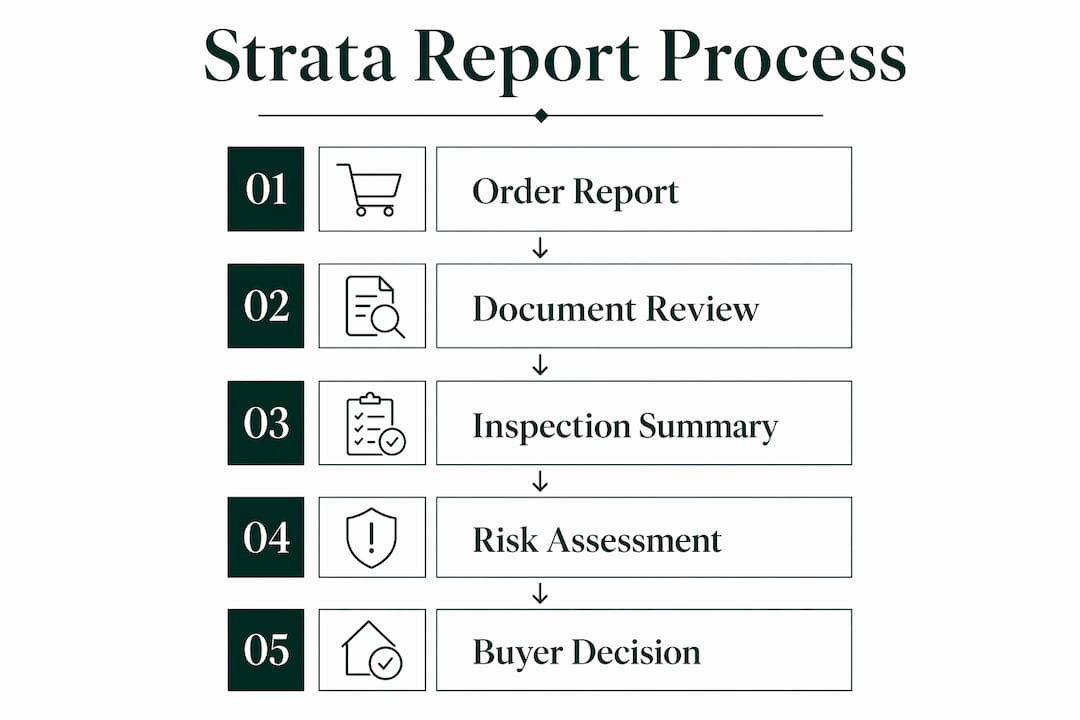
The source material comes from the strata manager’s files: AGM and committee minutes, financial statements, levy notices, insurance certificates, correspondence, and any defect or litigation records. Some records are originals; others are summaries prepared by the strata manager. Common gaps include missing invoices for approved works, incomplete minutes from committee meetings, and insurance policies without claims schedules.
Numbered steps in a typical strata inspection:
- Buyer or conveyancer places order with inspection firm, specifying the scheme and lot.
- Inspector requests access to strata manager records (physical or portal access).
- Inspector reviews documents covering the agreed timeframe (typically 3–5 years).
- Inspector prepares summary report with executive summary and attaches source documents.
- Report delivered to buyer, usually as a PDF bundle.
Timeline and cost comparison:
| Report type | Typical cost | Turnaround | Coverage |
|---|---|---|---|
| Statutory certificate | $80–$250 | 1–3 business days | Levy position and arrears only |
| Full strata records inspection | $250–$500 | 3–10 business days | Full records: minutes, financials, by-laws, insurance, litigation |
Buyers should obtain a report within 30 days of exchange and consider refreshing it before settlement if there is a significant gap between the two dates. A newly approved special levy or a fresh NCAT filing can appear in the weeks between exchange and settlement.
How to read a strata report — red flags that should change your approach
Most strata reports arrive as a large PDF. The executive summary, if one exists, is the right starting point. After that, go straight to the meeting minutes and work backwards from the most recent AGM.
Red flags and their likely implications:
- Repeated maintenance complaints (especially water ingress): Suggests a chronic defect that the owners corporation has not resolved. Ask for contractor reports and rectification orders.
- Motions approving special levies not yet billed: The most common hidden liability. Check the motion for the amount, the works scope, and whether it has been invoiced. Per-lot exposure can be estimated from the total levy divided by unit entitlements.
- Falling capital works fund balance: If the balance is declining against the 10-year plan, a special levy is likely within the plan period. Compare the balance to the plan’s projected expenditure.
- High levy arrears: A scheme where a material proportion of owners are in arrears has reduced capacity to fund repairs and may face cash-flow problems.
- Frequent or repeated insurance claims: Particularly for the same type of damage (water, fire, structural). Repeated claims can indicate a defect that has not been rectified and may affect insurability.
- Active litigation or NCAT proceedings: Can affect resale, financing, and the owners corporation’s ability to levy for legal costs.
- Inconsistent or missing minutes: Gaps in the record may indicate poor governance or records that have been withheld.
Pro Tip: To spot an ‘approved but not invoiced’ levy, search the minutes for the words “special levy” or “special resolution.” When you find a motion approving works, check whether the corresponding levy notice appears in the financial records. If it does not, the liability exists but has not yet been billed. Divide the total approved amount by the scheme’s unit entitlements to estimate your lot’s share.
When findings include active litigation, a significant funding shortfall, or multiple unresolved defect complaints, escalate to a strata lawyer or experienced conveyancer before exchange. A buyer’s agent can coordinate that referral and advise on whether the findings justify a price reduction, a conditional clause, or walking away entirely. The due diligence process for a strata property is more layered than for a freestanding house, and the strata report is only one part of it.
Cost, turnaround, and who orders the report
A full strata records inspection typically costs $250–$500, with turnaround commonly between 3 and 10 business days. A statutory certificate is cheaper and faster but covers only levy positions and arrears.
Practical points for buyers:
- The buyer usually pays for the strata records inspection, not the vendor.
- Orders are typically placed by the buyer’s conveyancer or solicitor, though a buyer’s agent can handle this directly.
- Sydney Property Buyers orders and coordinates strata inspections as part of the full service purchase process, ensuring the report is current and interpreted before exchange.
- A report dated more than 30 days before exchange may miss recently approved levies or new NCAT filings; consider refreshing it.
- Some buyers commission a second review before settlement if the settlement period is long (more than 60 days).
The cost of a strata inspection is modest relative to the purchase price of any Sydney apartment. A typical strata report that reveals a significant special levy or an active defect dispute can save buyers considerable expense over time.
What a strata report does not replace
A strata report reviews the owners corporation’s administrative and financial records. It does not physically inspect your lot, assess the structure of the building, or review the legal title. Treating it as a complete due diligence package is a common and costly mistake.
What you still need alongside a strata report:
- Building and pest inspection (AS 4349.1): Physically examines the interior of your lot and, where accessible, common areas. Identifies structural defects, moisture damage, and pest activity that the strata records will not disclose. Both reports are needed for comprehensive due diligence.
- Contract review by a conveyancer or solicitor: Reviews the contract of sale, vendor disclosure documents, and any special conditions. The strata report informs this review but does not replace it.
- Title search: Confirms ownership, encumbrances, caveats, and easements. A property title search is a separate check that the strata report does not cover.
- Independent valuation: Confirms the property’s market value independently of the asking price. Particularly relevant when strata report findings suggest the property carries undisclosed liabilities.
The strata report and the building and pest inspection work together. The strata report tells you about the scheme’s financial health and governance; the building inspection tells you about the physical condition of your lot. Neither substitutes for the other.
Practical steps: how to order a strata report and use the findings
Step-by-step process from order to exchange:
- Engage your conveyancer or buyer’s agent before making an offer, so the report can be ordered immediately once you identify a property.
- Place the order specifying the scheme name, lot number, and a records timeframe of at least 3–5 years.
- Request the report within 30 days of your intended exchange date to ensure it reflects the current position.
- Review the executive summary first, then the meeting minutes working backwards from the most recent AGM.
- Flag any red flags (special levies, litigation, funding shortfalls) and refer them to your conveyancer or strata lawyer.
- Use findings in negotiation: a material liability can justify a price reduction, a vendor contribution to an approved levy, or a conditional clause requiring the vendor to satisfy the levy before settlement.
- Refresh the report before settlement if the settlement period exceeds 60 days.
- Retain copies of all inspected documents and minutes for future reference, particularly if you plan to renovate or sell.
Sample questions to ask the strata manager or inspector:
- Has any special levy been approved at a general meeting but not yet invoiced?
- Are there any outstanding rectification orders or council notices affecting the building?
- Is there any current or pending litigation involving the owners corporation?
- What is the current capital works fund balance relative to the 10-year plan?
- Have there been any insurance claims in the past three years, and have the underlying defects been rectified?
When findings are material, your options are not limited to proceeding or walking away. A well-interpreted strata report gives you the information to negotiate from a position of knowledge, whether that means adjusting your offer, requesting a vendor disclosure, or inserting a conditional clause. That is where an experienced buyer’s agent adds real value: interpreting the findings, coordinating specialist advice, and translating the report into a negotiation position.
Key takeaways
A full strata records inspection is the single most important document a buyer of a strata titled property can commission before exchange, and the statutory certificate is not a substitute for it.
| Point | Details |
|---|---|
| Two documents, not one | The statutory certificate confirms levy positions only; the full records inspection covers minutes, financials, by-laws, insurance, and litigation. |
| Top three red flags | Special levies approved but not yet billed, underfunded capital works fund, and active litigation or NCAT proceedings. |
| Typical cost and turnaround | A full strata records inspection costs $250–$500 with a 3–10 business day turnaround; a statutory certificate costs $80–$250. |
| Statutory certificates are snapshots | They do not disclose approved motions in minutes that create future levy obligations. |
| Sydney Property Buyers | Orders, interprets, and acts on strata reports as part of full service due diligence for buyers across Inner West, Eastern Suburbs, Lower North Shore, and Eastern Beaches Sydney. |
A buyer’s agent’s view on strata reports and negotiation
Strata reports are where most buyers either protect themselves or leave money on the table. The buyers who get hurt are rarely the ones who skip the report entirely — they know they are taking a risk. The ones who get hurt are the buyers who receive a 300-page PDF, skim the executive summary, see no obvious alarm bells, and exchange. The liability was in the minutes on page 147.
The most useful thing a strata report does is not confirm that a building is fine. It is the tool that tells you how to negotiate. A special levy approved but not yet billed is not necessarily a reason to walk away — it is a reason to ask the vendor to contribute to it, or to adjust your offer by the estimated per-lot exposure. An underfunded capital works fund is not a dealbreaker if the building is priced accordingly. Active litigation is a different matter: it can affect financing, insurance, and resale, and it warrants a conversation with a strata lawyer before exchange, not after.
What I find buyers consistently underestimate is the value of reading the minutes rather than just the balance sheet. A capital works fund that looks healthy on paper can sit alongside two years of minutes showing the owners corporation has deferred the same roof repair three times. The numbers tell you the position today; the minutes tell you the trajectory.
Sydney Property Buyers coordinates the full due diligence process for clients, including ordering strata reports, flagging material findings, and translating those findings into a negotiation position. The report is a tool. Knowing how to use it is the part that actually protects the buyer.
Sydney Property Buyers handles strata due diligence for you
Strata due diligence is one of the areas where having the right representation makes a concrete difference to what you pay and what you avoid. Sydney Property Buyers orders and interprets strata reports, coordinates building and pest inspections, and uses the findings to shape your negotiation strategy — whether that means adjusting an offer, requesting a vendor contribution to an approved levy, or advising you to walk away before exchange.

Sydney Property Buyers operates across Inner West Sydney, Eastern Suburbs Sydney, Lower North Shore Sydney, and Eastern Beaches Sydney, serving many clients with a strong reputation. The agency’s full service process covers everything from strategy and off-market access through to settlement, with strata due diligence built into every purchase. If you have identified a property and need representation, the negotiation-only service is also available.
Contact Sydney Property Buyers on 1800 676 177 or at hello@sydneypropertybuyers.com.au to discuss your purchase.
This article is general information only and does not constitute legal, financial, or property advice. Confirm current legislative requirements with a qualified conveyancer, solicitor, or the relevant state authority for your specific situation.
Useful sources and further reading
- NSW Strata Schemes Management Act 2015 — the primary NSW legislation governing strata scheme management, records access (Section 182), and statutory certificates (Section 184).
- Buying a strata property — NSW Government — official NSW Government guidance for purchasers of strata titled properties, including the distinction between statutory certificates and full inspections.
- NSW Fair Trading — property inspections — practical guidance on pre-purchase inspection reports in NSW.
- Sydney Property Buyers — due diligence for buyers — explains the full scope of pre-purchase due diligence for Sydney property buyers, including strata and building inspections.
Recommended
- What is a property title search? Your 2026 guide
- What is a suburb report buyer’s agent in Sydney?
- Buyers agent suburb research methods: 2026 guide
- Types of buyers agent property assessments explained