An unconditional exchange is the moment a property contract becomes legally binding with no cooling-off rights remaining. From that point, neither party can walk away without severe financial consequences. Before you agree to go unconditional, you need formal finance approval in writing, a solicitor or conveyancer review, and completed building, pest, and strata checks.

The deposit becomes non-refundable. Both parties are locked to the settlement date. In many Australian states, risk of loss or damage to the property passes to the buyer at exchange. That is the full weight of what you are agreeing to.
Table of Contents
- What unconditional exchange means legally
- How unconditional exchange differs from conditional contracts
- When does a contract become unconditional in Australia?
- What actually happens at exchange
- What are the real risks for buyers who go unconditional?
- What should you confirm before agreeing to unconditional exchange?
- Can you exit an unconditional contract?
- Why do vendors ask for unconditional contracts?
- How a buyers agent reduces unconditional exchange risks
- Key takeaways
- The discipline that actually protects buyers
- Sydney Property Buyers: professional representation at every exchange
- Useful sources and next steps
What unconditional exchange means legally
An unconditional exchange occurs when both parties have signed identical copies of the contract, those contracts have been formally exchanged, all conditions have been satisfied or waived, and the cooling-off period has either ended or been waived. At that precise moment, the contract becomes legally binding with no further right to withdraw.
The immediate legal effects for buyers are:
- Deposit is non-refundable. The full deposit, commonly a percentage of the purchase price, is forfeit if you fail to complete.
- Settlement obligation is absolute. You must complete the purchase on the agreed date or face further legal action.
- Risk of loss passes to the buyer. In most Australian jurisdictions, if the property is damaged between exchange and settlement, the buyer bears that risk.
- Lender preparation begins. Your lender starts preparing loan documents; delays here do not excuse you from settlement.
The contrast with a cooling-off withdrawal is stark. During a standard cooling-off period, a buyer who withdraws typically forfeits only 0.25% of the purchase price. After an unconditional exchange, the full deposit is at risk, and the vendor can pursue additional damages on top.
| Situation | Buyer’s exposure |
|---|---|
| Withdrawal during cooling-off | 0.25% of purchase price (penalty only) |
| Withdrawal after unconditional exchange | Full deposit (5–10%) plus potential damages |
| Auction purchase (no cooling-off) | Full deposit on the day; no right to withdraw |
State mechanics vary. NSW has the most codified framework, centred on the five-business-day cooling-off period and the Section 66W waiver mechanism. Victoria and Queensland have their own cooling-off rules and vendor statement requirements, but the core principle is consistent across Australia: once exchange is unconditional, you are bound.
How unconditional exchange differs from conditional contracts
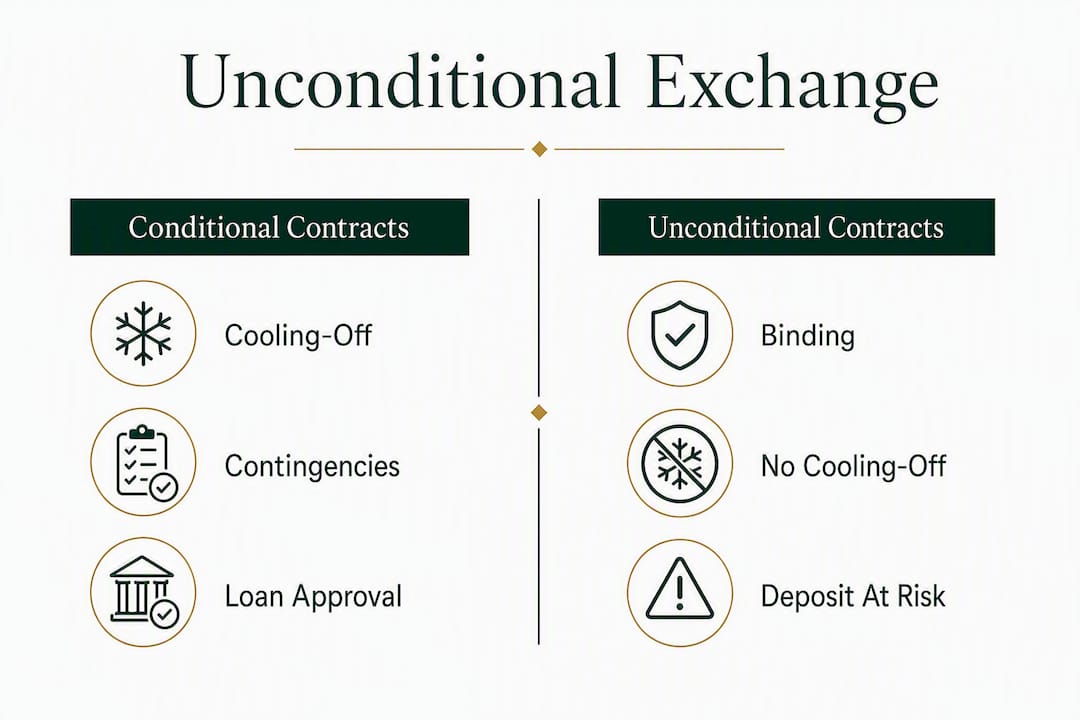
A conditional contract still has outstanding clauses, typically finance approval, building and pest inspection, or strata review, that must be satisfied before the contract becomes binding. If a condition fails, the buyer can usually terminate without penalty. An unconditional contract has none of those safety nets.

| Feature | Conditional exchange | Unconditional exchange |
|---|---|---|
| Cooling-off right | May apply (state-dependent) | None |
| Finance condition | Often included | Waived or already satisfied |
| Withdrawal cost | Low or nil if condition fails | Full deposit plus possible damages |
| Buyer’s risk level | Moderate | High |
| Typical use | Private treaty sales | Auctions, Section 66W, some developer sales |
Consider a concrete example. A buyer exchanges contracts with a finance clause. Their lender declines the loan. The buyer terminates under the finance condition and walks away without penalty. Now remove that clause. The same buyer, after an unconditional exchange, faces exactly the same lender refusal but has no exit. They must either find alternative finance or lose their deposit and potentially face a damages claim.
NSW property auctions are inherently unconditional. The fall of the hammer creates a binding contract on the spot. There is no cooling-off period, no finance clause, and no opportunity to renegotiate. Every inspection, every finance conversation, and every legal review must happen before you bid.
When does a contract become unconditional in Australia?
Three main scenarios produce an unconditional exchange in Australian property transactions.
Auctions. The most common path. When the hammer falls, the buyer pays a deposit on the day, often 10%, and exchange is immediate and unconditional. There is no cooling-off period and no conditions of any kind. Pre-auction due diligence is not optional; it is the only protection available.
Section 66W of the Conveyancing Act 1919 (NSW). For private treaty sales in NSW, a buyer’s solicitor or conveyancer can sign a Section 66W certificate that waives the five-business-day statutory cooling-off period. Exchange then becomes unconditional immediately. Solicitors provide this certificate only after confirming that finance, inspections, and legal review are complete. It is sometimes used as a competitive tool in multiple-offer situations, but it should never be provided before those checks are done.
Other scenarios:
- Off-the-plan and developer contracts, which often require unconditional exchange at signing with a long settlement period.
- Vendor requests for unconditional private-treaty exchanges in competitive markets, where sellers want certainty and buyers waive conditions to make their offer more attractive.
- Contracts where all conditions have been satisfied and the cooling-off period has expired naturally.
Pro Tip: In NSW, a Section 66W certificate is a strategic tool, not a formality. Treat it as the final step in a completed checklist, not the first move in a negotiation.
What actually happens at exchange
Exchanging contracts is the moment the transaction becomes legally complete. Two identical copies of the sale contract exist: one signed by the buyer, one by the vendor. Your solicitor or conveyancer arranges the physical or electronic exchange of those signed copies.
The practical sequence from exchange to settlement runs as follows:
- Exchange occurs. Signed contracts are swapped; deposit is paid or transferred to the agent’s trust account in cleared funds.
- Lender is notified. Your lender begins preparing formal loan documents and arranging a valuation if not already done.
- Solicitor/conveyancer begins pre-settlement checks. Title searches, council rates, water rates, and any outstanding notices are reviewed.
- Pre-settlement inspection. Usually conducted in the final days before settlement to confirm the property’s condition.
- Settlement. Funds are transferred, title is registered in the buyer’s name, and keys are released.
Settlement is typically set a number of weeks after exchange, though the contract specifies the date and it can be shorter or longer by agreement. At auction, the settlement period is stated in the contract of sale and is non-negotiable once exchange occurs.
Before exchange, buyers should have ready: the signed contract of sale, proof of identity, lender’s formal approval letter referencing the property, cleared deposit funds, and building insurance arranged to take effect from exchange.
What are the real risks for buyers who go unconditional?
The primary exposure is financial and it is substantial. If you cannot complete an unconditional contract, the vendor keeps your full deposit, which can represent a significant sum depending on the purchase price. The vendor can then pursue additional damages if they resell the property for less than your agreed price.
The most common trigger for this scenario is finance. A buyer secures pre-approval, exchanges unconditionally, and then discovers the lender’s valuation comes in below the purchase price. The lender reduces the loan offer. The buyer cannot make up the shortfall. The contract collapses.
Other risks include:
- A building inspection revealing structural defects after exchange, with no legal basis to exit.
- A strata report showing significant levies or building defects the buyer was unaware of.
- Personal circumstances changing between exchange and settlement (job loss, relationship breakdown) with no legal remedy.
Rescinding an unconditional contract is genuinely difficult. The grounds are narrow: vendor misrepresentation, fraudulent conduct, vendor breach of contract, or unconscionable conduct. Each requires evidence and legal action. Urgent legal advice is the first step, but even with strong grounds, litigation is slow and expensive.
Pro Tip: If your finance is pre-approval only, do not exchange unconditionally. Pre-approval is not a guarantee. A formal, property-specific approval letter from your lender is the only document that actually protects you.
What should you confirm before agreeing to unconditional exchange?
Work through this checklist in order. Do not exchange until every item is ticked.
- Formal, unconditional finance approval in writing. This must reference the specific property and purchase price. A pre-approval or indicative approval is not sufficient; lenders can and do decline after exchange when the valuation does not support the price.
- Completed building and pest inspection. Engage a licensed inspector before exchange. Allow 3–5 business days to book, conduct, and review the report.
- Strata report reviewed (for strata properties) or Section 32/vendor statement reviewed (Victoria/Queensland). Check for outstanding levies, special levies, building defects, and litigation.
- Solicitor or conveyancer review of the contract. Your legal adviser must review the contract, advise on any unusual clauses, and confirm whether a Section 66W certificate is appropriate in NSW.
- Cleared deposit funds available. The deposit must be in cleared funds, ready to transfer on the day of exchange.
- Building insurance arranged. Arrange cover to take effect from exchange, not settlement. In most Australian states, risk passes to the buyer at exchange.
For auction buyers, all six steps must be completed before the auction day. Allow at least 10–14 business days before the auction to book inspections, obtain a formal finance approval, and have the contract reviewed. Buyers who rush this process are the ones who end up losing deposits.
Pro Tip: Ask your solicitor or conveyancer to review the contract as soon as it is available, not the day before the auction. Most agents will provide the contract of sale a week or more before auction day.
Can you exit an unconditional contract?
Rarely, and never easily. Once exchange is unconditional, the legal grounds for rescission are narrow and the evidentiary burden is high.
Grounds that may allow exit include:
- Vendor misrepresentation. If the vendor or their agent made a false statement of fact that induced you to exchange, you may have grounds to rescind. Proving this requires clear evidence.
- Fraudulent conduct. A higher bar than misrepresentation; requires deliberate deception.
- Vendor breach of contract. If the vendor fails to meet their obligations under the contract, you may be entitled to terminate.
- Unconscionable conduct. Rare and fact-specific; requires showing the vendor took advantage of a serious disadvantage on your part.
If you believe any of these grounds exist, contact a solicitor immediately. Do not wait. The practical options are: negotiate a mutual rescission with the vendor (they may agree if they have another buyer), seek urgent legal advice on rescission grounds, or accept the loss and attempt to mitigate damages. Litigating is costly, slow, and uncertain. Prevention is the only reliable strategy.
Why do vendors ask for unconditional contracts?
Certainty. A vendor with an unconditional contract knows the sale will complete. There is no risk of the buyer pulling out on a finance or inspection clause, no extended negotiation, and no uncertainty around settlement.
Developers and vendors in competitive markets use unconditional terms to lock in settlement and avoid the risk of a buyer walking away. In a multiple-offer situation, a buyer who offers unconditional terms is signalling commitment. That can be decisive when a vendor is choosing between two similar offers.
The negotiation implication is direct: a buyer accepting unconditional terms is absorbing risk that would otherwise sit with the vendor. That concession has value. In a private treaty context, a buyer who agrees to go unconditional via Section 66W is entitled to ask for something in return, whether that is a price reduction, an earlier settlement, or inclusion of chattels. A property negotiation strategy that accounts for this dynamic produces better outcomes than simply agreeing to vendor terms.
Common scenarios where vendors push for unconditional exchange:
- Hot auction markets where competition is high and vendors hold leverage.
- Off-the-plan launches where developers need certainty across multiple simultaneous sales.
- Vendor preference in private treaty multiple-offer situations.
- Vendors who have already purchased elsewhere and need settlement certainty to fund their own purchase.
How a buyers agent reduces unconditional exchange risks
The specific risks of going unconditional, finance failure, missed defects, rushed legal review, are all manageable with the right preparation. A buyers agent coordinates that preparation so nothing falls through the gap.
Sydney Property Buyers provides the following as part of its full-service acquisition:
- Coordinated legal review. The team works with your solicitor or conveyancer to ensure the contract is reviewed well before auction day or exchange.
- Arranged building, pest, and strata inspections. Inspections are booked and conducted independently of open home schedules, seven days a week.
- Finance coordination. Buyers are guided to secure formal, property-specific lender approval before any unconditional commitment is made.
- Auction bidding. Licensed representation at auction, with a clear strategy and a firm limit, removes the emotional pressure that leads buyers to bid beyond their finance approval.
- Settlement support. The team monitors the post-exchange timeline and coordinates pre-settlement checks.
Sydney Property Buyers has secured numerous properties for clients across Inner West Sydney, Eastern Suburbs, Lower North Shore, and Eastern Beaches, with a strong reputation and average savings on purchase price. A notable portion of purchases are secured off-market, which means many clients avoid the unconditional pressure of a public auction entirely.
Pro Tip: Licensed buyer representation changes the practical timeline before exchange. When a buyers agent is coordinating inspections, legal review, and finance in parallel, the 10–14 days of pre-auction preparation becomes a managed process rather than a scramble.
Key takeaways
An unconditional exchange is legally binding the moment it occurs, and the deposit is at risk from that point forward.
| Point | Details |
|---|---|
| Contract is immediately binding | Once unconditional, neither party can withdraw without losing the deposit or facing damages. |
| Deposit exposure is 5–10% | You risk forfeiting 5–10% of the purchase price (the full deposit) as the minimum penalty for failing to complete. |
| Section 66W waives cooling-off in NSW | A solicitor-signed certificate removes the five-business-day cooling-off right for private treaty sales. |
| Formal finance approval is non-negotiable | Pre-approval is not sufficient; you need a written, property-specific approval before exchanging unconditionally. |
| Sydney Property Buyers | Provides coordinated pre-exchange due diligence, auction bidding, and settlement support to reduce unconditional risk. |
The discipline that actually protects buyers
The buyers who lose deposits are rarely reckless. They are usually well-intentioned people who moved one step too fast: they had pre-approval but not formal approval, or they skipped the building inspection because the property looked immaculate, or they signed a Section 66W certificate because the agent said it was standard practice.
What I see consistently is that the risk is not the unconditional exchange itself. It is the absence of a disciplined pre-exchange process. Buyers who treat formal finance approval, inspections, and legal review as a checklist to complete before any unconditional commitment, rather than paperwork to sort out afterwards, almost never lose deposits. The buyers who get into trouble are the ones who reverse that order.
The practical discipline is simple: never agree to go unconditional until every item on the checklist is done. Not nearly done. Done. In a competitive market, that discipline can feel like a disadvantage. In practice, it is the only thing that keeps your deposit safe.
Sydney Property Buyers: professional representation at every exchange
Unconditional exchange is the highest-stakes moment in any property purchase. Sydney Property Buyers is a fully licensed Sydney buyers agency that handles the entire pre-exchange process on your behalf, so you arrive at that moment with every box ticked.
The agency’s full-service acquisition covers strategy, property search (including off-market opportunities not available to the public), independent appraisal, building and pest coordination, legal review, auction bidding, and settlement management. For buyers who have already identified a property, the Negotiation Only service provides professional representation to secure the best price and terms. Directed by Kristan Johnson, 2024 Outstanding Buyers Agent of the Year (Inner West Local Business Awards), the agency holds NSW Licence 20456819 and operates across Inner West Sydney, Eastern Suburbs, Lower North Shore, and Eastern Beaches.
To discuss how Sydney Property Buyers can manage your next purchase from due diligence to settlement, call 1800 676 177, email hello@sydneypropertybuyers.com.au, or visit the services page to learn more.
Useful sources and next steps
The following resources are authoritative starting points for buyers who want to check legislation, understand their rights, or find professional help.
| Resource | What it contains |
|---|---|
| NSW Government: contracts and deposits | Plain-language explanation of exchange, deposit requirements, and cooling-off rights for NSW buyers |
| NSW Government: buying at auction | Official guidance on auction mechanics, deposit requirements, and the absence of cooling-off at auction |
| Conveyancing Act 1919 (NSW), Section 66W | Primary legislation governing the waiver of cooling-off rights in NSW private treaty sales |
| Eastside Legal: unconditional exchange NSW | Detailed legal explainer on the mechanics and consequences of unconditional exchange in NSW |
To find a licensed conveyancer or solicitor in Sydney, search the NSW Fair Trading register or ask your buyers agent for a referral. For a licensed buyers agent, the Real Estate Institute of NSW (REINSW) maintains a public directory.
Suggested search terms for further research:
- “Section 66W certificate NSW conveyancer”
- “unconditional exchange cooling-off NSW”
- “licensed buyers agent Sydney Inner West”
- “building and pest inspection Sydney before auction”
This article is general information only and does not constitute legal, financial, or conveyancing advice. Confirm the current rules with a licensed solicitor, conveyancer, or qualified professional for your specific situation.
Recommended
- What is a seller’s market? A guide for Sydney buyers
- What does a buyer’s market mean in sydney?
- Why a licensed buyer’s agent matters in Sydney
- Why a buyer’s agent suits interstate buyers in Sydney