A buyer’s agent checks strata records to uncover costs, governance failures and defect histories that the vendor has no obligation to volunteer and that a Section 184 certificate alone will never reveal. Get this step wrong and you can inherit a five-figure special levy the day after settlement.
Three categories of risk drive the review:
- Financial risk. Sinking fund shortfalls, rising levies and passed-but-not-yet-invoiced special levies can add thousands to your cost of ownership within months of purchase.
- Legal and governance risk. Restrictive by-laws, Fair Trading enforcement actions and active tribunal proceedings affect how you can use the property and what it will cost to resolve disputes.
- Building and defect risk. Repeated insurance claims, builder rectification disputes and deferred maintenance signal structural or waterproofing problems that may never fully resolve.
When a records review surfaces a red flag, the immediate consequences are concrete: negotiate a price reduction, require the vendor to pay a pending levy, delay exchange until the issue is clarified, or consider withdrawing from the purchase.
Pro Tip: Always refresh a strata records inspection within 30 days of exchange. A report ordered early in negotiations can miss a special levy passed at a committee meeting held the week before you sign.
Table of Contents
- What strata records actually are (and why the Section 184 certificate is not enough)
- What a buyer’s agent examines in the strata records
- Red flags in strata records and what they mean for your money
- How a buyer’s agent obtains and reviews strata records
- How long it takes and what it costs
- What to do after the records review
- How Sydney Property Buyers reviews strata records
- Key takeaways
- The records tell you what the vendor won’t
- Sydney Property Buyers handles strata due diligence for you
- Useful sources
What strata records actually are (and why the Section 184 certificate is not enough)
A strata records inspection, sometimes called a strata search or strata title inspection, is a review of the documents held by the owners corporation or its strata manager. The Section 184 certificate is a short, prescribed disclosure that gives a snapshot of current levies and basic financial details. It is useful, but it typically runs to a few pages and omits the meeting minutes and correspondence where the real risks hide.
A full records inspection covers the raw source material: financial statements, meeting minutes from AGMs, EGMs and committee meetings, the sinking fund and 10-year capital works plan, registered by-laws, insurance policies, claims history and correspondence with councils, contractors and regulators. Some providers add an executive summary, but the documents themselves are the authoritative record. An executive summary without the underlying minutes is like reading a book’s blurb and calling it research.
Recent NSW disclosure requirements expanded what the Section 184 certificate must include, adding Fair Trading enforcement actions and meeting records for the prior year. That is a meaningful improvement, but it still does not replace a full inspection. Always check the issue date on any certificate and request a fresh one if it predates April 2026 or if negotiations have run for more than a few weeks.
What a buyer’s agent examines in the strata records
Industry guidance recommends starting with the sinking fund and meeting minutes because they most clearly indicate likely future levies. A structured review covers the following, in rough priority order:
- Sinking fund vs capital works plan. Compare the current fund balance against the 10-year forecast. A shortfall signals an imminent special levy. If the building needs a $500,000 roof replacement and the fund holds $12,000, every owner will be hit.
- Routine levies and levy trajectory. Rising levies over three to five years indicate escalating costs. Flat levies in an ageing building can mean the committee is under-budgeting.
- Passed special levies or motions. A levy approved at a general meeting but not yet invoiced is a liability you inherit on settlement. This is the most common expensive surprise in strata purchases.
- Levy arrears across the scheme. High arrears mean the owners corporation is collecting less than it budgeted, which strains the admin fund.
- Meeting frequency and quorum. Repeated failed quorums indicate disengaged owners and stalled decision-making — a reliable early warning sign for governance failure.
- Litigation and disputes. Active NCAT proceedings, tribunal matters or legal correspondence with solicitors can run for years and cost six figures.
- Insurance policy limits and claims history. Repeated water-damage claims may indicate an unresolved defect. Underinsurance leaves every owner exposed.
- Building defects and builder rectification. Active litigation against a developer for cladding, waterproofing or structural defects is a serious flag for newer buildings.
- Correspondence. Letters from councils, fire authorities or the NSW Building Commissioner often contain compliance orders not obvious from the minutes alone.
- By-law restraints. Restrictions on pets, short-stay letting or renovations can directly contradict what the listing advertises.
- Developer handover matters. For buildings under 10 years old, check whether defect rectification from the original developer is complete or still contested.
| Item reviewed | What it signals | Buyer impact |
|---|---|---|
| Sinking fund vs capital works plan | Fund sufficiency for planned repairs | Shortfall → risk of imminent special levy |
| Passed special levy motions | Imminent owner contribution | Inherit liability on settlement |
| Levy arrears | Scheme cash-flow stress | Admin fund shortfall, rising levies |
| Litigation / NCAT proceedings | Legal cost exposure | Ongoing costs, resale difficulty |
| Insurance claims history | Recurring defects | Lender concerns, resale risk |
| By-laws | Use restrictions | Affects rental yield, lifestyle use |
Under Section 182 of the Strata Schemes Management Act 2015 (NSW), a prospective purchaser (or their authorised representative) has a legislated right to request inspection of the owners corporation’s records. The request must be in writing and accompanied by a prescribed fee.

Red flags in strata records and what they mean for your money
The most dangerous red flags are the ones that look minor in isolation. Here are the patterns that matter most:
- Recent special levy approvals or motions. Even a motion that was discussed but not yet voted on can indicate an imminent large contribution.
- Low sinking fund relative to planned works. An underfunded capital works plan is the single most reliable predictor of a future special levy.
- Repeated insurance claims for water damage. One claim may be a one-off. Three claims in five years usually means an unresolved waterproofing defect.
- Active defect litigation against the builder. These cases can drag on for years, consume strata funds and depress resale values.
- Fair Trading or regulator enforcement actions. A scheme under regulatory scrutiny has governance problems that rarely resolve quickly.
- Persistent levy arrears by owners. When a significant proportion of owners are in arrears, the scheme struggles to fund routine maintenance.
- Dysfunctional governance. No meetings held, repeated quorum failures or the same unresolved complaints appearing year after year.
- By-laws that contradict the listing. A listing that advertises short-stay rental potential in a building whose by-laws prohibit it is a material misrepresentation.
A special levy passed at a general meeting but not yet invoiced is a liability that transfers to the buyer on settlement. The Section 184 certificate will not show it. Only a full records inspection of the minutes will. This is why a buyer’s agent treats the records review as non-negotiable, not optional.
When to negotiate vs when to walk away. A low sinking fund in an otherwise well-governed scheme is usually a negotiation lever: ask the vendor to contribute to the fund or reduce the price by the likely levy amount. Active defect litigation with no resolution in sight, or a building under a compliance order, is closer to a deal-breaker. The distinction is whether the problem is quantifiable and bounded, or open-ended and contested.
How a buyer’s agent obtains and reviews strata records
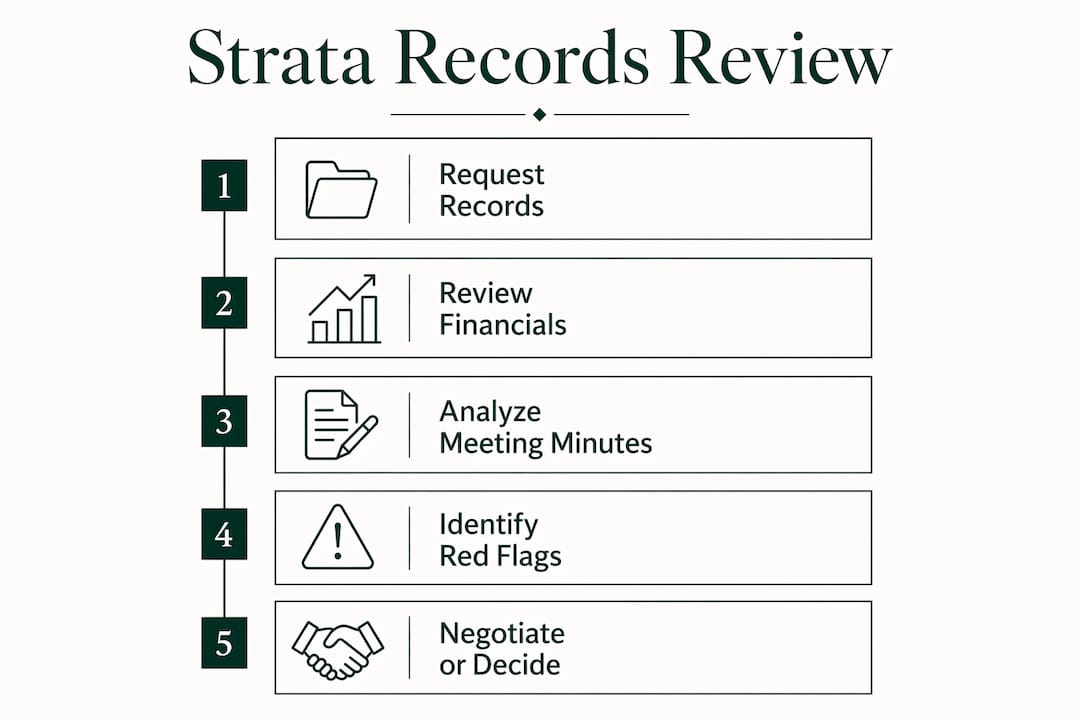
The process follows a clear sequence, and knowing where delays occur helps you plan your due diligence window.
- Instruct your agent or conveyancer. At the point of serious interest, instruct your buyer’s agent to initiate the records process. Do not wait until after exchange.
- Request the Section 184 certificate with the contract. The vendor’s solicitor typically attaches this to the contract for sale. Check the issue date and request a fresh one if it is outdated.
- Commission a full Section 182 inspection. Under Section 182 of the Strata Schemes Management Act 2015, a written request plus a prescribed fee gives your agent or a specialist strata search provider access to the owners corporation’s records. This is the buyer-commissioned inspection that goes beyond the statutory certificate.
- Agent reviews 5–7 years of minutes and correspondence. The agent or specialist analyst reads the raw documents, flags sinking fund adequacy, special levy motions, litigation and governance indicators.
- Triage flagged issues to the conveyancer. Rather than paying your conveyancer to read every page of a 300-page report, the agent flags specific items for legal interpretation. Conveyancer review remains essential for by-laws, special levy obligations and litigation risk. Automated analysis tools can provide a quick initial scan before escalating to paid professional time.
- Refresh the report before exchange. If negotiations extend beyond a few weeks, commission a fresh inspection. Records change frequently, and a report more than 30 days old can miss newly passed levies.
Typical turnaround. Strata managers generally respond to Section 182 requests within a few business days, though records held offsite or managed by a large firm can take longer. A specialist strata search provider typically delivers within 3–10 business days. The Section 184 certificate must be issued within 14 days under NSW law.
Pro Tip: Ask the strata manager whether any general meetings are scheduled in the next 30 days. A meeting on the horizon means new motions could be passed before exchange.

How long it takes and what it costs
Budget for three cost items, not one.
- Section 184 statutory certificate: typically in the range of $80–$250, ordered by your conveyancer as part of standard pre-purchase searches.
- Full strata records inspection (Section 182): commonly $250–$500 depending on the provider and scope of the search.
- Conveyancer review of flagged issues: an additional $300–$500 on top of standard conveyancing fees for a complex or high-value purchase.
| Item | Typical cost | Typical turnaround |
|---|---|---|
| Section 184 statutory certificate | $80–$250 | Up to 14 days (NSW statutory maximum) |
| Full Section 182 records inspection | $250–$500 | 3–10 business days |
| Conveyancer review of flagged items | $300–$500 (additional) | Depends on complexity |
The combined outlay for both reports is a fraction of what a single undisclosed special levy can cost. Skipping the full inspection to save some money is one of the more expensive decisions a unit buyer can make.
From April 2026, the expanded Section 184 certificate includes more information than before, but the cost structure above remains broadly the same. Always confirm current fees with your provider, as the prescribed fee for the statutory certificate is set under the Strata Schemes Management Regulations 2016.
What to do after the records review
Once your buyer’s agent has completed the review and flagged the key issues, the following steps protect your position before exchange.
- Get clarification from the strata manager. If a motion is ambiguous or a levy amount is unclear, write to the strata manager directly for confirmation. Do this before exchange, not after.
- Instruct your conveyancer on flagged items. Pass the agent’s triage notes to your conveyancer and ask for specific legal advice on special levy obligations, by-law compliance and any litigation risk.
- Negotiate price or request a vendor levy contribution. A pending special levy is a legitimate basis for a price reduction or a vendor credit at settlement. Your buyer’s agent should quantify the likely levy and use it as a negotiation lever.
- Require an updated Section 184 certificate. If the certificate attached to the contract predates April 2026 or is more than a few weeks old, request a fresh one before exchange.
- Consider conditional exchange. For serious issues, a conditional exchange clause or a longer cooling-off period gives you time to obtain further specialist advice before going unconditional.
- Notify your mortgage broker. If a major levy or active defect litigation surfaces, tell your broker immediately. Lenders can decline to finance units in buildings with significant unresolved defects or active litigation, and some insurers apply restrictions to schemes with repeated claims histories.
Conveyancer review is the right tool for interpreting legal consequences. Your buyer’s agent handles the financial and governance triage; your conveyancer translates the flagged items into contract protections and legal obligations.
How Sydney Property Buyers reviews strata records
Sydney Property Buyers integrates strata records review into every full-service acquisition as a standard component of due diligence, not an optional add-on. The review covers a minimum of five years of meeting minutes, financial statements, correspondence and insurance records, with the period extended to seven years for older buildings or where early minutes flag unresolved issues.
The methodology focuses on four metrics: sinking fund balance against the capital works forecast, frequency and size of special levies over the review period, meeting attendance and governance indicators (quorum rates, deferred resolutions), and correspondence with external agencies. Where automated tools provide a useful initial scan, the agent reviews the underlying documents directly rather than relying on a summary alone.
Kristan Johnson, director and licensed real estate agent, holds NSW Licence 20456819 and was named 2024 Outstanding Buyers Agent of the Year at the Inner West Local Business Awards. Sydney Property Buyers has secured many properties for clients across the Inner West, Eastern Suburbs, Lower North Shore and Eastern Beaches, achieving significant savings and a notable proportion of off-market purchases. The agency carries a high Google rating.
Where the records review surfaces a material issue, the finding feeds directly into the negotiation strategy. A quantifiable liability, such as a known pending levy, becomes a price adjustment. An open-ended risk, such as active defect litigation with no resolution timeline, triggers a recommendation to walk away or to exchange conditionally with specific protections in place. The due diligence process is designed so that buyers pay conveyancers only to interpret flagged legal issues, not to read every page of a long report from scratch.
Key takeaways
A buyer’s agent checks strata records because the Section 184 certificate alone cannot reveal passed special levies, governance failures or defect litigation that will cost you money from the day you settle.
| Point | Details |
|---|---|
| Section 184 is not enough | The statutory certificate omits meeting minutes and correspondence where the real financial risks hide. |
| Minutes and sinking fund first | Start with the capital works plan and AGM minutes to identify levy risk and governance quality quickly. |
| Statutory right under Section 182 | A written request plus a prescribed fee gives any prospective buyer access to the owners corporation’s full records. |
| Refresh before exchange | A report more than 30 days old can miss a newly passed special levy; always refresh if negotiations run long. |
| Sydney Property Buyers | Integrates a full strata records review into every acquisition, using findings directly to negotiate price or structure conditional exchange. |
The records tell you what the vendor won’t
The most instructive thing about a strata records review is not what it finds in the worst cases. It is what it finds in the ordinary ones.
A scheme that looks perfectly presentable at an open home can have three years of deferred maintenance sitting in the minutes, a sinking fund that covers roughly half of the capital works forecast, and a committee that has not achieved quorum at the last two AGMs. None of that appears on the Section 184 certificate. None of it is visible from the balcony.
The judgement call that separates a thorough review from a superficial one is knowing when a red flag is a negotiation lever and when it is a reason to leave. A low sinking fund in a well-governed scheme with a clear remediation plan is manageable. The same low fund in a scheme where the committee cannot get a quorum and the strata manager has changed twice in three years is a different problem entirely. The documents tell you which one you are looking at, but only if you read them with that question in mind.
Buyers who focus on the apartment and skip the governance review are, in effect, buying the kitchen and ignoring the building. Long-term value in strata depends far more on a well-funded, well-run scheme than on the quality of the appliances.
Sydney Property Buyers handles strata due diligence for you
Strata records are dense, and the risks are rarely labelled clearly. Sydney Property Buyers offers exclusive buyers agent representation that includes a full strata records review as part of every purchase, coordinated alongside building inspections, independent appraisal and negotiation strategy.

The full-service offering covers strategy, property search (on-market and off-market), strata and due diligence review, negotiation, auction bidding and settlement management across the Inner West, Eastern Suburbs, Lower North Shore and Eastern Beaches. A Negotiation Only service is available for buyers who have already identified a property. The average purchase time from engagement to settlement is around two months.
To instruct Sydney Property Buyers, a small retainer is required at engagement, deducted from the final fee on completion. Call 1800 676 177, email hello@sydneypropertybuyers.com.au, or visit the office at 79 New Canterbury Rd, Petersham NSW 2049. NSW Licence 20456819.
Useful sources
- Strata Schemes Management Act 2015 (NSW) — Section 182: The primary legislation governing the right to inspect owners corporation records. Use this to confirm the written-request process and prescribed fee framework.
- NSW Government — Buying a strata property: Official guidance on what a strata search report covers and when to obtain one.
- StrataChecks — NSW strata law changes April 2026: Explains the expanded Section 184 certificate requirements effective from 1 April 2026.
- StrataChecks — How to read a strata report in NSW: Practical guidance on reading priority, automated analysis tools and when to escalate to a conveyancer.
- Report Decoded — Strata report explained: Explains the difference between the Section 184 certificate and a full inspection, and covers typical costs.
- Australian College of Professionals — Inspecting strata records: Overview of what a strata inspection covers, who may request one, and the legislative framework under Section 182.
This article is general information only and does not constitute legal, financial or conveyancing advice. Confirm current fees, statutory requirements and your specific circumstances with a licensed conveyancer or solicitor before exchange.
Recommended
- Why a buyer’s agent suits interstate buyers in Sydney
- Why a buyer’s agent reviews contract: Sydney guide
- What is a suburb report buyer’s agent in Sydney?
- Why a buyer’s agent attends inspections in Sydney