A good property inspection checklist works in three passes: a quick look at the open home, a close look at the building and the paperwork before you are bound, and a final check before settlement. This guide gives you the list for a house and for an apartment, explains where your own eyes stop being enough, and shows how to turn what you find into a lower price or a walk-away. We are a Sydney buyers agency, and inspecting properties is part of how we protect buyers every week.
TL;DR
- Inspect in three passes: the open home walk-through, the building and pest report plus contract review, and the pre-settlement check.
- For houses, focus on water, structure, roof, subfloor and wiring. For apartments, add the strata records, common property and building defects.
- A visual check by you is a screening tool. A licensed building and pest inspector and your solicitor or conveyancer make the findings reliable.
- In NSW, the standard cooling-off period for established residential property is five business days from exchange, so book your inspections before you exchange.
- Use defects as negotiation evidence: get quotes, rank by seriousness, and put one clear request in front of the vendor.
Table of Contents
- Why a Sydney checklist differs from the ones you find online
- Pass one: the open home walk-through
- Apartment inspection checklist
- Pass two: the professional inspection before you commit
- Pass three: the pre-settlement inspection
- Using what you find in negotiation
- Where a buyers agent fits
- Work with a buyers agent from the first inspection
- FAQ
- Sources
Why a Sydney checklist differs from the ones you find online
Most checklists that rank for this phrase are written for the United States. They assume a signed contract, then a home inspection, then a repair negotiation. They refer to things that do not exist here, such as the way US inspection contingencies work.
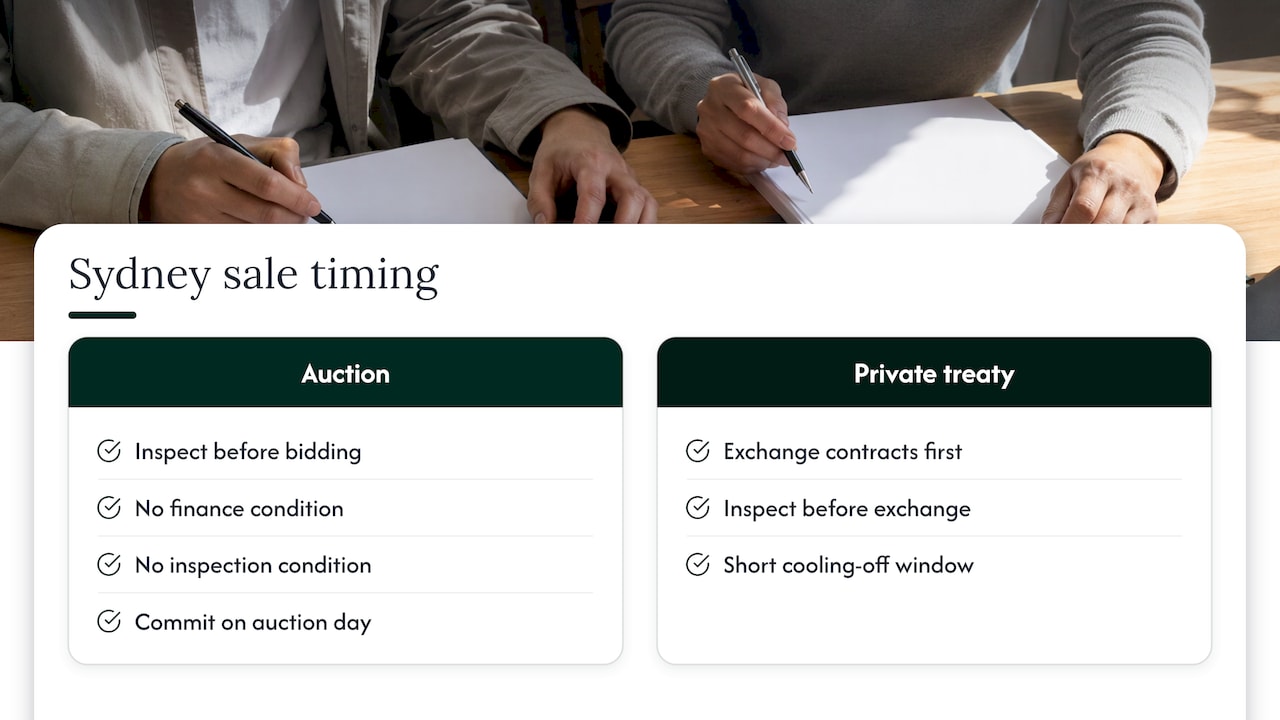
Sydney buyers face a different sequence. Many homes sell at auction, where you commit on the day with no finance or inspection condition. For private treaty sales, you normally exchange contracts and then have a short cooling-off window. So the inspection has to happen before you bid or exchange, usually in a few days, often with other buyers circling.
That timing is the whole reason a checklist matters. You are not building a wish list. You are deciding, quickly, what to spend inspection money on and which properties to drop.
Pass one: the open home walk-through
You have 15 to 30 minutes. Your aim is to eliminate properties with obvious problems, and to note what to put to a licensed inspector on the ones you keep. Bring a phone torch, a small level app or a marble, and take photos of everything you note.
Outside a house
- Roof: look for cracked, slipped or missing tiles, rusted sheeting and sagging ridge lines. Check gutters and downpipes for rust, sagging and overflow marks on the fascia.
- Walls: look for cracks. Hairline vertical cracks in render are common. Wide cracks, cracks that run diagonally from corners of doors and windows, or stepped cracks following the mortar lines deserve a closer look. Guidance from a US real estate regulator advises consulting a structural engineer about suspicious foundation cracks, and the same logic applies on any reactive clay soil.
- Drainage: stand in the yard and note where water would run. The ground should fall away from the house. Look for damp patches, pooling and soil piled against brickwork.
- Retaining walls and fences: leaning, bulging or cracked walls can be costly. Sydney’s sloping blocks make this a frequent issue.
- Trees: large trees close to the house or drains can affect footings and pipes.
- Driveways, paths and slabs: wide or uneven cracks can signal movement.
Inside a house
- Water stains and smell: look at ceilings, the corners of rooms, around windows and below bathrooms. A musty odour, fresh paint on one patch of ceiling or a dehumidifier running during the open home are all worth noting.
- Doors and windows: open and close several. Sticking doors and sashes that will not shut can point to movement or moisture.
- Floors: walk them. Bounce, slope, gaps and soft spots matter. A marble that rolls across a room tells you something.
- Kitchen: check cabinets under the sink for swelling and water damage, test the taps and range hood, and note the age of appliances. One US guide suggests that appliances over 10 to 15 years may be near the end of their useful life.
- Bathrooms: check grout and silicone, tile lift, drainage speed, water pressure, ventilation and mould around the ceiling and shower. Press on the floor near the toilet for softness.
- Electrical: test light switches and power points, and look at the switchboard. Old ceramic fuses, taped wires or scorch marks are warning signs.
- Safety: note smoke alarms, and any exposed wiring.
Roof space and subfloor
You will usually not be allowed into these at an open home. That is exactly why they go to a licensed inspector. Ask the agent about the roof space and subfloor access, because a property where access is blocked or refused is itself information.
Apartment inspection checklist
With an apartment, you are buying your unit and a share of the building. The unit can look perfect while the building has a problem that will be billed to every owner.
Inside the unit
- Balcony: check the balustrade is solid, the waterproofing looks intact and the floor falls away from the door. Look for rust, cracked tiles and staining on the ceiling of the unit below, if visible.
- Walls and ceilings: look for water stains, bubbling paint and cracking, especially around windows, bathrooms and the top-floor ceiling.
- Wet areas: test shower pressure and drainage, and look for mould and lifted tiles. Cracked or bubbling paint near a bathroom wall is a common clue to waterproofing failure.
- Windows and doors: check seals, locks, and that sliding doors run freely.
- Noise: stand quietly for a minute. Listen for neighbours, traffic, lifts and plant rooms.
- Services: switch on the air conditioning, exhaust fans and hot water, and note where the hot water system sits and how old it is.
Common property
A Canadian government condominium guide lists lobbies, lifts, corridors, stairwells, car parks and balcony railings as the shared elements to examine, and the same list works in Sydney. Look at how clean and maintained they are. Peeling paint, stained ceilings in the car park, rusted railings and cracked facades suggest deferred maintenance.
The paperwork that matters more than the walk-through
In a strata building, the records often tell you more than the inspection. A strata report summarises the levies, sinking fund, meeting minutes, disputes and building defects. Read what a strata report is before you rely on one, and see what buyers must check first on building defects in NSW strata. Our guide to why a buyers agent checks strata records explains which clauses in the minutes to look for.
Pass two: the professional inspection before you commit
This is where the real findings come from. Book a licensed building inspector and a timber pest inspector, often combined into one visit, and have your solicitor or conveyancer review the contract for sale, which is the legal step that sits alongside it.
What a professional inspection is, and is not
A home inspection reviews the visible and accessible parts of a property. Regulators describe it as not an appraisal, not a guarantee of code compliance and not technically exhaustive. The American Society of Home Inspectors’ standard adds that inspectors are not required to identify concealed conditions or latent defects. Sydney inspections work to the same principle: they report what the inspector can see and reach on the day.
So read the scope of the report before you rely on it. If roof space, subfloor or a certain structure was not accessible, the report will say so, and that gap is your risk. Ask the inspector what they could not inspect, and whether a specialist should look, such as a structural engineer for suspicious cracking, a licensed electrician for old wiring, or a hydraulic or drainage specialist for pipes.
Timing: the cooling-off window
In NSW, the standard cooling-off period for established residential property is five business days, ending at 5pm on the fifth business day after exchange. It is not a substitute for an inspection: it exists to give you a short exit, and leaving may cost you money. Your solicitor or conveyancer can tell you exactly how it applies to your contract and whether it can be waived or shortened. Our due diligence checklist for Sydney’s five-day cooling-off shows what to complete in that window.
If you are bidding at auction, the building report has to come first. We explain why in what to check before bidding at a Sydney auction.
Water: the defect behind most others
Moisture is the thread through most expensive findings: rotting framing, mould, cracked render, failing balconies and damp subfloors. Moisture in a basement or crawlspace, or stains on a ceiling, warrant further examination. A rainy-season home checklist shows the same logic: after heavy rain, walk the gutters, drains and ceilings for signs of ingress, then ask when the property last had a wet spell.
In Sydney, the best time to see a property’s water problems is after heavy rain. If your inspection day is dry, ask the vendor’s agent for any past reports and whether leaks have occurred.
Ranking what you find
Not every item in a report matters equally. A simple way to sort them:
| Priority | Examples | What to do |
|---|---|---|
| Safety | Faulty wiring, missing smoke alarms, unsafe balustrades, asbestos suspected | Get a specialist opinion and a quote before you proceed |
| Structural | Active movement, stepped or wide cracks, sagging roof frame, failing retaining walls | Engineer’s report; consider the price impact or walk away |
| Water | Leaks, rising damp, failing waterproofing, poor drainage | Quote the repair and negotiate |
| Maintenance and cosmetic | Worn paint, old carpets, tired fittings | Budget for it, but do not pay for it twice in the price |
An inspector’s standard also separates real defects from age. A system near the end of its normal life is not in itself a material defect, so a 20-year-old hot water system is a budget line, not a reason to walk.
Pass three: the pre-settlement inspection
Before you pay the balance, you inspect again, usually within days of settlement. You are checking that the property is in the condition you contracted for, that anything the vendor agreed to fix is fixed, and that fixtures included in the contract are still there. Switch on appliances, run taps, open and close windows, and check for new damage from the move-out. Our guide to the pre-settlement inspection checklist walks through it item by item. If something is wrong, tell your solicitor or conveyancer before settlement, not after.
Using what you find in negotiation
A report is leverage only if you use it properly. Consumer Reports notes that the findings give buyers a basis to negotiate a lower price or repairs. A few rules help:
- Get quotes. A vague claim that the roof is old is weak. A tradesperson’s quote for restumping or re-waterproofing is a number the vendor can weigh.
- Ask for one thing. A single price adjustment tied to the two or three largest items works better than a list of 20 grievances.
- Keep the report factual. Attach photos and the relevant pages, not the whole file.
- Know your limit. Decide before you negotiate what repair cost or defect would make you walk.
We lay out how to package this in a one-page building report negotiation packet, and our property negotiation advice covers the conversation itself.
Where a buyers agent fits
A checklist tells you what to look at. It does not tell you whether the price is right, whether better properties are being sold quietly, or how to act when the building report lands on a Thursday and the auction is on Saturday.
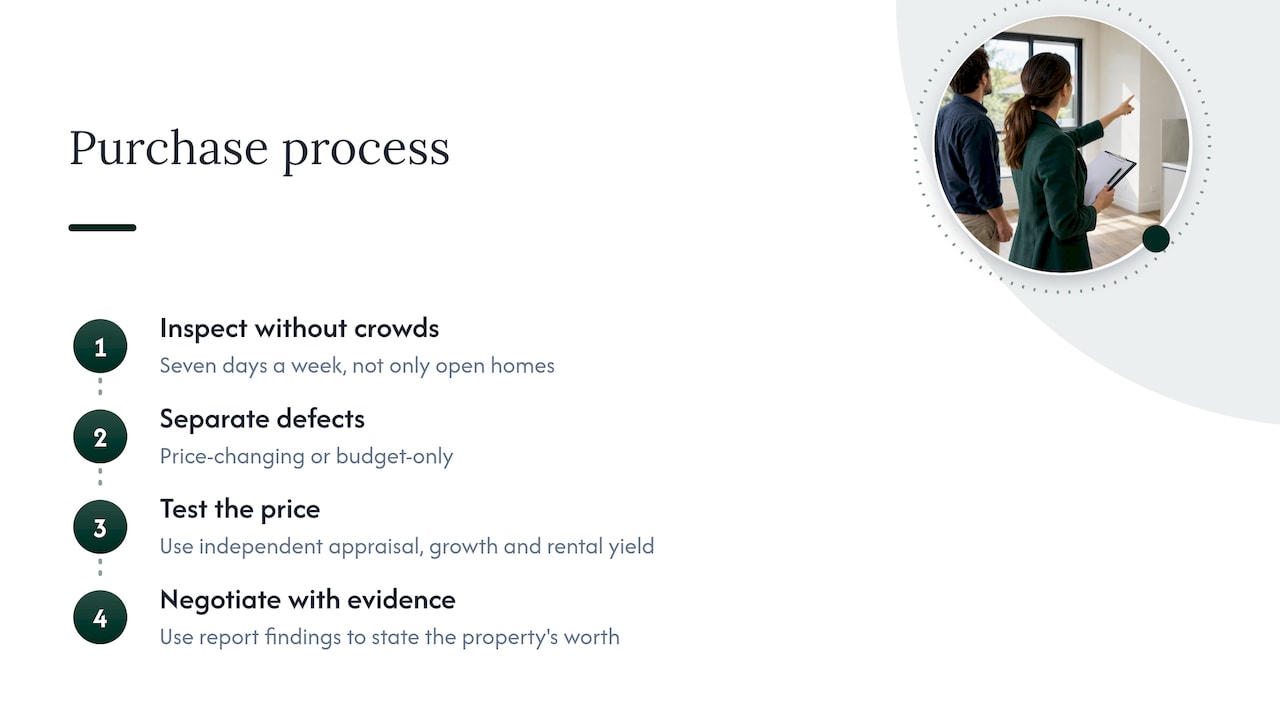
Our Full Service covers the whole purchase: strategy, property search on the market and off it, independent appraisal, due diligence, negotiation, auction bidding and settlement. Because we inspect properties seven days a week, independent of open home schedules, we can see a property without the crowd and before you commit time and money to reports. On the figures we hold for our clients, more than 30% of purchases are secured off-market and the average saving on the purchase price is about 9%.
If you have already found the property, our Negotiation Only service puts a licensed agent across the table from the vendor’s agent.
We are asked for a checklist every week, and we give one, but the checklist is rarely what saves a buyer money. What saves money is the order of operations.
First, we look at the property when there is no crowd. Seven days a week, not only on the open home. Second, we separate defects that change the price from defects that only change the budget. Third, we test the price against an independent appraisal, with capital growth and rental yield in view, because a sound building at the wrong price is still a bad purchase.
Buyers who go alone tend to inspect a property emotionally and negotiate it politely. We act only for purchasers, never for sellers, so our job is to be the calm person in the room who reads the report, understands what it means and tells the vendor’s agent exactly what the property is worth.
That is why we run the inspection, due diligence and negotiation as one process. The average purchase with us takes 54 days from engagement to settlement, and the findings from the first inspection are already working for you by the time we are at the table.
Kristan
Work with a buyers agent from the first inspection
If you would rather have an experienced licensed agent run your inspections, appraisal and negotiation across the Inner West, Eastern Suburbs, Lower North Shore and Eastern Beaches, see our Complete Purchase Solution and Auction Bidding services, or contact us through Sydney Property Buyers.

If you want a view on value before you commit to reports, see what a buyers agent property valuation report tells you.
FAQ
What should I look for when inspecting a house before buying?
Start with water and structure: roof condition, gutters, drainage, cracks, ceiling stains, damp smells, sticking doors and sloping floors. Then check wet areas, the switchboard and smoke alarms. Anything suspicious goes to a licensed building and pest inspector before you exchange contracts.
What is different about an apartment inspection?
You inspect the unit and the building. Check the balcony, wet areas and windows inside the unit, then the common property such as the car park, lifts and facade. Read the strata report as well, because levies, defects and disputes affect every owner.
Can I do the inspection myself?
You can and should do the first pass to screen out poor properties. A regulator in the United States notes that most buyers lack the knowledge, skill and emotional detachment to inspect a home themselves. For a property you are serious about, have a licensed inspector prepare the report and your solicitor or conveyancer review the contract.
Does an inspection report mean the property is free of defects?
No. A report covers what the inspector could see and reach on the day. Concealed conditions and areas without access may not be assessed, so read the limitations section and ask which specialists, if any, should follow up.
Sources
- Your NSW guide to cooling-off periods, Lawpath
- Questions and Answers on Home Inspections, North Carolina Real Estate Commission
- Inspections: Varied Tests, Verifications, NCREC Bulletins
- Standard of Practice, American Society of Home Inspectors
- Home Inspection Standards of Practice, InterNACHI
- Condominium Buyer’s Guide: Physical Evaluation Checklist, CMHC
- How to Get the Most From a Home Inspection, Consumer Reports
- What to Look for When Buying a House, Opendoor
Recommended
- Protect Your 5 Day Cooling Off: Sydney Due Diligence Checklist
- 3 Proofs Buyers in Australia Need: Pre Settlement Inspection Checklist
- Sydney Building Inspection Before Bidding: 4 Risks for US Buyers
- Sydney Auction Day Checklist: 7 Steps With a Buyer’s Agent