The short answer: there is no single global rule. In Sydney, a villa is usually a small, single-level home in a small complex, and a townhouse is usually a bigger, often multi-storey home in a complex of three or more dwellings. In the US the two words overlap far more, and a villa can share walls just like a townhome. If you are weighing a villa against a townhouse in Sydney, the label matters less than what you own, what you share and what it costs to keep.
This guide explains both meanings side by side. It then covers privacy, outdoor space, upkeep and strata costs, and ends with a checklist you can use on any property.
TL;DR
- In Sydney, “villa” usually means a single-level home with a courtyard in a small complex. “Townhouse” usually means a larger home, often over two or more floors.
- In the US, the words overlap. A villa can be attached, can carry association fees and is not automatically detached.
- Most Sydney villas and townhouses sit in a strata scheme, so you share ownership of common property and pay levies.
- Compare the strata plan, the levies and the by-laws before you compare floor plans.
- A buyers agent can check the records and negotiate for you, which matters most when a complex looks cheap.
Table of Contents
- Villa vs townhouse: the quick comparison
- Is a villa the same as a townhouse?
- Privacy, noise and living space
- Maintenance, levies and shared areas
- Which suits you: villa or townhouse?
- A pre-purchase checklist for either type
- Buying from overseas
- How Sydney Property Buyers can help
- FAQ
- Sources
Villa vs townhouse: the quick comparison
The table below uses the typical Sydney meaning, because that is where the terms are most often confused by overseas buyers. US usage follows in the next section.
| Feature | Villa (typical Sydney usage) | Townhouse (typical Sydney usage) |
|---|---|---|
| Levels | Usually one | Often two or three |
| Size | Smaller | Generally larger |
| Outdoor space | Private courtyard | Courtyard, sometimes a small garden or balcony |
| Parking | Often an attached garage | Garage or carport |
| Complex size | Usually small | Three or more dwellings |
| Walls | Usually attached on at least one side | Attached or, less often, freestanding |
| Shared areas | Driveways, gardens, external walls and roofs may be common property | Same, depending on the scheme |
Domain describes a townhouse as a self-contained dwelling within a complex of three or more, sometimes attached and sometimes freestanding, generally with a courtyard and a garage or carport. It also says that in NSW and Victoria a villa commonly means a small single-level home with an attached garage and private courtyard in a small complex. In Queensland the two words can be used interchangeably, so check which state an overseas article is describing.
Is a villa the same as a townhouse?
Not quite, but they are close relatives. Both are usually attached or semi-attached homes with their own front door, rather than an apartment reached through a shared internal hallway. The practical differences are height, size and how the word is used in your market.
How the words work in the US
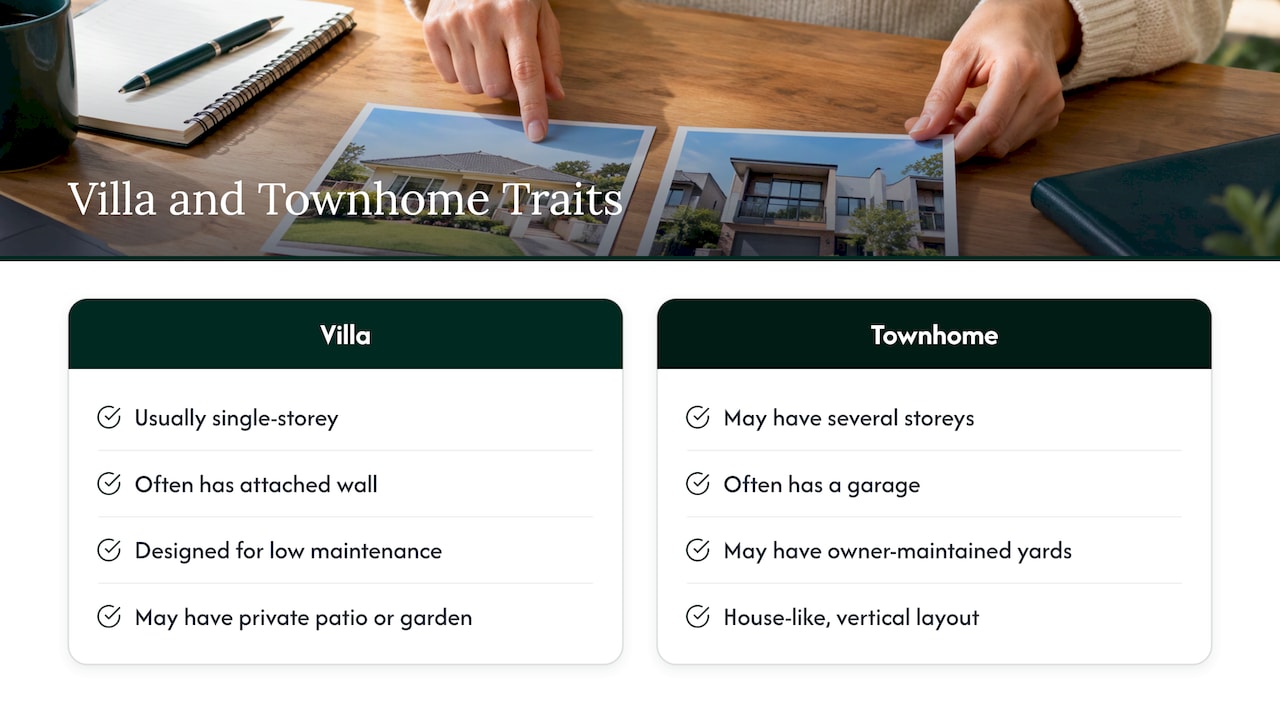
US listings are looser. Ownerly’s guide says villas and townhomes can both share walls, common areas and association fees, so a villa is not automatically detached or fee-free. It notes that villas are usually single-storey and may have a private patio or garden, while townhomes may have several storeys and often a garage or owner-maintained front and rear yards.
Del Webb draws a similar line: villas are usually single-storey with at least one wall attached to a neighbouring home, often designed for low-maintenance living. Many townhomes have a second or third storey. The useful distinction is lifestyle, single-level and low-maintenance versus vertical and house-like, not detached versus attached.
On the question of whether villas count as townhomes, the honest answer is sometimes. A villa that shares a wall is, structurally, an attached home much like a townhome. Developers and agents choose the word to signal a smaller, easier-living product.
How the words work in Sydney
In Sydney the two words are used more consistently, as the Domain description above shows. The more important point for an overseas buyer is ownership. A US townhouse owner typically owns the whole structure and the land it sits on, according to U.S. News. In NSW, townhouse developments and multi-dwelling housing may be strata-subdivided, as the NSW Planning Portal notes. When they are, you own a lot and share the common property with the other owners. The type of title varies by property, so the contract and title search tell you which one you are buying.
Privacy, noise and living space
Both types trade some privacy for price and convenience.
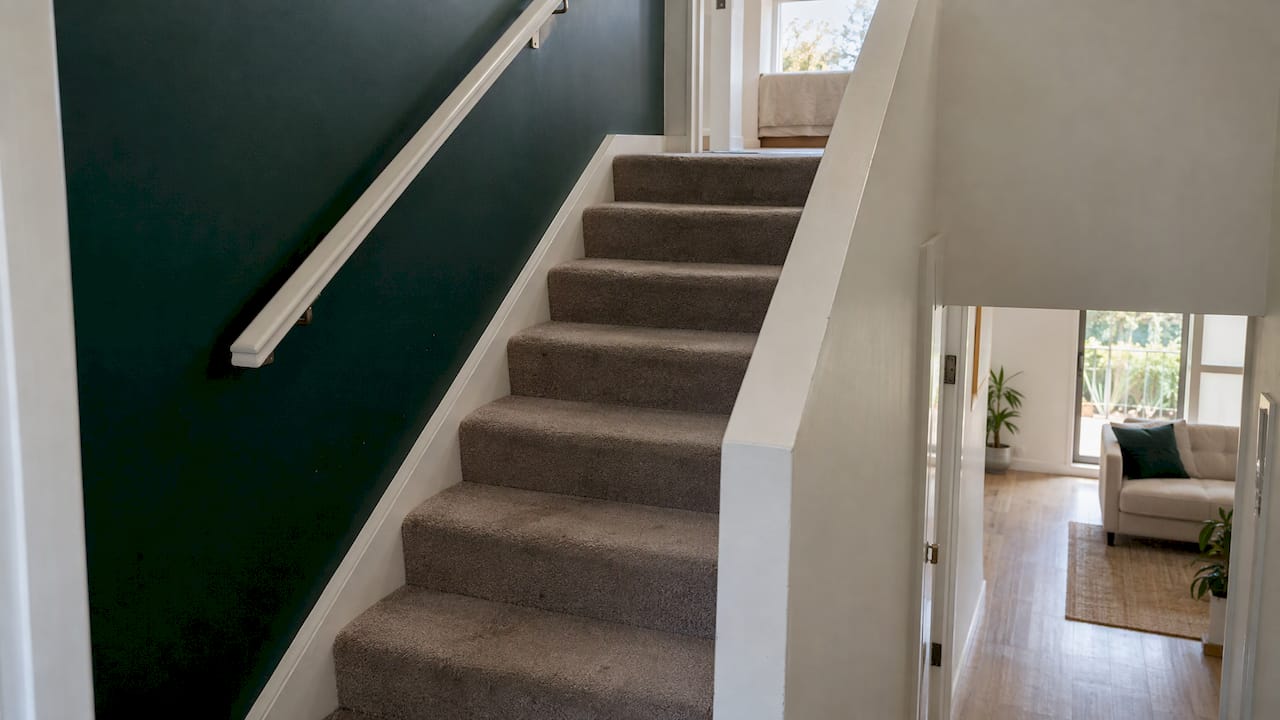
Townhouses. U.S. News describes a townhouse as typically a multistorey structure sharing one or more walls with neighbouring units, with its own entrance and sometimes private outdoor space. It lists less privacy, possible noise through shared walls, multiple levels and less space than a detached house as common trade-offs. Stairs matter: a three-level townhouse gives you separation between living and sleeping areas, but it is a daily climb.
Villas. A single-level villa suits downsizers, young families who want everything on one floor and anyone who dislikes stairs. The private courtyard replaces a backyard. Because villas are smaller, storage and room for a home office are the usual pressure points.
When you inspect, test the things a floor plan will not show:
- Which rooms back onto a party wall, and what is on the other side of it.
- Whether the courtyard is overlooked from a neighbour’s upper window.
- How the car space is reached, and whether visitors can park.
- Morning and afternoon light, since many complexes pack dwellings tightly.
This is one reason we inspect seven days a week, independent of open home times. A quiet Tuesday visit tells you more about noise and parking than a crowded Saturday.
Maintenance, levies and shared areas
This is where the real cost difference sits, and it is the same question for a villa and a townhouse.
What you own and what you share in NSW
The NSW Government explains that a strata scheme can contain apartments, townhouses or villas. Buying a lot also gives you shared ownership of common property such as gardens, external walls, roofs, driveways and stairwells. That surprises buyers who assume a townhouse roof is theirs to fix.
Where the boundary falls can vary. The NSW common property memorandum says common property elements can include walls, original waterproofing, shared services and some garage components, but the registered strata plan remains essential because boundaries and responsibility differ between schemes.
Our own guides explain this in more detail: what a strata scheme is and how unit entitlement decides your share of costs.
Levies, funds and special levies
According to the NSW Government, levies fund day-to-day administration and maintenance through an administrative fund, and major works through a capital works fund. It also warns that low levies can precede higher future charges or special levies. A cheap-looking villa in an older complex with a thin capital works fund can cost more than a pricier townhouse in a well-funded one.
Useful reading before you commit:
- What a special levy is and how it can arrive.
- What a strata report is and what it costs in Sydney.
- Strata by-laws in NSW, which can govern pets, renovations, parking and short-term letting.
The US comparison
If you are used to US communities, the closest equivalent to strata is a homeowners association. U.S. News says townhouses may offer amenities such as a clubhouse, gym or pool, while owners can still be responsible for interior and exterior upkeep, including landscaping, roofs and private outdoor areas, unless the association covers particular items. Del Webb adds that roofs are usually maintained by the community association. How shared funds hold up when large repairs arrive is covered in this explainer on HOA repair funding shortfalls. The same logic applies to a Sydney scheme: ask whether the reserves match the age of the buildings.
Which suits you: villa or townhouse?
There is no better type, only a better fit. Use these prompts.
A villa may suit you if:
- You want one level and low day-to-day upkeep.
- You are downsizing, or buying a first home on a tighter budget.
- A courtyard is enough outdoor space.
A townhouse may suit you if:
- You need more bedrooms or a study and want a house-like layout.
- You value a garage and a larger courtyard or small garden.
- You are happy with stairs.
For investors, the question shifts to land content, rental demand and growth. Smaller complexes with few owners can be simpler to run, while larger ones may have more resources but also more to repair. We analyse capital growth potential and rental yield together, rather than looking at price alone, because a lower purchase price does not always mean a better return once levies are counted.
A pre-purchase checklist for either type
Work through this before you bid or exchange.
- Read the strata plan. The NSW Government advises buyers to check it to see what they will own and share ownership of. Confirm who is responsible for the roof, external walls, fences and courtyard surfaces.
- Check the title type. Ask your conveyancer to confirm whether it is strata or another form.
- Review the levies and funds. Compare the administrative and capital works fund balances to the age of the buildings.
- Read the meeting minutes and by-laws. Look for disputes, planned works and rules that affect how you plan to live or rent.
- Commission a building inspection. Our guide to building defects in NSW strata shows what to check first.
- Check easements. Our easement checklist covers what to look for before exchange.
- Know your deadlines. Our due diligence checklist is built around protecting the cooling-off period.
Why a buyers agent checks strata records matters here: the reasons are set out in this guide.
Buying from overseas
Sydney sales run on local timelines, and many are by auction. If you are not in Sydney, you can still buy, but you need someone on the ground to inspect, check records and bid for you. Our guide to buying Sydney property sight unseen covers how that works, and proxy bidding at Australian auctions explains how someone can bid on your behalf.
Our perspective
Buyers often ask us whether a villa or a townhouse is the smarter buy. We answer with a different question: which complex, and what is in its records? Two properties with the same label can have very different strata funds, by-laws and maintenance liabilities.
We work only for buyers, never sellers, so our job is to read the plan, the levies and the minutes before a number is agreed, then negotiate on what we find. Our independent appraisal looks at the specific lot, not the category.
Some of our purchases, more than 30%, are secured off-market. In a segment where good villas and townhouses can move quickly, early access can mean less competition and a calmer negotiation.
Kristan
How Sydney Property Buyers can help
We are a licensed Sydney buyers agency covering the Inner West, Eastern Suburbs, Lower North Shore and Eastern Beaches. Our Complete Purchase Solution covers strategy, on-market and off-market search, independent appraisal, due diligence, negotiation, auction bidding and settlement. If you have already found a villa or townhouse, Negotiation Only gives you professional representation on price. Across our clients, the average saving on purchase price is about 9%, and the average time from engagement to settlement is 54 days.

See our buyers agent services or call 1800 676 177. If the complex is the unknown, our due diligence guide shows what we review. You can also read how buyers agents access off-market properties.
FAQ
Are villas better than townhouses?
Neither is better in general. A villa usually suits buyers who want a smaller, single-level home with low upkeep. A townhouse usually suits buyers who want more space and a house-like layout over several floors. The condition of the complex and its strata finances often matter more than the label.
Is a townhouse the same as a villa?
No, although they overlap. In NSW, a villa commonly means a small single-level home in a small complex, while a townhouse is generally larger and sits in a complex of three or more dwellings, according to Domain. In the US, the terms are used more loosely.
Are villas considered townhomes?
Sometimes. Where a villa shares a wall with its neighbour, it is structurally an attached home much like a townhome, and US sources note both can share walls and fees. In Sydney, the two are usually described separately by height and size.
Do villas and townhouses in Sydney have strata fees?
Most do. The NSW Government says a strata scheme can include townhouses and villas, and owners pay levies that fund administration, maintenance and major works. Check the strata report for the exact figures and the capital works fund balance.
Sources
- House types explained, Domain
- Buying a strata property, NSW Government
- Common property memorandum, NSW Government
- Strata subdivision, NSW Planning Portal
- What Is a Townhouse?, U.S. News
- What Is a Villa?, Ownerly
- Condos, Townhomes and Villas: What’s the Difference?, Del Webb
- What Happens If an HOA Can’t Pay for Repairs
Recommended
- Sydney inner west suburb comparison: 2026 guide
- Sydney Buyers: Mosman or Neutral Bay, Family Home or Apartment?
- Strata Levies and Property Value in Sydney: What US Buyers Should Know
- Inner West Property Guide: Suburbs, Prices and Buying Rules