In Sydney, buying the median house costs far more each week than renting the same one, and it needs a large pile of cash up front. The gap closes over time through rising rents, loan paydown and price growth, which is why the sensible answer depends on how long you will stay, how much cash you hold and which part of Sydney you are looking at. Below are the current figures in Australian dollars (A$), the break-even logic, and a way to decide that suits buyers living here or overseas, including readers in the United States.
TL;DR
- On the median Sydney house, repayments run about A$876 a week above rent at a 6.82% rate, before council rates, insurance and maintenance.
- Upfront cash for that house is around A$348,000 (deposit plus stamp duty), so the deposit hurdle matters as much as the repayment.
- One estimate puts the break-even against renting at around year 6 to 7 for a typical A$1.2 million property, earlier with first home buyer help.
- Units, and some apartment-heavy suburbs, narrow the gap sharply; houses on the North Shore do not.
- If you plan to stay at least six or seven years and can fund the entry costs, buying well, in the right suburb, is a strong long-term position.
Table of Contents
- The short answer: what each option costs per week
- Where Sydney prices and rents sit now
- Upfront costs: the real barrier
- A worked example
- Houses, units and suburbs behave differently
- How long you stay decides the answer
- First home buyer help in New South Wales
- If you live in the United States
- Our view
- How we can help if you decide to buy
- A simple way to decide
- FAQ
- Sources
The short answer: what each option costs per week
The cleanest comparison is the same home, rented versus bought. According to arthr.com.au’s November 2026 analysis of the median Sydney house, rent is A$857 a week while the repayment on 80% of the price is A$1,733 at 6.82% over 30 years. Of that repayment, A$1,501 is interest in the first year. Buying therefore costs A$876 a week more than renting at the start.
Owning adds more. Council rates, building insurance, maintenance and, for apartments, strata fees all sit on top. ABC News assumed 20% on-costs and found the gap at purchase widens to between A$348 and A$697 a week depending on the property, and noted it should close as rents rise, though that can take years or even decades.
Finder’s July 2026 data shows the same shape across the city: an average Sydney mortgage of A$7,307 a month against A$3,332 in rent.
Two things follow. Renting is the cheaper way to live in Sydney this year. Buying is a way to convert a large monthly outlay into equity you own, and whether that is worth it depends on the time you hold the property.
Where Sydney prices and rents sit now
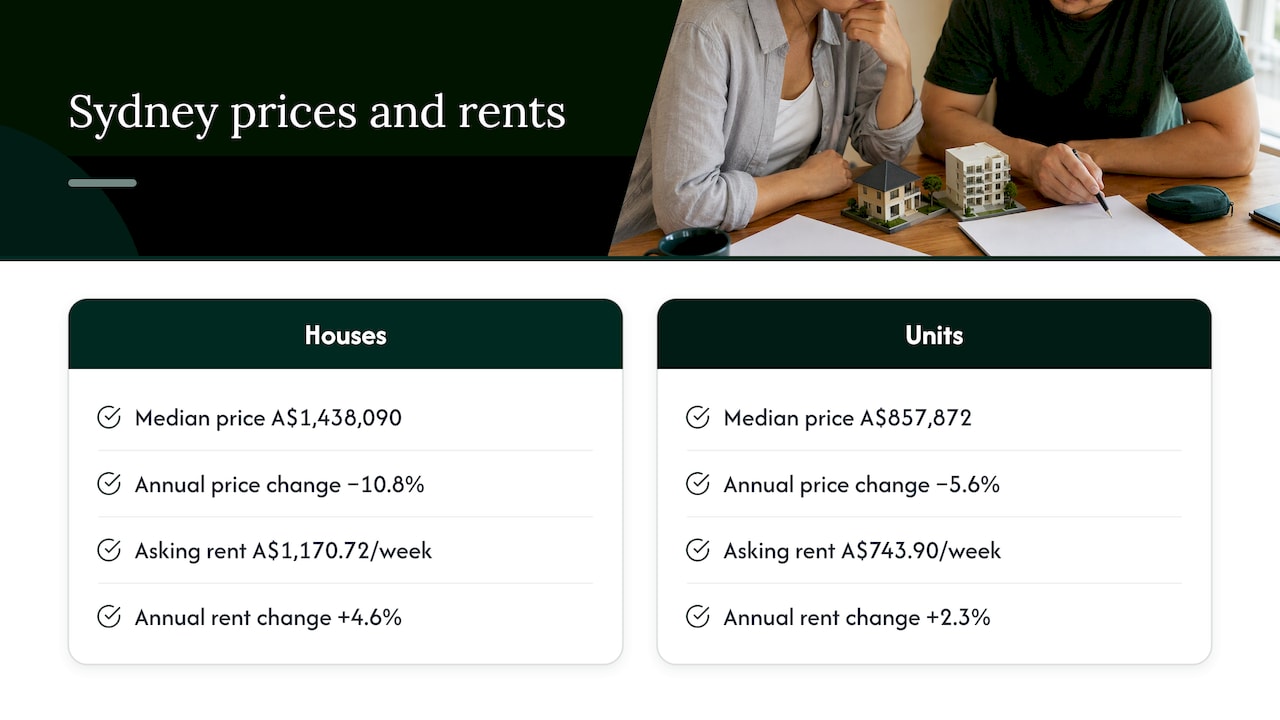
Prices and rents have moved in different directions, which is why the question is live again. Cotality’s November 2026 index, cited by arthr.com.au, puts the median Sydney house at A$1,438,090 and the median unit at A$857,872. Over the year to September, houses fell 10.8% and units fell 5.6%.
Rents went the other way. SQM Research shows Sydney house rents at A$1,170.72 a week, up 4.6% over 12 months, and unit rents at A$743.90, up 2.3% (asking figures, which run higher than the medians quoted elsewhere). Domain’s June quarter 2026 report, summarised by PropKT, found house rents at a record A$850 a week and a vacancy rate of 1.1%. Tight vacancy is what pushes rents up, and we unpack the three vacancy figures worth watching in our guide to Sydney rental vacancy and purchase timing.
National rents tell the same story. The Guardian reports that Australia’s median rent rose 5.5% over the year to September to A$713 a week while median prices were flat. In a few Sydney suburbs, including Ultimo, Warwick Farm, Rosehill, Liverpool and Granville, repayments were only about A$100 a week above rent.
If you want a plain explanation of how the headline price is calculated and why it can mislead, read our piece on what the Sydney median house price means for buyers.
Upfront costs: the real barrier
Most of the rent-or-buy decision is made before the first repayment. For the median house, arthr.com.au puts the 20% deposit at A$287,618 and stamp duty at A$60,382, so cash up front is about A$348,000. A smaller deposit carries lenders mortgage insurance (LMI); the same analysis estimates A$55,740 for a 5% deposit on that house.
The numbers are smaller for cheaper homes. ABC News works through an average loan of A$730,720: a 20% deposit is A$182,680, stamp duty for a Sydney first home buyer is A$22,334, and with conveyancing, inspections, title searches and a loan establishment fee a buyer should set aside at least A$206,000 from day one.
Here is a simple checklist of what to include in your own comparison:
| Cost | Renting | Buying |
|---|---|---|
| Deposit | Bond only | 5% to 20% of price |
| Stamp duty | None | Varies by price and buyer type |
| LMI | None | Applies under a 20% deposit unless a scheme covers it |
| Legal and inspections | None | Conveyancing, building and pest, title searches |
| Ongoing | Rent | Loan repayments, council rates, insurance, maintenance, strata levies |
| Exit | Notice period | Selling costs |
We cover what different deposit sizes actually buy in our breakdown of Sydney house deposits, and the cost of the report that protects apartment buyers in our strata report cost guide. If you are looking at a unit, strata levies belong in your monthly budget from day one.
A worked example
Take WealthWorks’ March 2026 figures for a Sydney median house of A$1,190,000. Their monthly buying cost is A$8,031 (mortgage A$6,504, council rates A$250, water A$85, insurance A$200, maintenance A$992), against A$3,170 to rent, a difference of A$4,861 a month. Stamp duty on that purchase for a buyer who is not a first home buyer is roughly A$52,000.
A cheaper example comes from Western Sydney. Dolaro calculates that for a A$950,000 home with a 20% deposit, upfront cash is about A$231,000 and the first-year housing cost is about A$69,376 against about A$35,364 renting, a gap of A$34,012 a year.
These are one-year snapshots. Interest is the biggest cost early in a loan, and the share going to principal rises each year. That is the equity you keep.
Houses, units and suburbs behave differently
The weekly gap is not the same everywhere. In Greater Sydney, FinSavvy’s analysis of NSW government data found the median house sold for A$1,550,000 in the March 2026 quarter while the median new house rent was A$800 a week, a gross yield of 2.7%. Units yield more, at 4.6%. A low yield means rent is small relative to price, so buying costs far more than renting.
FinSavvy’s suburb work shows how wide the range is. In Hornsby and Epping, where unit rents are high against prices, buying needs less than 1% a year in price growth to come out ahead. Chatswood needs 2.3% and the Turramurra house, renting at A$1,280 a week against a A$3,263,000 price, needs 4.2% a year. On the North Shore generally, FinSavvy found a house repayment at 20% deposit costs 2.5 to 3.2 times the median rent, narrowing to 1.2 to 2.2 times for units.
Cotality researcher Gerard Burg told The Guardian that areas with heavy apartment development tend to be cheaper to buy than rent, because new supply pushes purchase values down while rental availability stays tight.
The practical lesson: do not use one Sydney-wide figure. Run your own numbers for the suburb and property type you want. Our guide on how to research Sydney suburbs shows which data to pull, and our rental appraisal guide explains how to test a property’s rental value before you commit.
How long you stay decides the answer
Buying and selling together cost roughly 5 to 7% of a property’s value, according to NestPath, which also notes that a renter who invests the deposit and upfront cash can outperform a short-term buyer. For a typical A$1.2 million Sydney property with a 20% deposit and a rate of about 6.5%, it estimates break-even against renting at year 6 to 7. For first home buyers using the 5% Deposit Scheme, where the A$1.5 million Sydney price cap covers that home and LMI is avoided, it estimates year 4 to 5.
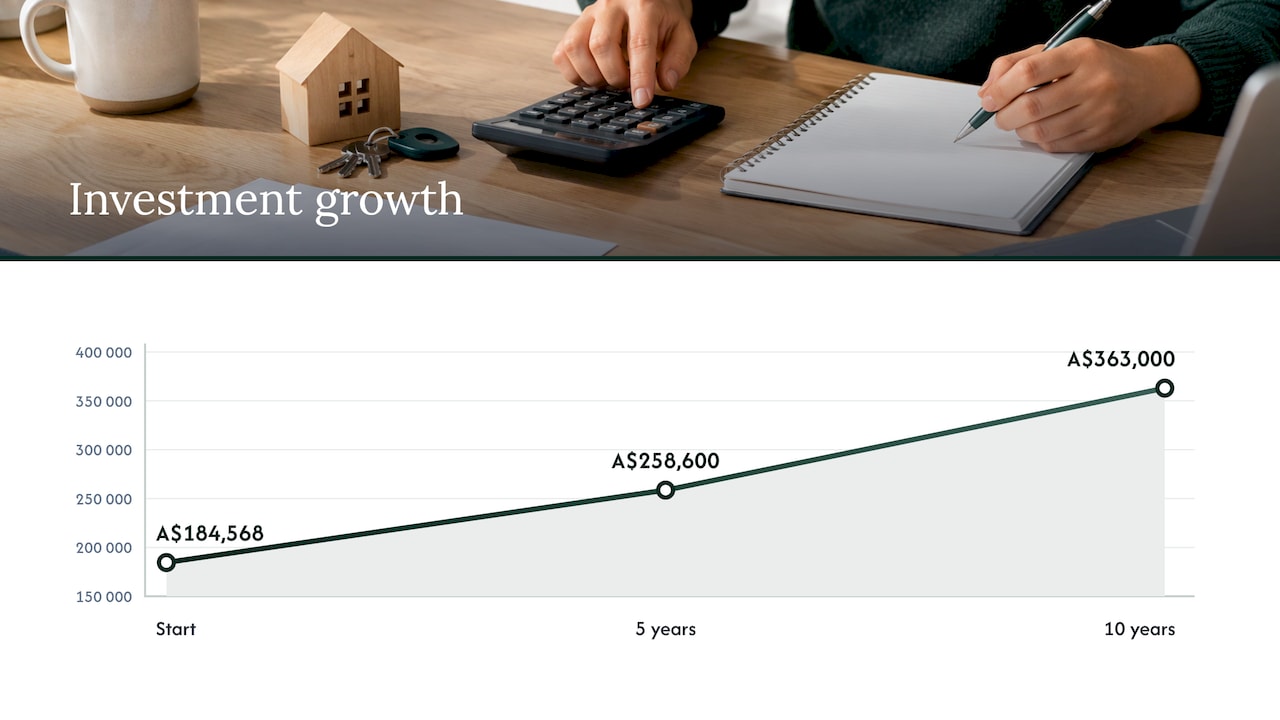
The investing argument is a fair one to weigh. Lacey Filipich, writing for ABC News, points out that a buyer is forgoing the chance to invest the money locked into the deposit and the weekly gap. WealthWorks illustrates it: A$184,568 invested at 7% a year would grow to about A$258,600 after five years and A$363,000 after ten. The same source shows the other side. If a property appreciates 5% a year and you bought with 20% down, your return on your own equity is 25%, because leverage multiplies gains (and losses).
So the two paths are not opposites. Owning gives you a leveraged asset, a fixed-rate option if you choose it, and no landlord deciding when you leave. A well-chosen property in a supply-constrained suburb is where those advantages count most.
First home buyer help in New South Wales
If you qualify, government support changes the sums, so check it before deciding. Revenue NSW says a First Home Buyers Assistance Scheme applicant must be an individual, an Australian citizen or permanent resident, at least 18, and must not have previously owned residential land in Australia. For transactions on or after 1 July 2023 you must also live in the home continuously for at least 12 months, starting within 12 months of completion.
The NSW First Home Owner Grant is A$10,000 for a new home, with price caps of A$600,000 for a newly built home or A$750,000 for vacant land plus a building contract, and it does not apply to established homes.
The federal First Home Guarantee lets eligible buyers borrow up to 95% without LMI. Since 1 October 2025 it has no income cap and unlimited places, and the NSW price cap is A$1,500,000 for the capital city and named regional centres. Confirm current caps on the official pages before you rely on them.
If you live in the United States
American readers often ask whether Sydney works like their home market. The mechanics differ, so do not carry US assumptions across. Prices, deposits and costs here are in Australian dollars, so exchange rates affect your real outlay. Properties are commonly sold by auction or private treaty, and auction purchases are unconditional on the day, which makes research before bidding essential. Our guides cover buying Sydney property from the US and how auction bidding increments work.
The first home schemes above are limited to Australian citizens and permanent residents. Foreign buyer rules, tax and finance are separate matters: speak to an Australian conveyancer or solicitor and a broker experienced with overseas buyers before you commit, and confirm your own tax position with a qualified accountant in both countries.
Our view
Most buyers ask us whether Sydney is too expensive to buy. The better question is whether you are buying the right property for the length of time you will hold it.
The weekly gap between rent and repayments is real, and the figures above show it. But buyers who do well are usually the ones who do not pay the market’s headline price. Across our clients, we have secured 100+ properties, with an average saving of around 9% on the purchase price and more than 30% bought off-market. A saving of that size on a Sydney home shortens your break-even period, because you start with less debt and more equity.
We also inspect seven days a week, not just at open homes, and run independent appraisals and investment analysis covering capital growth and rental yield. That is how we separate a suburb where buying makes sense from one where it is a stretch.
If you have decided to buy, our job is to make the entry cost work harder for you.
Kristan
How we can help if you decide to buy
If the numbers point to buying, the next step is finding and securing the right property at the right price. Sydney Property Buyers is a licensed buyers agency that represents buyers only, never sellers. Our Complete Purchase Solution covers strategy, on-market and off-market search, independent appraisal, due diligence, negotiation, auction bidding and settlement, with an average of 54 days from engagement to settlement.
Already found a property? Our Negotiation Only service puts a licensed negotiator on your side. To see how we work before you book, browse the properties we have secured for clients, or read how buyers agents find off-market properties. You can reach us on 1800 676 177 or at hello@sydneypropertybuyers.com.au.
A simple way to decide
- Set your holding period. Under about five years, renting usually leaves you with more cash. Beyond six or seven years, buying looks stronger on the estimates above.
- Count the cash. Add the deposit, stamp duty, legal costs and inspections, then keep a buffer. Check your eligibility for NSW and federal schemes.
- Compare like with like. Use rent for the same suburb and property type, not a city average.
- Add the on-costs. Council rates, insurance, maintenance and strata levies, around 20% on top of the repayment in ABC’s assumption.
- Test the downside. Ask what happens to your budget if the rate rises or you must sell early.
- Do the due diligence. A purchase is only as good as its checks, so work through our Sydney due diligence checklist before you commit.
FAQ
Is it cheaper to rent or buy in Sydney right now?
Renting is cheaper week to week. On the median house, repayments are about A$876 a week higher than rent at a 6.82% rate, and the gap is wider once running costs are added. In some apartment-heavy suburbs the difference is far smaller.
How long do I need to stay in Sydney for buying to pay off?
One estimate puts break-even at around year 6 to 7 for a typical A$1.2 million property with a 20% deposit, and year 4 to 5 for eligible first home buyers using the 5% Deposit Scheme. Your own result depends on the price you pay, your rate and the suburb’s growth.
How much cash do I need to buy in Sydney?
For the median house, around A$348,000 including a 20% deposit and stamp duty. For a more modest loan, ABC News suggests setting aside at least A$206,000. Eligible first home buyers may pay less stamp duty and may be able to buy with a 5% deposit.
Does a buyers agent help if I am comparing renting and buying?
Yes, once you have decided to buy. We search on and off the market, run independent appraisals and negotiate, so the price you pay and the property you choose support the long-term case for buying.
Sources
- Renting vs. Owning in Australia, Finder
- Is it cheaper to rent or buy in Sydney?, arthr.com.au
- Owning your own home isn’t always the best decision, ABC News
- Mortgage repayments are now cheaper than rent in some suburbs, The Guardian
- SQM Research property data
- Sydney house rents added $50 in a quarter, PropKT
- Renting vs Buying in Australia in 2026, WealthWorks
- Rent vs Buy Property Calculator by Suburb, FinSavvy
- North Shore Rent vs Buy by Postcode, FinSavvy
- Rent vs Buy Calculator Australia 2026, NestPath
- Eligibility for the First Home Buyers Assistance Scheme, Revenue NSW
- First Home Owner (New Homes) Grant, Revenue NSW
- High income, almost no deposit, Wombat Home Loans
Recommended
- How to research Sydney suburbs property in 2026
- A$40,000 to A$230,000: What Sydney House Deposits Buy in 2026
- 10 Sydney Suburbs Poised for 2026 Growth: US Investor Playbook
- 10 Sydney Suburbs With Strong 2026 Growth for US Investors