Most Sydney buyers need somewhere between 5% and 20% of the purchase price as a deposit, depending on which lending pathway they qualify for. Lenders still treat 20% as the benchmark that avoids lenders mortgage insurance, but the First Home Guarantee and other schemes let eligible buyers in with as little as 5% down. Either way, the deposit itself is only part of the cash you need. Stamp duty, legal fees, inspections and a settlement buffer all sit on top.
TL;DR:
- Borrowers can buy a Sydney property with as little as 5% deposit through schemes like the First Home Guarantee, avoiding LMI and reducing upfront costs.
- The true cost of a 20% deposit on an $800,000 home is approximately $160,000, while a 5% deposit can be saved in under two years at a monthly saving rate of $1,700.
- Additional purchase costs like stamp duty, legal fees, inspections, and settlement buffer can add up to 5-10% of the property price, requiring further savings.
- Waiting to save for a full deposit may lead to higher costs due to rising property prices and lost capital growth, making strategic deposit minimization more advantageous.
- Consulting a mortgage broker within 12 months of buying can help identify suitable lenders and prevent financing roadblocks before property selection.
Table of Contents
- Deposit needed for a Sydney house: what 5%, 10% and 20% actually cost
- Ways to buy in Sydney with a smaller deposit
- Other costs on top of your deposit
- How long it actually takes to save
- Practical ways to close the gap faster
- Getting professional help when your deposit is tight
- Where to check your numbers before you commit
- The deposit advice most buyers get backwards
- Sources
Deposit needed for a Sydney house: what 5%, 10% and 20% actually cost
The percentage you’re aiming for changes everything about your loan, so it helps to see the real dollar figures before you start saving blindly.
Lenders calculate your deposit against the loan-to-value ratio, or LVR. Borrowing more than about 80% of a property’s value generally triggers lenders mortgage insurance (LMI), an extra cost that can be significant. Staying at or below 80% usually avoids LMI, which is why 20% deposits are commonly recommended, although not legally required.
Here’s what that looks like on two realistic Sydney entry points:
- $800,000 property: 5% deposit around $40,000; 10% about $80,000; 20% about $160,000 (no LMI)
- $1,150,000 property: 5% deposit roughly $57,500; 10% around $115,000; 20% about $230,000 (no LMI)
Below 20%, most major lenders will still approve you, but expect a higher interest rate margin and an LMI premium added to your loan or paid upfront.
Ways to buy in Sydney with a smaller deposit
Several legitimate pathways exist specifically because the First Home Guarantee and similar schemes recognise how hard it’s become to save a full deposit while paying Sydney rent.
- First Home Guarantee: eligible first-home buyers can purchase with a low deposit, with the government guaranteeing the remainder so LMI isn’t charged. Price caps apply depending on the local government area, so check current thresholds before setting a budget.
- Shared-equity schemes: government or approved provider co-invests in the property with you, reducing the loan (and deposit) you need to fund yourself, in exchange for a share of future capital growth.
- Guarantor loans: a family member offers their own property as additional security, letting you borrow above typical deposit thresholds without LMI. This is powerful for closing a deposit gap fast, but it puts the guarantor’s property at genuine risk if you default, and you’ll still need to cover stamp duty and legal costs yourself.
Pro Tip: Check your eligibility for the First Home Buyer Grant before you assume you need the full 20%. Many buyers rule themselves out of schemes they’d actually qualify for.
Other costs on top of your deposit
Your deposit funds part of the purchase price, but settlement day demands a separate pile of cash that catches out plenty of first-time buyers. NSW Government guidance lists transfer duty, conveyancing, inspections and registration fees as standard components of any purchase.
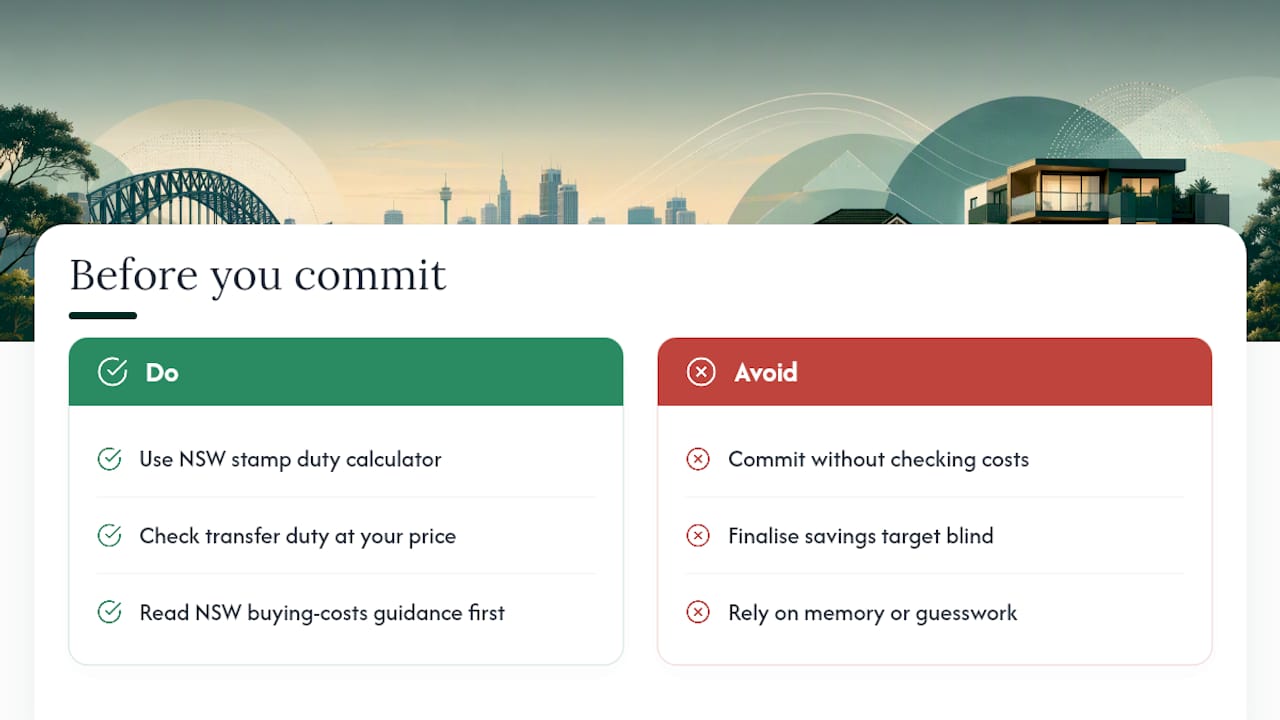
- Transfer duty (stamp duty): calculated on a sliding scale against purchase price; run your exact figure through the NSW stamp duty calculator, which also flags first-home buyer exemptions at common price points.
- Conveyancing and disbursements: typically a fixed professional fee plus several hundred dollars in registration and search disbursements.
- Building and pest inspections: budget for these on every shortlisted property, not just the one you eventually buy.
- Loan establishment and valuation fees: charged by your lender, usually a few hundred dollars.
- LMI: if your deposit sits below 20%, this can be paid upfront or capitalised into the loan, which increases your repayments over the life of the mortgage.
Buyers routinely underestimate one thing: the number of inspections and conveyancing quotes they’ll pay for across several shortlisted properties before one settles, not just the winning one.
How long it actually takes to save
The formula is simple: target deposit divided by your average monthly net savings equals your timeline in months. The scheme you choose to pursue is what changes the answer dramatically.
- 20% deposit on an $800,000 house ($160,000): saving $1,700 a month gets you there in roughly 7.8 years, broadly matching the near-eight-year timeline many Sydney buyers face without extra help.
- 10% deposit on the same property ($80,000): the same $1,700 monthly rate cuts that to around 3.9 years.
- 5% deposit via the First Home Guarantee ($40,000): saving at the same rate brings you in under two years, which is the gap that makes the scheme worth investigating properly.
These figures assume net savings after rent, so anyone still renting in inner Sydney should stress-test the monthly number honestly before committing to a timeline.
Practical ways to close the gap faster
Small structural changes to how you save, inspired by practical saving tactics, tend to beat sporadic willpower every time.
- Automate a transfer the day your pay lands, before you see the money in your everyday account.
- Use the First Home Super Saver Scheme (FHSS) to make voluntary super contributions taxed at a lower rate, then withdraw them for your deposit.
- Direct windfalls straight to savings: tax returns, bonuses and gifts should go to the deposit account, not everyday spending.
- Trim one major recurring cost rather than dozens of small ones. Cancelling unused subscriptions rarely moves the needle; renegotiating rent or insurance often does.
- Park deposit savings in a high-interest savings account or term deposit, not shares, if you’re within two years of buying. Volatility is the enemy of a fixed timeline.
Speak to a mortgage broker once you’re within 12 months of your target. They’ll confirm which lenders suit your deposit size and flag any LVR restrictions before you fall in love with a property you can’t finance.
Pro Tip: Keep a buffer of at least $10,000 to $15,000 beyond your calculated settlement costs. Building and pest issues, rate rises before settlement, and moving costs all tend to appear at once.
Getting professional help when your deposit is tight
A smaller deposit narrows your options, but it doesn’t have to mean settling for whatever’s left on the public market. Sydney Property Buyers sources on-market and off-market opportunities across the Inner West, Eastern Suburbs, Lower North Shore and Eastern Beaches, with independent appraisal and negotiation built into every purchase.
The director of this buyers agency has secured numerous properties for clients with an average purchase timeline of around 54 days from engagement to settlement.
Where to check your numbers before you commit
Run your own figures through the NSW stamp duty calculator to confirm transfer duty at your target price point. NSW Government’s guidance on buying costs covers the full list of fees you’ll encounter, and it’s worth reading before you finalise a savings target rather than after.
The deposit advice most buyers get backwards
Buyers spend years grinding towards a number that avoids LMI, when the actual cost of waiting, in lost capital growth and rising prices, often outweighs the insurance premium they were trying to dodge.
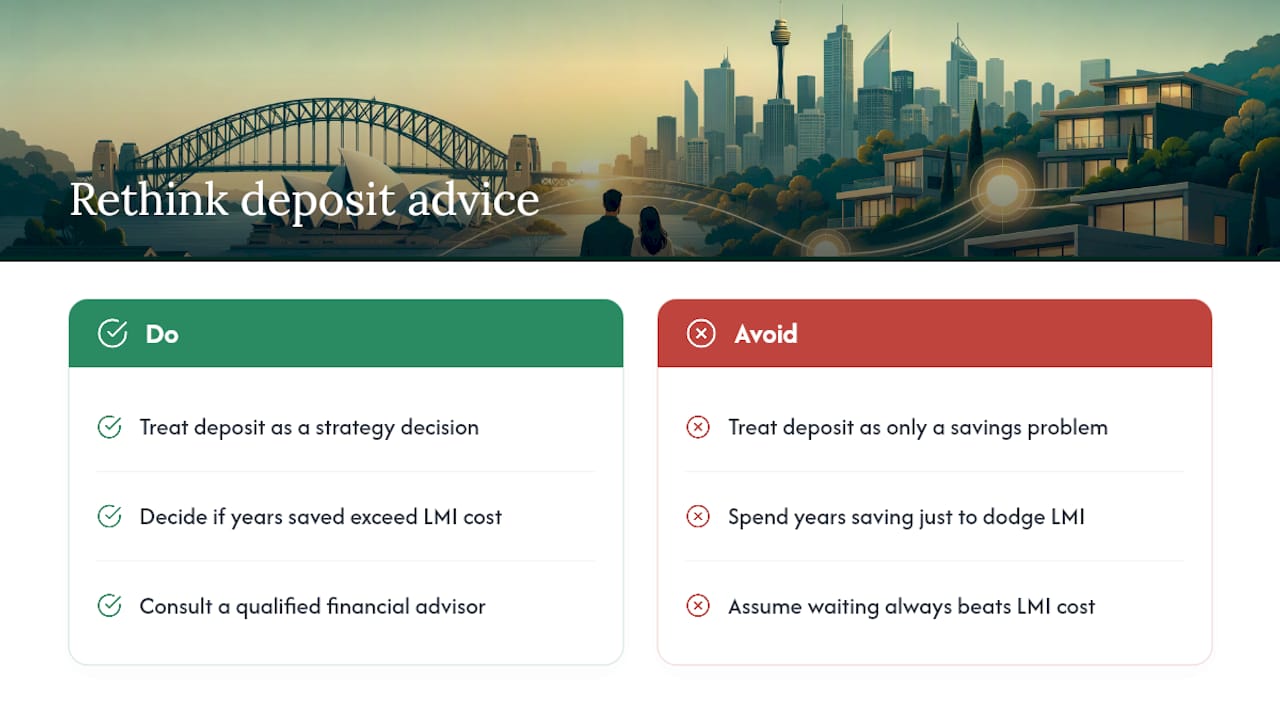
The conventional wisdom treats deposit size as purely a savings problem. It isn’t. It’s a strategy problem.
Then decide whether the years saved are worth more than the LMI cost. For most Sydney buyers under real time pressure, they are.
— Kristan
This article is general information, not a substitute for advice from a qualified financial advisor. Consult a qualified financial professional about your own circumstances before acting on anything here.
Sources
Recommended
- How to research Sydney suburbs property in 2026
- Sydney median house price explained: what it means for buyers
- Sydney inner west suburb comparison: 2026 guide
- Eastern suburbs property buying guide: 2026 edition