What does Sydney median house price mean?
The Sydney median house price is the sale price sitting exactly at the midpoint of all residential property transactions recorded in Sydney over a given period. Half of all houses sold for less than this figure, and half sold for more. It is not an average. It is a midpoint, and that distinction changes how you should read it.
The Australian Bureau of Statistics defines it precisely: rank every sale price from lowest to highest within the reference period, then identify the middle value. If 101 houses sold, the median is the 51st price on that list. The other 100 sales sit either side of it, fifty below and fifty above.
A simple example makes this concrete. Say five houses sold at $950,000, $742,000, $709,000, $662,000, and $630,000. Ranked in order, the middle sale is $709,000. That is the median, regardless of how far apart the top and bottom prices are.

Why does this matter? Because the median is resistant to distortion by extreme sales. One $10 million trophy home in Vaucluse does not drag the city-wide figure upward the way it would an average. The median stays anchored to where most of the market actually transacted.
Key points about the Sydney median house price:
- It covers a specific dwelling type (established houses or attached dwellings) and a specific geography (Greater Sydney or a defined suburb)
- It is recalculated each quarter using fresh transaction data, so it reflects current market conditions
- It is published by the ABS and tracked by data providers using CoreLogic residential property sales records
- It tells you where the market’s midpoint sits, not what any individual property is worth
- It is the standard benchmark used by property analysts, economists, and buyers agents across Australia
How is the Sydney median house price calculated?
The calculation draws on actual transaction prices, not asking prices, valuations, or estimates. The ABS uses transaction prices agreed between vendor and purchaser, excluding non-market transfers such as sales between family members or those arising from divorce settlements, because those do not reflect genuine market conditions.
Several variables shape which transactions feed into the median and how reliable the result is:
- Dwelling type: The ABS calculates separate medians for established houses and attached dwellings. Mixing the two would produce a figure that reflects neither category accurately.
- Geography: Sydney’s median covers Greater Sydney as defined by the Australian Statistical Geography Standard. Suburb-level medians use a much smaller transaction pool, which affects reliability.
- Time frame: Each quarterly median uses only the sales recorded in that quarter. Comparing medians across quarters tracks price movement over time.
- Transaction completeness: There is a known lag between a sale date and the ABS receiving the data, so recent quarters are revised as more records arrive.
- Non-market exclusions: Related-party sales are removed before the midpoint is calculated.
The ABS cautions against comparing the unstratified median directly with the mean price of dwellings. The mean is derived by dividing the total value of all residential dwellings in the state by the estimated number of dwellings in the stock. It covers all dwelling types across the whole state, whereas the median is calculated separately by dwelling type and by capital city versus rest of state. They measure different things, and treating them as interchangeable produces misleading conclusions.
Pro Tip: When researching a suburb, always confirm whether the median quoted covers houses only or includes units and townhouses. Combining dwelling types in one figure can make a suburb look cheaper or more expensive than it really is for the property type you are buying.
How Sydney’s median house price reflects market trends
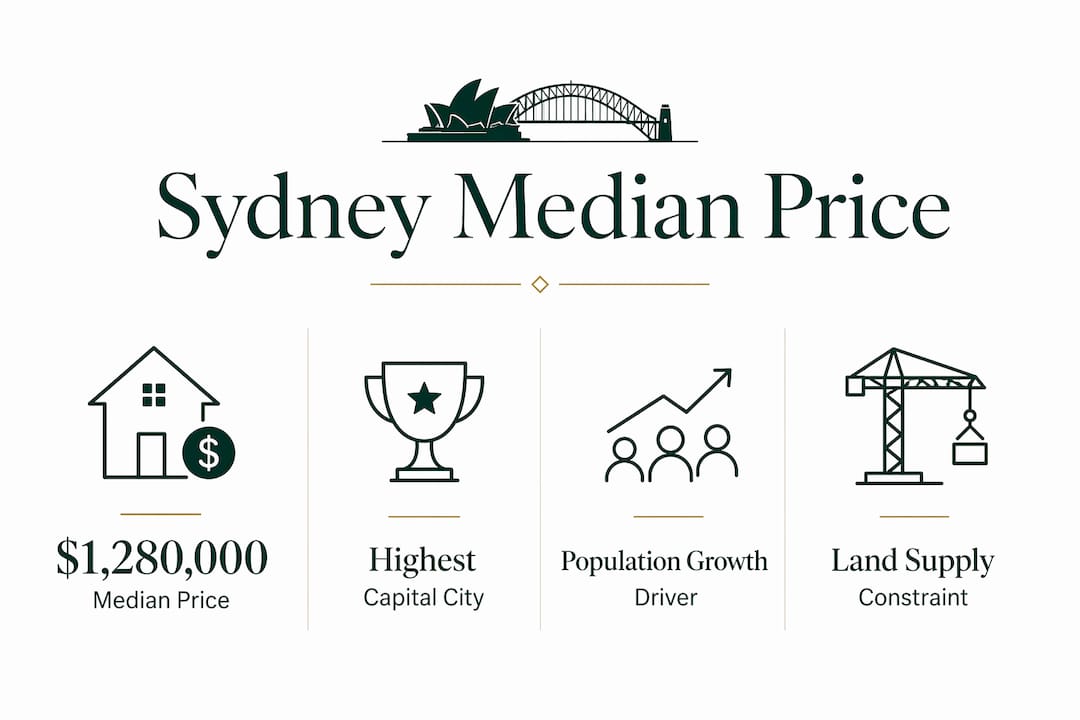
Sydney’s median house price is the highest of any Australian capital city. At march 2026, CoreLogic data put Sydney’s median at approximately $1,280,000, compared with Melbourne at $891,000 and Brisbane at $782,000. The ABS Total Value of Dwellings data for the same period recorded New South Wales’s mean dwelling price at $1,324,800, the highest in the country.

| City | Median house price (march 2026, approx.) |
|---|---|
| Sydney | $1,280,000 |
| Melbourne | $891,000 |
| Brisbane | $782,000 |
The gap between Sydney and other capitals reflects a combination of constrained land supply, strong population growth, and concentrated employment in the CBD and inner suburbs. It also reflects the composition of what sells in any given quarter. When more prestige properties transact, the median rises even if underlying values have not shifted.
Median price trends point to market direction, but they do not tell you whether a specific property has grown in value. A rising median across Sydney could mask a flat or falling market in particular suburbs, or it could reflect a surge in high-end sales rather than broad price growth. Property analysts consistently advise treating the median as a starting point, not a verdict on market health.
Affordability is where the median becomes most confronting. Sydney’s median house price sits well above what most households can borrow without a substantial deposit. Understanding Sydney property prices in this context means recognising that the median describes the market’s midpoint, not the floor. Plenty of houses sell below it, particularly in outer western suburbs and the greater metropolitan fringe.
Other important considerations when using the median house price
The median is a useful benchmark, but several factors can make it misleading if taken at face value.
- Small sample size: In suburbs with low transaction volumes, one or two outlier sales can shift the median dramatically. A suburb that records only eight sales in a quarter is far more vulnerable to distortion than one with eighty.
- Market composition shifts: If more expensive properties sell in one quarter than the last, the median rises even if no individual property has increased in value. Rising median prices do not always signal genuine growth; changes in market composition can create phantom movements.
- Dwelling type mixing: A median that blends houses and units will understate the true house price and overstate the unit price. Always confirm the dwelling type scope.
- Geographic boundary changes: The ABS notes that historical Sydney medians reflect capital city boundaries as previously defined, which have shifted over time. Long-run comparisons require care.
- The median is not your property’s value: An area posting a median of $1,280,000 contains properties ranging from well below that figure to well above it. The median tells you nothing about the specific house you are considering buying.
Pro Tip: Pair the median with days on market and auction clearance rates for the same suburb and period. A rising median alongside falling clearance rates often signals the market is thinning at the top, not genuinely strengthening.
How a licensed buyers agent uses median price data in practice
The median is where analysis starts, not where it ends. A licensed buyers agent uses it to establish a market context, then layers in suburb-level data, recent comparable sales, and off-market intelligence to arrive at a genuine view of what a specific property is worth.
The median house price tells you what the market’s midpoint looks like. It does not tell you whether the property in front of you is priced fairly, whether the vendor has priced it above recent comparable sales, or whether a better opportunity exists off-market. Buyers who anchor their offer to the suburb median without adjusting for property-specific factors routinely overpay or miss the mark entirely. The median is context, not a valuation.
Practical ways a buyers agent applies median price data:
- Establishing a suburb baseline: The median sets a reference point for whether a property is priced at, above, or below the typical market level for that area and dwelling type.
- Tracking quarterly movement: Comparing medians across consecutive quarters reveals whether a suburb is trending up, flat, or softening, which informs timing decisions.
- Identifying composition distortions: An experienced agent recognises when a quarterly median spike reflects a cluster of prestige sales rather than genuine broad-based growth.
- Combining with comparable sales: Recent sales of similar properties (same street, similar land size, similar condition) provide far more precise pricing guidance than the suburb median alone.
- Integrating off-market data: A significant share of Sydney transactions never appear in public listings. Off-market sales do not always feed into publicly reported medians promptly, which means the published figure can lag actual market conditions.
Sydney Property Buyers, directed by Kristan Johnson (2024 Outstanding Buyers Agent of the Year, Inner West Local Business Awards), uses median price data as one layer within a broader analysis that includes independent appraisal, due diligence, and negotiation strategy. With more than 100 properties secured for clients and over 30% of purchases completed off-market, the agency’s approach reflects exactly the kind of multi-metric thinking that median price data alone cannot replicate. Understanding buyers agent search strategies shows how this works in practice.
Contextual notes on median price interpretation
Context determines whether a median figure is useful or misleading. The same $1,280,000 Sydney median means something very different depending on whether you are buying a freestanding house in the Inner West or a townhouse on the city’s fringe.
Geography matters enormously. Sydney is not a single market. The Inner West, Eastern Suburbs, Lower North Shore, and Eastern Beaches each carry their own price dynamics, driven by proximity to employment, school catchments, transport access, and land scarcity. A city-wide median smooths over these differences entirely. Suburb-level medians are more useful, but they carry the small-sample risk described above.
Timing also shapes interpretation. Quarterly medians capture a snapshot. A quarter with unusually low transaction volumes, perhaps during school holidays or following a public holiday cluster, can produce a median that does not reflect the underlying trend. Comparing a single quarter’s figure to the same quarter in the prior year is generally more informative than a quarter-on-quarter comparison.
The ABS itself advises users to exercise caution when interpreting medians over time, particularly where capital city boundary definitions have changed. For buyers using historical data to assess long-run growth, this is a genuine constraint. A property valuation from a qualified valuer provides a property-specific figure that no median can replicate.
Limitations and common misconceptions about median house price
The most persistent misconception is that the median equals the typical property value in a suburb. It does not. The median is the midpoint of sales in a period, and the spread of prices around that midpoint can be enormous. A suburb with a median of $1,500,000 might contain properties selling from $900,000 to $3,000,000. The median tells you where the middle of recent sales sat, nothing more.
A second common error is treating a rising median as proof of capital growth. If the mix of properties selling in a quarter skews toward larger or more expensive homes, the median rises without any individual property increasing in value. The ABS makes this point explicitly: unstratified medians are raw transaction midpoints, not quality-adjusted price indexes. The stratified indexes the ABS publishes separately are designed to control for composition changes; the raw median is not.
A third misconception is that the median is always statistically reliable. In low-volume suburbs, it is not. The Reserve Bank of Australia has noted that in areas with few transactions, small sample bias can cause the median to fluctuate disproportionately due to outliers. A suburb recording a handful of sales in a quarter can show a dramatic median movement that reflects nothing about the broader market.
Finally, buyers sometimes confuse the median with the mean. The mean price of dwellings, as published by the ABS, divides the total value of all residential dwellings by the estimated number of dwellings in the stock. It covers all dwelling types across the whole state. The median covers a specific dwelling type in a specific geography. Comparing them directly produces a misleading picture of average housing costs in Sydney.
Key takeaways
The Sydney median house price is the midpoint sale price of all houses transacted in a given period, not an average, and it requires careful interpretation alongside suburb-level data, transaction volumes, and additional market metrics.
| Point | Details |
|---|---|
| Median is a midpoint, not an average | Half of Sydney houses sold above and half below this figure in any given period. |
| Sydney’s median at March 2026 | CoreLogic data put Sydney’s median at approximately $1,280,000, the highest of any Australian capital city. |
| Small sample risk | In low-volume suburbs, one or two outlier sales can shift the median significantly, per Reserve Bank of Australia research. |
| Median does not equal property value | A suburb median covers a wide price range; individual properties can sit well above or below the midpoint. |
| Use alongside other metrics | Pair the median with auction clearance rates and days on market for a complete picture of market conditions. |
Work with a buyers agent who reads beyond the median
Understanding what Sydney’s median house price means is the first step. Knowing how to act on it is where most buyers need support. Sydney Property Buyers offers a full purchase service covering strategy, independent appraisal, negotiation, and auction bidding, as well as a Negotiation Only service for buyers who have already identified a property. With a 5.0 Google rating, an average saving of approximately 9% on purchase price, and over 30% of purchases secured off-market, the agency brings the kind of market intelligence that no published median can provide on its own. Call 1800 676 177 or email hello@sydneypropertybuyers.com.au to speak with Kristan Johnson’s team.
Recommended
- What does a buyer’s market mean in sydney?
- How to research Sydney suburbs property in 2026
- Why time on market matters for Sydney buyers in 2026