Get a rental appraisal before you sign a contract, not after. It is a professional opinion of the weekly rent a property should achieve today. It tells you whether the yield you are counting on is realistic, and whether the loan you need will stack up once the bank applies its own conservative maths. This guide explains how to get a sound one on a Sydney property, who should provide it, and where buyers go wrong.
A note on terms. In the US, “appraisal” usually means a lender-ordered valuation after an offer is accepted. In Sydney, a rental appraisal is something different: an opinion on likely rent, given by an agent or buyers agent, usually before you commit.
TL;DR
- A rental appraisal is an informed opinion of likely weekly rent. It is not a formal valuation, and it is not binding on anyone.
- Ask for evidence: recent, like-for-like leased or advertised comparables, not area medians or a round number.
- Lenders typically cut expected rental income by at least 20% when testing your loan, so build your budget on the lower figure.
- Get two or three independent opinions, and keep one of them from anyone who profits if you buy.
- Do it before the contract is exchanged, and ideally before you bid at auction.
Table of Contents
- What a rental appraisal is, and what it is not
- Why the number matters more than it used to
- The rent range matters, and the Sydney market moves
- How to get a rental appraisal you can trust
- Compare the opinions: a quick table
- Turn the appraisal into a real budget
- When an appraisal is not enough
- Common mistakes buyers make
- Perspective: what we see from the buyer’s side
- How we can help
- If you also own property in the US
- FAQ
- Sources
What a rental appraisal is, and what it is not
A rental appraisal is an evidence-based opinion on the weekly rent a property is likely to achieve in the current market. Agents and buyers agents give them. The Real Estate Institute of NSW (REINSW) draws a clear line between an appraisal and a valuation: an appraisal is an agent’s or buyers agent’s opinion, while a valuation is a formal, independent assessment by a registered valuer, used for things like mortgage security, tax or legal disputes.
That matters for two reasons.
- An agent’s appraisal carries no regulatory weight. It is only as good as the comparables and the judgement behind it.
- Registered valuers work to professional standards. The Australian Property Institute publishes a practice guide on rental valuations and advice that sets out what a valuer must do when assessing rent. An agent’s opinion is not held to that standard, which is why a good one should still copy the method.
If you want a rent figure you can rely on in a dispute, or one that must stand up to a lender, a formal rental valuation is the right tool. For the everyday question of “what will this earn and should I buy it?”, a well-evidenced appraisal is what most investors use. We cover the main report types in our explainer on buyers agent property assessments.
Why the number matters more than it used to
Investors have less room for error than they once did. Property Investment Professionals of Australia told a NSW Parliament inquiry in August 2024 that only about 21.7% of investor portfolios were positively cash-flowed, down from 38% in earlier years. The same submission says long-term capital growth remains the most important driver for investors, followed by long-term rental income.
Put those together and the practical lesson is plain. Most investors are topping up the loan from their own pocket each month. If your appraisal is A$60 a week too high, that is roughly A$3,100 a year of income that never arrives. It is a cost you will only discover after you own the property.
The rent range matters, and the Sydney market moves
Rents in Sydney are not static. According to a roundup of SQM Research’s August 2026 figures, Sydney’s vacancy rate sat at 1.7%, with asking rents falling slightly over the month and more vacant listings than a year earlier. A loosening market is exactly when a stale appraisal misleads. An agent quoting last year’s achieved rents may be describing a market that has already shifted.
For a wider read on timing, see our piece on Sydney rental vacancy figures.
How to get a rental appraisal you can trust
Step 1: Define the property precisely
Two-bedroom units in the same street can rent for very different amounts. Before anyone gives you a number, write down:
- Bedrooms, bathrooms, car space, outdoor space, floor level and aspect
- Condition and any renovation needed to reach the rent you want
- Strata levies if it is a unit or townhouse
- Distance to train, light rail or bus, which often moves rent more than finishes do
Step 2: Ask for like-for-like comparables
This is where most appraisals fail. REINSW’s CEO Tim McKibbin has pointed out that median and average prices are helpful but represent past sales history rather than the value of the specific property in front of you. The same logic applies to rent. A suburb median for two-bedroom units tells you nothing about a dated unit on a main road with no parking.
Industry commentary on comparable sales points to using verified data from recent weeks up to about six months, not older figures. Apply the same discipline to rent: ask for three to five recently leased or currently advertised properties, each with an address, a weekly rent and a short note on how it differs from yours.
Step 3: Separate asking rent from achieved rent
Asking rent is what a landlord hopes for. Achieved rent is what a tenant signed. Listings that sit for weeks are telling you the asking figure was too high. Ask the person appraising for the days on market of each comparable.
Step 4: Inspect in person
A desktop estimate can be a starting point, but it misses the things that decide rent: condition, noise, light, the streetscape and how the building is kept. REINSW’s guidance on appraisals stresses that in-person assessment builds a more accurate picture than a virtual one. For inspections outside open-home times, our team inspects seven days a week, which lets us look at a property when it is quiet and the street is in its normal state.
Step 5: Get more than one opinion
Two or three opinions from different sources will show a range. If one comes in A$80 a week above the others, find out why before you rely on it. Be careful with free appraisals offered by agencies that want to manage the property: they have a reason to be generous, because a high number wins the management. Likewise, a selling agent has an interest in your enthusiasm.
Compare the opinions: a quick table
| Source | Best for | Watch out for |
|---|---|---|
| Property manager’s free appraisal | Quick read on local demand | May lean high to win the management |
| Selling agent’s comment | Context on the building and street | Has an interest in the sale |
| Buyers agent | Independent view tied to your purchase decision | Check it is evidence-based and shows comparables |
| Registered valuer (rental valuation) | A formal figure for lenders, tax or disputes | Cost and turnaround time |
Turn the appraisal into a real budget
Apply the bank’s haircut first
Lenders do not take your rental estimate at face value. The Australian Prudential Regulation Authority’s practice guide on residential mortgage lending notes that lenders commonly apply a discount of at least 20% to expected rental income when assessing serviceability, with larger reductions for riskier properties. Put simply, if you appraise rent at A$700 a week, the bank may count only A$560 of it.
That gap is a leading cause of surprises at pre-approval stage. Build your borrowing capacity on the discounted figure, not the headline.
Then work out your own cash flow
Use the appraised rent, not the optimistic one, and subtract:
- Loan interest and any principal repayments
- Council and water rates
- Strata levies for units and townhouses
- Landlord insurance
- Property management fees
- Maintenance, plus an allowance for vacancy between tenants
Our rental yield formula with worked examples walks through the gross and net calculations step by step, and our guide to beating lender tests on an investment purchase explains how serviceability shapes what you can bid.
A worked example
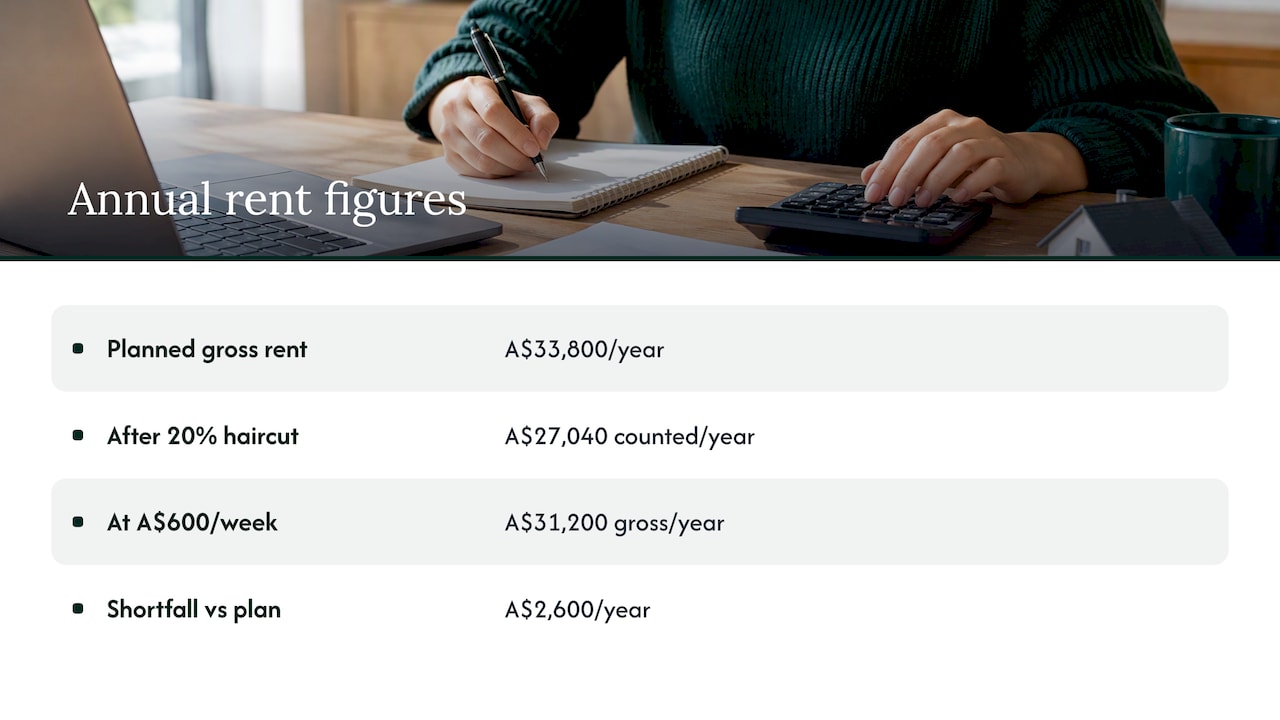
Suppose you appraise a two-bedroom unit at A$650 a week. That is A$33,800 a year in gross rent. The lender’s 20% haircut brings the figure it counts down to A$27,040. If your appraisal was in fact too high and the unit lets at A$600, the gross income is A$31,200, and you are short by A$2,600 a year compared with your plan, before any vacancy. The numbers are illustrative, but the pattern is real: small weekly differences compound into thousands of dollars a year.
When an appraisal is not enough
Sometimes you should commission a formal valuation instead of relying on an opinion. REINSW’s guidance suggests that where there are no relevant recent sales, a formal valuation is the safer route, because an opinion can leave a large gap between your purchase price and the bank’s eventual valuation. Consider one when:
- The property is unusual: a large dual-occupancy, a converted warehouse, a unit in a small mixed-use building
- You are borrowing close to your limit
- The comparables you can find are thin or more than six months old
- You need a figure to support a decision with a partner, family member or co-investor
For land values and sales data, NSW’s Valuer General valuation portal offers free land value searches and valuation sales reports, a useful cross-check on the sales evidence behind a price. Our guide on using Valuer General comparables shows how we use it.
Common mistakes buyers make
- Using area medians as a rent guide. They describe the past across many different homes, not the one you are considering.
- Trusting a single verbal figure. Ask for the comparables in writing.
- Ignoring the suburb’s micro-differences. Streets a few hundred metres apart can rent very differently. We looked at this in Newtown versus Marrickville, where a modest weekly gap changes the whole yield picture.
- Forgetting running costs. Strata levies in particular can erase a strong-looking yield.
- Appraising after you are committed. At auction there is no cooling-off period, so the work has to be done beforehand. Our guide to Sydney auction bidding covers what that means in practice.
Perspective: what we see from the buyer’s side
We act only for buyers, never for sellers, so nobody pays us more if you pay more. That shapes how we handle rent estimates. Our view is that a rental appraisal is a stress test, not a sales tool. We want to know the lowest rent a property could reasonably achieve, and whether the purchase still works at that level.
In practice we run three checks before we recommend a bid. First, does the rent hold up against recent, like-for-like comparables rather than a suburb average? Second, does the loan still work after the lender’s haircut? Third, is the property one that tenants will keep wanting in five years, because capital growth and rent both depend on that? We pair rental yield with capital growth potential because an investment that only wins on one of them is rarely a good one.
The other thing we see is how often the best properties never reach a portal. More than 30% of our purchases are secured off-market, and on those the appraisal has to happen quickly and privately, so the buyer can move before a campaign begins. Clients also tell us the most useful part is the independent appraisal on price, not just on rent: it gives them the confidence to walk away, which is where a lot of savings come from. Across our clients, the average saving on purchase price is about 9%.
— Kristan
How we can help
If you are weighing a Sydney purchase and want the rent and price opinions done independently, our Complete Purchase Solution covers strategy, on-market and off-market search, independent appraisal, due diligence, negotiation, auction bidding and settlement. If you have already found a property and want help getting the price right, Negotiation Only puts a licensed agent across the table for you. We work across the Inner West, Eastern Suburbs, Lower North Shore and Eastern Beaches, and you can see properties we have secured for clients. Our average time from engagement to settlement is 54 days.
If you are earlier in the process, our guide to buyers agent investment property searches in Sydney explains what to expect.

If you also own property in the US
Many of our overseas enquiries come from buyers who already hold a home back in the US and wonder whether to rent it out while they invest in Sydney. The same principle applies: test the rent against real comparables before you rely on it. This guide on how to rent out an inherited property covers that situation on the US side, including the risk of overestimating the income a property will produce.
FAQ
Is it wise to get a rental appraisal before buying?
Yes. It is the cheapest way to test your assumptions before you are legally committed. A realistic rent figure tells you whether the purchase suits your budget, and it protects you from relying on an optimistic number that your lender will discount anyway.
How accurate is a rental appraisal?
It is an opinion, not a guarantee. Its accuracy depends on the quality of the comparables and on the person giving it. An appraisal backed by recent, like-for-like leased properties and an in-person inspection is far more reliable than a figure quoted over the phone.
What is the difference between a rental appraisal and a valuation?
An appraisal is an informed opinion from an agent or buyers agent. A valuation is a formal assessment by a registered valuer, used for purposes like lending or legal matters. If a lender or a dispute is involved, a valuation carries the weight.
How much rent will the bank count?
Lenders vary, but APRA’s guidance notes a common haircut of at least 20% on expected rent, so assume the bank counts about 80% of your appraised figure. Ask your broker or lender for their exact policy before you bid.
Sources
- REINSW: The difference between market appraisals and valuations
- REINSW: Comparable sales, the formula and differing markets
- REINSW: What is value?
- APRA: Prudential Practice Guide APG 223, Residential Mortgage Lending
- API: AVGP 301 Rental Valuations and Advice
- Property Investment Professionals of Australia submission to NSW Parliament, 8 August 2024
- Valuer General NSW Valuation Portal
- Australia Develops: Rental vacancy rates across Australia
Recommended
- How to research Sydney suburbs property in 2026
- Sydney Rental Vacancy: 3 Figures US Buyers Can Use to Time a Purchase
- How Buyers Saved 9% on Sydney Tenanted Purchases: NSW Legal Checklist
- Buyers agent investment property search: Sydney guide