Sydney’s rental vacancy rate sits below the generally recognised threshold for a healthy, balanced market, and that scarcity is still pushing advertised rents higher across most of the city. For renters this means faster competition and less room to negotiate lease terms, while landlords are seeing shorter vacancy periods and stronger pricing power. If you want to track where this is heading, watch three figures: the monthly vacancy rate, new rental listings, and median asking rent.
TL;DR:
- A citywide vacancy figure can hide sharp suburb differences, so compare local rates and average readings across three months to separate trends from monthly noise.
- Advertised rents on new listings can respond within weeks, while citywide medians and existing lease renewals may take months or a year to reflect changes.
- Renters should prepare payslips, rental history, and references before inspections, since popular properties can draw multiple applications within days and leave little negotiating room.
- Landlords can relet vacant homes faster, but aggressive renewal increases may drive away reliable tenants and create a costly vacancy if demand softens.
- Buyers should compare suburb vacancy with rental listings, sale stock, auction results, and days on market; falling vacancy alone does not prove supply is shrinking.
Table of Contents
- Sydney’s latest vacancy rate figures and what they signal
- How a tight vacancy rate pushes rents higher
- What tight vacancy means for renters right now
- What tight vacancy means for landlords and investors
- What to watch next and how fast conditions usually shift
- What licensed practitioners see in the current market
- How vacancy swings shape a buyer’s decision-making
- Vacancy rates, rental yield and capital growth over time
- Using vacancy data to time negotiations and purchases
- Vacancy differences across Sydney’s suburbs
- How Sydney’s vacancy rate has moved over recent years
- What this data means for your next move
- Buyer’s agent support when vacancy conditions are shifting
- FAQ
Sydney’s latest vacancy rate figures and what they signal
Sydney’s rental vacancy rate has remained persistently tight through 2025 and into 2026, tracking below the 3% threshold that property economists and portals such as Domain and SQM Research treat as the point of balance between renters and landlords. A rate much below that line points to a landlord’s market: limited stock, fast-moving applications, and upward pressure on asking rents.
A vacancy rate below the commonly cited healthy benchmark indicates a tight rental market where available homes are scarce relative to demand, a pattern Sydney has shown for several consecutive reporting periods.
Three things worth separating when you read a headline vacancy number:
- The headline city-wide figure often masks sharp differences between inner suburbs and outer growth corridors.
- A single month’s reading can be noisy; a three-month moving average gives a steadier read on direction.
- Listings volume and median rent movements usually confirm (or contradict) what the vacancy rate alone suggests.
For the most current readings, we always recommend checking primary sources directly, since vacancy data is revised monthly and headline figures can shift quickly between reporting cycles.
How a tight vacancy rate pushes rents higher
Rental markets move on a simple supply and demand chain: fewer available homes mean more people competing for each listing, and that competition translates into higher asking rents. When vacancy drops, prospective tenants submit more applications per property, landlords and agents can be more selective, and asking prices for new listings tend to firm up first.
The timing matters here. Advertised rents on new listings usually move within weeks of a vacancy shift, but the citywide median rent, which blends new leases with existing tenancies, takes longer to catch up. Renewals on existing leases often lag by months or even a full year, since many tenants are mid-contract when conditions change.
A few factors slow or speed up that pass-through:
- NSW tenancy protections limit how often and how much rent can rise within a fixed term, which smooths the adjustment for sitting tenants.
- Investor supply entering or leaving the market (new builds, off-the-plan completions, landlords selling up) can offset or amplify vacancy pressure.
- Seasonal patterns, such as the usual uptick in listings over summer, create short-term vacancy swings that do not always reflect the underlying trend.
Pro Tip: Track new listing prices rather than the median rent if you want an early read on where the market is heading, since new listings move first and the median catches up later.
What tight vacancy means for renters right now
A low vacancy rate changes almost everything about the rental search in practical terms, from how long a property stays listed to what landlords expect from an application.
- Expect shorter time-to-lease: well-presented properties in popular suburbs can attract multiple applications within days, sometimes hours, of listing.
- Expect more competition at inspections, with agents sometimes running group viewings rather than one-on-one appointments.
- Expect landlords and agents to request stronger evidence of affordability, such as payslips, rental history, and references, before shortlisting an application.
- Expect less room to negotiate on rent, bond, or lease length when multiple applicants are chasing the same property.
- Expect to move faster than usual: having documents ready before inspections, rather than after, genuinely improves your odds in a tight market.
Flexibility on move-in date and lease length can also help an application stand out when a landlord is choosing between several similar offers.
What tight vacancy means for landlords and investors
When vacancy falls, landlords typically gain pricing power and move to capture it, but that shift comes with trade-offs worth weighing rather than chasing blindly.
- Rent increases on vacant properties tend to come first, with renewals on existing tenancies following more cautiously to avoid losing good tenants.
- Faster re-letting becomes achievable, since fewer days on market means less lost rent between tenancies.
- Screening tends to tighten, with landlords favouring applicants who show stable income and a clean rental history over those simply offering the highest rent.
- The trade-off is real: pushing rent too aggressively on renewal risks losing a reliable tenant and absorbing a longer vacancy if the broader market softens.
- Presentation and marketing still matter even in a landlord’s market; properties that are well-photographed and competitively priced from day one typically lease faster and attract stronger applicants.
Protecting yield in this environment is less about chasing the highest possible rent and more about balancing a sustainable increase against the cost of a prolonged vacancy. Landlords focused on long-term tenancy stability often find that a measured approach to pricing, paired with tenant retention strategies that reduce turnover, protects income more reliably than maximising every renewal.
What to watch next and how fast conditions usually shift
Vacancy rates rarely move in isolation. A handful of drivers tend to set the direction over the coming months:
- New housing and apartment completions entering the Sydney market, which add supply over time.
- Net migration into New South Wales, which has been a major demand driver for rental housing.
- Interest rate settings and lending conditions, which influence how many would-be buyers stay in the rental pool longer.
- Investor activity, since investors selling out of the market can tighten rental supply even as the same properties may later return as owner-occupied homes.
Typically, shifts in underlying supply or migration take a few months to show up clearly in vacancy figures, and longer again before median rent statistics reflect the change. Readers tracking the market should watch the monthly vacancy rate, new listing volumes, and net migration data together rather than any single figure in isolation.
What licensed practitioners see in the current market
Kristan Johnson, director of Sydney Property Buyers and a licensed real estate agent, works daily with buyers navigating these supply conditions across Sydney’s inner and eastern markets.
Years spent negotiating and bidding in tight Sydney conditions shape how vacancy data gets read in practice: a falling vacancy rate in a target suburb often signals that competition for both rentals and purchases is about to intensify, which affects how quickly a buyer needs to move and how firmly a vendor is likely to hold their price.
When vacancy tightens in a suburb, we see it in rental appraisals before it shows up in the official statistics. Buyers who understand that lag have an advantage in both negotiation and timing.
Signals worth tracking alongside the headline vacancy number include local rental appraisal trends, days-on-market for comparable rentals, and how quickly similar properties in the same postcode are being relisted.
— Kristan
How vacancy swings shape a buyer’s decision-making
A falling vacancy rate changes the calculus for anyone weighing up whether to buy now or wait. Tight rental conditions typically signal strong underlying demand for housing in a suburb, which supports the case for buying sooner rather than later if rental yield or future resale value is part of the decision.
Conversely, a loosening vacancy rate, where more rental stock is coming onto the market, can suggest softer near-term rental demand and may give buyers more room to negotiate on price or settlement terms, since vendors face less competitive pressure to offload quickly.
Buyers researching a suburb should treat vacancy data as one input alongside listing volumes, auction clearance rates, and days-on-market, rather than relying on it in isolation. A suburb with falling vacancy but rising stock levels for sale, for instance, can indicate landlords exiting the rental market to sell, which has different implications than a simple shortage of new rental supply. Reading these signals together, rather than reacting to a single headline figure, tends to produce better-timed decisions, whether that means moving quickly on a well-priced property or holding out through a softer patch. Anyone serious about using this kind of data should start with thorough groundwork; our guide on how to research Sydney suburbs property in 2026 walks through the practical steps.
Vacancy rates, rental yield and capital growth over time
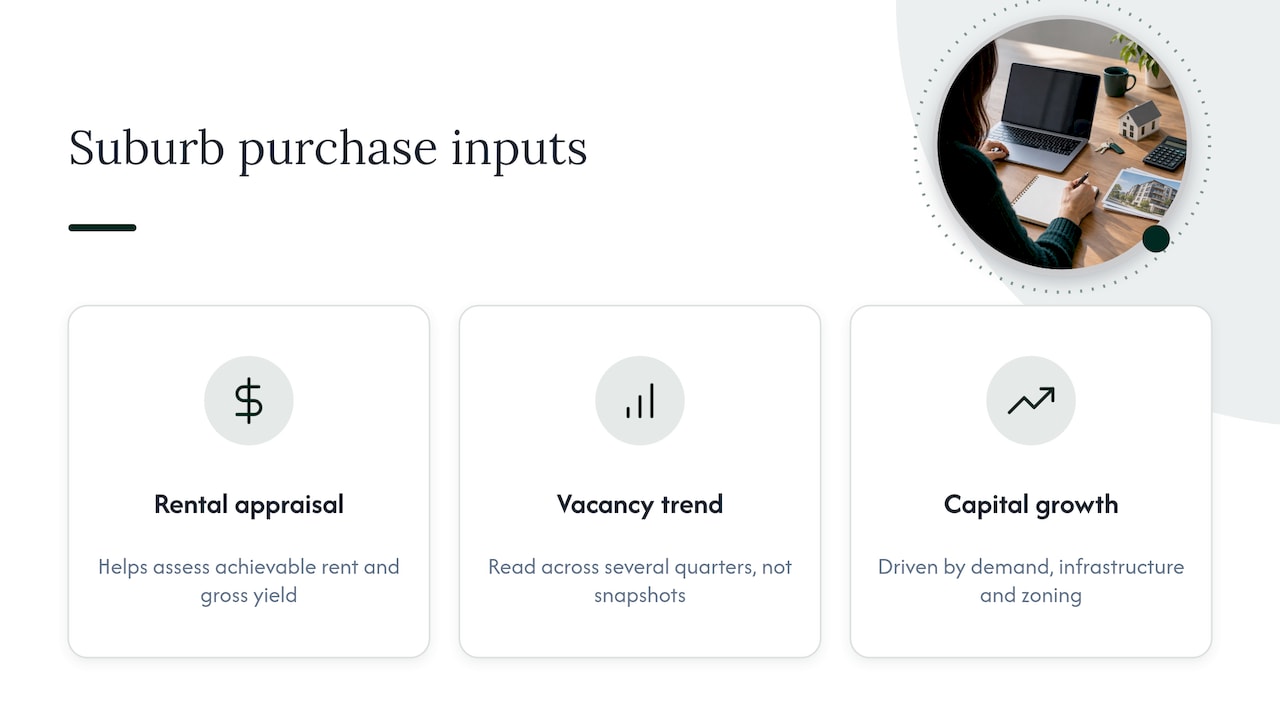
Vacancy conditions feed directly into rental yield, since lower vacancy supports higher achievable rents, which lifts gross yield on a given purchase price. That relationship is most useful to investors when it is read over several quarters rather than a single snapshot, since short-term vacancy dips can reflect seasonal listing patterns rather than a genuine supply shift.
Capital growth is a separate question, driven more by long-term demand fundamentals such as population growth, infrastructure investment, and zoning changes than by month-to-month vacancy swings. That said, suburbs with persistently tight vacancy often also see sustained buyer demand, since the same underlying scarcity that pushes rents up tends to support property values over the medium term.
Investors assessing a potential purchase benefit from looking at vacancy trends alongside rental yield history and recent capital growth figures for the specific suburb, rather than relying on city-wide averages that can obscure local conditions. A holistic read that combines current rental appraisal, vacancy trend, and growth trajectory gives a far more reliable picture than any single metric reviewed alone. Investors exploring Sydney opportunities from overseas can find useful context in our piece on buying Sydney property from the US in 2026.
Using vacancy data to time negotiations and purchases
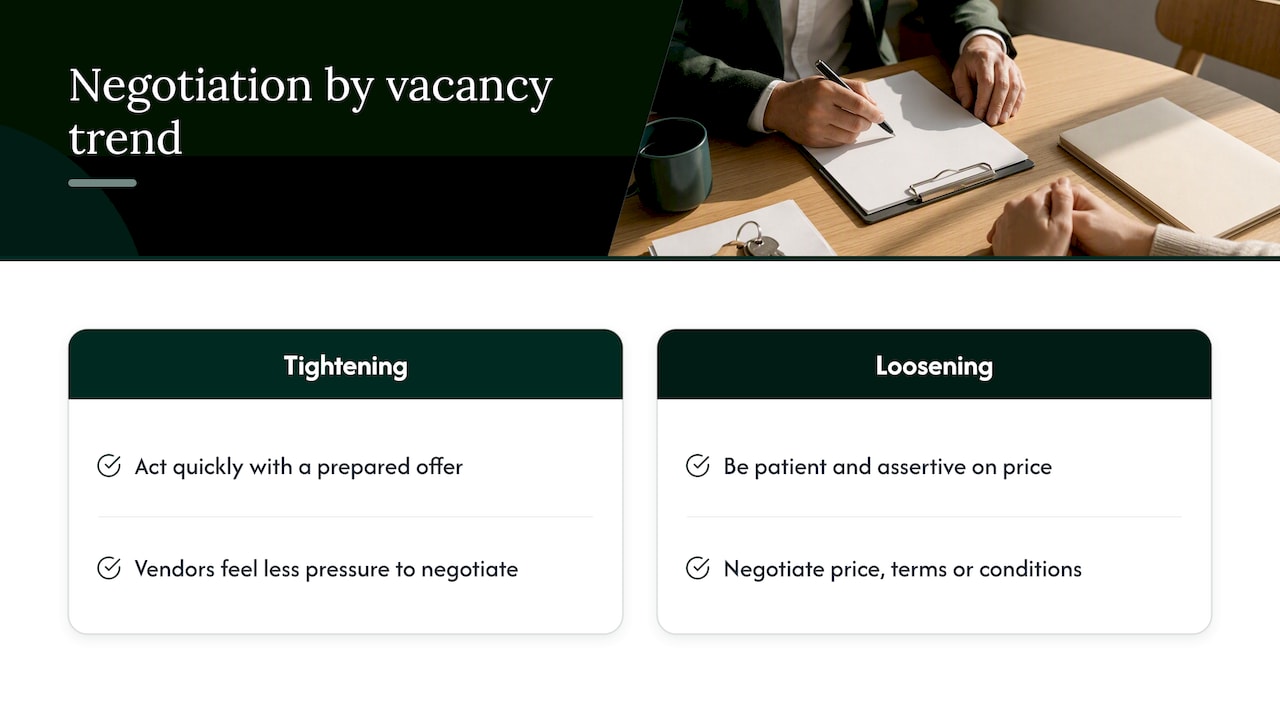
Vacancy conditions can be used strategically at the negotiating table, not just as background context. In suburbs where vacancy is tightening and rental demand is strong, vendors often feel less pressure to negotiate on price, since they know the property’s investment appeal will attract interest regardless. In these conditions, buyers tend to do better by moving quickly with a well-prepared offer rather than trying to negotiate hard on price.
Where vacancy is loosening or rental stock is building up, buyers can afford to be more patient and more assertive on price, settlement terms, or conditions, since vendors in these suburbs may be facing softer rental demand and slower-moving stock.
Timing a purchase around seasonal vacancy patterns also matters. Rental listings typically rise over the summer months as leases turn over, which can briefly ease vacancy pressure and create short windows where tenanted investment properties are easier to assess and negotiate. Buyers considering a tenanted purchase should also factor in the legal checklist that comes with an existing tenancy; our breakdown of how buyers saved 9% on Sydney tenanted purchases covers the practical steps involved.
Vacancy differences across Sydney’s suburbs
Sydney’s rental market is not uniform, and vacancy conditions can differ sharply between neighbouring suburbs let alone across the wider metropolitan area. Inner-city and inner-west pockets close to transport and employment hubs tend to run tighter than outer growth corridors, where new housing supply is still being delivered.
Eastern Suburbs and Lower North Shore markets often show their own distinct patterns, shaped by a smaller pool of rental stock, strong owner-occupier demand, and limited new development compared with high-growth areas further from the city centre. These supply constraints can keep vacancy persistently low even when city-wide figures ease slightly.
Buyers and renters researching a specific suburb should always check localised vacancy and listing data rather than relying on a Sydney-wide average, since that headline figure can mask meaningful differences between, for example, a tightly held eastern beaches pocket and a rapidly growing outer suburb with several new apartment developments settling at once. Our North Shore buyer’s guide covers some of the specific dynamics at play in that part of the market.
How Sydney’s vacancy rate has moved over recent years
Sydney’s rental vacancy rate has swung considerably over the past several years, shaped by border closures, the return of overseas migration, and shifting investor activity. The sharpest tightening occurred as international arrivals resumed strongly after 2022, adding substantial rental demand at a time when new housing supply had slowed.
The multi-year vacancy pattern underscores a structural mismatch between population growth and new housing delivery rather than a short-term blip.
Understanding that longer trend matters more than reacting to any single month’s figure. A city that has run below balance for several consecutive years is unlikely to flip into oversupply quickly, which is a useful anchor for both renters weighing whether to wait out current conditions and investors assessing whether tight rental demand is likely to persist.
What this data means for your next move
Reading vacancy data in isolation tells you less than reading it alongside listing volumes, rental appraisals, and suburb-level growth trends, and that combination is what genuinely useful decision-making looks like, whether you are a renter timing a search, a landlord setting a renewal, or a buyer weighing up when to act. We apply this same layered approach when advising clients on acquisitions across the Inner West, Eastern Suburbs, and Lower North Shore. If you valued a second set of eyes on how current conditions affect a specific purchase decision, our purchase track record shows the kind of outcomes this approach has delivered.
Buyer’s agent support when vacancy conditions are shifting
Navigating a Sydney purchase while vacancy and rental conditions are moving is far easier with representation that understands both sides of the equation. We work exclusively for buyers, which means every assessment of a property’s rental potential, negotiation position, or off-market opportunity is made with your interests alone in mind.
Our Complete Purchase Solution covers the full journey from strategy and property search, including on-market and off-market opportunities, through independent appraisal, due diligence, negotiation, auction bidding, and settlement. For buyers who have already found a property and need strong representation at the table, our Negotiation Only service provides focused support without the full search process.
Properties are inspected independent of standard open-home schedules, and every assessment includes a holistic look at capital growth potential and rental yield rather than price alone.
If current vacancy and rental conditions in your target suburb are making timing feel harder to judge, get in touch with our team to talk through a purchase strategy built around where the market is actually heading, not just where it has been.
FAQ
Is there a rental crisis in Sydney?
Sydney’s rental vacancy rate has stayed below the level considered healthy for several consecutive years, which has created sustained pressure on availability and rents across much of the city. Conditions vary by suburb, with some inner and eastern pockets tighter than outer growth corridors where new supply is still being delivered.
What is the 7% rule for rental property?
Some investors use it informally as a rough yield benchmark when comparing properties, but it is not a standard applied uniformly by lenders, regulators, or industry bodies.
Are rents dropping in Australia?
Rents have generally continued rising across most of Sydney rather than falling, reflecting the persistently low vacancy rate that has characterised the market for several years. Some outer suburbs with stronger new housing supply have seen rent growth ease compared with inner-city pockets, but outright falls remain uncommon in the current environment.
What is the 30% rent rule in Australia?
The 30% rule is a common affordability guideline suggesting that a household should spend no more than 30% of its gross income on rent to avoid housing stress. It is used widely by housing researchers and policy bodies as a benchmark rather than a legal requirement, and actual affordability varies by income, location, and household circumstances.
Recommended
- Buy Sydney Property from the US in 2026: Off Market & Auction Wins
- Save 9%: Best Time to Buy in Sydney Is When You Have Leverage
- US Buyers: Buy Sydney Property Sight Unseen Without Getting Burned
- Why time on market matters for Sydney buyers in 2026