The best time to buy in Sydney is the moment your finances are ready and the market hands you genuine negotiating leverage, not some elusive “bottom” that only reveals itself in hindsight. That usually means winter or a soft quarter, when listings sit longer and competition thins. Sydney Property Buyers clients secure roughly 9% below asking price on average, proof that preparation beats prediction.
TL;DR:
- Buyers can often negotiate about 9% below asking price during softer market periods with longer days on market and lower auction clearance rates.
- The best window to buy occurs in winter when listings are fewer, competition is lower, and seller urgency tends to decrease, especially in established suburbs or lifestyle hubs.
- Securing pre-approval, clearly defining your buying criteria, and lining up inspection teams before a listing appears are key steps to acting quickly when opportunities arise.
- Off-market properties and relisted listings with signs of vendor flexibility, such as new agents or price drops, offer better chances for negotiation in a changing market.
- Major economic news, interest rate changes, and seasonal factors significantly influence buyer confidence and market activity, making timing around these events crucial.
Table of Contents
- When is the best time to buy in Sydney’s market cycle?
- How do you prepare to act the moment a window opens?
- What negotiation and auction tactics work in a softer market?
- When does hiring a buyer’s agent make sense?
- How do economic indicators and news events shape buying timing?
- Do different Sydney suburbs have different buying windows?
- Should you time a purchase around holidays or major events?
- Agent perspective: subtle signs an opportunity is emerging
- How Sydney Property Buyers helps you act at the right moment
- Sources
When is the best time to buy in Sydney’s market cycle?
Forget trying to catch the exact low point. Journalists covering Sydney property consistently warn that buyers who wait for the true market bottom often miss it entirely, because confidence returns faster than headlines report it. By the time enough good news accumulates to convince a nervous buyer, prices have already started climbing again.
What you can time reliably is seasonality. Winter (June to August) is traditionally Australia’s quietest selling period, while spring floods the market with fresh stock and fresh competition. Fewer buyers touring open homes in July means less pressure at negotiation, even if the property itself is identical to one that would attract six competing offers in October.
Interest rates matter just as much as the calendar. When rates rise, borrowing capacity shrinks and buyer numbers drop, which softens prices and reduces auction competition. When rates fall or hold steady, demand rebuilds quickly and the window narrows. Watch the cycle, not just the current setting.
Three signals tell you more than any forecast:
- Days on market climbing suggests reduced urgency among sellers, and more room to negotiate.
- Auction clearance rates falling below 60% typically signals a buyer-friendly quarter.
- New listing volumes rising without matching buyer turnout usually precedes softer pricing.
Recent quarterly data backs this up: one Sydney agency reported days on market increasing and buyer numbers decreasing through a soft quarter, yet well-priced homes in sought-after streets still moved fast. That’s the pattern worth understanding. Softening is rarely uniform. It creates pockets of opportunity for buyers who are ready to move the moment the right listing appears, while indecisive buyers watch good stock disappear regardless of the broader trend.
How do you prepare to act the moment a window opens?
A buying window in Sydney can close within days. Preparation is what separates buyers who capture it from those who watch it pass.
- Lock in finance first. Get formal pre-approval, not just a rate estimate, and have your deposit sitting ready with clear evidence of funds for your lender and any vendor.
- Write a tight buying brief. Nail down property type, target suburbs, and your genuine non-negotiables versus the trade-offs you’ll accept. Vague briefs waste inspection time and slow you down exactly when speed matters.
- Line up your due diligence team. Have a building and pest inspector, a conveyancer, and ideally a valuer you can call on short notice, not one you need to source after finding the property.
- Set realistic timelines. Search-to-settlement typically runs around 54 days for an organised buyer, but urgent auction or private-treaty bids can compress that dramatically. Know your settlement flexibility before you need it.
Researching target suburbs properly before you start inspecting also saves weeks. A structured approach to suburb research means you’re not learning a street’s flood history or school catchment the same week you’re trying to make an offer.
Pro Tip: Get your pre-approval reassessed every 90 days. Lending criteria shift, and a stale approval can fall over right when you need it to move fastest.
What negotiation and auction tactics work in a softer market?
Longer days on market change the negotiation dynamic entirely, but only if you use the extra time deliberately rather than just waiting passively.
For private sales, structure your offer around what the vendor actually needs, not just the price. A conditional offer with a flexible settlement date, a shortened inspection clause, or a rent-back arrangement can beat a higher headline price if it solves the seller’s real problem. Practical levers that consistently sway vendors include flexible settlement terms, staged inspection windows, and conditional offers that respect the seller’s timing while still protecting your position as buyer.
At auction, discipline beats enthusiasm. Set your ceiling before you arrive, based on genuine comparable sales, and be willing to walk away and negotiate directly with the vendor afterwards if the property passes in. A pass-in during a quiet auction market often hands you more leverage than the auction itself would have.
Key tactics worth building into your approach:
- Time written offers for midweek, when agents have fewer competing enquiries to juggle.
- Ask directly whether the vendor needs a fast or delayed settlement, then offer exactly that.
- Watch for properties relisted with a new agent or a price drop; both signal vendor flexibility.
When clearance rates soften and days on market stretch out, the properties that still move quickly are the ones where the buyer removed friction for the seller, not just the ones with the biggest cheque.
Off-market opportunities compress this whole equation further. Properties never publicly listed carry far less competitive pressure, because there’s no auction, no open home queue, and no bidding war to inflate the outcome.
When does hiring a buyer’s agent make sense?
Two mandate types cover most situations. Negotiation only suits buyers who’ve already found their property and simply need skilled representation to secure it on better terms. Full service covers everything from strategy and search through to appraisal, due diligence, bidding, and settlement.
Certain scenarios tip the scales firmly towards engaging an agent:
- You’re buying interstate or overseas and can’t attend inspections during the week.
- You want access to properties that never reach public listing.
- You’re intimidated by auction bidding or have been outbid repeatedly.
- You’re time-poor and the search itself is the bottleneck, not the finance.
A reputable Sydney buyer’s agent should offer genuine market search across on-market and off-market stock, independent appraisal, hands-on negotiation or bidding, and support through to settlement. Sydney Property Buyers, directed by licensed agent Kristan Johnson (NSW Licence 20456819), has secured over 100 properties for clients across the Inner West, Eastern Suburbs, Lower North Shore, and Eastern Beaches, with more than 30% of purchases secured off-market.
How do economic indicators and news events shape buying timing?
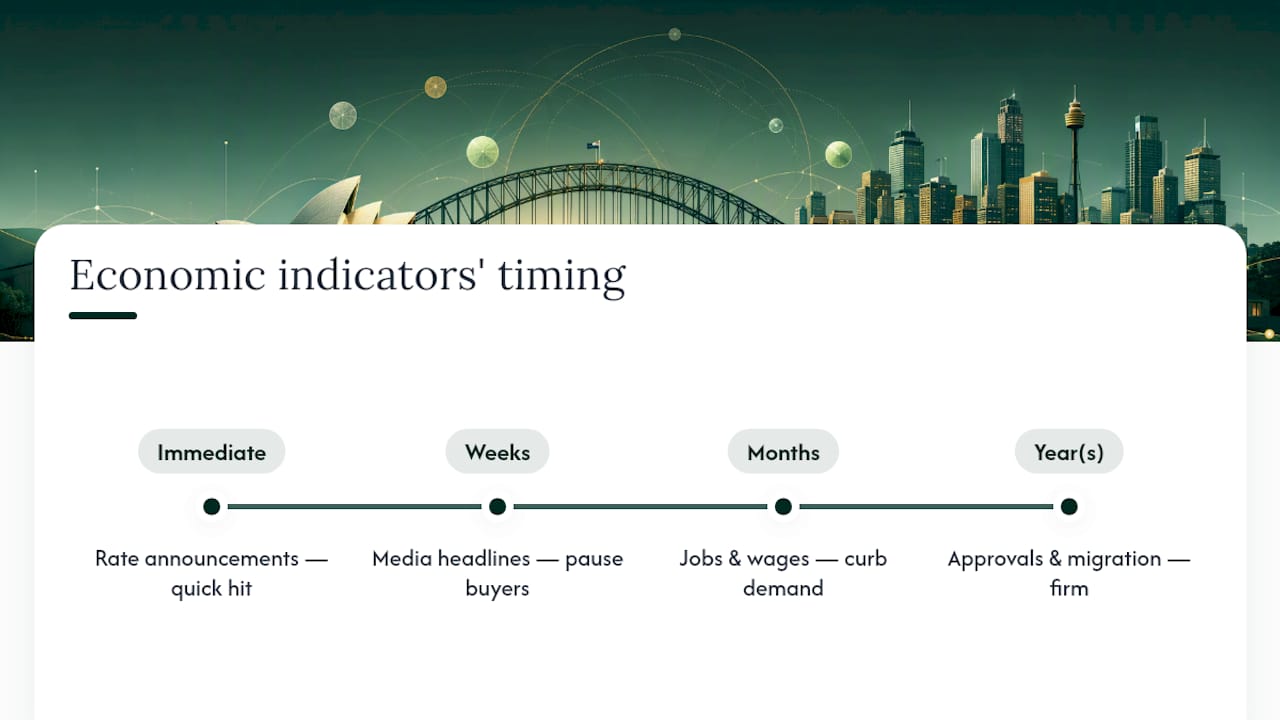
Interest rate announcements move buyer sentiment faster than almost anything else in Sydney property. A single Reserve Bank decision can shift open-home attendance within a fortnight, either flooding inspections with newly confident buyers or emptying them if a hold turns into a surprise hike.
Employment figures and wage growth data matter almost as much, because they shape how comfortable lenders and buyers feel about serviceability. When unemployment ticks up even slightly, discretionary upgraders tend to pull back first, which thins competition for family homes in established suburbs.
Media coverage itself becomes a factor. Heavy negative headlines about falling prices can trigger a temporary pause among buyers, even when the underlying fundamentals in a specific suburb haven’t shifted at all. That gap between headline sentiment and street-level reality is exactly where prepared buyers find room to move. Building approval data and net overseas migration figures also feed into supply and demand over a longer horizon. Rising migration without matching new supply tends to firm up prices in well-located suburbs within a year or two, so tracking these figures alongside your local shortlist gives you a much sharper read than watching city-wide averages alone.
Do different Sydney suburbs have different buying windows?
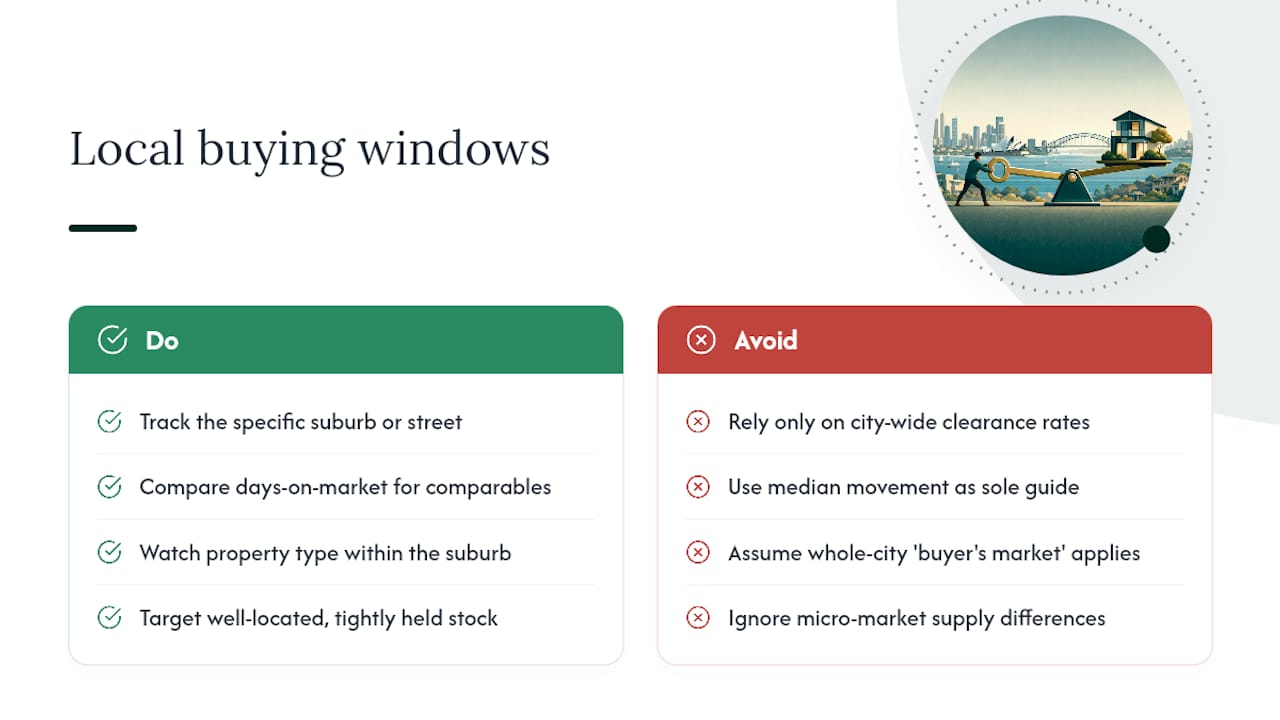
Sydney’s market moves in fragments, not as one block. Some suburbs and property types hold firm even when the city-wide numbers soften, and analysts point specifically to family homes in established suburbs and boutique apartments in lifestyle hubs as consistently resilient performers regardless of the broader cycle.
That fragmentation cuts both ways for buyers. It means a “buyer’s market” headline for Sydney overall can mask a genuinely competitive pocket in, say, the Inner West, where tightly held streets near good schools rarely soften even in a downturn. Meanwhile, an oversupplied apartment corridor further out might sit soft for months.
The practical takeaway: city-wide clearance rates and median price movements are a starting point, not a decision-making tool. Track the specific suburb, even the specific street, where you’re actually looking. Days on market for comparable properties in your target area tells you far more than any citywide report. A buyer’s market designation for Sydney as a whole can still hide fierce competition for the handful of genuinely well-located homes that come up each quarter, which is exactly why quality stock in tightly held pockets keeps attracting fast, decisive offers.
Should you time a purchase around holidays or major events?
The weeks around Christmas and the January school holidays are traditionally the quietest stretch in Sydney property, with agents reporting fewer new listings and thinner open-home attendance through mid-December into late January. That quiet can work in your favour if you’re organised, because vendors who do list during this window are often motivated by a genuine deadline, such as a job relocation or a settlement they need to align.
Easter creates a similar, shorter lull. Long weekends generally see auction volumes drop, and agents often reschedule sales either side of the break rather than compete for buyer attention during it.
The Sydney school year also shapes demand in family-focused suburbs. Competition for homes near sought-after primary and secondary school catchments tends to spike in the lead-up to enrolment deadlines, typically in the months before the following year’s intake. If you’re not chasing a specific catchment, buying just after that seasonal rush eases can mean less competition for comparable properties nearby. None of these windows guarantee a discount on their own, but combined with softer seasonal listing volumes, they’re worth building into your search timeline rather than ignoring.
Agent perspective: subtle signs an opportunity is emerging
Watch vendor behaviour, not just price. A relisted property with a new agent, a quietly extended settlement offer, or a seller suddenly open to pre-auction offers are all green flags. Red flags include vendors fishing for unrealistic guide prices or refusing building reports.
The buyers who do best act decisively once those signs stack up, rather than waiting for a headline to confirm what’s already visible on the ground. Speed matters, but only once your finance and due diligence are already sorted. Acting fast on an unprepared brief is how good buyers overpay for the wrong property.
— Kristan
How Sydney Property Buyers helps you act at the right moment
Spotting a window is only half the job. Converting it into a settled property, before conditions shift again, is where most buyers lose ground. Sydney Property Buyers offers both full-service acquisition and negotiation-only representation, with inspections available seven days a week, independent of open-home schedules, so a strong listing never slips past you while you wait for a Saturday.

Across the Inner West, Eastern Suburbs, Lower North Shore, and Eastern Beaches, the agency has secured more than 100 properties for clients under NSW Licence 20456819, with over 30% sourced off-market and a 5.0 Google rating from past clients. The average saving against asking price sits around 9%, built on the kind of negotiation groundwork covered above rather than luck.
If you’re ready to move on a Sydney purchase, or want a second set of eyes before you bid, get in touch on 1800 676 177 or visit Sydney Property Buyers’ services page to see which mandate fits your situation.
Sources
Recommended
- Why engagement timing matters with a buyer’s agent
- Why time on market matters for Sydney buyers in 2026
- Benefits of buying off-market in Sydney: 2026 guide
- Why off-market listings matter for Sydney buyers