Strata levies are the regular fees every Sydney apartment owner pays to run and maintain a shared building. They are roughly the equivalent of condo or HOA dues in the US, but they work under New South Wales law. They don’t predict whether your apartment will rise in value. They do shape what you can afford, what a buyer will pay when you sell, and whether a building is being looked after. Below, we explain typical amounts, how levies relate to value, and the checks we run before a client commits. All dollar figures are Australian dollars (A$).
TL;DR
- Typical Sydney levies run from about A$3,000 a year for a low-rise block to A$12,000 or more for a high-rise with facilities, commonly 0.3% to 1.2% of a property’s value a year.
- Research on listing data found no meaningful link between levy size and future capital growth. The condition of the building matters more than the number on the notice.
- A very low levy can mean deferred maintenance, and a special levy can arrive later to pay for it.
- Before you sign, read the strata report, the Section 184 certificate, the capital works plan and two years of meeting minutes.
- Price the levy into your budget as a permanent running cost, the way you would a mortgage payment.
Table of Contents
- What a strata levy is, in US terms
- What Sydney levies typically cost
- Do higher levies lower a unit’s value?
- Why a low levy can be a warning
- Why levies rise
- Where levies sit in the current Sydney market
- Worked example: two apartments, one price
- Checks to run before you buy
- Our perspective: treat the levy as a diagnostic
- How we can help
- FAQ
- Sources
What a strata levy is, in US terms
A Sydney apartment is usually owned as a lot within a strata scheme. You own your unit, and you share ownership of the common property (stairs, lifts, roof, structure, gardens) through a body called the owners corporation. Think of it as a condo association that every lot owner belongs to automatically. If you want the wider picture, our guide to strata schemes in Australia covers the structure.
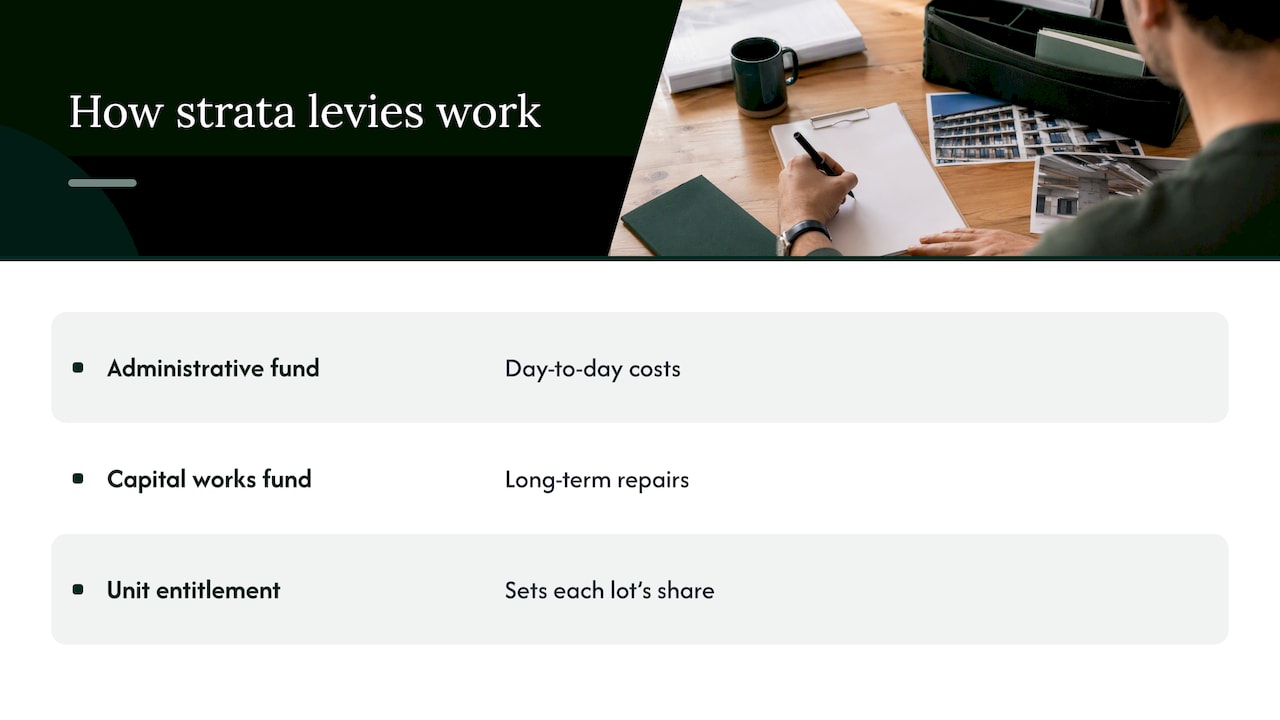
The levy is how that body pays its bills. In NSW, schemes must keep an administrative fund for day-to-day costs and a capital works fund for long-term repairs. At the annual general meeting (AGM), the owners corporation sets a budget and each lot is charged in proportion to its unit entitlement. Unit entitlement is a share set when the scheme is created, so a larger or more valuable lot generally pays more than a small one in the same building.
Levies are normally billed quarterly. Late payment has teeth: the same NSW court presentation notes that overdue levies attract simple interest at 10% per annum once a month past due.
What Sydney levies typically cost
Published figures vary by source and building, so treat any average as a range rather than a promise. One 2026 guide puts annual levies at these levels:
| Building type | Typical annual levy (A$) |
|---|---|
| Low-rise | 3,000 to 5,000 |
| Mid-rise | 5,000 to 8,000 |
| High-rise | 8,000 to 12,000+ |
That table comes from the Strata Fee Calculator guide to Sydney strata fees. Another industry blog reports that a standard two-bedroom apartment now sits around A$1,200 to A$1,500 a quarter, up from A$900 to A$1,100 three years earlier. Those two sources describe different slices of the market, which is exactly the point: the building drives the number.
For scale, the Domain House Price Report coverage put the median Sydney unit price at A$849,068. At 0.3% to 1.2% of value, a median-priced unit would carry roughly A$2,500 to A$10,200 a year in levies. Compare that with a US condo, where HOA dues are also a fixed monthly drag on affordability, and you have the right mental model.
Do higher levies lower a unit’s value?
This is the question behind most searches for this topic, and the honest answer is: not in the way most buyers assume.
A buyer who compares two similar apartments will often mentally subtract the levy difference from the price. That is sensible for cash flow. A higher levy reduces the income an investor keeps and the mortgage a lender thinks you can service. So at the margin, a levy that is high for what the building offers can weigh on price.
But levy size on its own does not forecast growth. Microburbs analysed 1.66 million listings that mentioned levies and concluded there is no meaningful relationship between levy size and later capital growth. The researchers’ framing is useful: a levy is a service fee for keeping the asset viable, not a signal of appreciation. They also note that a low-levy building that ignores capital works can be far riskier than a higher-levy building that plans its major repairs.
In practice, three things sit behind the number:
- What the building offers. The Strata Fee Calculator guide estimates each extra amenity such as a pool, lift, gym or concierge adds about A$80 to A$100 per quarter to base costs. A building with a pool and gym will cost more than a walk-up block, and the buyer pool for it will usually expect that.
- How well the building is maintained. A well-funded capital works fund is a good sign, even if it makes the levy look heavy.
- What is coming. Upcoming works, defects or insurance increases will change the levy, whatever it is today.
Why a low levy can be a warning
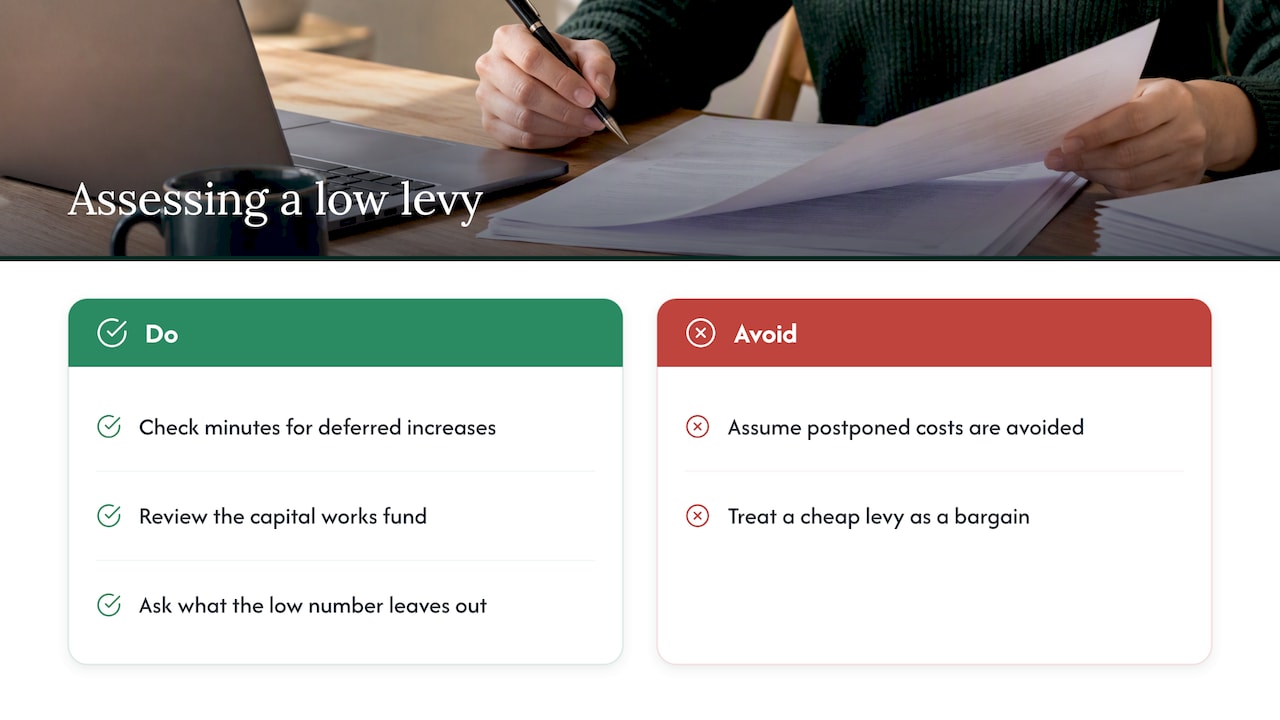
A cheap levy looks like a bargain on the listing. Sometimes it is. Sometimes it means the owners have voted year after year to keep the budget down while the building ages.
NSW government guidance says levies are approved by majority vote at the AGM and are proportional to unit entitlement. They are not fixed. If the minutes show that a meaningful increase was recently voted down or deferred, assume the cost has been postponed rather than avoided. The next owners, possibly you, pick it up.
The same logic applies to a single quarter’s notice. A building that has underfunded its capital works fund can fall back on special levies. The Local Court material explains that special levies can only be raised for expenses that cannot be met from the existing funds, and the owners corporation must approve them. For a plain-English walk-through, see our guide on what a special levy is.
This isn’t unique to Sydney. Condo buyers elsewhere face the same trap, and a Singapore property platform has written a useful condo maintenance fee checklist on why fees jump and why unusually low fees deserve scrutiny. The rules differ, but the instinct is the same: ask what the low number is leaving out.
Why levies rise
Strata costs in Sydney have been climbing. A 2023 news report described increases of 15 to 20 per cent on average in a year, driven by insurance, utilities and maintenance, but we couldn’t verify that page directly, so use it only as a sign of direction, not as a figure to plan around. More reliably, market commentary on Sydney’s 2026 conditions says strata increases are often the hidden cost of ageing infrastructure and mounting maintenance.
The usual causes:
- Insurance. A shared building policy is paid from the administrative fund, so premium rises go straight into levies.
- Age and legacy systems. Older buildings with outdated lifts or fire safety systems are prone to one-off special levies for mandated upgrades, as the Strata Fee Calculator guide notes.
- Defects. In newer buildings, the discovery of defects can force remediation, and owners share the cost by unit entitlement. NSW’s Project Remediate guide for apartment owners explains that each lot owner bears its entitlement share of any levies raised to repay a loan for rectification works.
- Amenities. Every shared facility is a permanent line in the budget.
Where levies sit in the current Sydney market
The headline figure for Sydney’s market recently was a median house price of A$1,733,891, down 3.3% over the quarter, with units down 1.5%. The same report says analysts see the upper end leading the downturn and more affordable segments holding up better because supply is short.
For a buyer, softer conditions mean more room to negotiate on price. They do not reduce the levy, and a lower purchase price paired with a high levy can leave your total holding cost unchanged. The right comparison is price plus ten years of levies plus any likely special levy, not price alone. Our overview of the Sydney property forecast for US buyers looks at market direction in more detail.
Worked example: two apartments, one price
Imagine two two-bedroom apartments, each listed around A$850,000, close to the median unit price.
- Apartment A is in a 1970s walk-up of eight lots. The levy is low, at about A$2,400 a year. The minutes show the owners rejected a roof repair quote two years running, and the capital works fund is nearly empty.
- Apartment B is in a 2012 mid-rise with a lift and a small gym. The levy is about A$6,500 a year, and the capital works fund holds a healthy balance against a ten-year plan.
On the listing, A looks cheaper to hold by A$4,100 a year. But a roof replacement shared across eight lots could easily land as a special levy of many thousands per owner. That is a hypothetical, not a quote, but it shows why the comparison cannot stop at the quarterly notice. If A’s roof cost A$60,000, each lot at equal entitlement would owe A$7,500, which cancels almost two years of the levy saving in one bill. B’s higher levy is buying predictability.
This is the reasoning behind the research view that a well-maintained building with higher levies can be the safer asset than a neglected building with low ones.
Checks to run before you buy
These are the documents we ask for before a client commits to a strata property. Each one answers a different question.
- Strata report. Commission an independent report on the scheme’s records, finances and any disputes. Our guide to what a strata report is explains what it covers.
- Section 184 certificate. This certificate gives a snapshot of the lot’s financial position, including outstanding levies and any special levies in force. The NSW form includes a section on special contributions to the administrative, capital works or other fund, with the amount and the date of determination.
- Ten-year capital works plan. NSW record-keeping guidance points buyers to this plan for major expenses not yet reflected in current levies. Check it is current and that the fund balance is on track to meet it.
- Two years of AGM and committee minutes. Legal and industry commentary recommends this because minutes often contain discussion of special levies or major works that never appear in marketing material. Look for deferred decisions, defect claims and arguments over budgets.
- Building age and systems. Ask about lifts, fire safety, cladding, waterproofing and the roof.
- By-laws. Rules on pets, renovations and short-term letting affect both your lifestyle and resale. See our note on strata by-laws in NSW.
The reasoning behind the paperwork is covered in why a buyer’s agent checks strata records. If you’re buying from overseas, you will want to read the records before you wire a deposit, not afterwards.
Our perspective: treat the levy as a diagnostic
We act only for buyers, never sellers, so we have no reason to flatter a building. Here is how we approach levies for clients.
We don’t screen apartments by levy size. A single number says little. Instead we ask what the levy is paying for, and what it isn’t. A building that funds its capital works plan is doing its job, and a building that keeps levies low by skipping repairs is borrowing from the next owner.
We also treat the paperwork as negotiating material. When the records show a likely special levy, a deferred repair or an unfunded plan, that is a legitimate reason to adjust the price, and our clients’ average saving on purchase price is around 9%. When a building is sound, we’d rather tell you to pay the asking price and move on than invent a discount.
For investors, we look at levies inside the full picture: rental yield after levies, capital growth potential of the location, and the condition of the asset. Our average time from engagement to settlement is 54 days, and a good share of that is making sure the strata documents have been read properly, not just received.
— Kristan
How we can help
If you are weighing a Sydney apartment and want the levy, the records and the price assessed by someone who works only for you, our Complete Purchase Solution and Auction Bidding service covers strategy, search (on-market and off-market), independent appraisal, due diligence, negotiation and settlement. If you’ve already found a property, Negotiation Only gives you professional representation on price. We service the Inner West, Eastern Suburbs, Lower North Shore and Eastern Beaches, and inspections run seven days a week. You can also see recent purchases we’ve secured.
FAQ
What is the average strata fee in NSW?
There is no single average, because the building drives the cost. One 2026 Sydney guide gives A$3,000 to A$5,000 a year for low-rise, A$5,000 to A$8,000 for mid-rise and A$8,000 to A$12,000 or more for high-rise buildings, as published by Strata Fee Calculator. Your own building’s budget, shown in the strata report, is the figure that counts.
Do high strata levies reduce what an apartment is worth?
Not reliably. A levy that is high for what the building provides can weigh on price, because it reduces cash flow and borrowing capacity. But research on listing data finds no meaningful link between levy size and future capital growth, so judge the building’s condition and funding too.
What is a special levy, and can it be avoided?
A special levy is an extra charge raised when the existing funds can’t cover an expense. It must be approved by the owners corporation. You can’t fully avoid the risk, but you can reduce it by reading the capital works plan, the fund balance and recent minutes before you buy. Our guide covers special levies in more detail.
What happens if levies are paid late?
Under NSW rules summarised in a Local Court presentation, overdue levies attract simple interest at 10% per annum once a month past due. If you are buying from overseas, set up automatic payment so a missed notice doesn’t cost you.
Sources
- Average Strata Fees in Sydney (2026 Guide), Strata Fee Calculator
- Estimating Strata Levies from Listing Descriptions, Microburbs
- Assessing and Determining Strata Levies and Reasonable Costs, NSW Local Court
- Levies, NSW Government
- Record keeping requirements, NSW Government
- Section 184 Certificate, NSW Fair Trading
- Apartment owners guide to Project Remediate, NSW Government
- Sydney’s median house price falls to $1.73m, Domain report coverage
- The Rising Costs of Strata Living, UnitBuddy
Recommended
- Strata schemes in Australia: what every buyer must know
- Strata by-laws in NSW: what buyers and owners need to know
- What is a strata report? A buyer’s guide for 2026
- US Investors Face NSW Land Tax Once Land Value Exceeds A$1,075,000