If you own an investment property in New South Wales, you almost certainly owe land tax once your total unimproved land value passes the general threshold, currently A$1,075,000. Foreign owners, including US investors, also face a separate surcharge with no tax-free threshold at all. Revenue NSW’s own Land Tax Calculator gives the exact figure for your circumstances.
TL;DR:
- Both thresholds have remained fixed since January 2025, increasing the risk of bracket creep as land values rise faster than thresholds, potentially boosting land tax bills over time.
- Foreign owners, including US investors, face surcharge land tax on each residential property without any tax-free threshold, and both surcharge and general land tax can apply simultaneously.
- The land value used for taxation is assessed by the NSW Valuer General on December 31, with a three-year averaging system and aggregation of all NSW landholdings for each owner.
- Proper planning around ownership structures, settlement timing, and property portfolio management can help reduce or delay land tax liabilities, especially for long-term investors.
Table of Contents
- NSW land tax nsw investment property thresholds and rates for 2026
- Who has to pay, and which properties are exempt?
- How Revenue NSW actually calculates your bill
- Surcharge land tax for US and other overseas investors
- Land tax timing around settlement
- Practical ways investors manage their exposure
- Worked examples using the Revenue NSW calculator
- A buyer’s agent’s view on land tax and purchase strategy
- Getting purchase-stage tax risk right before you bid
- Where to check the official figures
- Sources
- FAQ
NSW land tax nsw investment property thresholds and rates for 2026
Land tax in NSW isn’t charged on your home. It’s charged on everything else. That single distinction catches out more overseas investors than any other part of the system, because in many US states property tax applies uniformly regardless of whether you live in the home.
For the 2026 land tax year, two thresholds determine what you pay:
- General threshold: A$1,075,000. Below this combined land value, most individual owners pay nothing.
- Premium threshold: A$6,571,000. Above this, a steeper rate kicks in.
The general rate is A$100 plus 1.6% of the land value above A$1,075,000, up to the premium threshold.
Quick figures: general threshold A$1,075,000, premium threshold A$6,571,000, general rate A$100 + 1.6% above threshold.
Here’s the part that catches long-term investors out. Both thresholds were frozen from 1 January 2025, rather than indexed annually as they once were. Sydney land values have historically climbed faster than most fixed thresholds, so a property portfolio that sat comfortably under A$1,075,000 in unimproved land value this year can drift above it within two or three revaluation cycles without you buying anything new. That’s bracket creep, and Revenue NSW’s own guidance on the freeze is worth reading if you’re holding property for the long haul, because it means your land tax bill can climb even while your rental strategy stays exactly the same.
Who has to pay, and which properties are exempt?
Your principal place of residence is exempt. Everything else you hold in NSW, generally, is not.
Taxable land includes:
- Investment and rental properties
- Holiday homes, even if used only occasionally
- Vacant residential land
- Commercial and industrial land held for investment
Common exemptions cover a principal place of residence, land used for primary production (working farms, largely), and a handful of narrower categories like retirement villages and certain non-profit land. From 2026, the principal place of residence exemption also carries a tightened ownership-percentage rule: if you hold only a minority stake in a property you occupy, that stake may not automatically qualify for the exemption in the way it once did, so joint arrangements between family members or co-investors need checking against the current rules rather than assumed.
Ownership structure changes the calculation too. Individuals and joint owners can generally claim one tax-free threshold between them for jointly held land. Companies and certain trusts are treated very differently. Land held in a special or discretionary trust typically doesn’t get the tax-free threshold at all, meaning tax can apply from the first dollar of land value. If you’re weighing up a trust structure for asset protection reasons, that’s a trade-off worth running past an accountant before settlement, not after.
How Revenue NSW actually calculates your bill
The maths sounds simple until you hit the word “aggregation,” which is where most first-time investors get their estimate wrong.
- Valuation date. Your liability is assessed on land you own at midnight on 31 December each year. Buy on 1 January and you dodge that year’s assessment entirely; buy on 30 December and you’re on the hook.
- Valuation source. The unimproved land value used isn’t your purchase price or your council rates notice. It comes directly from the NSW Valuer General, who assess the land alone, stripped of buildings and improvements.
- Three-year averaging. Rather than taxing you on a single year’s valuation spike, Revenue NSW averages the current year’s value with the two previous years. This smooths out the kind of valuation whiplash Sydney’s market produces every few years.
- Aggregation. All your non-exempt NSW landholdings get added together before the threshold is applied. Own three investment units each worth A$500,000 in land value, and you’re aggregated to A$1,500,000, comfortably over the threshold, even though no single property crosses it alone.
- Ownership shares. Joint owners are assessed as a notional single owner first, then each owner’s individual liability is worked out against their own portfolio, with secondary deductions applied to avoid double taxation on the same share.
Pro Tip: Don’t estimate your liability from your last council rates notice. Council land values and Valuer General land values for tax purposes are calculated on different cycles and can diverge meaningfully, so always check your actual Revenue NSW land tax assessment or the calculator.
Surcharge land tax for US and other overseas investors
If you’re a US citizen or resident buying residential property in NSW without permanent residency, surcharge land tax applies on top of everything above, and it plays by different rules entirely.
Surcharge land tax applies separately to each residential property owned by a foreign person and has no tax-free threshold. This means foreign owners owe surcharge land tax on every applicable property regardless of individual land value, even if the property value is below general land tax thresholds.
Two things follow from that:
- Surcharge and general land tax can both apply to the same residential property in the same year, calculated separately and then added together.
- Foreign ownership status is assessed on the individual, not the property, so a US-based buyer purchasing through an Australian company or trust doesn’t automatically escape it.
Practical steps for overseas buyers are straightforward but easy to miss under settlement pressure: register with Revenue NSW as a foreign person where required, confirm directly with Revenue NSW whether any exemption applies to your specific visa or residency status, and factor the surcharge into your rental strategy and cash flow projections before you bid, not after you win the property.
Land tax timing around settlement
Revenue NSW typically issues annual assessment notices from mid-January, with notices for the 2026 land tax year beginning to issue from 19 January 2026. If you’re settling in January or February, that timing matters for working out who’s actually liable for the year.
- A section 47 clearance certificate confirms whether land tax is owed on a property, and purchasers should request one before settlement to avoid inheriting a seller’s unpaid liability. This ties directly into standard vendor disclosure obligations you’ll already be reviewing.
- Payment options include a 0.5% discount for paying the full year in one lump sum within 60 days, or an interest-free instalment plan if you’d rather spread the cost across the year.
- Settlement timing itself deserves attention. A purchase that settles just before or after 31 December can shift a full year’s liability from buyer to seller, or vice versa, so this is worth confirming as part of your pre-exchange checklist.
Practical ways investors manage their exposure
None of these are loopholes. They’re structural and timing decisions that shape how much tax you’re liable for, and they only work if you get them right before you buy, not after.
- Ownership structure. Holding property as an individual or joint owner generally preserves your access to the tax-free threshold; holding through certain trusts can forfeit it entirely, so the structure decision has direct, ongoing tax consequences.
- Portfolio aggregation awareness. Because all your NSW land gets added together, spreading purchases across a partner, a company, or a trust can change your aggregate exposure, though it also changes your access to thresholds and exemptions in ways that need proper advice.
- Settlement timing. Where practical, timing a settlement relative to 31 December can shift a year’s liability to whichever party is better positioned to absorb it, a detail experienced negative gearing strategies often factor into broader cash flow planning.
Pro Tip: Run any structuring idea past a tax adviser and your buyer’s agent before you sign a contract, not after. Land tax structures that make sense on paper can unravel if they conflict with your finance approval, your exemption eligibility, or your exit strategy.
Worked examples using the Revenue NSW calculator
Numbers make this real in a way percentages never quite do.
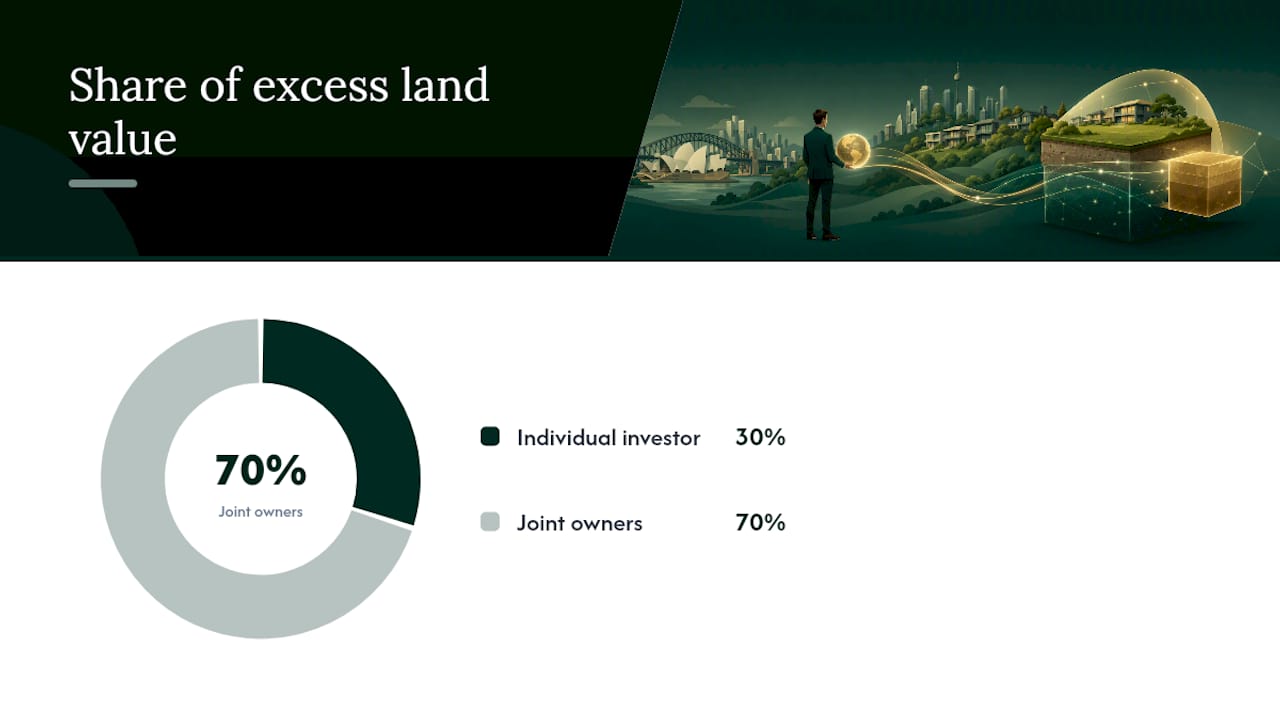
Example 1: Individual investor, single property. Say your investment unit carries an unimproved land value of A$1,300,000 after three-year averaging. That’s A$225,000 above the A$1,075,000 threshold.
Example 2: Joint owners. Two co-investors jointly hold a property with a combined land value of A$1,600,000.
| Scenario | Land value (averaged) | Amount above threshold | Tax owed |
|---|---|---|---|
| Individual, single property | A$1,300,000 | A$225,000 | A$3,700 |
| Joint owners, combined | A$1,600,000 | A$525,000 | A$8,500 (before apportionment) |
To run your own numbers, open the Land Tax Calculator, enter your land values and ownership details, and it’ll estimate your liability against current thresholds. One limitation worth knowing upfront: the calculator can’t be used for land owned by related companies, discretionary trusts, or special trusts, so if your holding sits inside one of those structures, you’ll need a direct assessment from Revenue NSW or your adviser instead.
A buyer’s agent’s view on land tax and purchase strategy
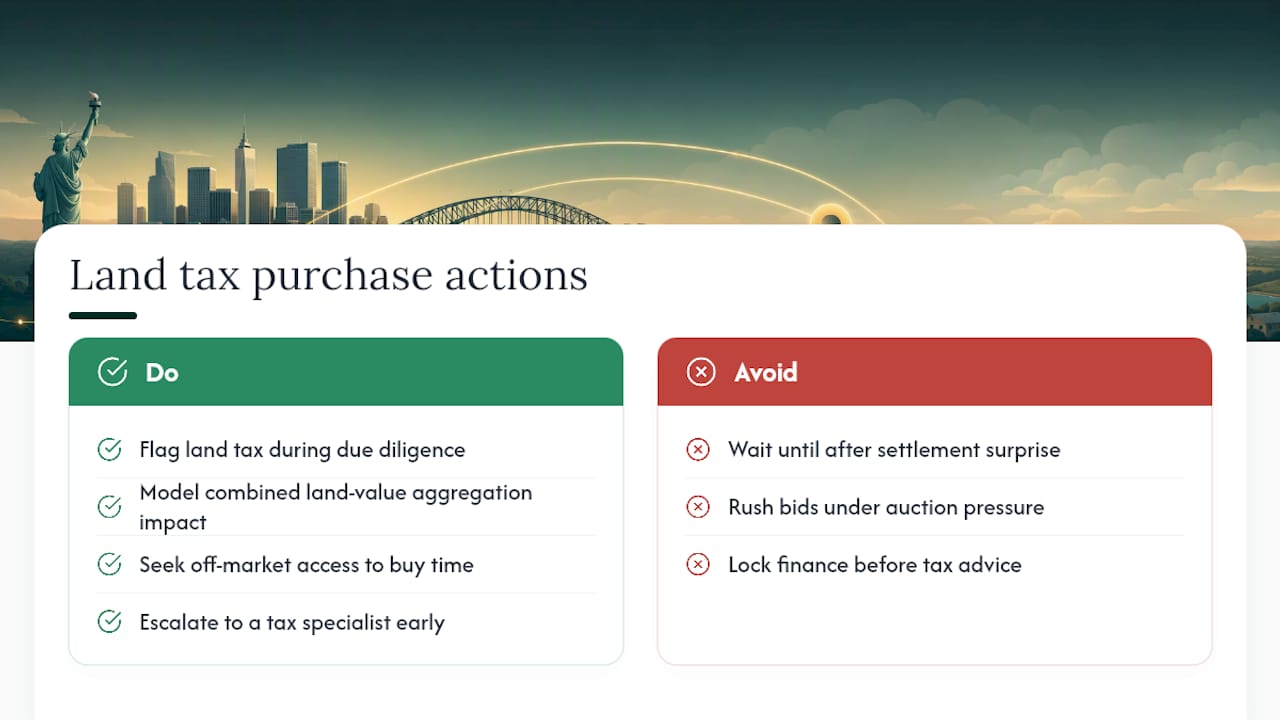
Land tax exposure gets flagged during due diligence, well before a client puts in an offer, not after settlement when the assessment notice turns up as a surprise. Combined land value across a client’s existing NSW holdings can push a new purchase straight past the general threshold, and that changes the real annual cost of the deal.
Off-market access matters here too. Properties that never hit open inspection queues give more time to model the aggregation impact properly, rather than rushing a bid under auction pressure. For complex cases, structures involving trusts, overseas ownership, or large existing portfolios, the right move is escalating to a tax specialist early in the acquisition timeline, not after finance is already locked in.
— Kristan
Getting purchase-stage tax risk right before you bid
Land tax modelling works best when it happens during due diligence, before an offer goes in, and that’s precisely where a dedicated buyer’s agent earns their fee. runs independent appraisals and due diligence on every property a client is considering, which means aggregation risk, surcharge exposure for overseas buyers, and structural questions get flagged while there’s still time to act on them, not discovered on an assessment notice months after settlement.

The Full Service offering covers the whole purchase, from strategy and property search through to negotiation, auction bidding, and settlement support, with access to off-market properties that give you more room to weigh up the numbers properly. If you’ve already found a property and just need strong negotiation, Negotiation Only representation covers that specific stage. For US-based and other overseas investors navigating NSW’s surcharge rules on top of standard land tax, having someone local who understands both the market and the tax mechanics reduces the chance of an unwelcome surprise after settlement. Call 1800 676 177 or get in touch to talk through your situation before you make an offer.
Where to check the official figures
For exact, current thresholds, rates, and calculators, go directly to Revenue NSW’s land tax pages, which cover thresholds, calculation methods, and surcharge rules. The NSW Valuer General publishes the unimproved land values used in every assessment, and the same Revenue NSW site hosts the calculator and clearance certificate request process.
This article is general information, not a substitute for advice from a qualified financial advisor. Consult a qualified financial professional about your own circumstances before acting on anything here.
Sources
FAQ
Do I need to pay land tax on an investment property in NSW?
Yes, in almost all cases. Unless a specific exemption applies, any investment property is taxable land, and you’ll owe land tax once your aggregated NSW landholdings exceed the general threshold.
How can I minimise or avoid NSW land tax?
You can’t legally avoid land tax on genuinely taxable land, but you can manage exposure through ownership structure choices, careful settlement timing around the 31 December taxing date, and staying under the aggregated threshold, ideally with advice from a tax professional before you buy.
What is the six-year rule for land tax in NSW?
There isn’t a general six-year rule for NSW land tax exemptions; that concept applies to a different area of tax law (capital gains tax absence rules) and shouldn’t be confused with the land tax principal place of residence exemption, which has its own separate criteria.
What are the foreign resident land tax rules in NSW?
Foreign persons owning residential land in NSW pay surcharge land tax in addition to any general land tax owed, calculated per property with no tax-free threshold, so it can apply even on modest-value holdings.
Recommended
- 10 Sydney Suburbs Poised for 2026 Growth: US Investor Playbook
- Can a foreign buyer purchase Sydney property in 2026?
- Underquoting NSW: what the 2026 law changes mean for buyers
- Strata by-laws in NSW: what buyers and owners need to know