If you plan to bid at an NSW property auction, you need to understand the reserve and price guide rules, bidders record obligations, vendor bid disclosure, underquoting and advertising rules, and what it means to be contract ready. A licensed buyers agent can guide clients through this process repeatedly. Before auction day, check the published price guide and reserve expectations, and arrive with finance, deposit and contract review already sorted.
TL;DR:
- Ask the agent in writing whether the guide matches current reserve expectations, then compare it with recent nearby sales before setting your bidding limit.
- Bring photo identification, provide accurate contact details, and check the bidder record before bidding; request corrections immediately because the record supports the eventual contract.
- Auctioneers must disclose vendor bids and cannot make them after the reserve is reached; they may reject invalid bids or pass the property in.
- Arrange finance, contract review, deposit funds, and inspections before bidding; the winning auction bid creates an immediate binding contract with no cooling off period.
Table of Contents
- What changed for price guides and reserve publication
- Bidders record and registration: what you must provide
- Can an auctioneer refuse the highest bid?
- Underquoting and misleading advertising: spotting the red flags
- How to be contract ready for auction day
- Practitioner insight: tips from a licensed buyers agent
- Legal implications of auction sales and when the contract becomes binding
- Cooling off periods and your rights after the auction
- How agents and auctioneers are expected to conduct themselves
- Why contract readiness beats chasing clearance rates
- How Sydney Property Buyers helps NSW bidders
- FAQ
- Regulator and practical resources
What changed for price guides and reserve publication
A reserve is the minimum price a vendor will accept, set privately and usually not disclosed until the auction itself, often only once bidding reaches that level; sellers sometimes withhold reserve details because they can sell their property in any condition without repairs or conditions. A price guide is the agent’s estimate of likely sale price, used in advertising before auction day. The two are meant to align, though in practice they have not always matched, which is the root of most underquoting complaints.
NSW news coverage reported proposals pushing for earlier publication of price guides and tougher penalties where advertised figures diverge sharply from the eventual reserve. The direction of travel is towards more transparency earlier in the campaign, not less.
For a buyer, this matters practically:
- Ask the agent directly whether the price guide reflects the vendor’s current reserve expectations.
- Request recent comparable sales to sanity check the guide against the local market.
- Treat a price guide that moves significantly during the campaign as a signal to revisit your own valuation, not the vendor’s final word.
Buyers considering a pre-auction offer should use the same checks, since a weak guide can mislead early negotiation just as easily as it misleads auction day bidding.
Bidders record and registration: what you must provide
Agents running an NSW auction are required to keep a bidders record, a log of everyone who registers to bid, and that record typically must be retained for several years under NSW property agent regulation. It exists so there is a verifiable account of who participated and what identification they presented.
Registration on the day usually follows a consistent sequence:
- Provide photo identification, generally a driver’s licence or passport.
- Supply your name, address and contact details to the agent or auctioneer’s clerk.
- Receive a bidder number, which you hold up to signal each bid.
Auction platforms increasingly let you save a bidder profile for reuse across listings, but the submitted record for each specific property remains its own document. Always check that the details on the day’s record are correct before bidding starts. If something is wrong, a misspelt name, an old address, ask for it to be corrected immediately rather than after the auction, since the record underpins the eventual contract.
Can an auctioneer refuse the highest bid?
A vendor bid is a bid made on behalf of the seller, usually by the auctioneer, to test the market or nudge bidding towards the reserve. These are only used before the reserve is reached, and auctioneers are expected to disclose when a bid is a vendor bid so genuine bidders are not misled about how many real buyers are competing.
Auctioneers do hold lawful discretion in running the auction:
- They can decline a bid that is not a genuine increment, or one called out of turn.
- They can pause or adjourn the auction, including to consult the vendor once the reserve is reached.
- They can declare the property passed in if the reserve is not met, rather than accept a bid below it.
What an auctioneer cannot lawfully do is accept a vendor bid after the reserve has been reached, or disguise who is making a bid. If you suspect a bid came from the vendor’s side without disclosure, you are entitled to ask the auctioneer directly whether it was a vendor bid.
Pro Tip: Count the vendor bids as they’re called. If the number seems high relative to genuine competition, slow down and reassess before you commit your next bid.
Underquoting and misleading advertising: spotting the red flags
Underquoting happens when an advertised price guide is set unrealistically low to attract more bidders, only for the property to sell well above it. Regulators have responded with fines and proposals to mandate clearer, earlier price guides specifically to close this gap.
A few warning signs are worth watching for:
- A price guide that seems well below recent comparable sales in the same street or suburb.
- Vague wording such as “offers over” with no clear figure, paired with a separately quoted guide.
- A guide that jumps noticeably higher partway through the campaign without an obvious market reason.
The simplest check is to ask the agent, in writing, whether the price guide reflects the vendor’s current reserve expectations, and to compare it against sold prices for similar properties nearby. If the numbers do not line up, treat the listing with more caution and factor that into your bidding limit.
How to be contract ready for auction day
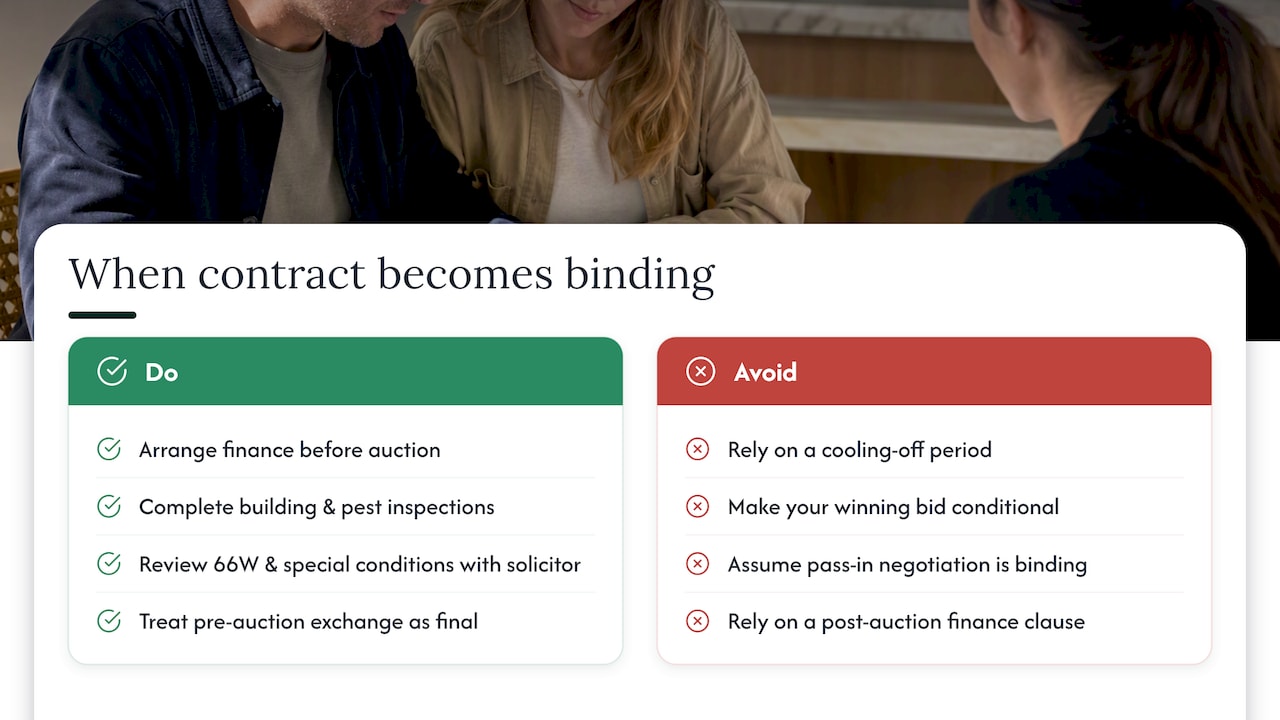
Winning the bid is only the start. The moment the auctioneer’s hammer falls, you are in a binding contract, so the paperwork and funds need to be sorted beforehand, not after.
- Have your deposit ready in the form the agent specifies, commonly a bank cheque or cleared electronic transfer, since personal cheques are often refused.
- Review the contract of sale with your solicitor or conveyancer well before auction day, including any special conditions.
- Arrange finance approval in advance, since there is no cooling off period once you have won at auction.
- Organise a building and pest inspection ahead of time, since you cannot make the sale conditional on one after the fact.
- If you are the only registered bidder, the auctioneer may still require an opening bid at or near the reserve before declaring the property sold, so come prepared to open strongly rather than waiting for competition that may not appear.
A significant share of properties purchased through full-service buyer representation is secured off-market entirely, which can mean skipping the auction process altogether for buyers who would rather negotiate privately.
Practitioner insight: tips from a licensed buyers agent
An experienced licensed buyers agent has built a buyer-exclusive practice around exactly this process. The tactical edge at auction usually comes down to reading the room: noting which bids are vendor bids, watching increment size for signs of hesitation, and knowing when to hold back rather than chase a rising price. Buyers who engage representation for auction bidding typically have contracts reviewed, finance confirmed and a firm limit set well before the auctioneer opens the floor, which removes the pressure to make decisions in the moment.
Legal implications of auction sales and when the contract becomes binding
An auction sale differs from a private treaty purchase in one important respect: there is no five-business-day cooling off period. Once the auctioneer’s hammer falls on the winning bid, the contract is exchanged immediately and becomes binding on the spot.
This is why pre-auction preparation carries more legal weight than in most other purchase scenarios. Finance should already be arranged, since there is no finance clause to fall back on. Building and pest inspections need to happen before the auction, not after, because you cannot make your winning bid conditional on anything once it is accepted.
The same binding effect applies if a property sells prior to auction through a negotiated pre-auction offer, provided the vendor agrees to exchange before the scheduled auction date. Buyers taking this route should still treat the contract as final once signed, which is why reviewing the 66W certificate and special conditions with a solicitor beforehand matters just as much as it does for auction day itself.
If a property is passed in because the reserve is not met, the highest bidder is typically given first right to negotiate privately with the vendor immediately afterwards. That negotiation is not binding until a contract is signed and exchanged, so the usual review process still applies.
Cooling off periods and your rights after the auction
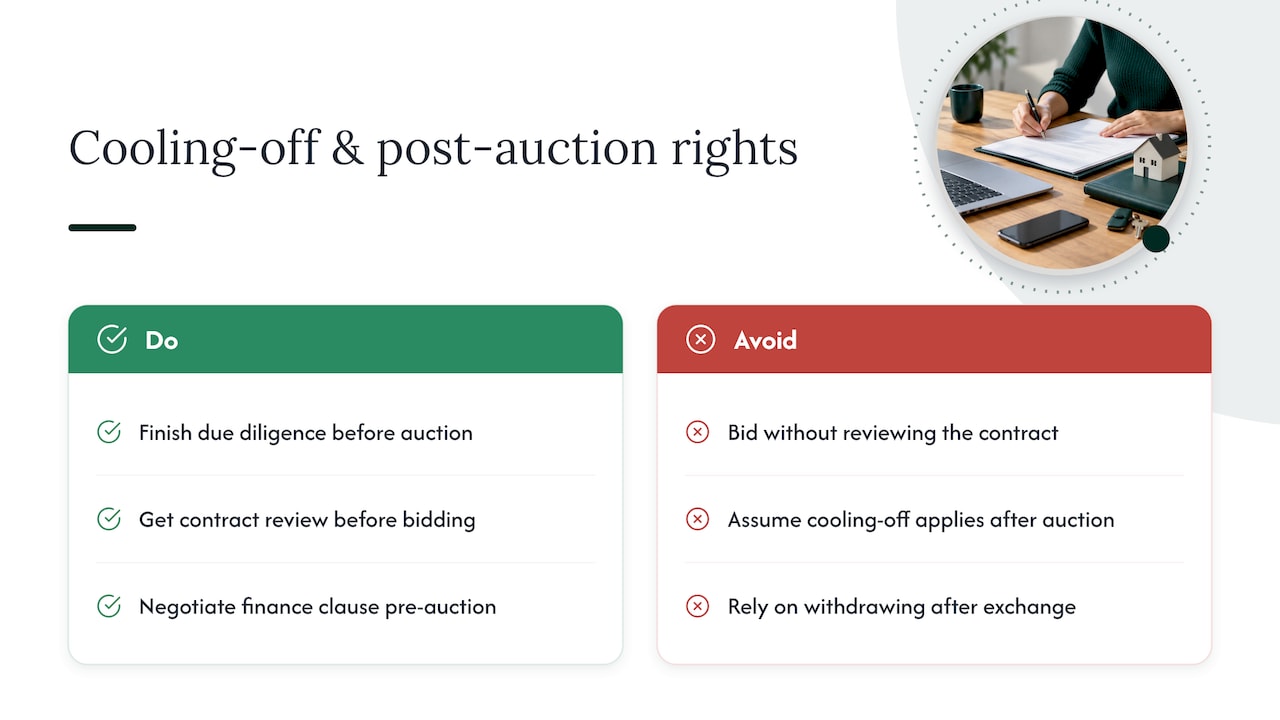
Buying at auction removes the standard cooling off period available under NSW conveyancing rules. If you sign a contract through a private treaty sale, you ordinarily get five business days to reconsider, during which withdrawing costs a small percentage of the purchase price. That protection does not apply once you are the successful bidder at auction, nor does it apply to a contract exchanged unconditionally on the day a property was due to go to auction, even if the auction itself did not proceed.
This is the clearest practical reason to finish your due diligence before the auction rather than after. Your rights post-auction are essentially limited to whatever conditions you negotiated into the contract beforehand, such as a subject-to-finance clause in a rare case where a vendor agrees to one, which is uncommon at auction but occasionally offered on a passed-in property during subsequent negotiation.
Once exchanged, the contract proceeds to settlement on the date specified, generally without further opportunity to withdraw short of a genuine legal defect in the contract itself. That is why solicitors recommend a full contract review before you ever register to bid, not after you have already committed to a winning number.
How agents and auctioneers are expected to conduct themselves
Agents and auctioneers operating in NSW are bound by conduct standards under the Property and Stock Agents Act and its regulation, which govern honesty in advertising, handling of deposits, and fair running of the auction itself. An auctioneer must disclose vendor bids, must not accept bids after declaring the property sold, and must handle the bidders record accurately and retain it as required.
Breaches carry real consequences. Agents found to have underquoted or misrepresented a price guide face fines, and repeated or serious breaches can affect a licence. The regulator’s guidance sets out these obligations clearly for both agents and the buyers who rely on their conduct being consistent from one auction to the next.
For buyers, the practical takeaway is that you are entitled to ask questions during the process, whether a bid was genuine, whether the price guide reflects the reserve, what identification is required for registration, and to expect straight answers. An auctioneer who avoids these questions, or who seems reluctant to disclose vendor bids, is worth treating with extra caution regardless of how compelling the property itself looks.
Why contract readiness beats chasing clearance rates
Clearance rates make headlines, but they tell you nothing about whether you are ready to act when it matters. In practice, the buyers who win at auction are the ones who finished their legal and financial preparation days earlier, not the ones who read the most market commentary. If reserve timing, vendor bid disclosure or contract review feels unclear, professional representation removes that uncertainty before you ever raise your hand.
— Kristan
How Sydney Property Buyers helps NSW bidders
We represent buyers only, never vendors, which means every auction day decision is made in your interest alone. Our services cover the parts of this process that catch most bidders out:
- Complete Purchase Solution: strategy, property search, due diligence, negotiation and auction bidding through to settlement.
- Auction Bidding: we attend and bid on your behalf, applying the same vendor bid and increment reading covered above.
- Negotiation Only: representation once you have identified a property, including pre-auction offer negotiation.
We also source off-market opportunities outside the standard auction campaign entirely. Explore our services or call 1800 676 177 to discuss an upcoming auction.

FAQ
What are the auction rules in NSW?
NSW auction rules require agents to keep a bidders record, disclose vendor bids, and avoid accepting bids after the property is declared sold. There is no cooling off period once the hammer falls, and the winning bidder must exchange contracts and pay the deposit immediately.
Can an auctioneer refuse the highest bid?
An auctioneer can decline a bid that is not a genuine increment or called out of turn, and can pass the property in if the reserve is not met, rather than accept a bid below it. They cannot, however, accept an undisclosed vendor bid once the reserve has been reached.
What happens if you are the only bidder?
If you are the sole registered bidder, the auctioneer may still require you to open at or near the reserve before declaring the property sold. Coming prepared to make a strong opening bid, rather than waiting for competition, is the safer approach.
What not to do at an auction?
Avoid bidding without finance already arranged, since there is no finance clause once your bid is accepted, and avoid skipping the building and pest inspection beforehand. Do not assume a low price guide reflects the vendor’s reserve without checking comparable sales first.
Regulator and practical resources
For the legislation underpinning agent and auctioneer conduct, see the Property and Stock Agents Act and regulation, which covers disclosure duties, bidders records and advertising obligations. If you would like representation for an upcoming auction, our contact and services page sets out how we work with buyers across the Inner West, Eastern Suburbs, Lower North Shore and Eastern Beaches.
Recommended
- Beginners: Stop $5,000 Jumps Draining Your Budget in Auction Bidding
- Sydney property auction bidding: how to bid with confidence
- Five Business Days: What NSW Buyers Must Do Before the 5pm Cutoff
- Be Contract Ready to Win Sydney Pre Auction Offers