Make a pre-auction offer when the vendor wants certainty, the campaign is showing signs of fading interest, and you can exchange contracts immediately. Before you approach the agent, lock in written finance pre-approval and confirm your contract is ready to sign. We structure offers this way for clients every week.
TL;DR:
- A pre-auction offer can be effective in a cooling market with low buyer inquiry and when the vendor is under genuine time pressure.
- Having confirmed finance pre-approval, reviewed contracts, and proof of funds ready before making the offer increases the likelihood of acceptance.
- Presenting a contract-unconditional offer with a larger deposit and flexible settlement terms can make your bid more attractive than competing conditional offers.
- Speed is crucial; being contract-ready allows you to exchange immediately and reduces the risk of gazumping or losing the deal.
- Off-market and off-list opportunities often favor buyers who are fully prepared, emphasizing the importance of thorough pre-auction groundwork.
Table of Contents
- What a pre-auction offer actually is
- When a pre-auction offer makes sense in Sydney
- How to prepare before you make the offer
- How to present the offer through the selling agent
- Negotiation tactics and what makes an offer stand out
- Risks and red flags to watch for
- How Sydney Property Buyers handles pre-auction offers
- Why contract readiness, not price, usually decides the outcome
- Get help structuring a pre-auction offer that vendors take seriously
- FAQ
- Sources
What a pre-auction offer actually is
A pre-auction offer is a bid made before the scheduled auction date, submitted directly to the selling agent in the hope the vendor will accept and sell “prior” rather than running the full campaign. It sits earlier in the sales timeline than the auction itself but later than the open private treaty stage, when a property has already been marketed with an auction date attached.
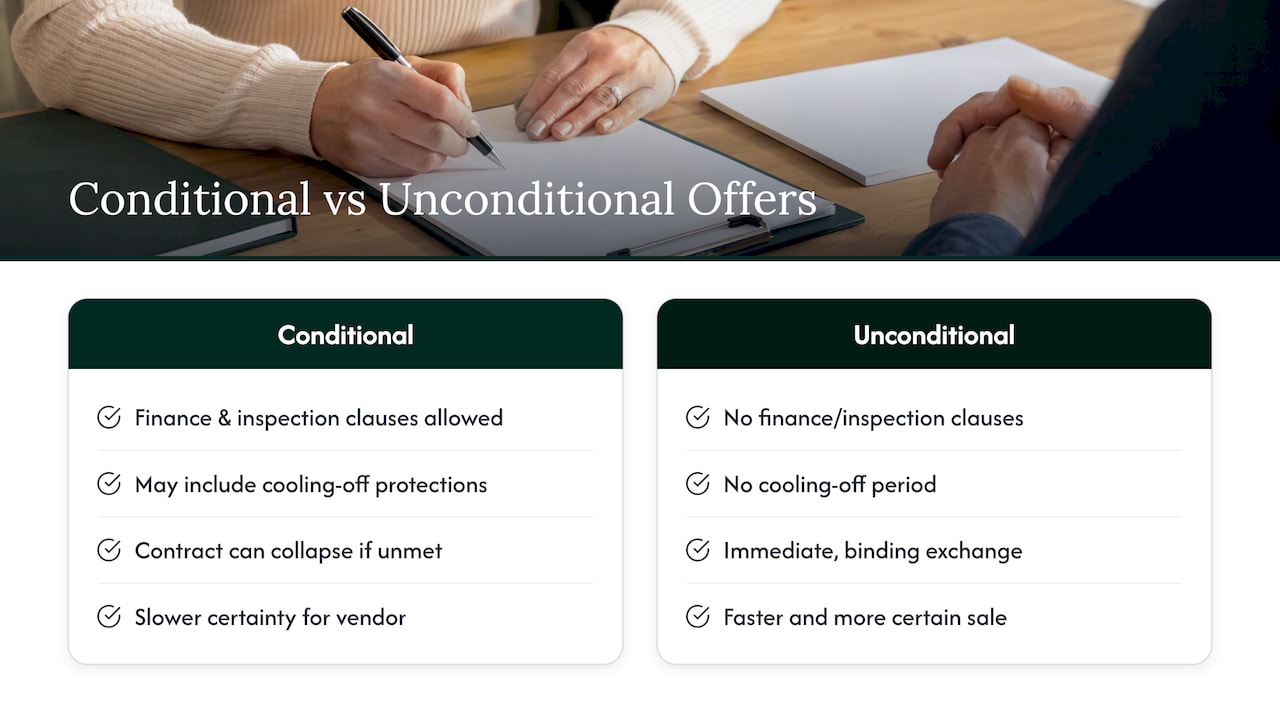
The critical distinction is conditional versus unconditional. A conditional offer still carries finance approval, a building and pest inspection clause, or other contingencies, meaning the contract could collapse if those conditions are not met. An unconditional offer removes those safety nets. You are committing to exchange contracts on the spot, with no cooling-off period to fall back on if your circumstances change. Unconditional exchange is the mechanism vendors want to see because it closes the sale immediately and takes the uncertainty of auction day off the table.
Selling agents typically handle a pre-auction offer by presenting it to the vendor along with any other offers received, rather than accepting it unilaterally. Vendors can refuse, counter, or accept. Some agents will tell competing parties an offer has been made, prompting a round of counter-bids before auction day even arrives. Understanding this process matters because it shapes how you draft the offer, what you include as proof of seriousness, and how quickly you need to be ready to sign.
When a pre-auction offer makes sense in Sydney
Not every campaign is a good candidate for a pre-auction approach. The strategy works best when specific market and vendor conditions line up, and it tends to fail, or simply waste your time, when they do not.
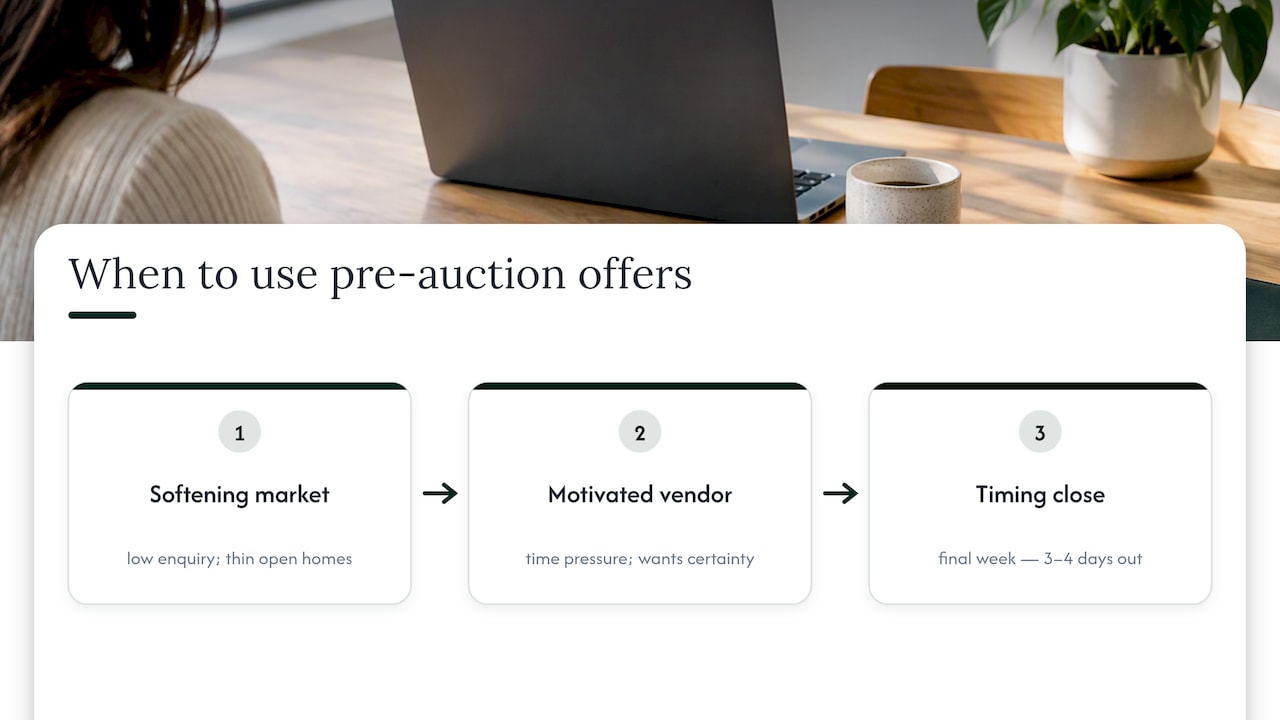
Market signals worth watching. A softening market is the clearest green light. When buyer enquiry drops off, open home numbers thin out, or an agent seems to be fielding fewer calls than they expected, vendors start worrying about a thin auction room. In that environment, a credible offer with immediate exchange looks far more attractive than the gamble of auction day. Low competition from other buyers strengthens your position further: if you sense you are the only serious party circling a property, a pre-auction approach can secure it before anyone else surfaces.
Vendor motivation is the other half of the equation. Some sellers are under genuine time pressure, a settled purchase elsewhere, a job relocation, a need to access equity, and these vendors often prefer a certain sale now over the possibility of a better price later. Agents will sometimes hint at this directly (“the vendor wants to be gone by the end of the month”) or indirectly through a flexible attitude to settlement terms. Vendors who are testing the market with no urgency, by contrast, are far less likely to budge before auction day. If the agent is vague about motivation or reluctant to discuss the vendor’s position at all, treat that as a sign the pre-auction route is unlikely to land.
Timing relative to auction day changes the dynamic too. Early in the campaign, vendors are usually still hoping competitive bidding will push the price up, so they have little incentive to accept an early offer unless it is exceptional. As the auction date approaches, particularly in the final week, vendors who have not seen the enquiry levels they expected become noticeably more receptive. An offer made three or four days out, backed by proof you can exchange immediately, often gets a serious hearing precisely because the vendor is weighing a real offer against the risk of an auction that might fail to reach reserve.
The combination to look for is straightforward: a market that has cooled, a vendor with a reason to want certainty, and a timeline close enough to auction that the agent is genuinely motivated to bring a deal to the table rather than wait and see.
How to prepare before you make the offer
Vendors who accept a pre-auction offer are trading the unpredictability of auction day for certainty. Every part of your preparation should be aimed at proving you can deliver that certainty without delay.
- Get written finance pre-approval, not just a verbal indication from your lender, and have evidence of funds ready to show the agent if asked.
- Have your solicitor or conveyancer review the contract of sale before you make an offer, so you know exactly what you are agreeing to if the vendor says yes on the spot.
- Understand what unconditional exchange means in New South Wales: once contracts are exchanged unconditionally, you generally cannot walk away without losing your deposit, and the usual cooling-off period does not apply to auction-style unconditional purchases. Unconditional exchange carries real legal weight, so confirm the terms before you commit.
- Decide your deposit size and settlement timeline in advance. A standard deposit is often 10%, but a slightly larger deposit or a settlement date that suits the vendor can make an otherwise ordinary offer stand out.
- Arrange a building and pest inspection ahead of time if you can, so you are not relying on a conditional clause to protect you later. Where that is not possible, understand that a conditional offer is inherently weaker in the vendor’s eyes, since it still carries a chance of falling through.
- Prepare a short evidence pack, written pre-approval, proof of funds, and your proposed contract terms, so the agent can take something concrete to the vendor rather than a verbal indication of interest.
Pro Tip: Have your solicitor review the contract before the campaign even reaches its final week, so you can move within hours rather than days if the right moment to offer appears.
Buyers who skip this groundwork tend to lose pre-auction opportunities not because their price was wrong, but because they were not ready to exchange the moment the vendor said yes.
How to present the offer through the selling agent
The process for making a pre-auction offer is fairly standard across Sydney campaigns, but small details in how you present it often decide whether the vendor takes it seriously.
- Contact the selling agent directly, never the vendor. Agents are legally obliged to present genuine offers to their client, and a phone call followed by a written offer is the usual channel. A buyer’s agent can handle this conversation on your behalf, which keeps the exchange professional and removes emotion from the negotiation.
- Put the offer in writing with every material term spelled out: purchase price, whether it is conditional or unconditional, deposit amount, proposed settlement date, and an expiry time for the vendor’s response.
- Set a realistic expiry window. A window of roughly 24 to 72 hours is common, and shorter windows are often used in the final days before auction to force a timely decision without pressuring the vendor unfairly.
- Expect a counteroffer. Vendors frequently come back with a higher figure or different settlement terms rather than accepting outright, so decide beforehand how far you are prepared to move and on what terms.
- Record acceptance properly. A verbal “yes” from the agent is not a binding contract. Exchange only becomes legally effective once both parties have signed identical contracts and those contracts have actually been exchanged, usually through the solicitors or conveyancers involved.
Throughout this process, your proof of funds and finance pre-approval should be ready to hand over the moment the agent asks, since any delay at this stage can allow a competing buyer to step in ahead of you.
Negotiation tactics and what makes an offer stand out
Price is not the only lever in a pre-auction negotiation, and in many cases it is not even the deciding factor. Vendors weighing a pre-auction offer are really weighing certainty against the unknown outcome of auction day, so the terms around your price often matter as much as the number itself.
- Unconditional exchange removes the vendor’s biggest fear, a failed auction campaign, so it tends to carry more weight than a slightly higher conditional offer.
- Flexible settlement terms that suit the vendor’s circumstances, whether that means a quick 30-day settlement or a longer one to match their own moving plans, can tip a decision in your favour.
- Fewer special conditions make your offer easier for the vendor’s solicitor to approve quickly, which matters when an agent is trying to close a deal before auction day.
- A larger-than-standard deposit signals reduced risk to the vendor and can make your offer more compelling even at the same purchase price.
- A professionally packaged offer, presented through a buyer’s agent or solicitor with clear documentation, reads as more credible to a selling agent than a hurried phone call.
Working with a buyer’s agent at this stage also does something less obvious: it takes the emotional charge out of the negotiation. A buyer’s agent packages the offer, manages the back and forth with the selling agent, and handles counteroffers without the price creep that often happens when a buyer negotiates directly and starts to feel attached to the result.
Pro Tip: If the agent starts talking in vague terms about “other interest” without any specifics, that is often a cue to confirm your ceiling price privately and be ready to walk rather than keep raising your offer against an unverified rival.
The clearest sign you should step back is when the negotiation stops being about the property’s value and starts being about not losing. That shift is exactly when buyers overpay.
Risks and red flags to watch for
The two biggest risks in a pre-auction negotiation are gazumping and the legal weight of an unconditional exchange. Gazumping happens when a vendor accepts your offer in principle but keeps negotiating with other buyers, or simply takes a higher undisclosed offer before contracts are exchanged. Because nothing is binding until exchange, a verbal acceptance offers no protection. The only real defence is speed: have your solicitor and deposit ready so you can exchange the moment the vendor agrees, closing the window for a better offer to appear.
The second risk sits inside the unconditional exchange itself. Unconditional exchange removes cooling-off protection and makes your deposit genuinely at risk if your finance falls through or an issue turns up that a building and pest inspection would have caught. Conditional offers avoid that exposure but are weaker in the vendor’s eyes precisely because they can still collapse, so they tend to succeed only when competition is low or the vendor is less focused on certainty.
If you are unsure whether to go unconditional, or the contract contains terms you do not fully understand, get advice from a solicitor or conveyancer before you sign anything, not after. The cost of an hour of legal advice is trivial next to the cost of a forfeited deposit.
How Sydney Property Buyers handles pre-auction offers
Our team focuses on negotiation, auction bidding, and off-market acquisition, representing buyers exclusively across Inner West Sydney, the Eastern Suburbs, the Lower North Shore, and the Eastern Beaches.
In practice, a pre-auction offer prepared by us follows the same groundwork outlined above: finance pre-approval confirmed, the contract reviewed, and a short evidence pack ready before the offer is ever put to the selling agent. Buyers engaged on a full service solution also gain access to off-market properties, which is relevant here because many pre-auction opportunities never reach a public listing at all.
We have a strong reputation and have secured numerous properties for clients, achieving average purchase price savings and completing purchases efficiently. A notable share of our purchases are secured off-market rather than through public campaigns. For a pre-auction negotiation, where speed and contract readiness decide the outcome, that process matters more than the price alone.
Why contract readiness, not price, usually decides the outcome
The part of pre-auction buying that gets underrated is how much of the outcome is decided before the number is ever discussed. A buyer with pre-approval, a reviewed contract, and a clear deposit ready to move is competing on a different axis entirely to one who still needs a week to sort finance.
The conventional advice tends to treat pre-auction offers as a pricing exercise: offer strong, offer early, offer confidently. That misses the point. A strong number attached to a buyer who cannot exchange for ten days is worth less to a vendor than a fair number attached to someone who can sign today. If you take one thing from this, prioritise being exchange-ready over being the highest bidder. The number matters less than most buyers assume.
— Kristan
Get help structuring a pre-auction offer that vendors take seriously
Pre-auction negotiations move fast, and the buyers who miss out are usually the ones still sorting finance or contract review when the vendor is ready to say yes. We offer three ways to engage, depending on where you are in the process.

- Full service purchase: strategy, property search across on-market and off-market opportunities, appraisal, due diligence, negotiation, and settlement handled end to end.
- Negotiation only: professional representation for buyers who have already found a property and need experienced negotiation to handle the offer and any counteroffers.
- Auction bidding: representation on auction day for buyers whose pre-auction offers do not result in an early sale.
Engaging us means your offer arrives at the selling agent already contract-ready, backed by proof of funds and a proposed settlement timeline the vendor can act on immediately. Visit the services page to see which option fits your situation, or call 1800 676 177 to discuss a specific property before the next auction date closes in.
FAQ
What is the current auction clearance rate in Sydney?
Clearance rates move week to week and vary by region, so there is no single figure that holds across the whole city at any given time. Check the latest results from a recognised Sydney auction reporting source before relying on a specific number for your suburb.
What is the 3-minute rule in auctions?
There is no universally recognised “3-minute rule” in Australian property auctions, and definitions circulating online vary. If you have seen the term used by a specific agent or source, ask them directly what they mean by it rather than assuming a standard definition applies.
What is Sydney’s clearance rate?
Sydney’s clearance rate changes weekly and differs significantly between regions such as the Inner West, the Eastern Suburbs, and the Lower North Shore. For an accurate current figure, check a dedicated auction results source rather than relying on a city-wide average.
What is the best auction site in Australia?
There is no single platform widely agreed to be the best, since major real estate portals and individual agency sites all list auction properties differently depending on the agency running the campaign. A buyer’s agent who tracks campaigns across multiple sources can often surface opportunities, including off-market ones, that a single site will not show.
Does Sydney Property Buyers help with pre-auction offers specifically?
Yes, both the Complete Purchase Solution and Negotiation Only services cover pre-auction negotiation, including preparing the evidence pack and dealing directly with the selling agent.
Sources
- Avoid Losing Your Deposit: When to Make a Non-Contingent Offer
- David Mordue, Get Your Mortgage Pre-Approval or Mortgage Refinance Today
- How a buyers agent handles multiple offers in Sydney
- Unconditional exchange: what Sydney buyers must know
- Services, Sydney Property Buyers
Recommended
- Sydney property auction bidding: how to bid with confidence
- How to make an offer on a Sydney property
- How a buyers agent handles multiple offers in Sydney
- Why clearance rates matter for Sydney property buyers