Yes, US-based buyers can purchase a Sydney property sight unseen, but it carries more risk than an in-person purchase and needs active management. The single best step is to appoint a licensed Sydney buyer’s agent before you commit to anything. Auctions and hidden defects are where remote buyers get burned, and both need explicit, planned mitigation rather than good luck.
TL;DR:
- Using a licensed buyer’s agent reduces risks by providing access to off-market properties, arranging independent inspections, and representing your interests at auction.
- Virtual inspections like live video walkthroughs and raw footage enable you to identify critical issues, but often cannot reveal hidden defects or renovation problems.
- Appointing an experienced local solicitor or conveyancer to review contracts and set contingencies is essential to mitigate contractual and settlement risks.
- Budget at least 4 to 6 weeks for due diligence, inspections, and contract exchanges, with settlement typically taking 30 to 90 days depending on the agreement.
- The key to successful remote buying is trusting qualified professionals to assess property condition and value, as visual media alone cannot substitute for expert judgement.
Table of Contents
- How a sight-unseen purchase actually works
- What can go wrong and how to cover it
- Which remote inspection methods are worth paying for
- A practical checklist for buying from overseas
- Why a licensed buyer’s agent changes the equation
- The real risk isn’t distance, it’s confidence
- How Sydney Property Buyers supports a remote purchase
- Resources to help you prepare
- FAQ
How a sight-unseen purchase actually works
Buying from the United States means you discover properties through online listings, a local agent network, or off-market channels that never reach public portals. Off-market deals matter more than they might sound: in Sydney’s competitive pockets, properties change hands before a sign ever goes up, so off-market property access can be the difference between seeing real options and seeing leftovers.
Virtual inspection media (video walk-throughs, floor plans, photo sets) give you a sense of layout, light, and finish, but they cannot tell you about subfloor damage, plumbing age, or a dodgy renovation hidden behind fresh paint.
The purchase involves several people working in your interest: you, a buyer’s agent acting on your behalf, the seller’s agent (who does not represent you), a building and pest inspector, and a solicitor or conveyancer handling the contract. Each has a distinct job, and a remote buyer who skips any one of them is exposed.
- Identify the property and transaction route: private treaty, auction, or off-market.
- Commission remote inspection media and an independent building and pest check.
- Have a solicitor review the contract and raise any special conditions.
- Make or authorise an offer, or bid at auction through a representative.
- Exchange contracts, pay the deposit, and move towards settlement.
Private treaty sales generally allow conditional offers and a cooling-off period, giving you breathing room to complete checks after exchange. Auctions do not: once the hammer falls, the sale is unconditional, which changes everything about how you prepare. A remote purchase typically runs from several weeks to a couple of months from first offer to settlement, potentially longer where finance or interstate logistics add delay.
What can go wrong and how to cover it
The risks of buying sight unseen cluster around four areas, each with a practical fix.
- Hidden or structural defects: commission an independent building and pest inspection before you commit, and specify that it cover roof space, subfloor, and moisture readings, not just a walk-around.
- Misleading media and staging: ask for a live walkthrough and raw, unedited footage rather than a polished agent reel, and request the floor plan with room dimensions, not just room names.
- Contractual exposure: have a local solicitor or conveyancer review the contract for special conditions, and use a cooling-off period or conditional clauses wherever the sale method allows it, as explained in this guide to due diligence for property buyers.
- Auction exposure: set a firm bidding limit tied to your finance pre-approval, and have someone represent you in the room rather than bidding blind by phone.
- Currency and settlement logistics: budget for foreign exchange fees and confirm how an international transfer will clear in time for settlement, since bank processing delays are a common and avoidable hold-up.
Pro Tip: Ask the selling agent for a video call on-site rather than a pre-recorded tour. A live walkthrough lets you direct the camera to the exact spots (ceiling corners, window frames, bathroom grout) that staged photos conveniently avoid.
Which remote inspection methods are worth paying for
Not all remote inspection tools carry equal weight, and it pays to know what each one actually proves.
- Live video walk-throughs let you direct attention to specific defects in real time and ask questions as you go, making them more reliable than anything pre-recorded.
- 3D or Matterport-style tours are useful for understanding layout and flow but can flatten depth perception and hide condition issues, a limitation worth weighing before you treat one as a substitute for an in-person inspection.
- High-resolution photo sets are the weakest format alone, since lighting and lens choice can disguise cracks, damp, and uneven floors.
- An independent local inspector should check structural soundness, pest activity, moisture, and any unapproved building work, reporting back before you exchange.
- Council and title searches confirm that renovations were properly approved and reveal easements, encumbrances, or zoning issues that no video tour will ever show you.
Treat polished agent footage and a glossy brochure as marketing, not evidence, and always ask who commissioned the media before relying on it.
A practical checklist for buying from overseas
A remote purchase runs more smoothly when the financial and administrative pieces are lined up before you start looking seriously.
- Secure finance pre-approval and confirm how your deposit will be transferred and cleared in Australian dollars.
- Engage a licensed buyer’s agent early, since most work on a retainer paid at engagement and deducted from the final fee at settlement.
- Line up a local solicitor or conveyancer to review contracts before you make any binding commitment.
- Decide your preferred route: a conditional private treaty offer where available, or a clear set of auction bidding rules and limits if the property is going under the hammer.
- Budget beyond the purchase price for building and pest inspections, conveyancing fees, foreign exchange charges, and stamp duty, which varies by state and property value.
- Set a realistic timeline: inspections and due diligence typically take one to two weeks, exchange follows shortly after, and settlement is commonly 30 to 90 days later depending on the contract terms.
Off-market purchases account for a significant share of acquisitions for clients of Sydney Property Buyers, meaning a meaningful share of opportunities for remote buyers never appear on public portals at all.
Why a licensed buyer’s agent changes the equation
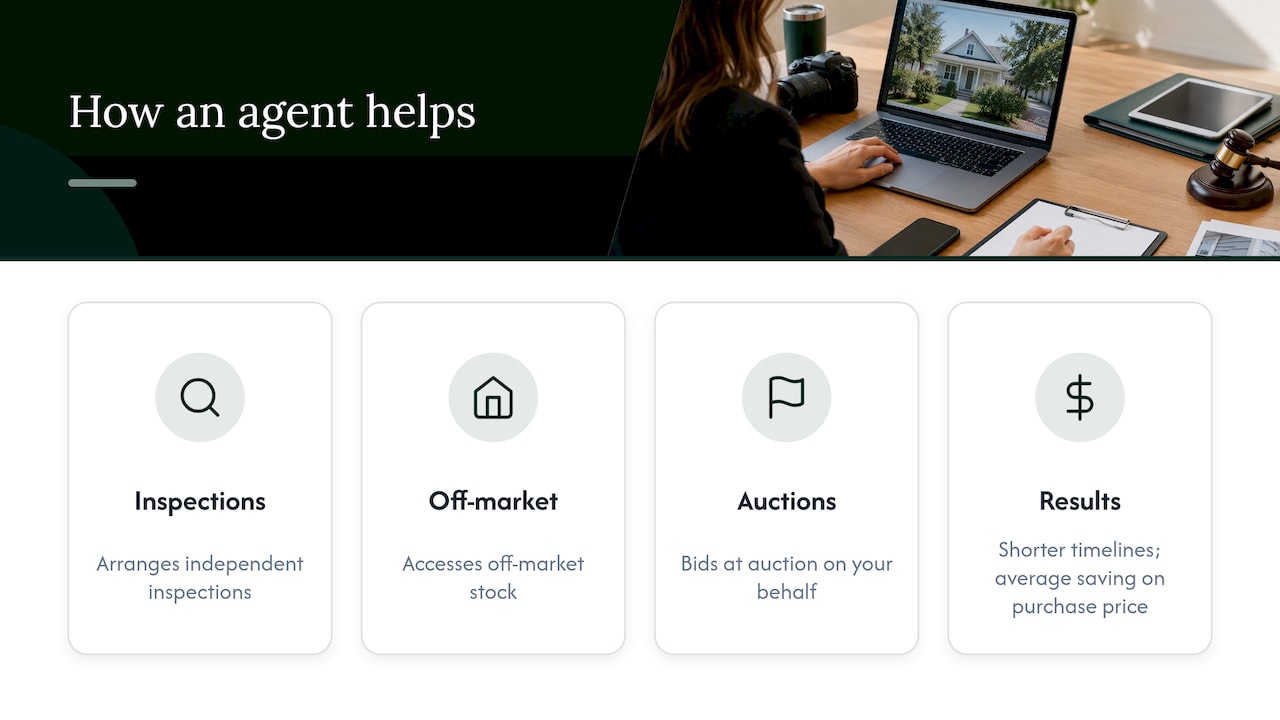
Kristan Johnson, a licensed real estate agent and the 2024 Outstanding Buyers Agent of the Year (Inner West Local Business Awards), has guided buyers through exactly this scenario: committing to a Sydney property from another country. Sydney Property Buyers has secured many properties for clients, with purchases typically completed in a reasonably short timeframe and an average saving achieved on purchase price. A buyer’s agent arranges independent inspections, accesses off-market stock, and bids at auction on your behalf, removing the three biggest hazards of buying from a distance.
The real risk isn’t distance, it’s confidence
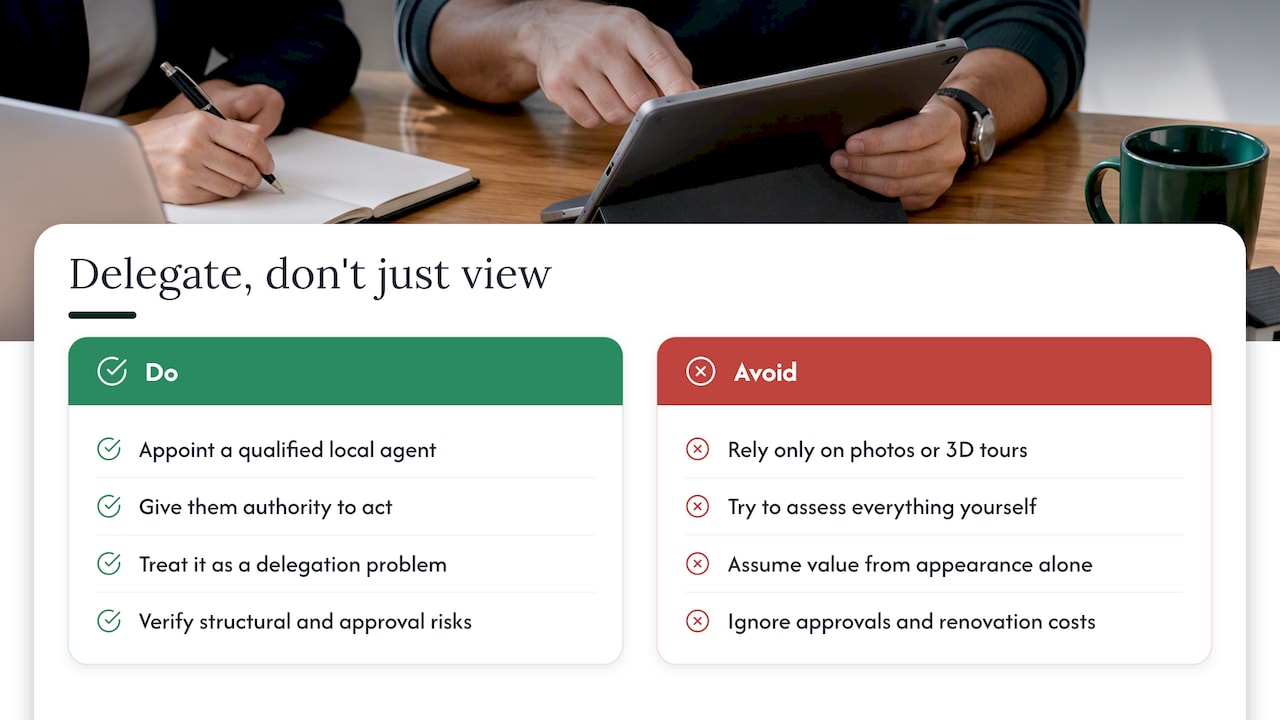
The conventional advice on sight-unseen buying focuses almost entirely on technology: better video, 3D tours, more photos. That misses the point. A crystal-clear tour of a property with a cracked slab is still a bad purchase. The real gap between a remote buyer and a local one isn’t visual information, it’s judgement: knowing what a crack means, what a renovation without approval costs later, and what a property is actually worth before the auction room decides for you.
Buyers who do best from overseas treat the purchase as a delegation problem, not an information problem. They don’t try to see everything themselves; they appoint someone qualified to see it for them and act on their authority. That single decision, more than any tour technology, is what separates a smooth remote purchase from a costly one.
— Kristan
How Sydney Property Buyers supports a remote purchase
Buying from another country shouldn’t mean buying blind. Some buyers agents offer a Complete Purchase Solution covering strategy, property search, independent appraisal, due diligence, negotiation, auction bidding, and settlement, enabling remote buyers to make confident decisions. Negotiation Only representation may be available for buyers who have already found a property, to secure professional bidding and contract support without the full search process.
- Complete Purchase Solution: end-to-end management from first search to settlement day.
- Auction Bidding: a licensed representative bids on your behalf, within limits you set in advance.
- First contact typically involves a retainer, a discussion of your budget and target areas, and a clear timeline for next steps.
Get in touch through the services page to arrange a remote consultation and find out which service suits your situation.
Resources to help you prepare
A few further resources are worth reviewing before you commit to a remote purchase.
- Why a buyer’s agent suits interstate buyers explains the practical case for representation when you cannot attend inspections.
- Our process, from search to settlement sets out what to expect after engagement.
- A mortgage pre-approval guide is useful background before you start making offers.
FAQ
Can you buy a house sight unseen in Sydney?
Yes, buyers purchase property sight unseen in Sydney regularly, particularly interstate and international buyers who rely on video walkthroughs, floor plans, and independent inspections instead of attending in person. The practice carries more risk than viewing in person, so independent verification of the property’s condition is essential before committing.
Can I buy property in Australia as a US citizen?
US citizens can buy property in Australia, though foreign buyers generally need approval from the Foreign Investment Review Board and face additional fees and conditions depending on the property type. A local solicitor or buyer’s agent can confirm the specific requirements that apply to your situation.
What is the 3-3-3 rule for buying a house?
Definitions of the 3-3-3 rule vary, and it is not a standard Australian property or lending term. If you have encountered it in a US context, it is worth checking with a local mortgage broker or solicitor whether an equivalent principle applies to Australian lending.
How much income do you need to buy a property in Sydney?
The income required depends heavily on the purchase price, deposit size, interest rate, and existing debts, so there is no single figure that applies to every buyer. A mortgage broker or lender can calculate borrowing capacity based on your specific financial position before you start house hunting.
When should a US buyer use a buyer’s agent for a sight-unseen purchase?
A buyer’s agent is worth engaging as early as possible, ideally before you begin seriously viewing properties online, so they can arrange off-market access, independent inspections, and represent you at auction. This removes the need to rely solely on seller-supplied media and gives you professional judgement on the ground in Sydney.
Recommended
- Why a buyer’s agent suits interstate buyers in Sydney
- Why off-market listings matter for Sydney buyers
- How to make an offer on a Sydney property
- Can a foreign buyer purchase Sydney property in 2026?