A buyers agency agreement is the binding contract that sets out your agent’s duties, fees and your rights as a buyer, and it deserves a careful read before you commit. The single most important thing to confirm before signing is an itemised fee schedule paired with explicit, written limits on any bidding or offer authority. Get those two things nailed down and most other contract risks fall away.
TL;DR:
- Confirm that the agreement includes a detailed fee schedule and explicit limits on bidding authority to prevent unexpected costs or unauthorized offers.
- Ensure the contract specifies a clear end date, renewal process, and a cooling-off period that you can rescind in writing within one business day without penalty.
- Set a written maximum bid limit before auction and require that any bid above this limit is explicitly authorized in writing to avoid unintended commitments.
- Verify the agent’s licence number, ask for recent purchase references, and clarify off-market access to assess their capability and trustworthiness before signing.
- Negotiate terms such as exclusivity duration, fee caps, and expense approvals in writing, and involve a solicitor if clauses seem overly broad or unfamiliar.
Table of Contents
- What a buyers agency agreement is and the agent’s legal duties
- Key terms to look for in the agreement
- Fees, commissions and other costs
- Written authority and auction bidding
- How to review, negotiate and amend before you sign
- Practical pre-sign checklist and questions to ask
- A practitioner’s view on how these clauses play out
- How Sydney Property Buyers can help with your agreement
- Sources to check before you sign
- FAQ
What a buyers agency agreement is and the agent’s legal duties
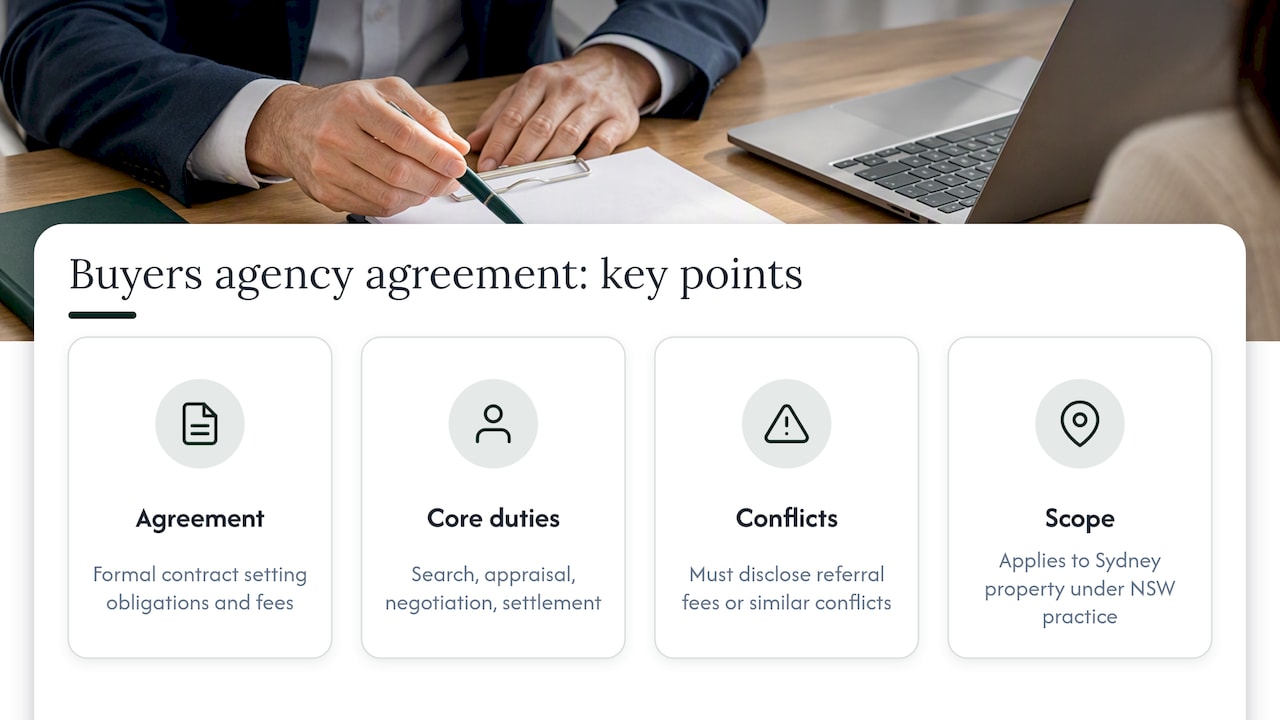
A buyers agency agreement is the formal contract between you and a licensed buyer’s agent, setting out what the agent will do on your behalf and what you’ll pay for it. For anyone purchasing Sydney property, it matters because it converts a verbal arrangement into an enforceable set of obligations covering search, appraisal, negotiation and settlement.
The agreement should specify that the agent acts in your best interests, seeks the best possible purchase price on your behalf, and discloses any conflicts of interest, such as a referral fee from a conveyancer or mortgage broker. A buyer’s agent’s role in reviewing the contract typically extends beyond the agency agreement itself into due diligence on the property contract.
This guidance applies to agreements governing purchases of Sydney property, where contract language and consumer protections follow New South Wales practice rather than a generic national template.
Key terms to look for in the agreement
Read the agreement clause by clause rather than skimming to the signature page. A few items decide whether the contract protects you or exposes you.
- Scope and exclusivity: accept exclusivity only if it’s tied to a defined service level, and challenge any clause that locks you in regardless of the agent’s activity.
- Duration and termination: look for a clear end date, a renewal mechanism that requires your active consent, and a stated notice period to exit.
- Cooling-off rights: many buyers have a one business day cooling-off period for agency agreements, and rescission must be delivered in writing within that window to avoid fees.
- Disclosure and conflicts: any referral arrangement, commission split or related-party dealing should appear in writing, not as a verbal aside.
- Red-flag wording: watch for overbroad authorisations (“agent may act as necessary”), fees not listed anywhere in the document, and automatic extension clauses that renew without your signature.
Pro Tip: Practitioners advise buyers never to sign away the cooling-off right without independent legal advice, even when an agent frames it as a formality.
Fees, commissions and other costs
Buyer’s agents in Sydney typically charge either a fixed fee or a percentage commission based on the purchase price, and each model suits a different buyer. A fixed fee versus percentage comparison is worth reading in full, but the short version is that a fixed fee removes any incentive tied to a higher sale price, while a percentage model can scale unpredictably on an expensive purchase.
Beyond the core fee, itemised fee disclosure should cover disbursements such as building and pest inspection costs, auctioneer fees where relevant, and any third-party reports commissioned during due diligence.
Most agreements require a retainer at engagement, which is deducted from the final fee at settlement rather than charged on top of it. Before signing, insist on:
- A written fee schedule listing every charge and when it applies.
- Confirmation of the retainer amount and whether any portion is refundable.
- Examples of situations where extra costs might arise, such as an extended search period.
Written authority and auction bidding
Written bidding authority is the clause that protects you most directly at auction, because it stops an agent from committing you to a price you haven’t agreed to. Without it, a verbal understanding can turn into a dispute about what was actually authorised.
- Set a maximum bid limit in writing before auction day, separate from any general authority to inspect or negotiate.
- Require that any bid above the agreed limit needs your explicit sign-off, by phone and followed up in writing, before the agent proceeds.
- Confirm who is responsible for the auction deposit and the settlement timeline once a successful bid is made.
- Ask for immediate written confirmation after each bid placed on your behalf, not a summary after the event.
Sound auction bidding practice keeps these authorisations distinct, so an agent authorised to attend and inspect isn’t automatically authorised to bid without your separate, written go-ahead.
How to review, negotiate and amend before you sign
Work through the agreement in a fixed order: fees first, then bidding authority, then cooling-off rights, then termination terms. That sequence catches the items most likely to cause disputes later.
Several terms are genuinely negotiable. Exclusivity length, fee caps, retainer amounts and any expense approvals above a set threshold can usually be adjusted if you ask before signing rather than after.
- Request written amendments rather than relying on verbal promises from the agent.
- Involve a solicitor or conveyancer if the agreement includes unfamiliar clauses or unusually broad authority language.
- Treat any pressure to waive your cooling-off right or accept vague fee wording as a reason to pause, not proceed.
Pro Tip: If an agent resists putting a requested change in writing, that reluctance is itself useful information.
Practical pre-sign checklist and questions to ask
Before you sign, walk through this checklist and raise anything missing directly with the agent.
- Written, itemised fee schedule covering the core fee and all disbursements.
- Explicit bidding authority with a stated maximum and a sign-off procedure for increases.
- Clear cooling-off statement and the correct method for rescission.
- Termination notice period stated in days, not left open-ended.
- Examples of recent purchases or references you can contact.
Ask the agent directly about off-market access, how often they inspect properties, their general negotiation strategy, their licence number, and whether they carry professional indemnity insurance. You can verify a licence number through NSW Fair Trading’s public register before you commit to anything.
A practitioner’s view on how these clauses play out
Kristan Johnson, a licensed real estate agent and director of a buyers agency, has seen how a vague bidding clause turns a straightforward auction into a dispute. Explicit bid limits and itemised fee disclosure consistently prevent the two most common complaints: buyers paying more than intended, and being billed for costs they never saw listed. That experience shapes why some buyers agencies build clear authority language and disclosure into every agreement, alongside access to off-market properties and regular inspection availability.
— Kristan
How Sydney Property Buyers can help with your agreement
If you’d rather have someone negotiate on your behalf than parse contract clauses solo, a buyers agency can offer services depending on where you are in the process. Some offer complete purchase solutions covering strategy, search, appraisal, negotiation, auction bidding and settlement from start to finish, while negotiation-only services suit buyers who’ve already found a property and need representation to secure the best price.

Engagement works on a retainer basis, deducted from the final fee at settlement, so there’s no large upfront cost. You can view recent purchases secured for clients or check the services page for full details, then call 1800 676 177 or email hello@sydneypropertybuyers.com.au to discuss which service fits your purchase.
Sources to check before you sign
Verify any agent’s licence number against NSW Fair Trading’s public register before engaging them, and treat a refusal to provide references or recent purchase examples as a warning sign. For modelling bid strategies ahead of auction day, the Auction Bid Calculator from DealAnalyzerAI helps set a realistic ceiling before you agree to written authority limits. For broader guidance on vetting a buyer’s agent, see this practical interview checklist.
This article is general information, not a substitute for advice from a qualified lawyer. Consult a qualified legal professional about your own circumstances before acting on anything here.
FAQ
What is a buyers agency agreement in real estate?
A buyers agency agreement is a written contract between a property buyer and a licensed buyer’s agent that sets out the agent’s duties, fee structure and the scope of services, such as search, negotiation and auction bidding. It protects both parties by making expectations and costs explicit rather than assumed.
Can US citizens buy homes in Australia?
Foreign buyers, including US citizens, generally need approval from the Foreign Investment Review Board before purchasing Australian residential property, and rules vary by visa and residency status. This is a matter for a solicitor or migration adviser to confirm against your specific circumstances before you engage a buyer’s agent.
Is a 3% broker fee standard?
There’s no single standard rate for buyer’s agent fees in Sydney, since agents commonly charge either a fixed fee or a percentage commission that varies by agency and service level. The only reliable way to compare is to request a written, itemised fee schedule from each agent you’re considering.
How much does a buyer’s agent make in Australia?
A buyer’s agent’s earnings depend entirely on their fee structure and the volume and value of purchases they handle, and there’s no published industry-wide figure. Ask any agent you’re considering for their specific fee schedule rather than relying on a general assumption.
Recommended
- Fixed fee vs percentage buyers agent: Sydney guide
- Sydney property auction bidding: how to bid with confidence
- How a buyers agent handles multiple offers in Sydney