To make an offer on a Sydney property right now, request the vendor’s contract of sale, get finance pre-approval, and instruct a solicitor or licensed conveyancer to review the contract before you put forward any price or terms. That sequence is not optional — it is the foundation of every credible offer in NSW.
Here is what to do immediately:
- Request the contract of sale. Under NSW law, a vendor must have a contract prepared before the property can be marketed. Ask the selling agent for it the moment you are serious about a property. The NSW Government confirms buyers should have the contract examined by a lawyer or licensed conveyancer before making an offer.
- Arrange finance pre-approval. Know your borrowing capacity before you negotiate. A pre-approval letter strengthens your position with the vendor.
- Instruct a conveyancer or solicitor. They review the contract, flag risks, and manage exchange. Engage them before you make any offer.
- Decide your price range and key terms. Settle on a walk-away price, preferred deposit amount, and settlement period before you sit down with the agent.
- Order inspections early. Building and pest reports, and strata reports for apartments, should be commissioned as soon as you receive the contract.
Three warnings before you go further: first, an accepted offer is not legally binding — the sale only becomes binding at exchange of contracts. Second, gazumping is legal in NSW until exchange, meaning the vendor can accept a higher offer right up to that moment. Third, advertised price guides are frequently lower than the vendor’s actual expectations — a practice known as underquoting.
Pro Tip: Never pay an expression of interest deposit thinking it secures the property. It does not. Only exchange of contracts binds the vendor.
Key takeaways
Making a credible offer on a Sydney property requires the contract reviewed, finance confirmed, and inspections completed before you submit a price — and exchange completed as quickly as possible once terms are agreed.
| Point | Details |
|---|---|
| Contract review before offer | Request the vendor’s contract immediately and have a solicitor or conveyancer review it before submitting any price or terms. |
| Finance confirmed first | Pre-approval and supporting documents must be ready before you negotiate — vendors favour buyers who can proceed without delay. |
| Due diligence is non-negotiable | Building and pest inspections, strata reports, and title searches must be completed before or during the cooling-off period. |
| Exchange is the binding moment | An accepted offer is not legally binding; only exchange of contracts locks in the sale and protects you from gazumping. |
| Sydney Property Buyers | Achieves an average saving of approximately 9% on purchase price in the Inner West, Eastern Suburbs, Lower North Shore, and Eastern Beaches. |
Table of Contents
- How do you make an offer on a Sydney property, step by step?
- What do you need to arrange before making an offer?
- What should you check in the vendor’s contract and due diligence?
- How do you submit an offer in NSW — verbal or written?
- How do you negotiate effectively when buying in Sydney?
- What happens at exchange, during cooling-off, and at settlement?
- What are your rights around underquoting and gazumping in NSW?
- What do you do after your offer is accepted, countered, or rejected?
- When does hiring a buyers agent in Sydney actually make sense?
- A buyers agent’s perspective on making offers in Sydney
- How Sydney Property Buyers can help you secure your next property
- Sources
How do you make an offer on a Sydney property, step by step?
The process from first inspection to settlement follows a clear sequence, though the pace at which you move through it can determine whether you secure the property or lose it to another buyer.
-
Attend the property and request the contract (Day 1). Ask the selling agent for the contract of sale at or immediately after your first inspection. In NSW, this document must exist before the property is advertised, so there is no reason to wait.
-
Send the contract to your solicitor or conveyancer (Day 1–2). A thorough contract review typically takes 24–48 hours. Your legal representative will check title details, registered encumbrances, easements, zoning certificates, and any special conditions the vendor has inserted.
-
Commission inspections (Days 2–5). Order a building and pest inspection for houses, or a strata inspection report for apartments. These can often be arranged within 48–72 hours in Sydney. For off-the-plan purchases, review the Conveyancing (Sale of Land) Regulation 2022 disclosure requirements with your solicitor.
-
Confirm finance (Days 3–7). If you have pre-approval, notify your broker or lender that you are proceeding. Formal approval typically requires a valuation of the specific property, which the lender orders.
-
Submit your offer (Days 5–10). Once you have reviewed the contract, received inspection results, and confirmed your budget, submit a written offer to the agent. Include price, deposit, settlement period, and any conditions.
-
Negotiate (Days 5–14). Expect counter-offers. The agent will present your offer to the vendor and relay their response. Multiple rounds are common in Sydney’s private treaty market.
-
Exchange of contracts (as soon as terms are agreed). Both parties sign identical copies of the contract and the copies are exchanged — physically or electronically. The buyer pays the deposit (typically 10%) at exchange. This is the moment the sale becomes legally binding.
-
Cooling-off period (five business days post-exchange). Under the Conveyancing Act 1919 (NSW), you have five business days to rescind, though a 0.25% penalty applies. In competitive markets, buyers often waive this via a Section 66W certificate.
-
Settlement (typically 30–90 days post-exchange). Your conveyancer manages title searches, loan drawdown, and the final transfer. A practical step-by-step guide from Select Conveyancing confirms this workflow as standard practice across NSW.
Statistic: Sydney Property Buyers secures properties for clients in an average of 54 days from engagement to settlement — a timeline that reflects how quickly a well-prepared buyer can move through this sequence.
What do you need to arrange before making an offer?
Preparation before you submit a single dollar figure is what separates credible buyers from those who lose properties to better-organised competitors.
Finance pre-approval comes first. A conditional pre-approval from your lender tells you exactly what you can borrow and signals to the vendor that you are a serious buyer. Gather your supporting documents before you start inspecting: two to three months of payslips, recent bank statements, tax returns if self-employed, and proof of your deposit funds. Your mortgage broker will need these to submit a formal application quickly once you identify a property.
Budget beyond the purchase price. Stamp duty (transfer duty in NSW) is a significant cost that many first-time buyers underestimate. NSW Fair Trading’s buying guide recommends factoring in all transaction costs before setting your offer ceiling.
Vendors in Sydney often favour buyers who can offer flexible settlement dates or a higher deposit — these non-price levers can be as persuasive as an extra $10,000 on the price.
Pro Tip: When you present an offer, attach your pre-approval letter and a brief note confirming your deposit funds are available. It takes 30 seconds and immediately distinguishes you from buyers who are still arranging finance.
For suburb-specific research to inform your budget and comparable sales, the guide on how to research Sydney suburbs is a useful starting point.
What should you check in the vendor’s contract and due diligence?
The vendor’s contract of sale is the single most important document in the transaction. In NSW, the seller must have it prepared before the property is advertised — a requirement that works in your favour, because you can request it immediately and have your solicitor review it before you commit to anything.
The Conveyancing (Sale of Land) Regulation 2022 prescribes which documents must be attached to the contract. Your solicitor will check these, but as a buyer you should know what to expect:
- Title search and registered plan — confirms the vendor’s ownership and the property’s legal boundaries.
- Section 149 (planning) certificate — shows zoning, heritage overlays, flood risk, and development restrictions.
- Sewerage diagram — confirms drainage location relative to the building.
- Pool compliance certificate — required where a pool is present.
- Strata plan and by-laws — for apartments, the strata report reveals levies, outstanding works, and the financial health of the owners corporation.
- Vendor’s disclosure statement — any known defects or encumbrances the seller is obliged to disclose.
Beyond the contract itself, commission your own independent checks. The full scope of property due diligence covers:
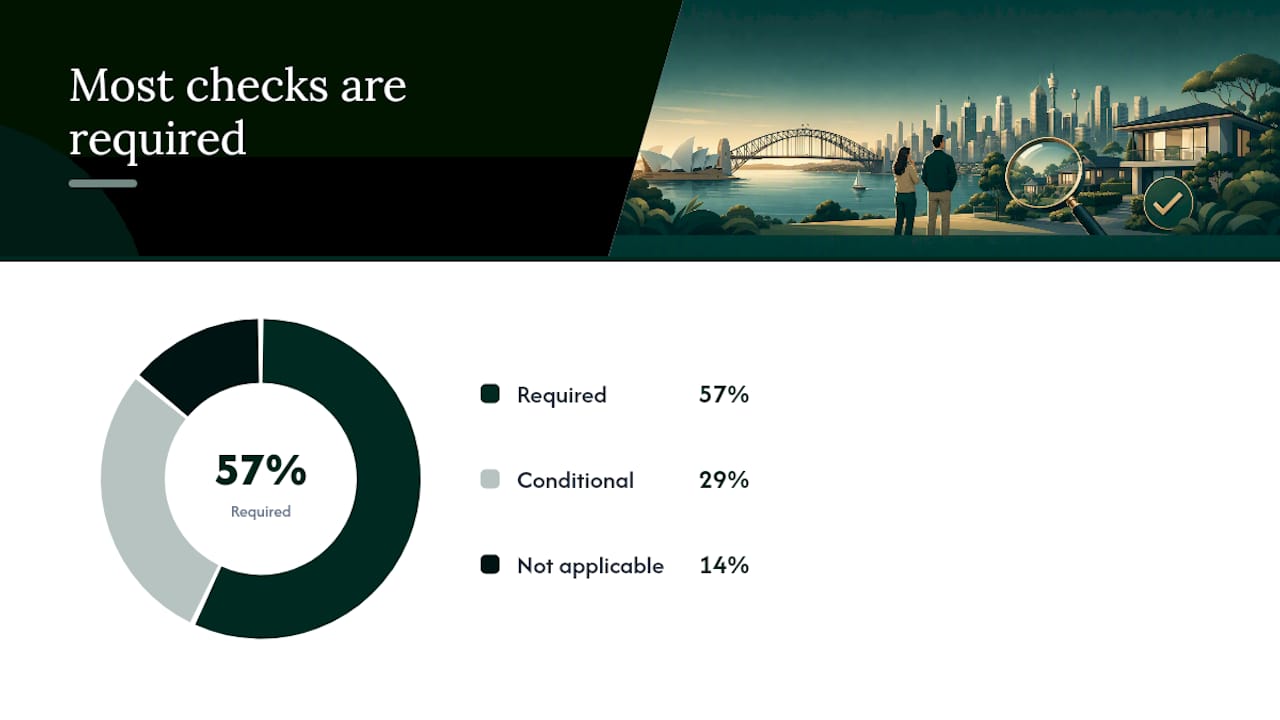
| Check | Houses | Apartments | Off-the-plan |
|---|---|---|---|
| Building and pest inspection | Required | Exterior/common areas | Review building report when available |
| Strata inspection report | Not applicable | Required | Review draft by-laws and disclosure |
| Title search | Required | Required | Required |
| Section 149 certificate | Required | Required | Required |
| Easements and covenants | Required | Required | Required |
| Pool compliance certificate | If pool present | If pool present | If pool present |
| Developer disclosure statement | Not applicable | Not applicable | Required |
Legal note: A contract is not legally binding until exchange. Until that moment, neither party has any enforceable obligation — which is why completing due diligence quickly and moving to exchange without delay is the most effective risk management strategy available to a buyer.
How do you submit an offer in NSW — verbal or written?
Offers in NSW can be made verbally or in writing. Verbal offers are common at open homes, but they carry real risk: there is no record of what was agreed, and the agent has no obligation to present a verbal offer to the vendor in any particular form. CommBank’s practical guide recommends written offers specifically to maintain a clear record of negotiations.
A written offer, sent by email to the selling agent, should include:
- Purchase price — your opening figure, stated clearly.
- Deposit amount — typically 10% of the purchase price, payable at exchange.
- Proposed settlement date — a specific date or number of days post-exchange (e.g. 42 days).
- Finance condition — if you require formal loan approval, state the lender, loan amount, and the number of days you need (typically 14–21 days).
- Building and pest inspection condition — if not already completed, request a condition allowing you to withdraw if the report is unsatisfactory.
- Inclusions — list any fixtures, fittings, or chattels you expect to be included (e.g. dishwasher, blinds, garden shed).
- Offer expiry — give the vendor a deadline (24–48 hours is standard) to prevent the offer sitting open indefinitely while the agent shops for higher bids.
Sample offer fields (adapt to your situation):
Once the agent presents your offer, the vendor will accept, reject, or counter. A counter-offer is simply a new offer from the vendor — you are free to accept, counter again, or walk away. Nothing is binding until both parties have signed and exchanged contracts.
Pro Tip: Always follow up a verbal negotiation with a written email summarising what was discussed. It keeps the agent honest and gives you a paper trail if the terms are later disputed.
How do you negotiate effectively when buying in Sydney?
Negotiation in Sydney’s residential market is rarely a single exchange. Understanding the vendor’s position — and your own — before you open is what gives you room to move.
Set your opening offer using comparables. Pull recent sales data for comparable properties in the same suburb (same size, condition, and street type) from the past 90 days. If the property has been on the market for more than three to four weeks without a price reduction, the vendor may be more flexible. Days on market is one of the clearest signals of vendor motivation. For structured suburb research methods, the buyers agent suburb research guide covers the analytical approach in detail.
Use non-price levers. Experienced buyers agents know that property negotiation strategy is rarely just about price. A shorter settlement period, a higher deposit, or an unconditional offer can be worth more to a motivated vendor than an extra $15,000–$20,000 on the price. If the vendor is downsizing and needs time to find their next home, offering a longer settlement at a slightly lower price can win the deal.

Conditional versus unconditional offers. A conditional offer (subject to finance, subject to building inspection) protects you but is less attractive to a vendor who wants certainty. An unconditional offer removes those protections but signals strength. In competitive Sydney suburbs, unconditional offers are common — but only make one if your finance is confirmed and your inspections are complete.
Handling multiple offer situations. When an agent tells you there are multiple offers, you face a decision: submit your best price and terms, or hold back. In tight markets across the Inner West, Eastern Suburbs, and Lower North Shore, agents sometimes call for best-and-final offers by a set deadline. If you are in that position, submit your genuine ceiling — not a figure you plan to negotiate from.
Pro Tip: In a best-and-final scenario, consider adding a small, odd increment to your offer (e.g. $1,252,500 rather than $1,250,000). It signals you have thought carefully about the number and can differentiate your offer from round-figure bids at the same level.
For complex multiple-offer situations, the guide on how a buyers agent handles multiple offers in Sydney explains the tactical options in detail.
What happens at exchange, during cooling-off, and at settlement?
Exchange of contracts is the legal turning point in every NSW property transaction. Before exchange, neither party is bound. After exchange, both are.
Here is how it works in sequence:
-
Solicitors prepare for exchange. Once price and terms are agreed, your solicitor and the vendor’s solicitor coordinate the exchange. Both parties sign identical copies of the contract.
-
Deposit is paid at exchange. The standard deposit in NSW is 10% of the purchase price, paid into the agent’s trust account. Some vendors accept 5%, particularly for off-the-plan or where negotiated. An expression of interest deposit paid earlier is not the same thing — it does not bind the vendor and does not count as the contract deposit until exchange is formalised.
-
Cooling-off period begins. Under Section 66S of the Conveyancing Act 1919, you have five business days from exchange to rescind the contract. If you do, you forfeit 0.25% of the purchase price. For example, the penalty for rescinding during the cooling-off period amounts to a small fraction of the purchase price.
-
Section 66W waiver. In competitive markets, vendors often require buyers to waive the cooling-off period before exchange. This is done via a Section 66W certificate, signed by your solicitor or barrister after they have provided advice. Waiving cooling-off removes your statutory safety net entirely — only do it when your inspections and finance are complete.
-
Settlement (typically 30–90 days post-exchange). Your conveyancer manages the pre-settlement process: final title search, loan drawdown, preparation of transfer documents, and calculation of adjustments (rates, water, strata levies). A final title search just before settlement confirms no new caveats or encumbrances have been registered since exchange.
Statistic: Settlement periods typically range around several weeks, depending on the circumstances of the buyer and vendor.
Pro Tip: Ask your solicitor to conduct a final title search in the week before settlement. New caveats occasionally appear between exchange and settlement, and catching them early avoids last-minute delays.
What are your rights around underquoting and gazumping in NSW?
Two risks define the Sydney buying experience more than any other: underquoting and gazumping. Both are worth understanding before you make your first offer.
Underquoting occurs when an agent advertises or quotes a price guide that is lower than the vendor’s actual price expectations or the agent’s own estimated selling price. It is an offence under NSW law. NSW Fair Trading is the regulatory body responsible for investigating complaints and can fine agents found to be underquoting. Agents must base any advertised estimated selling price on reasonable factors — comparable sales, the vendor’s instructions, and market conditions.
Practical responses if you suspect underquoting:
- Run your own comparable sales analysis independently of the agent’s price guide.
- Ask the agent directly for the vendor’s price expectations and any written price guide they have provided to the vendor.
- If you believe underquoting has occurred, lodge a complaint with NSW Fair Trading online or by calling 13 32 20.
Gazumping is the practice of a vendor accepting a higher offer from another buyer after already agreeing (verbally or in writing) to sell to you. It is legal in NSW until exchange of contracts. The only effective protection is speed: move to exchange as quickly as possible once terms are agreed.
Practical responses if you are gazumped:
- Confirm whether the new offer has actually been accepted or whether the agent is using it as leverage.
- Decide quickly whether you can or want to improve your offer.
- If you cannot match the new offer, walk away — the property was not secured, and your legal position before exchange is weak.
- Engage a buyers agent for your next attempt. Coordinated, rapid exchange is one of the clearest advantages professional representation provides.
Statistic: The highest-risk window in any Sydney transaction is the period between an accepted offer and exchange. Expressions of interest deposits and verbal agreements provide no legal protection — only exchange binds the vendor.
What do you do after your offer is accepted, countered, or rejected?
If your offer is accepted:
- Notify your solicitor or conveyancer immediately and confirm the agreed price and terms in writing to the agent.
- Arrange the deposit funds — confirm with your bank how long a transfer will take and whether any notice period applies to term deposits.
- If you have not already completed building and pest inspections, order them now. Do not wait until after exchange unless you are waiving the cooling-off period.
- Instruct your mortgage broker to proceed with formal loan approval and the lender’s valuation.
- Coordinate with your solicitor on exchange timing — aim to exchange within five to seven business days of acceptance to minimise gazumping risk.
If your offer is countered:
- Review the counter-offer against your walk-away price. If the counter is within range, respond with a revised offer or accept.
- Consider whether non-price adjustments (settlement date, deposit size, conditions) could close the gap without increasing the price.
- Set a firm internal limit before you counter again. Negotiation without a ceiling leads to overpaying.
If your offer is rejected or you are competing in a multiple-offer scenario:
- Ask the agent what the vendor’s primary objection was — price, terms, or timing. The answer shapes your next move.
- Decide whether to resubmit at a higher price or walk away. If you are at your ceiling, walking away is the right call.
- In a formal best-and-final process, submit your genuine maximum with the strongest possible terms. Holding back in a best-and-final round rarely works.
Auctions versus private treaty. At auction, there is no cooling-off period and no conditions — the highest bidder exchanges contracts on the day and pays the deposit immediately. Private treaty offers allow conditions and a cooling-off period, but carry gazumping risk until exchange. For off-market opportunities, the process is typically private treaty with more room to negotiate on terms.
When does hiring a buyers agent in Sydney actually make sense?
A buyers agent is not necessary for every purchase, but there are specific situations where the cost of representation is clearly justified by the outcome.
Competitive markets and tight suburbs. In Sydney’s Inner West, Eastern Suburbs, Lower North Shore, and Eastern Beaches, well-priced properties regularly attract multiple offers within the first week. A buyers agent with established agent relationships often knows about properties before they are listed and can negotiate from a position of market knowledge rather than reaction.
Interstate and overseas buyers. If you cannot attend inspections in person, a buyers agent conducts them on your behalf, seven days a week. The guide on why a buyers agent suits interstate buyers covers the practical advantages in detail.
For buyers who want access to that pipeline, exclusive buyers agent representation is the only route.
Complex contracts and negotiation. When a contract contains unusual vendor conditions, heritage overlays, strata issues, or development potential, having an agent who understands the commercial implications of those clauses is worth considerably more than their fee.
Pro Tip: If you have lost two or more properties at the offer or auction stage, that is a clear signal to bring in professional representation. The cost of a buyers agent is almost always less than the cumulative cost of failed purchases, wasted inspections, and legal fees.
A buyers agent’s perspective on making offers in Sydney
The most common mistake buyers make is treating the offer as the beginning of the process. By the time you submit a price, you should already know the contract inside out, have your finance confirmed, and have a clear view of what the property is worth relative to recent comparable sales. Buyers who skip those steps and lead with a number are negotiating blind.
The second mistake is conflating an accepted offer with a secured property. In Sydney, I have seen vendors accept offers on a Friday and exchange with a different buyer on a Monday. Until contracts are exchanged, the property is still on the market. The urgency to exchange is not bureaucratic — it is the only thing that actually protects you.
On negotiation: price is rarely the only lever. Settlement timing, deposit size, and the presence or absence of conditions all matter to vendors, and experienced buyers agents use them deliberately. In a multiple-offer situation, the buyer who wins is not always the one who paid the most — it is often the one whose offer was cleanest and whose solicitor was ready to exchange the same day.
How Sydney Property Buyers can help you secure your next property
Negotiating a Sydney property purchase on your own is possible. Doing it well, quickly, and without overpaying is harder than most buyers expect.

Sydney Property Buyers offers two ways to engage. The Full Service covers everything from suburb research and property search (including off-market opportunities) through to independent appraisal, contract coordination, negotiation, auction bidding, and settlement management. The Negotiation Only service is for buyers who have already identified a property and want professional representation to negotiate the best price and terms without paying for a full search.
Both services operate on a fee-for-service model: a small retainer is required at engagement, which is credited against the final fee on completion. There is no ongoing commission and no conflict of interest — Sydney Property Buyers represents buyers only, never sellers.
To discuss your situation and find out which service fits, call 1800 676 177, email hello@sydneypropertybuyers.com.au, or visit the services page to review the full offering and start the conversation.
Sources
The following NSW government resources and practical guides are the authoritative references for every legal and procedural point covered in this article.
- Making an offer on a property | NSW Government
- CONVEYANCING ACT 1919 – SECT 66S Cooling off period
- CONVEYANCING (SALE OF LAND) REGULATION 2022
- How to Make an Offer on a Property in NSW: A Step-by-Step Guide – Select Conveyancing
This article is general information, not a substitute for advice from a qualified lawyer. Consult a qualified legal professional about your own circumstances before acting on anything here.
Recommended
- How a buyers agent handles multiple offers in Sydney
- Blog – Welcome
- What is a property negotiation strategy for Sydney buyers?
- Why a buyer’s agent suits interstate buyers in Sydney