Sydney prices are likely to hold broadly flat to modestly higher through 2026, with growth concentrated in supply-constrained pockets rather than spread evenly across the city. That outlook rests on two anchors: a published forecast of Sydney’s median house price reaching roughly $1.9 million by the end of 2026, driven largely by supply tightness and scheme effects, and the ongoing influence of interest rates on what buyers can borrow and offer. The sections below unpack the data, the drivers and what this means for your next move.
TL;DR:
- Sydney’s median house price is projected to reach about $1.9 million by the end of 2026, driven mainly by supply constraints and borrowing scheme effects.
- Interest rate movements will be the primary influence on market direction, with cuts potentially boosting offers and rises cooling demand.
- Areas close to transport, employment hubs, and with limited new supply are more likely to outperform, while suburbs with many new apartments may face softer prices.
- Construction costs and policy shifts are key factors limiting new supply, and rental demand remains strong due to migration and population growth.
- External risks like a global slowdown or policy tightening could significantly alter the forecast, emphasizing the importance of building a buffer in affordability planning.
Table of Contents
- Sydney’s 2026 baseline: the numbers so far
- Interest rates, construction costs and the other forces shaping 2026
- Which Sydney suburbs are likely to outperform in 2026
- What buyers and investors should actually do in 2026
- How a buyer’s agent applies this forecast in practice
- How government policy and regulation shape the 2026 outlook
- Employment, wages and migration: the macro backdrop for 2026
- Rental trends and what they mean for 2026 investment decisions
- External risks that could change the 2026 picture
- Long-term demographic trends behind Sydney’s housing demand
- A buyer’s agent’s view on the 2026 market
- How we help you act on the 2026 forecast
- FAQ
- Sources
Sydney’s 2026 baseline: the numbers so far
Any 2026 forecast has to start with where Sydney sits right now, and the picture is one of modest, uneven momentum rather than a runaway market. Early in 2026, national commentary pointed to signs of softening in Sydney and Melbourne, with the path forward tied closely to where interest rates head next.
Against that backdrop, one widely cited projection has Sydney’s median house price climbing to around $1.9 million by the end of 2026, a forecast largely driven by constrained housing supply and government assistance schemes that increase buyer borrowing capacity without adding stock. This is a projection, not a certainty, alongside commentary noting affordability pressures that may limit broader gains.
A short timeline helps explain how we got here:
- Through 2024 and into 2025, elevated interest rates slowed borrowing capacity and cooled buyer activity across much of Sydney.
- Construction activity failed to keep pace with population growth, leaving a persistent gap between new supply and underlying demand.
- By early 2026, clearance rates and monthly price movements were being watched closely as the first real signal of which way the market would tip.
Sydney’s median house price could reach roughly $1.9 million by the end of 2026, according to published forecasts, a figure that assumes supply constraints persist and that borrowing conditions do not tighten sharply from here.
The honest summary: Sydney is not in boom conditions, nor is it falling sharply. It is a market where the direction of interest rates and the pace of new construction will decide whether 2026 delivers modest growth or a flatter year.
Interest rates, construction costs and the other forces shaping 2026
Three forces will do most of the work in determining how 2026 actually plays out.
- Interest rates remain the single biggest lever on buyer borrowing capacity, and any further cuts would likely flow through to higher offers at auction within a few months, while a pause or rise would do the opposite.
- Construction costs are limiting how much new supply can realistically come onto the market. Industry surveys show that construction-cost rises are reducing near-term completions, with feasibility constraints mattering more to actual delivery than planning reform alone.
- Migration and investor demand continue to add pressure to a housing stock that is not growing quickly enough to absorb it, particularly in established, well-located suburbs.
New apartment and townhouse projects are especially sensitive to this cost pressure. Research into build costs shows that apartment feasibility is often constrained by construction costs that cannot always be passed through into sale prices, which is one reason developers shelve projects and existing stock stays in demand.
It is also worth remembering that policy and rate changes do not show up in prices immediately. A rate cut or a new grant scheme typically takes several months to filter through to buyer behaviour and settled sale prices, which means the market you see today is still partly reacting to decisions made six to twelve months ago.
Pro Tip: Watch auction clearance rates over consecutive weekends rather than a single data point, since one week can be skewed by a handful of unusual results.
Which Sydney suburbs are likely to outperform in 2026
A citywide forecast hides a lot of variation at ground level, and 2026 is likely to reward buyers who think in terms of suburb characteristics rather than postcode lists alone.
- Suburbs close to established transport, schools and employment hubs, where land is genuinely scarce, tend to hold value even when broader conditions soften.
- Areas with little new supply in the pipeline are less exposed to the oversupply risk that weighs on growth corridors with large numbers of near-identical new builds.
- Suburbs carrying a heavy concentration of newly completed apartments, particularly where rental demand has not kept pace, are more exposed to price softness and longer selling times.
- High entry-price suburbs can be more sensitive to small rate movements, since a larger share of buyers there rely on maximum borrowing capacity.
For a buyer or investor, the practical task is weighing capital growth potential against rental yield rather than chasing one at the expense of the other. A tightly held inner suburb might offer stronger long-term growth with a lower yield, while an outer growth area might offer better cash flow but carry more supply risk. Our analysis of suburbs poised for 2026 growth looks at this trade-off in more detail for specific pockets of the city.
What buyers and investors should actually do in 2026
The forecast matters less than what you do with it. A few practical priorities stand out for anyone planning to buy in Sydney this year.
- If you are financially ready and find the right property, waiting for a clearer signal on rates rarely pays off, since well-located stock tends to attract competition regardless of the broader cycle.
- Stress-test your borrowing against at least one further rate rise before settling on a maximum offer, and talk to your lender early about how a fixed versus variable rate changes your buffer.
- Treat building and pest inspections as non-negotiable, and for investment purchases, stress-test the rental yield against a vacancy period of several weeks, not just the advertised rent.
- In a subdued or uncertain market, patient, incremental bidding at auction tends to outperform aggressive early jumps, since it reveals less about your ceiling and forces competitors to show their hand first.
Our guide to researching Sydney suburbs before you buy and our breakdown of auction bidding with confidence both expand on these points for readers who want a step-by-step approach.
Pro Tip: Ask your lender for a written pre-approval that factors in a rate buffer, not just the current rate, so your maximum offer on auction day is a number you have already stress-tested.
How a buyer’s agent applies this forecast in practice
Turning a citywide forecast into a winning purchase means translating it into specific search criteria and a realistic offer strategy for each property, not just reading the headlines.
- We use current rate settings and suburb-level supply data to set a defensible maximum price before a client ever walks into an auction.
- Independent appraisal and off-market sourcing matter most in constrained-supply conditions like 2026, where the best-value properties often never reach a public listing.
- A typical brief runs from initial strategy and search criteria through appraisal, due diligence, negotiation or auction bidding and settlement, averaging 54 days from engagement to a signed contract.
How government policy and regulation shape the 2026 outlook
Government decisions touch almost every part of the 2026 forecast, from how much buyers can borrow to how much new stock reaches the market. Grant schemes and expanded eligibility for first-home buyer assistance tend to lift borrowing capacity for that segment, which can push up prices at the entry end of the market even when broader conditions are flat, a dynamic cited as one driver behind forecasts of Sydney’s median house price climbing toward $1.9 million by the end of 2026.
On the supply side, state planning reforms aimed at speeding up approvals have had less impact on actual completions than hoped, because the deciding factor for most developers is feasibility, not approval speed. Industry survey data shows that rising construction costs are the dominant handbrake on new supply, regardless of how quickly a project clears planning.
Foreign investment surcharges, land tax settings and rental reforms also shape investor behaviour, sometimes nudging investors toward or away from certain property types. None of these policies acts in isolation. A grant that boosts demand without a matching increase in supply tends to push prices up, while a tax change that discourages investor purchases can soften demand in the same segment that renters rely on. For 2026, the practical reading is that policy will keep nudging demand at the margins while construction costs continue to cap how quickly supply can respond.

Employment, wages and migration: the macro backdrop for 2026
Property prices do not move in isolation from the broader economy, and three macro factors matter most heading into 2026.
Employment conditions set the ceiling on how many buyers can realistically enter the market and service a mortgage. A softening labour market tends to slow upgrader activity first, since people are less willing to take on a larger mortgage when job security feels uncertain.
Wage growth determines how quickly borrowing capacity recovers as rates ease, or how much it erodes if rates rise. When wages grow faster than living costs, buyers can absorb a given interest rate more comfortably, which supports price growth even without a rate cut.
Migration remains one of the more persistent demand drivers for Sydney housing, adding to a population base that construction has struggled to keep pace with in recent years. That combination, population growth outrunning new supply, is a central reason analysts point to supply tightness as a key driver behind price forecasts for 2026, alongside the direct effect of interest rates on what buyers can borrow.
Taken together, these three factors mean the 2026 outlook is not just about the cash rate. A strong labour market and steady wage growth can offset a higher rate environment, while a weaker jobs market can undercut the benefit of rate cuts.
Rental trends and what they mean for 2026 investment decisions
Rental conditions feed directly into whether a Sydney property purchase makes sense as an investment in 2026, and the dynamics here are closely tied to the supply story playing out in sales markets.
Persistent undersupply relative to population growth has kept rental demand firm across much of Sydney, and that tightness shows up most clearly in established suburbs with limited new rental stock coming online. For investors, this matters because rental yield and vacancy risk should be stress-tested against realistic numbers, not just the headline advertised rent, since a property that sits vacant for several weeks can quickly erode an otherwise attractive yield.
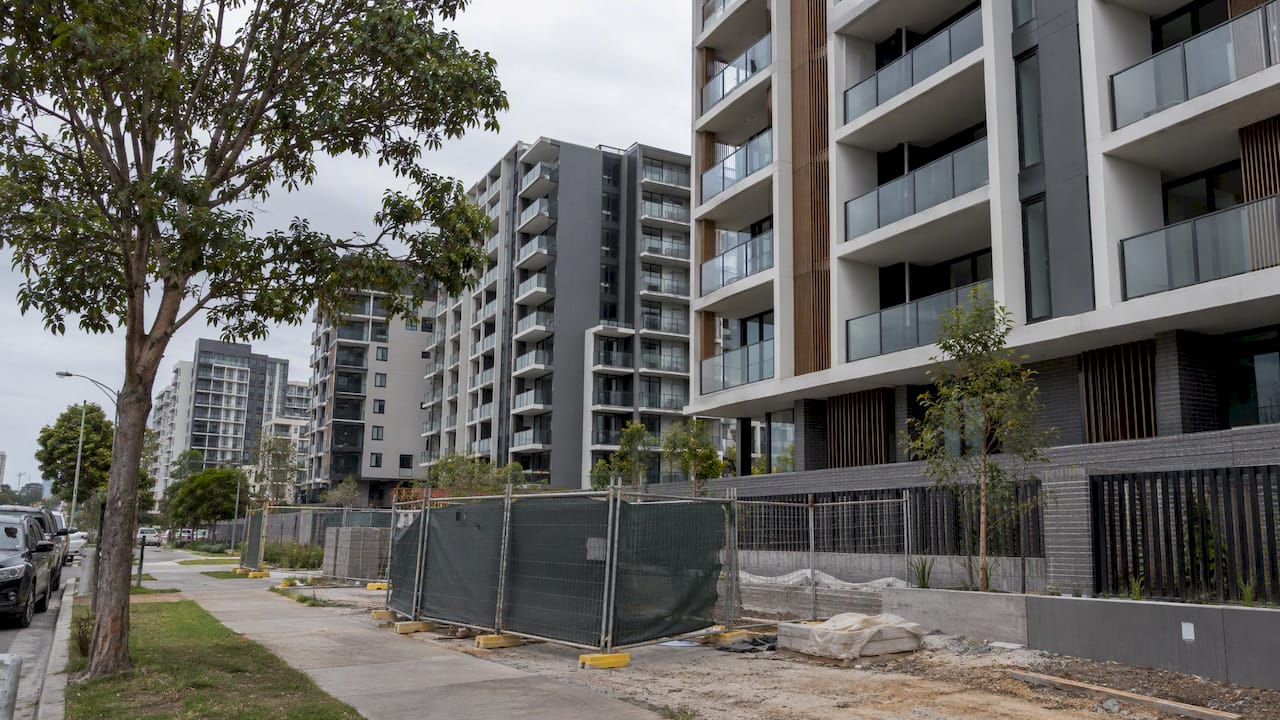
Areas carrying a heavy concentration of newly completed apartments present a different risk profile: a sudden influx of similar rental stock can soften achievable rents and extend vacancy periods, even in a city where rental demand is broadly strong. That is one reason suburb-level analysis matters more than city-wide rental statistics when assessing an investment purchase.
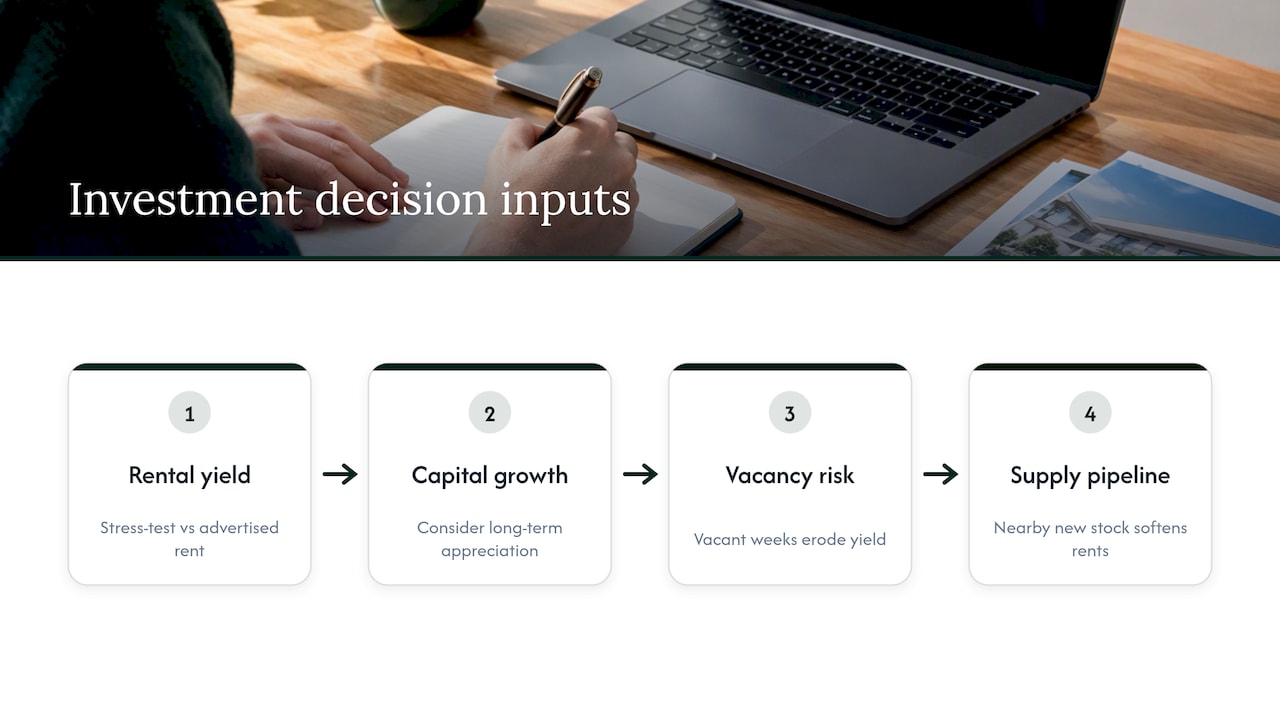
For anyone buying with an investment objective in 2026, the practical approach is to treat rental yield as one input alongside capital growth potential, vacancy risk and the likely supply pipeline nearby, rather than relying on a single headline rental figure to justify a purchase.
External risks that could change the 2026 picture
Every forecast carries uncertainty, and 2026 is no exception. A handful of external risks could shift the outlook meaningfully from the base case of modest, uneven growth.
A sharper than expected economic slowdown, whether domestic or linked to global conditions, could soften employment and wage growth, pulling demand out of the market faster than current forecasts assume. Global financial shocks, including sudden shifts in offshore interest rates or credit conditions, can also flow through to local lending costs even when the cash rate itself stays steady.
On the policy side, a sudden tightening of lending standards or a reversal of first-home buyer assistance could remove demand from the lower end of the market quickly, while a fresh round of stimulus could do the opposite. Analysts generally caution against treating any single point forecast as fixed, and instead recommend prioritising serviceability scenarios, what you could afford under a range of rate outcomes, over a specific predicted price.
The practical takeaway is that 2026 forecasts should be read as a central scenario, not a guarantee, and buyers who build in a buffer for rate or income shocks are better placed regardless of which way the broader market moves.
Long-term demographic trends behind Sydney’s housing demand
Beyond the year-to-year noise, a few demographic trends are likely to keep shaping demand for Sydney housing well beyond 2026. Population growth driven by migration continues to outpace the rate at which new homes are built, a structural mismatch rather than a temporary one, and it underpins much of the supply tightness cited in current price forecasts.
Household composition is also shifting, with smaller average household sizes increasing the number of dwellings needed to house the same population. An ageing population adds another layer, with some owners downsizing out of larger homes while others stay put longer than previous generations, affecting the mix and timing of stock that reaches the market.
These trends do not move quickly, but they matter because they set the demand floor beneath shorter-term rate cycles. Even in a year where interest rates ease or housing markets soften briefly, the underlying mismatch between population growth and new housing supply tends to reassert itself once short-term conditions settle.
A buyer’s agent’s view on the 2026 market
What strikes me most in 2026 is how often well-prepared buyers still lose properties to less-prepared ones who simply move faster at auction. We keep seeing the same pattern: a property that attracts modest interest on paper draws three or four determined bidders once auction day arrives. If you are navigating this market without daily exposure to it, hands-on help is worth considering.
— Kristan
How we help you act on the 2026 forecast
Supply constraints mean the properties worth buying in 2026 often never reach a public listing, which is where off-market access genuinely changes outcomes.

- Our Complete Purchase Solution covers strategy, search, appraisal, negotiation and settlement for buyers who want comprehensive representation.
- Negotiation Only suits buyers who have found a property and need professional representation to negotiate the best price.
- Auction Bidding provides representation at auction for buyers facing competitive conditions.
Call us on 1800 676 177 or visit our services page to discuss which approach fits your 2026 purchase.
FAQ
What are the latest updates on the Sydney property market?
Early 2026 commentary pointed to early signs of softening in Sydney and Melbourne, with the direction for the rest of the year depending heavily on where interest rates head next. Clearance rates and monthly price movements are being watched closely as the clearest short-term signal.
What are the current property prices near Western Sydney Airport?
Specific published price data for suburbs immediately surrounding Western Sydney Airport is not publicly listed in the sources behind this article. Broadly, areas tied to major infrastructure projects like the airport tend to attract investor interest ahead of completion, though outcomes vary significantly by suburb and proximity.
What is the hardest month to sell a house?
There is no single Sydney-specific figure in our sources identifying one hardest month to sell, and selling conditions vary by suburb and year. As a general pattern, activity tends to slow over the Christmas and New Year period, when fewer buyers are actively inspecting properties.
What is the forecast for the Melbourne property market in 2026?
Early 2026 reporting grouped Melbourne alongside Sydney as showing signs of softening, with the outlook for both cities tied closely to interest rate movements. Detailed Melbourne-specific price forecasts are not covered in the sources behind this article.
Sources
- NMHC survey: multifamily construction starts lose momentum as costs rise — Multi-Housing News
- How much does it cost to build an apartment complex — RSMeans
Recommended
- Benefits of buying off-market in Sydney: 2026 guide
- Sydney property auction bidding: how to bid with confidence
- Can a foreign buyer purchase Sydney property in 2026?
- US Buyers: Buy Sydney Property Sight Unseen Without Getting Burned