Yes, you can buy a tenanted property in Sydney, and the moment settlement happens, you inherit the tenancy exactly as it stands. Under the Residential Tenancies Act 2010 (NSW), a sale does not cancel a lease. Fixed-term agreements generally run their full course, periodic tenancies continue until proper notice is served, and you must sort out bond and rent payment details before or at settlement.
TL;DR:
- Buyers should verify the tenancy agreement, rent ledger, and bond lodgment before making an offer, as missing documentation predicts a problematic handover.
- Fixed-term leases continue unchanged after sale, and vacant possession depends on actual lease expiry or proper early surrender, not just contractual clauses.
- Immediate notification of rent payment details and bond transfer at settlement prevents arrears and legal complications post-purchase.
- Protecting against missing or incomplete tenancy documents with vendor warranties and conditional clauses reduces the risk of disputes and NCAT proceedings.
- Conducting a pre-offer tenancy review through an experienced buyer’s agent helps identify risks and ensures compliance before exchange.
Table of Contents
- What to check before you exchange on a tenanted property purchase in Sydney
- NSW tenancy laws for buyers: what you inherit and what you can enforce
- Handling rent, bond and insurance when settlement day arrives
- What to do once you own a tenanted property
- Buying a tenanted home when you actually want to live in it
- Warning signs and contract protections every buyer should insist on
- How Sydney Property Buyers works through tenanted purchases
- A buyer’s agent’s take on tenanted purchases
- Get a pre-offer tenancy review before you commit
- Where to check the details yourself
- Sources
- FAQ
What to check before you exchange on a tenanted property purchase in Sydney
Before you sign anything, get the paperwork in your hands and read it properly. A tenanted property purchase in Sydney lives or dies on the quality of the documents behind it, not the photos in the listing.
Start with the tenancy agreement itself, the ingoing condition report, and the rent ledger. These three documents tell you what the tenant agreed to, what condition the property was in when they moved in, and whether they have actually been paying on time. A vendor who cannot produce all three within a day or two is telling you something.
Run through this before making an offer:
- Read the tenancy agreement in full, including lease dates and any special clauses (surrender rights, break clauses, penalty terms for early exit).
- Check the rent ledger for arrears, late payments, or unusual gaps.
- Ask for proof the bond is lodged correctly with the NSW Rental Bond Board.
- Ask whether there have been any NSW Civil and Administrative Tribunal applications or disputes involving the tenancy.
- Confirm who currently manages the property and how that arrangement transfers, or ends, at settlement.
Missing paperwork is the single biggest predictor of a messy handover. Reviewing the ingoing condition report, rent ledgers, and any breach notices before exchange catches most problems that would otherwise surface after you’ve already paid your deposit, according to property investment guidance on tenanted purchases.
Pro Tip: Ask the selling agent for the tenant’s full payment history going back at least twelve months, not just the last quarter. A tenant who looks reliable on a three-month snapshot can have a very different pattern over a full year.
NSW tenancy laws for buyers: what you inherit and what you can enforce
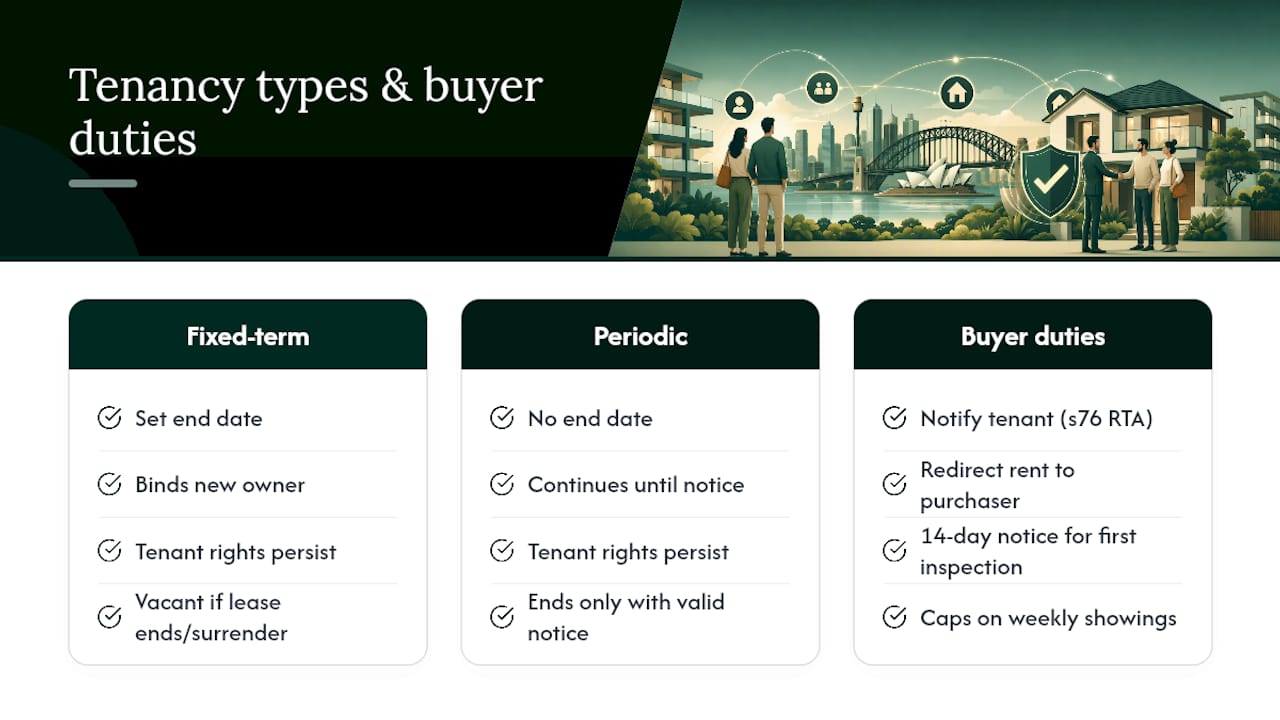
The type of tenancy attached to the property determines almost everything about what happens next. A fixed-term tenancy runs to a set end date and binds the incoming owner just as it bound the seller. A periodic tenancy has no end date and continues indefinitely until either party gives the correct notice. Under section 76 of the Residential Tenancies Act 2010, the new owner must be formally named to the tenant, and rent must be redirected to the purchaser. The sale itself changes none of the tenant’s rights.
Tenants keep their statutory protections through the entire sale process, including during marketing. If a property is being shown to prospective buyers while a tenant lives there, the landlord (or agent) must give the tenant written notice of at least 14 days before the first inspection and make a genuine effort to agree on times that suit them, according to tenancy sale guidance from Armstrong Legal. There are also caps on how many showings can happen in a given week, so a vendor cannot run open homes daily just to move a sale along faster.
Vacant possession is where buyers most often trip up. A contract can only require vacant possession at settlement if the tenancy actually ends by that date, whether through lease expiry, a negotiated surrender, or valid notice already served before exchange. You cannot simply write “vacant possession” into a contract and expect a sitting tenant with eight months left on a fixed-term lease to disappear. If you need the property empty, that condition has to be built into the contract terms and matched against the real tenancy dates, not assumed.
Where a dispute arises, either over notice periods, bond handling, or alleged breaches, the NSW Civil and Administrative Tribunal is the forum that resolves it. NCAT hearings are relatively fast and informal compared with court, but a poorly documented purchase can still end up there, costing time and legal fees you had not budgeted for.
Handling rent, bond and insurance when settlement day arrives
Rent payments do not automatically follow you. Once settlement is confirmed, the tenant needs written notice naming you as the new landlord and stating exactly where rent should now be paid, whether that’s a new bank account, a new property manager, or a new agency altogether. Get this notice out immediately. A tenant left in the dark about payment details has a legitimate excuse for falling into arrears through no fault of their own.
Bond handling needs the same urgency. The vendor and their agent should transfer the bond record with the NSW Rental Bond Board, completing the relevant change-of-landlord paperwork so the bond legally sits with you rather than the previous owner. Chase this at settlement, not weeks later, because an unresolved bond transfer complicates any future claim if the tenancy ends in dispute.
Landlord insurance should be in place from the day you settle, not the day you get around to it. Cover for tenant-related risks, including rent default and malicious damage, matters more with an inherited tenancy than a vacant purchase, since you have no history with this tenant yourself.
On tax, rental income from a tenanted property is assessable from the date you take ownership, and you can generally claim deductions on holding costs from that same date. Rules around depreciation, capital works deductions, and reporting obligations are specific enough that a chat with an accountant experienced in investment property Sydney purchases will save you more than it costs.
What to do once you own a tenanted property
The week after settlement sets the tone for the entire tenancy. Handle it well and you have a cooperative tenant who pays on time and looks after the place. Handle it badly and you have a dispute on your hands within a month.
- Write to the tenant immediately. Introduce yourself as the new owner, confirm the new rent payment details in writing, and give them a way to contact you or your property manager.
- Never attempt to remove a tenant without proper grounds. Buyers who try to force a tenant out, whether through pressure, changing the locks, or simply ignoring the lease, risk NCAT proceedings and can face substantial compensation claims, as legal case studies on unprepared buyers make clear.
- Negotiate a surrender if you need the property sooner. A tenant can agree to leave early in exchange for a financial incentive, but document it properly as a deed of surrender, conditional on your settlement actually completing.
- Give proper notice before any renovation work. Entering a tenanted property to carry out repairs or upgrades still requires the standard access notice; you cannot let yourself in because you now hold the title.
Buyers who skip step one and go straight to renovation plans are the ones who end up explaining themselves to NCAT.
Buying a tenanted home when you actually want to live in it
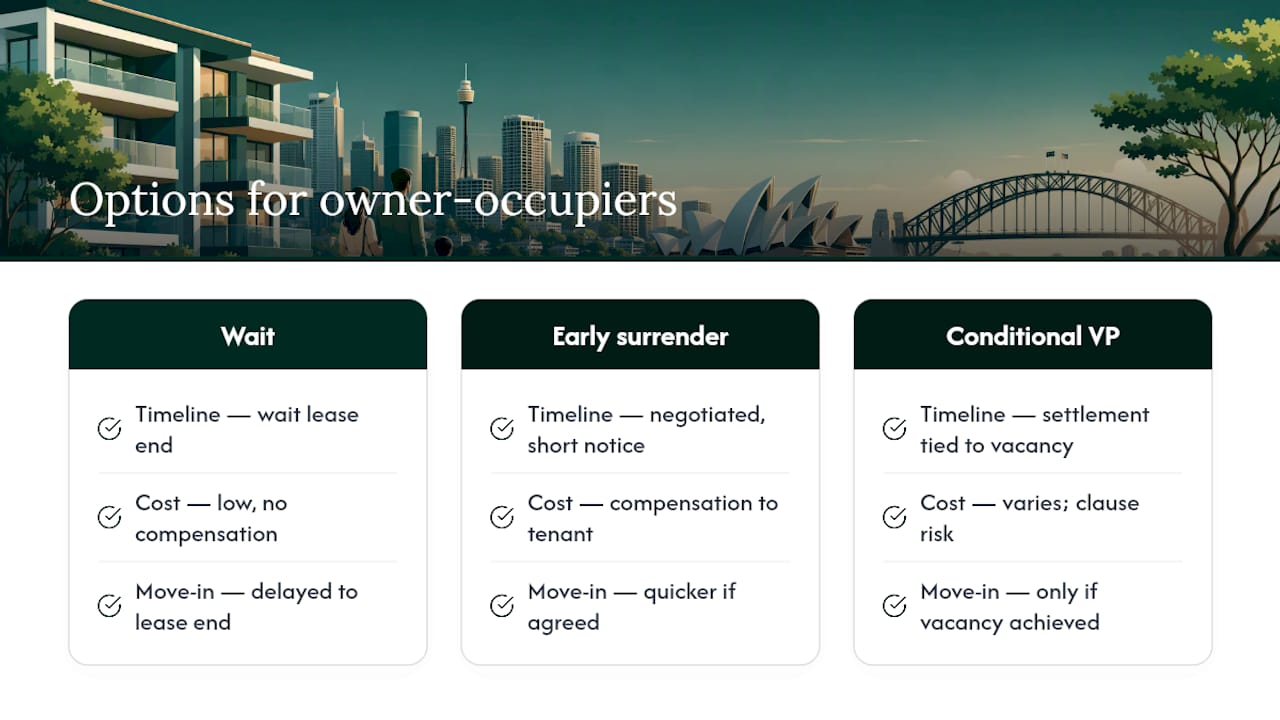
Owner-occupiers face a different calculation. If the current lease is fixed-term with six months left to run, you generally cannot force vacant possession on settlement day. The lease terms that existed before the sale keep governing the property afterwards, and your intention to move in does not override a tenant’s legal right to stay until the lease ends.
Your realistic options are to wait out the lease, negotiate an early surrender with the tenant (usually involving some form of compensation), or build a conditional vacant-possession clause into the contract itself that ties settlement to the tenancy actually ending. Each option has a different timeline and a different cost, so work out which one suits your own moving date before you commit to an offer.
If you’re hoping to use a first-home buyer grant or stamp duty concession, check your eligibility with a solicitor or the relevant NSW authority before assuming a tenanted property qualifies. Occupancy requirements attached to some concessions can be affected by a delayed move-in date.
Warning signs and contract protections every buyer should insist on
Certain red flags should make you slow down, not push through. Missing tenancy paperwork, an incomplete or absent bond record, a pattern of repeated rent arrears, or any hint of past NCAT involvement are the four warning signs that come up again and again in disputed purchases.
- Vendor cannot produce the tenancy agreement or ingoing condition report.
- Bond amount on record does not match what the tenant says they paid.
- Rent ledger shows repeated late payments or unexplained gaps.
- Any evidence of past or pending NCAT applications relating to the tenancy.
Protect yourself at the contract stage rather than hoping problems don’t surface later. Ask your solicitor to build in vendor warranties confirming the tenancy documents are complete and accurate, a clause confirming bond transfer will occur correctly, and, where relevant, a conditional vacant-possession clause tied to actual lease expiry rather than a hopeful date. Structuring these protections, including escrow arrangements for any disputed rent, shifts documentary risk back onto the seller where it belongs, a tactic detailed in legal commentary on tenancy pitfalls.
Pro Tip: If a vendor’s agent is vague about tenancy history during a viewing, ask the question again in writing. A written answer that later turns out to be wrong gives you leverage; a verbal one gives you nothing.
A buyer’s agent who has handled tenanted purchases before will usually spot these gaps during due diligence, before they become your problem, and can negotiate conditional terms into the contract on your behalf.
How Sydney Property Buyers works through tenanted purchases
Sydney Property Buyers handles tenancy due diligence as a standard part of both its Full Service and Negotiation Only offerings, checking lease documents, rent ledgers, and bond records before a client commits to an offer. That review happens whether the property is listed publicly or sourced off-market, which matters given that more than 30% of the agency’s purchases are secured off-market, often before a tenancy issue would even surface in a standard listing.
The agency inspects properties seven days a week, independent of open home schedules, which gives more room to verify tenancy conditions properly rather than relying on a single Saturday viewing. Clients have secured over 100 properties this way, with an average saving of around 9% on purchase price and settlement typically completed within 54 days of engagement.
If you’re weighing up a tenanted listing and want a second opinion before you make an offer, Sydney Property Buyers offers a pre-offer tenancy review as part of its standard buyer’s agent services, covering exactly the checks outlined above.
A buyer’s agent’s take on tenanted purchases
The mistake I see most often is buyers treating tenancy paperwork as a formality to sort out after exchange, rather than a condition of the deal itself. By the time contracts are signed, your leverage to fix a missing bond record or a patchy rent ledger has largely gone.
Insist on seeing the tenancy agreement, condition report, and full rent ledger before you make an offer, not after. If a vendor is reluctant to produce them, that reluctance tells you something the listing photos never will. A pre-purchase review from someone who does this daily costs far less than untangling an NCAT dispute six months in.
— Kristan
Get a pre-offer tenancy review before you commit
If you’re circling a tenanted listing and want the lease, bond, and rent history checked before you put in an offer, that’s exactly the gap Sydney Property Buyers fills for Sydney buyers. Rather than relying on a single open home viewing and a vendor’s summary, the agency runs independent inspections seven days a week and checks tenancy documents as standard, whether the property is on-market or one of the off-market listings clients gain access to.

Full Service covers the whole purchase, from strategy and search through to due diligence, negotiation, and settlement, with tenancy checks built into the due diligence stage. Negotiation Only suits buyers who have already found a tenanted property and want an experienced negotiator handling price and conditional contract terms, including vacant-possession clauses where relevant.
To get a property reviewed before you exchange, call 1800 676 177, email hello@sydneypropertybuyers.com.au, or visit the services page to see which option fits your situation.
Where to check the details yourself
For anyone who wants to read the legal source material directly, section 76 of the Residential Tenancies Act 2010 (NSW) covers notice of sale obligations, while the Tenants’ Union factsheet on sale of rented premises explains tenant-facing rights during a sale. For process-level detail, Kells’ conveyancing guide and Armstrong Legal’s guidance on selling tenanted property are both worth reading before you exchange.
This article is general information, not a substitute for advice from a qualified lawyer. Consult a qualified legal professional about your own circumstances before acting on anything here.
Sources
- RESIDENTIAL TENANCIES ACT 2010 – SECT 76 Notice of sale of residential premises by landlord
- Key Things to Know When Buying a Tenant-Occupied Property
- The hidden pitfalls of existing tenancies: a nightmare for unprepared buyers
- What happens when you buy a house with tenants?
FAQ
Can a foreign buyer purchase a tenanted property in Sydney?
Foreign buyers can generally purchase residential property in Australia, though most require approval from the Foreign Investment Review Board and should confirm current eligibility rules with a solicitor before making an offer on any Sydney property, tenanted or otherwise.
Can I evict a tenant straight after buying a house in NSW?
No. Existing tenancy agreements survive the sale, and you can only end a tenancy through proper legal grounds and notice periods under the Residential Tenancies Act 2010; attempting to force a tenant out can lead to NCAT proceedings and compensation claims.
What are red flags when buying a tenanted property?
Missing tenancy agreements, incomplete bond records, repeated rent arrears on the ledger, and any history of NCAT disputes are the clearest warning signs a buyer should chase down before exchange.
What are the main steps in buying a tenanted property in NSW?
Review the tenancy agreement, condition report, and rent ledger, confirm the bond is correctly lodged, build vendor warranties into the contract, then handle rent redirection and bond transfer promptly at settlement, ideally with a pre-offer review from a buyer’s agent familiar with tenanted purchases.
Does an existing tenancy affect my home loan approval?
Lenders assess a tenanted property largely the same as a vacant one for owner-occupier loans, though rental income can sometimes be factored in positively for investment loan serviceability; check with your broker how your specific lender treats it.
Recommended
- Save 9%: Best Time to Buy in Sydney Is When You Have Leverage
- Section 32 explained: what Sydney buyers need to know
- How to make an offer on a Sydney property
- How a buyers agent saves you money on property