Gross rental yield is (annual rent ÷ property value) × 100. Net rental yield is ((annual rent − annual expenses) ÷ property value) × 100. Both figures are expressed as percentages, typically shown to one decimal place (5.2%, not 5.23417%). Gross yield tells you how a property compares against others on paper; net yield tells you what it will actually put in your pocket.
TL;DR:
- Accurate conversion of weekly or monthly rent to annual figures is essential, as mixing these measurements will lead to false yield calculations.
- Gross yield provides a quick comparison across properties but does not account for expenses, which can reduce actual returns by 0.9 to 2 percentage points or more.
- Expenses such as management fees, rates, insurance, maintenance, strata levies, and vacancy allowances should be deducted from gross rent to determine net yield.
- Strata levies significantly impact net yield for units, often reducing the apparent advantage shown by gross yield figures.
- Relying on optimistic rent estimates or asking prices without independent appraisal and verification greatly skews yield calculations, leading to misleading investment judgments.
Table of Contents
- How to calculate rental yield: converting rent to an annual figure
- Gross rental yield in practice: a worked example
- Net rental yield formula and what to subtract
- Two worked examples: house versus strata unit
- Expenses checklist and the mistakes that skew your numbers
- Using a rental yield calculator versus building a full pro forma
- How a buyers agent uses yield alongside other numbers
- Where to check your formulas and figures
- Why the simple yield number still gets misread
- Sources
How to calculate rental yield: converting rent to an annual figure
Most rent is quoted weekly or monthly, but the rental yield formula only works with an annual figure. Get this conversion wrong and every number downstream is wrong too.
The rule is fixed: multiply weekly rent by 52, and monthly rent by 12. Never mix the two, and never use a “per calendar month” figure as though it were weekly.
- Confirm whether the advertised rent is weekly or monthly.
- Convert to an annual figure ($650/week × 52 = $33,800/year, or $2,800/month × 12 = $33,600/year).
- Divide the annual rent by the property’s value.
- Multiply by 100 to get a percentage.
- Round to one decimal place for reporting.
Gross yield is the fastest way to shortlist properties across suburbs before you dig into expenses. Its limit is obvious once you use it: it ignores every cost of actually running the property, so two homes with identical gross yields can produce very different cash flow once rates, insurance, and management fees enter the picture.
Gross rental yield in practice: a worked example
Take a property valued at $750,000 renting for $650 a week. Annualise the rent first: $650 × 52 = $33,800. Divide that by the purchase price and multiply by 100: ($33,800 ÷ $750,000) × 100, which is around four and a half percent.
That 4.5% sits close to what many Sydney houses return before costs, though yields vary sharply by suburb and property type. As a rough benchmark, gross yields in the typical range for houses (https://www.nerdwallet.com/au/home-loans/what-is-rental-yield) in established, high-demand areas, while units and regional stock often print higher.
| Input | Value |
|---|---|
| Property value | $750,000 |
| Weekly rent | $650 |
| Annual rent (×52) | $33,800 |
| Gross rental yield | 4.5% |
This figure says nothing about strata, rates, insurance, or vacancy. It is a screening tool, not a return you can bank.
Net rental yield formula and what to subtract
Net yield answers the question gross yield can’t: what does this property actually return once it’s running? The formula subtracts every recurring holding cost before dividing by the property’s value: ((annual rent − annual expenses) ÷ property value) × 100.
Expenses that belong in that subtraction, according to the breakdown Westpac uses, typically include:
- Property management fees (usually 5 to 8.8% of rent collected)
- Council rates and water rates
- Building insurance and landlord insurance
- Routine maintenance and repairs
- Strata or owners corporation levies, where applicable
- Land tax, if it applies to the property
- A vacancy allowance, even when the property is currently tenanted
Using the $750,000 house above, assume annual expenses of $6,800 (management, rates, insurance, and a maintenance reserve). Net yield becomes: (($33,800 − $6,800) ÷ $750,000) × 100 = 3.6%.
That 0.9 percentage point drop from the 4.5% gross figure is on the lighter end. Net yield commonly falls a few percentage points below gross once strata, management, and maintenance are properly counted, and a vacancy allowance, often modelled as 2 to 4% of gross rent, should sit inside that expense line rather than being ignored because the property happens to be occupied today.
Two worked examples: house versus strata unit
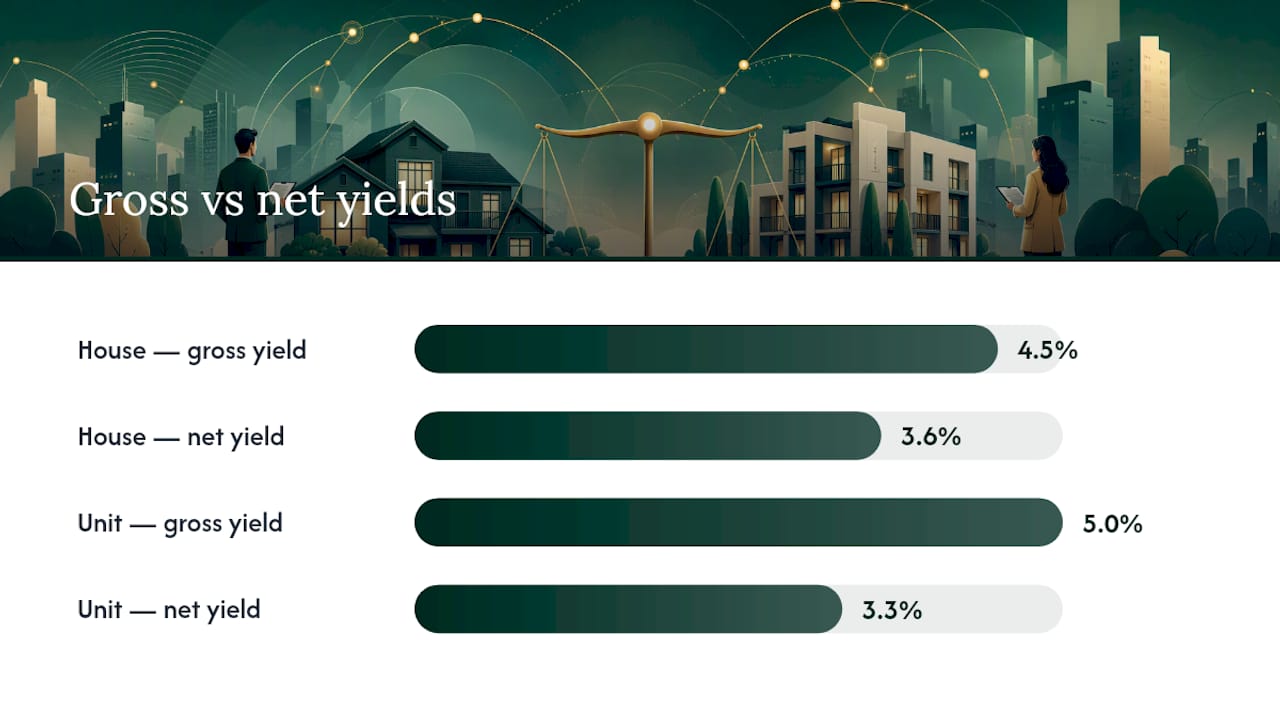
Expense structure is where gross and net yield diverge most, and nothing illustrates that better than comparing a freestanding house against a unit carrying strata levies.
Example A: suburban house, approximately $750,000, $650/week rent
- Annual rent: about $33,800
- Expenses: management, rates, insurance, and maintenance reserve totaling around $6,800
- Gross yield: around 4.5%
- Net yield: around 3.6%
Example B: inner-city unit, about $650,000, $600/week rent
- Annual rent: approximately $31,200
- Expenses: management, council rates, insurance, strata levies, and maintenance adding up to roughly $9,660
- Gross yield: approximately 5%
- Net yield: about 3.3%
| Metric | House | Unit |
|---|---|---|
| Gross yield | 4.5% | 5.0% |
| Net yield | 3.6% | 3.3% |
| Gap (gross to net) | 0.9 pts | around one percentage point |
The unit looks stronger on gross yield alone, but strata levies close most of that gap. Anyone comparing properties purely on the headline gross figure would have picked wrong.
Expenses checklist and the mistakes that skew your numbers
Undercounting costs is the single biggest reason net yield calculations mislead investors. The recurring items to budget for every time: management fees, council rates, water charges, building and landlord insurance, ongoing maintenance, strata levies where relevant, and land tax if it applies to your holding structure.
Vacancy deserves its own line rather than being assumed away.
The most common arithmetic errors:
- Using weekly rent figures without converting to annual, or mixing weekly and monthly inputs in the same calculation
- Calculating yield against the asking price rather than the actual purchase price or a current market valuation
- Ignoring one-off costs at settlement, such as pest and building reports or initial repairs, that inflate the true holding cost in year one
- Forgetting land tax where it applies, particularly for investors holding multiple properties in one name
If the property still stacks up on the lower figure, you have some margin for error built in.*
Using a rental yield calculator versus building a full pro forma
An online calculator is fine for a first pass, provided you feed it the right inputs: rent (correctly annualised), property value, a vacancy allowance, and your expense estimate rather than a placeholder. Tools such as the Rental Property Calculator from Real Estate Investor Toolkit let you test these inputs quickly and see cash flow alongside yield.
- Enter annualised rent, not weekly or monthly figures.
- Set a realistic vacancy rate, not zero.
- Add every expense line rather than a rounded estimate.
- Re-run the numbers with management fees adjusted up or down a percentage point to see sensitivity.
- Move to a full cash-flow pro forma once you’re weighing loan repayments, tax effects, or depreciation, since yield alone doesn’t capture any of that.
Lenders don’t rely on your net yield figure either. Most shade rental income for serviceability, commonly accepting only around 75% of market rent when assessing your ability to service a loan, so a strong yield on paper won’t automatically translate into borrowing capacity.
How a buyers agent uses yield alongside other numbers
Yield calculations are only as good as the market rent and property value fed into them, and that’s where a lot of DIY modelling goes wrong. Sydney Property Buyers cross-checks proposed rent against genuine comparable lettings and an independent appraisal of value, rather than accepting an agent’s ambitious rent estimate or an inflated asking price at face value, as outlined in our investment property search guide.
Negotiation also shapes the yield equation directly. Buying $30,000 to $50,000 below the asking price on a $750,000 purchase lifts gross yield by several tenths of a percentage point without touching the rent line, and off-market access often produces exactly that kind of discount.
Before trusting any yield figure, ask:
- How was the market rent derived, and from which comparable listings?
- Is the property value based on the asking price or an independent appraisal?
- Does the expense list include strata, land tax, and a vacancy allowance?
- What’s the vacancy assumption, and is it realistic for the suburb?
- Has the rent been annualised correctly from a weekly or monthly figure?
Where to check your formulas and figures
For a second reference point, Wise’s step-by-step breakdown confirms the same gross and net formulas with its own worked figures, and the CalculateStuff calculator is a quick way to sanity-check your own inputs before committing to a purchase decision.
Why the simple yield number still gets misread
Most investors treat gross yield as the headline and net yield as an afterthought, when it should be the reverse. The gap between the two, often 1 to 2.5 percentage points once strata and management are counted properly, is where the real investment decision sits. A property advertised on a punchy gross figure and a property with a modest gross figure but low holding costs can land in the same place once you do the subtraction properly.
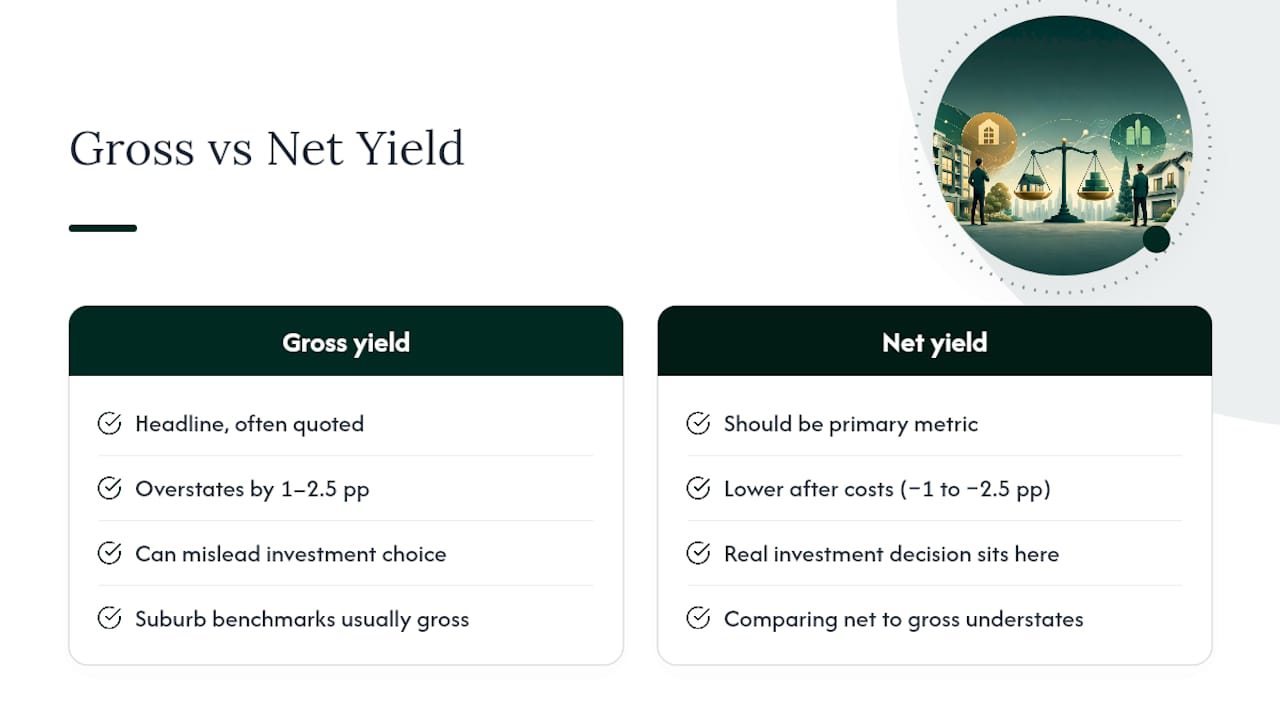
The conventional advice to “aim for a good yield” is close to useless without specifying which yield. Suburb benchmarks quoted online are almost always gross, which means comparing your own net calculation against them consistently understates your property’s real performance relative to the market average, not because your maths is wrong but because you’re comparing two different things.
What I’d prioritise first: get the market rent and the property value right before touching the formula at all. The arithmetic is trivial once you have accurate inputs; every yield calculation that goes wrong does so because someone plugged in an optimistic rent estimate or an asking price rather than a proper appraisal. That’s the step DIY investors skip, and it’s the step a buyers agent exists to fix, through independent valuation, verified comparable rents, and negotiation that improves your entry price before the formula ever runs. If you want that groundwork done properly, our full-service offering covers exactly this before you commit to a number.
— Kristan
Sources
Recommended
- Negative gearing explained: a guide for Australian investors
- Buyers agent investment property search: Sydney guide