When competing bids land, the strongest move you control is certainty: a written finance approval or proof of funds, plus the cleanest terms you can afford. Sellers weigh price, deposit, conditions and settlement date together, so a tidy offer at a sensible price often beats a higher one full of conditions. A buyers agent usually sharpens each of those levers.
TL;DR:
- Sellers compare price with deposit, finance certainty, inspection conditions, settlement timing, and requests such as rent back, so tailor terms to the vendor’s priorities.
- Base your offer on three recent comparable sales and a written walk away price; cap any escalation clause at that limit and attach finance approval.
- Complete building and pest inspections before bidding, because reports can support shorter conditions; do not waive protections before legal review.
- Sealed offers reward your strongest complete terms, while auctions require a firm written ceiling; in NSW, auction bids have no cooling off period.
Table of Contents
- Which offer elements matter most to sellers
- Pricing and offer structure tactics for competitive bids
- Auction and bidding tactics in stacked-offer scenarios
- How a buyers agent strengthens your offer
- How to avoid overpaying: budget guardrails and verification checks
- Step by step: what to do when you learn there are multiple offers
- Timing strategy: when to submit offers in relation to other bids and auction dates
- Legal and contractual aspects specific to NSW and Sydney relevant to multiple offers
- Psychological tactics and rapport-building with sellers and agents to influence offer preference
- What we have learned: common mistakes and priorities from an experienced buyers agent
- How we can help when you face multiple offers
- FAQ
- Sources
Which offer elements matter most to sellers
When several offers land on one desk, the selling agent compares them side by side. The headline price is only one line of that comparison. NAR’s consumer guide explains that sellers may take the offer that looks best on paper or open a negotiation, and that they weigh terms such as escalation clauses and counteroffers rather than price alone.
These are the components sellers typically line up against each other:
- Headline price: the number on the contract, and the first thing everyone reads.
- Deposit: a larger deposit signals commitment and gives the seller more security if you fail to settle.
- Finance condition: an offer subject to loan approval carries more risk than one backed by approval in hand or cash.
- Building and pest condition: a short or waived inspection window removes a common reason for a deal to fall over.
- Settlement period: a date that suits the seller’s next move can be worth real money to them.
- Seller requests: a rent-back or a longer or shorter settlement can sway a close decision.
Think in terms of net to seller: what the vendor actually walks away with, adjusted for risk and timing. Say Offer A is at a higher price, subject to finance and a building report, with a longer settlement. Offer B is at a lower price, unconditional, with a larger deposit and a settlement date the vendor asked for. Many sellers will take B, because A could collapse and leave them re-listing. Now flip it: if A’s buyer holds a written approval and drops the building condition, A wins on price. The mix of terms decides it, not the price alone.
Pricing and offer structure tactics for competitive bids
Start from evidence, not nerves. Pull the three most recent comparable sales, work out what the seller realistically expects to net, and build your number from there. Arbitrary jumps of tens of thousands of dollars rarely move a seller as much as people think; they mostly move your budget.
Here is how the structural tools fit together:
- Escalation clauses: your offer automatically beats a rival bid by a set increment, up to a cap you choose. Agents and sellers respond differently, and some treat them with caution, so keep the wording simple and the cap firm. The NAR guide above defines how they work for consumers.
- Deposit size: in our experience a bigger deposit conveys seriousness. It makes sense when your finance is solid and you are confident in the property after inspections.
- Conditions: shorten rather than abandon them where you can. Do your building and pest inspections before offering, so you can drop that condition with confidence.
- Settlement date: ask the agent what the vendor wants, then match it if you can.
Pro Tip: Pair a modest escalation increment with a hard cap set at your walk-away price, and attach written finance approval. You stay competitive without letting the clause carry you past your budget.
For deeper negotiation technique, our guide on property price negotiation in Sydney covers how we approach it day to day.
Auction and bidding tactics in stacked-offer scenarios
A sealed multiple-offer process and a live auction reward different habits. In a sealed process you get one shot at your best terms, so structure matters most. At auction, price is public and moves in real time, so discipline matters most. Our post on Sydney property auction bidding walks through the day itself.
Work through this before auction day:
- Set your top bid in writing the night before, based on comps and your budget, and treat it as final.
- Choose your increments. Open with confident, sizeable bids to signal strength, then drop to smaller steps near your limit. Avoid drifting in tiny increments that prolong the contest and tempt you past your number. See our notes on auction bidding increments.
- Arrange finance and deposit so the deposit payable on the fall of the hammer is not a surprise. Check the auction deposit percentage you should expect.
- Appoint a bidder. A buyers agent bidding for you removes emotion from the moment.
- Know the vendor bid and reserve rules so you can read where the price really stands.
Be aware that some bidders use decoy tactics to rattle rivals; this explainer on shadow bidding describes the idea. A firm limit protects you from all of it.
How a buyers agent strengthens your offer
A buyers agent works for you alone, and on offer day that shows up in practical ways. We prepare the contract wording, confirm your finance in advance so the selling agent can see it, present your offer personally, bid on your behalf at auction, and handle any counteroffer that comes back. Our walkthrough on how a buyers agent handles multiple offers in Sydney explains the sequence.
Off-market access changes the picture too. When we secure a property before it is advertised, there may be no rival bids at all, which removes the contest rather than winning it. A substantial share of our purchases have been secured off-market.
Our job in a multiple-offer situation is to make your offer the easiest one for the seller to say yes to, at a price you have already decided you can live with.
Here is what we bring to that table:
- Directed by Kristan Johnson, a licensed real estate agent and the Outstanding Buyers Agent of the Year (Inner West Local Business Awards).
- Many properties secured for clients and a strong Google rating.
- Savings on purchase price across our client purchases.
- Inspections seven days a week, so we are not tied to open home times.
- Independent appraisals and capital growth and rental yield analysis behind each recommendation.
How to avoid overpaying: budget guardrails and verification checks
Overpaying usually happens in a few emotional minutes. The fix is to decide everything before those minutes arrive.
- Fix a walk-away price and write down why: the comps, the yield if you are investing, and what you can comfortably afford.
- Check three recent comparable sales from the same street or pocket, not the best-case example the agent mentions.
- Get an independent appraisal or valuation before raising a bid.
- Run rental and yield checks if the property is an investment.
- Confirm your finance limits. Know your pre-approval ceiling, what conditions the lender may attach after contract, and how long formal approval takes.
Sellers do give weight to certainty, and your side of that is strong if your paperwork is ready. As NAR’s guidance notes, a seller’s choice depends on how they weigh the terms in front of them, which is why a firm finance letter can be worth more than a few extra thousand dollars.
Our own track record points the same way: we have achieved savings on clients’ purchase prices, and we put that down to preparation rather than bluster.
Step by step: what to do when you learn there are multiple offers
Speed matters, but order matters more. Our guide to making an offer on a Sydney property covers the basics; here is the multiple-offer version.
- Ask the agent for the timeline. Find out the deadline for offers and whether the vendor will accept offers before then.
- Request clarity on the process. In NSW the agent must tell you if there are other offers, though they need not share the details.
- Gather proof of finance. Have approval or evidence of funds ready to send within hours.
- Decide your structure. Choose between a firm best-and-final or a capped escalation, then set the deposit.
- Book inspections quickly. A building and pest report lets you remove that condition honestly.
- Submit in writing with the agent’s confirmation of receipt.
- If it is an auction, confirm your bidder, your top number and your deposit method, and if you are unsuccessful, ask the agent to keep you informed if the sale falls through.
Timing strategy: when to submit offers in relation to other bids and auction dates
Timing is a lever most buyers waste. Before an auction, a strong pre-auction offer can persuade a vendor to pull the property from the campaign, but only if it clears their expectations and arrives early enough to matter. Make it too late and the agent has little reason to disrupt a well-attended auction.
If the agent has set a deadline for private offers, submit with a few hours to spare rather than at the last minute. A tidy, early offer gives the agent time to take it to the vendor, and it avoids the risk of a technical problem on the final afternoon. Sending your offer first can also anchor the conversation, but it only works if the terms are clean enough to hold up against later bids.
Match your inspections to the calendar. Complete your building and pest checks before the offer date so your terms are credible, since a fast, unconditional bid depends on knowing the property is sound. If a campaign is only days old and interest is heavy, assume rivals are moving and shorten your decision time accordingly. If a property has lingered, you have more room to negotiate on price and conditions.
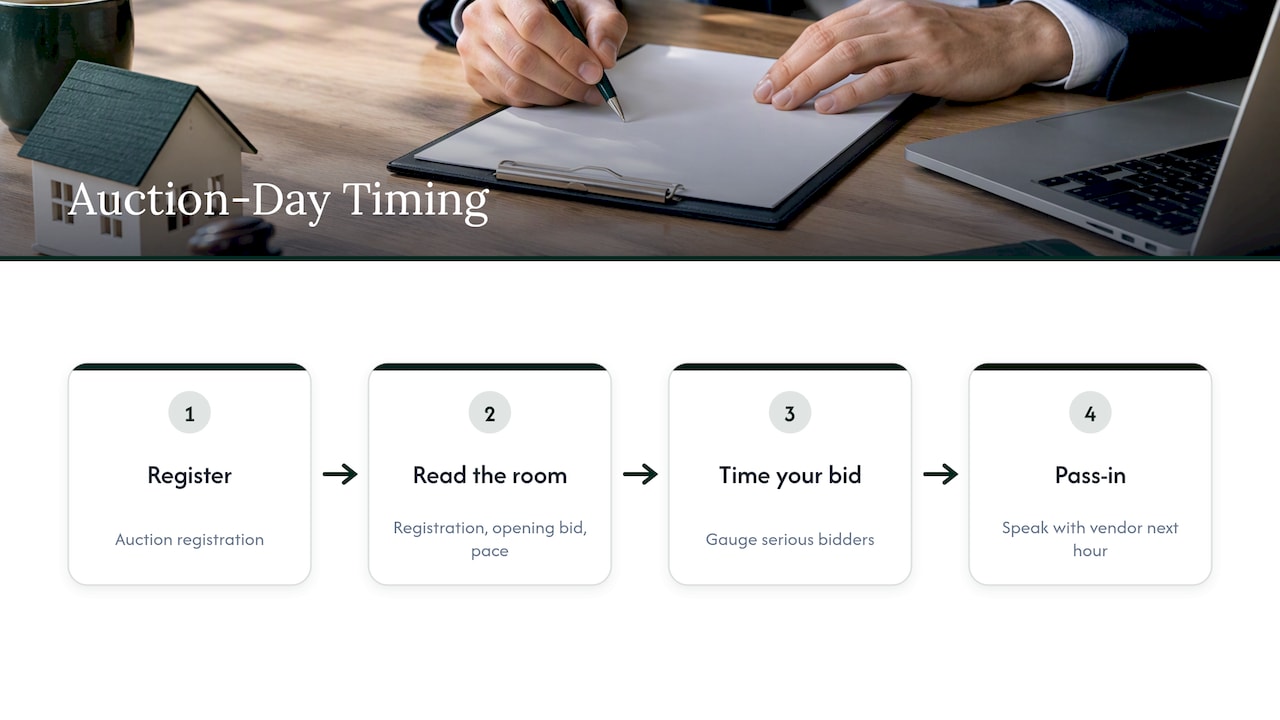
Auction day carries its own rhythm. Registration, the opening bid and the pace of the early rounds all tell you how many serious bidders are present. We read that room and set the moment to bid accordingly. Finally, if the auction passes in, the next hour is often the best time to talk: the vendor has just seen the market’s response and may be more flexible than at any point in the campaign.
Legal and contractual aspects specific to NSW and Sydney relevant to multiple offers
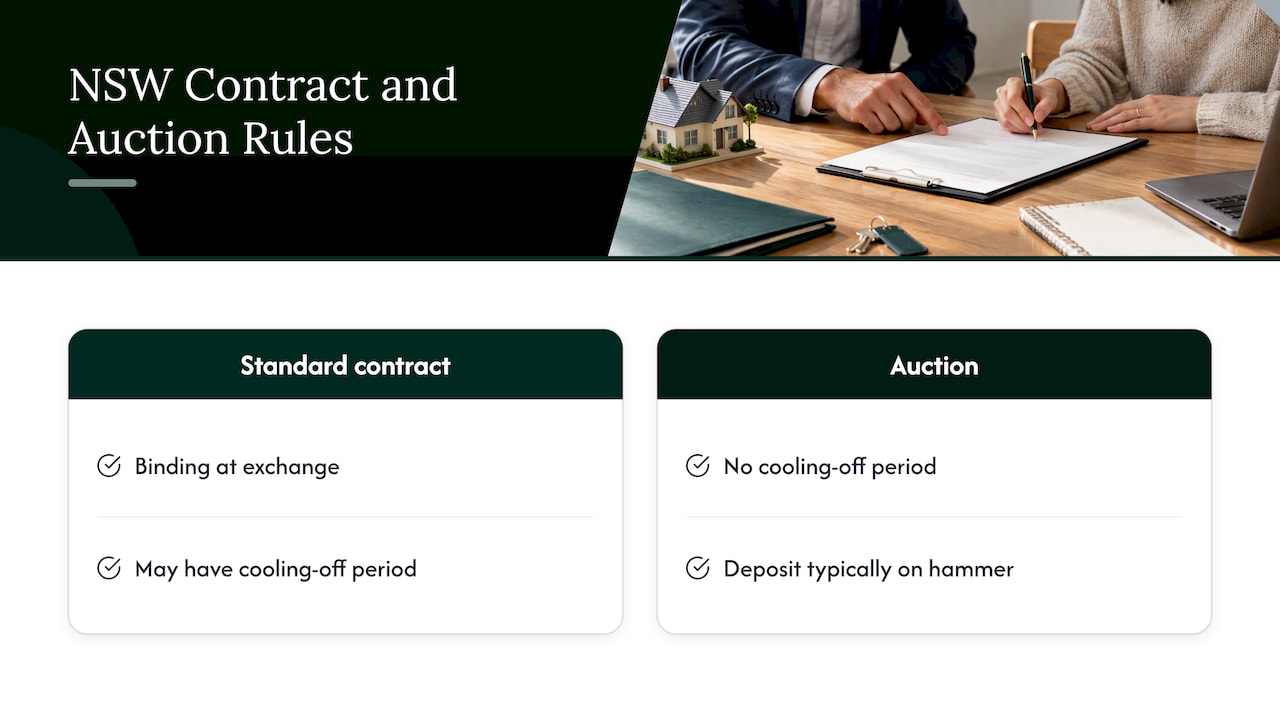
In NSW, contracts for the sale of land are generally exchanged, and that moment is when the deal becomes binding. A standard residential contract may come with a cooling-off period. Ask your solicitor or conveyancer about the terms and whether it can be waived or shortened. At auction there is no cooling-off, and the deposit is typically paid on the fall of the hammer, so you must be ready before you bid.
Because a signed contract with a strong deposit and a waived cooling-off period is a powerful signal of seriousness, some buyers present exactly that. It carries risk: once the cooling-off period is gone, you lose a safety net, so you should only do it after your inspections and legal review are done. Get your solicitor or conveyancer to read the contract before you exchange, and ask them to check special conditions, title and any easements.
Agents in NSW also work under rules about how they handle competing offers and how they must disclose information to buyers. They must pass on offers to the vendor, and they should not misrepresent the existence of other bids. If you are unsure whether a process is being run fairly, ask your solicitor or contact NSW Fair Trading for current requirements, since these rules change.
Finance conditions also need care. A contract made subject to finance has an end date, and if your lender does not approve within that window the vendor may have the right to terminate. This is why we encourage buyers to have formal approval, not just pre-approval, before bidding in competitive campaigns. For the specific rules that apply to your purchase, rely on your solicitor or conveyancer.
Psychological tactics and rapport-building with sellers and agents to influence offer preference
Selling agents are people with deadlines, targets and a vendor to keep happy. Treat them that way. A buyer who is polite, responsive and straightforward is easier to work with than one who is vague or demanding, and in a close contest that goodwill can tip an agent’s recommendation.
Start with honesty about where you stand. Tell the agent what you can do, what you cannot do and how fast you will act, then do what you said. Agents remember buyers who deliver. Ask what matters to the vendor: a quick settlement, a flexible rent-back, a clean unconditional contract. Then build your offer around the answer rather than guessing.
A short, personal note to the vendor can help when the agent is willing to pass it on, but keep it factual and modest. Talk about the family or plans you have for the home, not about how much you love the kitchen. Never pretend to have a competing offer, and never push the agent into disclosing details they should keep private.
Manage your own psychology too. Anchoring and fear of loss push bidders past their limits, which is why we separate the decision from the moment: your top number is set days before, and a bidder or agent holds you to it. If you feel yourself wanting to add one more increment, that is the cue to stop and check the number you wrote down. Calm, prepared buyers tend to read a situation more accurately and make better calls under pressure.
What we have learned: common mistakes and priorities from an experienced buyers agent
The error I see most is chasing a small price gambit when certainty would have done more. Buyers add a few thousand dollars to a conditional offer and lose to someone who simply removed the conditions. The second mistake is leaving inspections too late, so the report arrives after the decision has already been made. The third is auction emotion: the moment another bidder holds eye contact, people forget the number they set.
One pattern from our work, with details changed: a buyer was up against two other offers, all within a similar price range. Ours came with a written finance approval, a clean contract and a settlement date the vendor had mentioned wanting. It was not the highest number, but it was the one the agent could take to the vendor with no questions left open, and it was accepted.
My priorities are simple. Get your finance verified, inspect early, set your walk-away price and keep to it. A purchase you can comfortably afford beats a win you regret.
— Kristan
How we can help when you face multiple offers
If you are competing for a Sydney home, we can handle as much or as little of the process as you need. Our Complete Purchase Solution covers strategy, on-market and off-market search, independent appraisal, due diligence, negotiation, auction bidding and settlement. If you have already found the property, our Negotiation Only service puts a professional across the table on your behalf. Our Auction Bidding service means we hold your number on the day.

Call us on 1800 676 177 or email hello@sydneypropertybuyers.com.au to book a consultation before the next offer deadline.
FAQ
What is the 3-3-3 rule in real estate?
It is an informal rule of thumb, and definitions vary between agents, so treat it as a prompt for planning rather than a legal standard. Ask whoever quotes it to spell out exactly what the three numbers mean before you rely on it.
Can I make multiple offers on different houses at the same time?
Yes, you can generally make offers on more than one property, but each signed contract is binding once exchanged. Keep any offer conditional or unsigned until you have decided, and ask your solicitor how your finance and deposit would work if two were accepted.
What is the hardest month to sell a house?
There is no single answer that holds across every suburb and year, and local conditions matter more than the calendar. As a buyer, the useful point is that quieter periods can mean fewer rival bidders, which can improve your negotiating position.
Is it okay to offer $100,000 below the asking price?
It can be, if your comps support it and you present it with clean terms and clear finance. In a heavily contested campaign a low offer is unlikely to be considered, so base your number on recent sales rather than a fixed discount.
Recommended
- How a buyers agent handles multiple offers in Sydney
- Be Contract Ready to Win Sydney Pre Auction Offers
- Win Sydney Property Negotiations, Advice From an Award Winning Agent
- 3–5% Off Asking? Negotiate Sydney House Price With NSW Safe Tactics