Buy and hold means purchasing a property, renting it out and keeping it for years, often a decade or more, so that rent covers the running costs while the value grows. Investors commonly plan to own for five to 30 years, earning from rent in the short term and from growth when they finally sell. It rewards patience, a sound purchase price and a property in a location tenants keep wanting.
This guide covers how the strategy makes money, the costs people forget, how to pick a property worth holding, the US tax rules that matter, and how an independent buyers agent can help you secure the right asset at the right price. Where we refer to tax and market figures, they are for the United States unless stated otherwise.
TL;DR
- Buy and hold earns from several sources at once: rent, loan paydown, price growth and tax treatment. Judge a deal on total return, not monthly cash flow alone.
- The purchase price and the location decide most of the outcome. A property bought well and in a market with steady demand has the easiest road.
- Budget for vacancies, repairs, insurance and property taxes, and keep cash in reserve before you buy.
- US investors should check depreciation, recapture and 1031 exchange rules with a tax professional before they commit.
- Buying well is a skill in itself. A buyers agent who represents only the purchaser can search, appraise and negotiate for you.
Table of Contents
- What buy and hold property investing means
- How a buy and hold property makes money
- The costs and risks to plan for
- What makes a property worth holding
- How long to hold
- Long-term or short-term rental?
- US tax rules to check before you hold
- Buying well is half the return
- Working with Sydney Property Buyers
- A simple process for your first purchase
- FAQ
- Sources
What buy and hold property investing means
The idea is simple. You buy a residential property, such as a house, a unit or a small multifamily building, and let a tenant pay the bills while you wait. The rental side is essential, because an empty property can fall into disrepair and cut your profit.
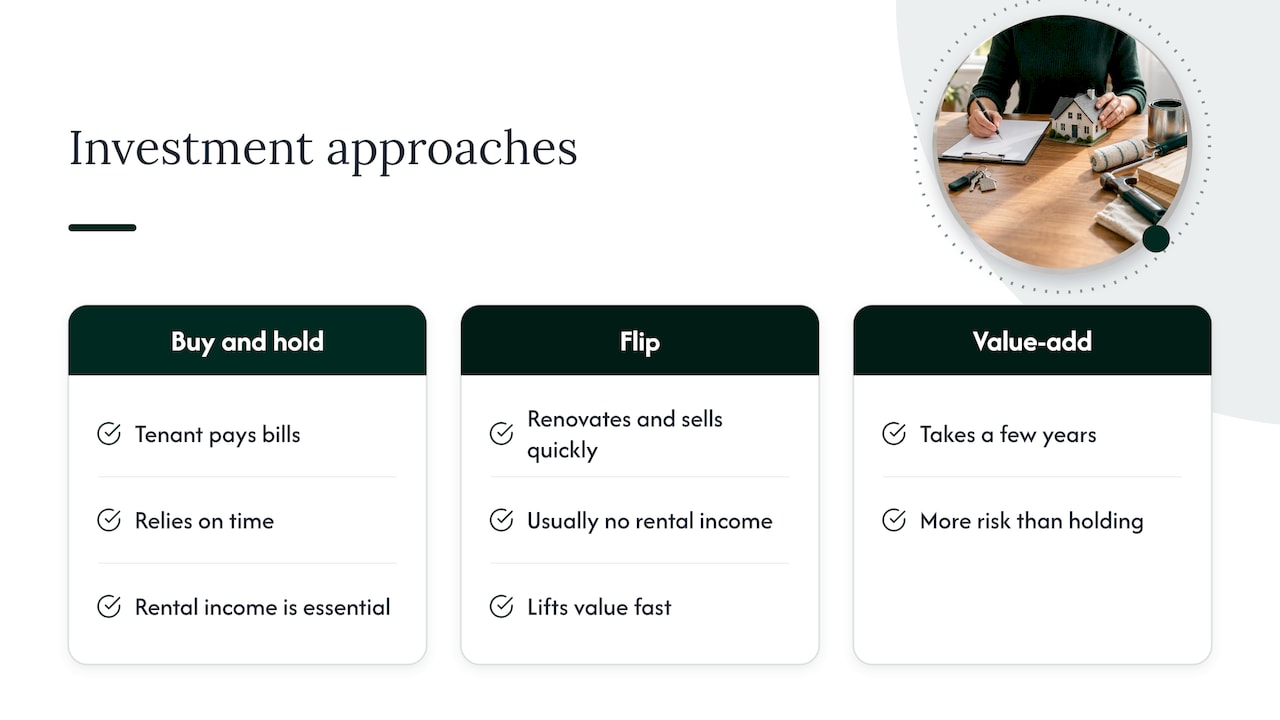
It differs from a flip, where an investor buys, renovates and sells quickly, usually without rental income. A flipper uses capital to lift value fast, while a buy-and-hold investor relies on time. Value-add projects sit in between: they typically take a few years and carry more risk than simply holding.
It also suits different temperaments. Rocket Mortgage notes that passive investors can use a property manager for minimal day-to-day involvement, while active investors handle tenants and maintenance and make decisions such as refinancing.
How a buy and hold property makes money
Most new investors count only the monthly rent left after the mortgage. Experienced ones count five or so return streams. One US investor guide lists them as cash flow, appreciation, loan paydown, tax benefits and leverage.
Rental income
Many properties produce 4% to 10% ROI from rent alone, depending on the market. One 2026 compilation reports a national average gross rental yield of 6.51% in the third quarter of 2025, up from 6.10% a year earlier. Gross yield ignores costs, so treat it as a screening number, not your take-home.
A quick first pass is to divide annual rent by the purchase price. Rocket Mortgage recommends this yield check to see whether a property is likely to produce positive cash flow over time.
Loan paydown
Every repayment your tenant’s rent funds reduces the loan balance. That is equity you build without writing another cheque. Investor guides describe this as one of four simultaneous return sources, alongside cash flow, appreciation and tax treatment.
Appreciation and leverage
Prices drift upward over long periods, though not every year and not in every place. US home prices measured by the S&P CoreLogic Case-Shiller index grew 309% from March 1995 to March 2025. Harvard’s Joint Center for Housing Studies reports the median existing single-family home price reached $412,500 in 2024.
Leverage magnifies the effect. With 20% down, a 4% price gain becomes a 20% gain on your cash. It works in reverse too, which is why reserves and a sensible loan size matter.
Tax treatment
In the US, the building (not the land) of a residential rental can be depreciated, giving a deduction that often exceeds the actual wear on the property. We cover the rules below.
A worked example
Say a property costs $400,000 and rents for $2,400 a month. Annual rent is $28,800, a gross yield of 7.2%. That figure is illustrative only. Now subtract property taxes, insurance, maintenance, a vacancy allowance and management, and add back the loan principal your tenant repays and the growth you hope for. The picture changes completely depending on those inputs, which is why the sections below matter more than the headline yield.
The costs and risks to plan for
The strategy fails most often when an investor underestimates ongoing costs. Estimate mortgage payments, maintenance, tenant turnover, property taxes, insurance and the cost of finding tenants, and keep one to three months of expenses in reserve for emergencies, including periods without a tenant.
A few specifics worth building into your numbers:
- Upfront cash. One lender guide suggests planning on at least 25% of the property value in cash, plus closing costs, an inspection (typically upwards of $500) and landlord insurance, which costs more than standard homeowner cover.
- Vacancy and capital works. One underwriting guide recommends a 5% to 10% vacancy reserve and $200 to $400 per unit each month for capital expenditure, using the 1% rule as a first-pass screen.
- Insurance costs. Home insurance premiums jumped 57% from 2019 to 2024, according to Freddie Mac, so quote the cover before you finalise your numbers.
- Liquidity. Real estate is not a liquid investment, and finding the right buyer at the right price can take time. Hold with a plan, not a hope.
Insurance deserves a proper read before you settle on a reserve figure. This landlord insurance coverage breakdown maps the parts of a policy so you can plan for repairs, tenant gaps and other unexpected expenses.
The lesson from U.S. Bank’s guidance is that cash flow is one of the most important drivers of performance, and that insurance, property taxes, upkeep and periodic major expenses must all sit in your assumptions from the start.
What makes a property worth holding
The best holding properties are in a place people want to live, at a price that still leaves room to grow. Look at population movement, the local economy and jobs, 20-year appreciation, cost of living, average rent and crime rates. The wrong market can mean high vacancy and negative appreciation when you come to sell.
A practical checklist:
- Demand that does not depend on one employer. Stable jobs and in-migration support rent.
- A price that works at today’s rent. Do not rely on a rent rise to make the numbers stack up.
- Low-maintenance condition. A property needing constant repairs eats yield. Get an independent inspection before you commit.
- Landlord rules you can live with. Location drives everything, including landlord-friendly laws; be wary of rent caps below inflation or very long eviction moratoriums.
- A realistic exit. Houses and well-located units in broad markets are easier to sell than niche stock.
If you are looking beyond your home market, take the same discipline abroad. Sydney is one example, and our guide on how to research Sydney suburbs shows the layers of data we check before shortlisting a suburb. For vacancy, our look at Sydney rental vacancy explains the figures investors can use to time a purchase.
How long to hold
There is no single right answer. RealWealth describes a short-term hold as selling within five years and a long-term hold as five to ten years, benefiting from rent increases and growth across property cycles. Cotality’s data shows investors hold for about six years on average, and that about 40% of small investors with fewer than ten properties keep them for a decade or longer.
Sell when the numbers tell you to, not when the market feels exciting. Reasons to sell include a property that no longer meets your return target, a need to release equity for a better asset, or a change in your own plans.
Long-term or short-term rental?
Buy and hold normally means long-term tenancies, which give predictable income and fewer turnovers. Some investors test furnished short-stay letting instead. A stress test comparing short and long term rentals is a useful way to see how each model holds up if occupancy or rates soften. Whichever you pick, run the numbers on the weaker scenario, not the best one.
US tax rules to check before you hold
This is general information, not tax advice. Speak to a CPA or tax adviser about your own situation.
- Depreciation. Under the IRS rules for residential rental property, improvements and buildings are depreciated over 27.5 years under the general depreciation system. Land is not depreciable.
- Deductible expenses. Ordinary and necessary rental expenses, such as mortgage interest, property taxes, insurance and maintenance, are generally deductible. Repairs are treated differently from improvements, which are depreciated.
- Capital gains on sale. The IRS sets long-term rates for most net capital gain at no higher than 15% for most individuals, with higher brackets applying to some taxpayers. Depreciation you claimed is taxed separately on sale as unrecaptured Section 1250 gain, with a maximum federal rate of 25%.
- 1031 exchanges. A like-kind exchange can defer gain and recapture by reinvesting in replacement real property, but it defers rather than eliminates the tax. The replacement must be identified within 45 days and closed within 180 days.
If you buy outside the US, your tax position changes again. Foreign property can carry its own taxes and reporting duties in both countries, so get cross-border advice first. For Australian purchases, our article on whether buyers agent fees are tax deductible in Australia is a good starting point.
Buying well is half the return

With a long hold, the price you pay on day one sets your yield and your equity for years. Even a small saving flows through every year of ownership. That is why serious investors treat the purchase as a project in its own right: shortlist by data, inspect in person, appraise independently and negotiate firmly.
U.S. Bank’s wealth team advises enlisting an agent who specialises in investment property and seeking advice from trusted professionals, not just a realtor. In Sydney, that role belongs to a buyers agent: a licensed professional who acts only for the purchaser. Our pages on what a buyers agent does and why exclusive representation matters and on how off-market access works explain the practical side.
Our view: hold what you bought well
We only ever act for buyers, never sellers, so our view is simple: the best buy and hold result begins before the contract is signed. An investor who buys on a shortlist built from data, an independent appraisal and a firm negotiation starts the holding period ahead.
We look at the whole investment, not just the headline price: capital growth potential, rental yield and how the property will perform as the years pass. We inspect seven days a week, so we are not tied to open home times, and more than 30% of our purchases have been secured off-market, before the wider public sees them. Our clients have saved about 9% on average against the purchase price, and the average time from engagement to settlement is 54 days.
A property you plan to keep for ten years deserves ten hours of homework for every one you would spend on a flip. That is the work we do for you.
Kristan
Working with Sydney Property Buyers
If your plan is to hold Sydney property, we can handle the purchase from strategy to settlement. Our Complete Purchase Solution covers strategy, on-market and off-market search, independent appraisal, due diligence, negotiation, auction bidding and settlement. If you have already found a property, our Negotiation Only service puts a licensed agent across the price talks.

We cover the Inner West, Eastern Suburbs, Lower North Shore and Eastern Beaches. You can see properties we have secured for clients, or call 1800 676 177 to talk through your plan. We are a licensed agency (NSW Licence 20456819) and our office is at 79 New Canterbury Rd, Petersham NSW 2049.
A simple process for your first purchase
- Set your return target. Decide the total return you need, including growth, not just rent.
- Fix your budget and reserves. Include purchase costs, inspection, insurance and several months of costs held back.
- Choose the market. Compare locations on jobs, population, rents and vacancy, then pick suburbs inside it. Our Sydney inner west suburb comparison shows how this works in practice.
- Appraise independently. Judge value on comparable sales, not the seller’s expectation.
- Negotiate or bid with a limit. Set a ceiling before auction day. Our guides to auction bidding increments and negotiating a house price in Sydney cover the tactics.
- Plan the hold. Choose a manager if needed, review rent annually and revisit your exit every few years.
FAQ
Is buy and hold a good strategy for beginners?
It is one of the more approachable ways to invest in property because it does not rely on quick renovations or perfect timing. Rocket Mortgage describes it as suitable for both passive and active styles. The key is a sound purchase, adequate reserves and a long enough horizon.
How much cash do I need to buy and hold?
It depends on the loan and the market. One lender guide suggests holding at least 25% of the property value in cash, plus closing costs, inspection and insurance. Keep further reserves for vacancy and repairs.
What return can I expect?
No one can promise a figure. Rent alone often yields 4% to 10% depending on the market, and growth comes on top over the long run. Costs, vacancies and your purchase price will move your actual result.
Can I buy and hold property in Sydney from overseas?
Many overseas buyers do, and a buyers agent can handle the search, inspections, negotiation and auction bidding on your behalf. Our guide to buying Sydney property from the US explains the process, including off-market and auction purchases. Get tax advice in both countries first.
Sources
- An Investor’s Guide to the Buy & Hold Real Estate Strategy
- What is buy-and-hold real estate investing? Rocket Mortgage
- What is Buy-and-Hold Real Estate? REtipster
- The 5 ways real estate pays you
- 28 Rental Property ROI Statistics
- Buy and Hold Real Estate Strategy: How It Pays
- The State of the Nation’s Housing 2025
- Guide to Buy & Hold Real Estate Investing
- Rental Strategy: Buy-and-Hold for Cash Flow
- Investing Unit 4: Real Estate, Financial Security for All
- How to Buy an Investment Property, U.S. Bank
- How To Buy and Hold Real Estate
- Small investors, big squeeze, Cotality
- IRS Publication 527
- IRS Topic no. 409, Capital gains and losses
- Depreciation Recapture guide
- Landlord insurance coverage
- Short vs long term rentals stress test
Recommended
- What is a property investment brief? Your 2026 guide
- What is a property negotiation strategy for Sydney buyers?
- Save 9%: Best Time to Buy in Sydney Is When You Have Leverage