Generally, no. If you pay a buyer’s agent to find and negotiate an investment property in Australia, the ATO treats the fee as a cost of acquiring the property, not a running cost of earning rent. You can’t claim it against rental income in the year you pay it. The fee can still earn its keep later: it can be added to the property’s cost base, which reduces your capital gain when you sell.
That is the answer in one paragraph. The rest of this guide covers the detail that decides whether it applies to you: investor or owner-occupier, Australian resident or overseas buyer, and what to keep on file so your accountant can use the fee years from now. This is general information, not tax advice. Your own position depends on your circumstances, so confirm it with a registered tax agent.
TL;DR
- Buyers agent fees on an investment property are a capital acquisition cost, so they are not deductible against rental income in the year you pay them.
- They can be added to the property’s cost base for capital gains tax (CGT), lowering the taxable gain when you sell.
- Ongoing property management and letting fees are different: those are deductible because they relate to earning rent.
- For your own home, the fee is not deductible, and the main residence exemption usually means the cost base rarely matters.
- Keep the agreement, every invoice and proof of payment from the day you engage the agent, not just from settlement.
Table of Contents
- The short answer, by type of buyer
- Why the ATO treats the fee as a capital cost
- Where the fee does help: your CGT cost base
- What you can deduct on a rental
- If you are buying your own home
- Buyers based overseas, including the United States
- What to keep, and from when
- Our perspective
- Working with Sydney Property Buyers
- FAQ
- Sources
The short answer, by type of buyer
The question looks simple, but the answer shifts with what you are buying and who you are for tax purposes.
| Your situation | Deductible against income in the year paid? | Can it go in the cost base? |
|---|---|---|
| Investment property in Australia, Australian resident | No | Yes, as an incidental cost of acquisition |
| Your own home (main residence) | No | Technically yes, but a full main residence exemption usually makes it irrelevant |
| Australian resident buying overseas property | Generally no | Generally yes |
| Foreign resident buying Australian property | No | Depends on your CGT position, so take advice |
| Ongoing property manager or letting agent on a rental | Yes | Not applicable, it is a revenue expense |
Some websites claim buyers agent fees are fully deductible in the year you incur them. That does not match the ATO’s published treatment of acquisition costs, and it is worth treating with caution before you plan your cash flow around it. The ATO rental properties guide lists the costs of acquiring a rental property, such as the purchase price and conveyancing, as costs you can’t claim a deduction for.
Why the ATO treats the fee as a capital cost
The test behind almost every property deduction is the same. Is the expense part of earning the income, or part of establishing the asset that earns it?
A buyer’s agent does their work before you own anything. They define the brief, search, appraise, inspect, negotiate or bid, and help you through to settlement. All of that is spent to acquire the property, which is why the ATO groups it with conveyancing and stamp duty. In its words, these are costs of acquiring the property, which you can’t claim as a deduction against rent.
The ATO also warns that many investors assume every cost tied to a property is claimable. In its guidance on what to consider before buying a rental property, the ability to claim an immediate deduction depends on the property being held to produce assessable income, and capital expenses are treated differently from day-to-day ones.
Timing matters too. Costs you incur before the property is rented or available to rent are not running costs. The ATO says you can claim immediate deductions for certain expenses provided the property is rented or available to rent on commercial terms. A buyer’s agent fee is paid before that point and is capital in nature anyway.
Where the fee does help: your CGT cost base
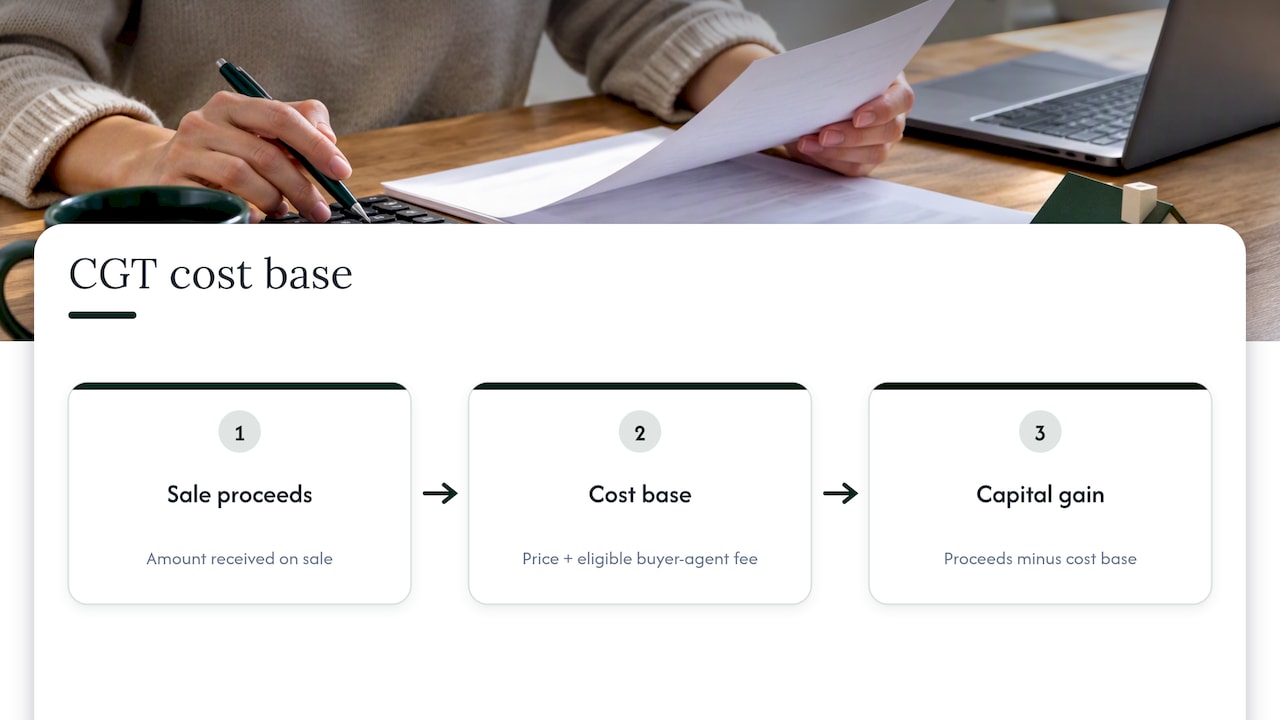
The fee is not wasted from a tax view. When you sell an investment property, your capital gain is broadly the sale proceeds minus your cost base. The cost base is not just the purchase price. The ATO’s legal database on cost base elements includes remuneration for services of a surveyor, valuer, auctioneer, accountant, broker, agent, consultant or legal adviser in the incidental costs of acquiring or disposing of the asset. The ATO’s guidance for rental buyers likewise confirms that incidental acquisition costs, including buyer’s agent fees, can be included in the cost base.
A worked example
This is a hypothetical illustration, not a quote or a forecast.
- Purchase price: A$1,000,000
- Buyer’s agent fee: A$20,000
- Other acquisition costs (conveyancing, stamp duty and so on): A$55,000
Your cost base is built from all of those costs, so A$1,075,000 before any later capital works or other adjustments. If you later sell for A$1,400,000, the gain before any discount or other adjustments is A$325,000. Without the agent’s fee in the cost base it would be A$345,000. The fee reduces your gain by A$20,000. How much tax that saves depends on your marginal rate and which concessions apply at the time, which is exactly the conversation to have with your accountant.
A few practical points follow from this:
- The benefit arrives years later. It shows up when you sell, so there is no tax cheque at the end of this financial year.
- It only helps if there is a gain. If you sell at a loss, the fee increases the capital loss instead, which can offset other capital gains.
- Evidence is everything. If the ATO reviews your CGT calculation, you need records from the purchase to prove each cost.
Other capital spending joins the same pile
The cost base can also include certain capital expenditure after you buy, as opposed to repairs. If you are comparing what a renovation adds, such as new window furnishings, this plantation shutters resale return breakdown shows how one upgrade is viewed from a resale angle. Whether any improvement is a deductible repair or a capital improvement is a separate question to settle with your tax agent before you claim it.
What you can deduct on a rental
Buying and holding are different phases, and the ATO draws a clear line between them. Once the property is rented or genuinely available for rent, many costs become claimable. The ATO separates fees for finding a property from fees for managing or collecting rent. Agency fees and commissions that relate to producing rental income are deductible, so a property manager’s ongoing management fee generally falls on the claimable side.
A simple way to sort your costs:
- Before settlement, to acquire: buyer’s agent fee, conveyancing, stamp duty, building and pest inspections. Capital, so cost base.
- After settlement, to earn rent: property management fees, advertising for tenants, insurance, council rates and repairs. Generally deductible in the year incurred, subject to the ATO’s rules.
- After settlement, to improve: capital works and improvements. Different rules again, often spread over time or added to the cost base.
If you want to see how our fee sits within a purchase, our guide to what you’ll actually pay for a buyers agent in Sydney breaks down the costs, and the comparison of fixed fee and percentage models shows how structure affects the size of the invoice that ends up in your cost base.
If you are buying your own home
The fee is not deductible against income, because a home you live in produces no assessable income. Technically it forms part of the cost base, but a main residence is generally exempt from CGT, so the cost base seldom matters for tax. The fee should be judged on what it saves or protects: price, risk, time and access to properties you would not otherwise see.
It is worth remembering that a home can later become a rental. If you move out and rent the property, your records of acquisition costs become relevant again. Keep the invoice either way.
Buyers based overseas, including the United States
Many of our enquiries come from buyers living abroad, so two situations are worth separating.
You are a foreign resident for Australian tax purposes. The ATO states that foreign and temporary residents are subject to CGT only on taxable Australian property, and Australian real property such as a house, apartment or land is included. The rules for foreign residents have their own features, including a separate page on foreign residents and capital gains tax, so get Australian advice before you assume the cost base works as it does for residents. Your home country will have its own rules too. We are not able to advise on United States tax, so speak to a US tax professional who understands cross-border property. Foreign buyers also face state-based charges, and our note on NSW land tax for US investors covers one that catches people by surprise.
You are an Australian resident buying property overseas. As an Australian tax resident you must declare income you earn anywhere in the world. The ATO says capital gains on overseas assets are treated the same way as gains on Australian property, and you may be entitled to a foreign income tax offset if you have paid foreign tax on the gain. In practice that means an agent’s fee on an overseas purchase is generally a capital cost for your cost base, not an immediate deduction.
If you are weighing up buying remotely, our piece on why a buyer’s agent suits interstate buyers in Sydney covers the practical side, which applies equally to buyers abroad.
What to keep, and from when
Because the benefit can arrive a decade after you pay, your paperwork has to last. Build a single folder for each property and include:
- the signed buyers agency agreement (ours is explained in our guide to itemised fees and written bids in a Sydney buyers agency agreement)
- the retainer invoice and the final invoice, with the dates paid
- proof of payment, such as a bank statement line
- the contract of sale, settlement statement and conveyancer’s cost summary
- stamp duty assessments and any inspection or valuation invoices
Start the record on the day you engage the agent. A retainer paid months before settlement is still part of the acquisition cost. With us, the fee is payable on completion of a purchase and a small retainer is taken at engagement and deducted from the final balance, so your invoices will show both. Ask your accountant to log the total against the property on the day you settle, so it is not hunted for at sale time.
Our perspective
We get this question often, and we would rather answer it plainly than let anyone buy on a wrong assumption. Buyers agent fees are not a tax deduction trick, and we would be wary of anyone who sells them that way. Our fee is a cost of acquiring a property, and it should earn its place on the strength of what it does for the purchase.
What we focus on is the other side of the ledger. Our clients have saved about 9% on purchase price on average, and more than 30% of our purchases are secured off-market, meaning the property was never publicly listed. We measure ourselves against price paid, the quality of the asset and a purchase that runs to time, averaging 54 days from engagement to settlement. We also inspect seven days a week, so you are not limited to open home times.
For investors, the tax treatment is part of the analysis, not the headline. We look at capital growth potential and rental yield together, because a property with a slightly higher price and stronger long-term performance can leave you better off after tax than a cheaper one that stalls. Then we hand your accountant a clean paper trail. Our practical advice: ask your tax agent about the cost base before you sign, not after settlement.
— Kristan
Working with Sydney Property Buyers
Sydney Property Buyers is a licensed buyers agency (NSW Licence 20456819) that acts only for purchasers, never sellers. If you want us to run the whole purchase, from strategy and search through due diligence, negotiation, auction bidding and settlement, see our Complete Purchase Solution and Auction Bidding services. If you have already found a property and want an expert to negotiate the price, Negotiation Only is built for that. Call 1800 676 177 or email hello@sydneypropertybuyers.com.au, and we will explain how our fee is structured before you commit.
FAQ
Are buyers agent fees tax deductible for an investment property?
Not in the year you pay them. The ATO treats them as an acquisition cost, like conveyancing and stamp duty, so they are not claimable against rental income. They can be added to the cost base and reduce your capital gain when you sell.
Is a property manager’s fee treated the same way?
No. Fees for managing a rental or collecting rent relate to earning assessable income, so they are generally deductible. The difference is the work done: finding and buying a property is capital, managing an existing tenancy is revenue.
Can I claim the fee if I buy a property to live in?
No, because a home you live in does not produce assessable income. The fee is technically part of the cost base, but with a main residence exemption it rarely changes your tax. If you later rent the home out, keep the invoice in case it becomes relevant.
Does a fixed fee or a percentage fee change the tax treatment?
The structure does not change the treatment, because both are payments for acquiring the property. A fixed fee or percentage only affects the amount that goes into the cost base. Our guide to fixed fee versus percentage buyers agents explains how each works.
Should I speak to an accountant before engaging a buyer’s agent?
Yes, particularly if you are an investor, a foreign resident or buying through a trust or company. A registered tax agent can confirm how the fee and your other costs will be recorded for your situation, and set up your records before settlement.
Sources
- ATO: Rental expenses 2026
- ATO: Rental properties guide 2026
- ATO: Rental expenses
- ATO: What to consider before buying a rental property
- ATO: Common property expenses
- ATO legal database: cost base elements
- ATO: Agency fees, commissions and wages you pay
- ATO: Taxable Australian property
- ATO: Foreign residents and capital gains tax
- ATO: Capital gains on overseas assets
Recommended
- Fixed fee vs percentage buyers agent: Sydney guide
- Save an average 9% on Sydney property: is a buyer’s agent worth it?
- Buyers agent fees in Sydney: what you’ll actually pay
- Types of buyers agent licensing requirements in Australia