A licensed buyer’s agent is a regulated real estate professional authorised under NSW law to represent a purchaser exclusively and negotiate property transactions on their behalf. In the Sydney market, where auction clearance rates remain high and competition for quality stock is fierce, understanding why a licensed buyer’s agent matters is the difference between a confident purchase and a costly mistake. This article covers the NSW licensing framework, the practical value of exclusive representation, off-market access, and the professional standards that separate credentialed agents from the rest.
Why licensed buyer’s agent status is non-negotiable in NSW
The legal foundation matters before anything else. A NSW class 1 real estate licence authorises an agent to represent buyers, negotiate purchases, and act on a purchaser’s behalf in property transactions. Without this licence, a person cannot legally conduct those activities on your behalf. This is not a technicality. It is the statutory boundary that determines whether your representative has the legal authority to protect your interests at the negotiating table.
Unlicensed assistants operate under strict limits. They require supervision by a licensed agent in charge and cannot conduct full negotiations independently. This means that if you engage someone who is not properly licensed, or whose business relies on unlicensed staff conducting negotiations without oversight, your purchase is exposed to both legal risk and weaker representation. NSW Fair Trading oversees compliance, and verifying a licence number before engaging any buyer’s agent is a straightforward step that many buyers skip to their detriment.
Pro Tip: Before signing any buyer’s agent agreement, search the agent’s name and licence number on the NSW Fair Trading licence check portal. A valid class 1 or class 2 real estate licence is the minimum requirement for anyone negotiating on your behalf.
The importance of buyer’s agent licensing extends beyond compliance. A licensed professional carries professional indemnity obligations, is bound by the Property and Stock Agents Act 2002, and operates within a framework that gives you formal recourse if something goes wrong. That accountability structure simply does not exist with unlicensed operators.
How exclusive buyer representation removes conflicts of interest
Most buyers do not realise that the selling agent at an open home is legally obligated to the vendor, not to them. The selling agent’s fee depends on achieving the highest possible price. Any advice they offer about value, competition, or urgency is filtered through that incentive. A licensed buyer’s agent works on the opposite side of that equation.

Exclusive buyer representation eliminates dual agency conflicts by ensuring your agent never lists properties for sale. Their sole commercial interest is securing the best outcome for you. This structural difference changes everything about how negotiation is conducted, what information is shared, and how advice is framed.
The practical consequences of exclusive representation include:
- Undivided loyalty. Your agent’s fiduciary duty runs entirely to you, covering confidentiality, full disclosure of known risks, and loyalty in all negotiations.
- Aggressive negotiation. Because there is no divided loyalty, your agent can negotiate without divided loyalty and push harder on price, conditions, and settlement terms.
- Honest walk-away advice. A buyer’s agent with no stake in the sale will tell you when a property is overpriced or when the vendor’s terms are unreasonable, even if that means losing the deal.
- Confidentiality protection. Details about your budget, timeline, and motivation are kept from the vendor’s side, which is information that selling agents routinely use to extract higher prices from unrepresented buyers.
“Buyer’s agent fiduciary duties are distinct from listing agents, changing ethical obligations and negotiation approach by prioritising buyer confidentiality and loyalty.” — Legal Clarity
This distinction is particularly relevant in Sydney’s Inner West, Eastern Suburbs, and Lower North Shore, where vendor advocacy is sophisticated and selling agents are experienced at managing buyer psychology during competitive campaigns.
What off-market access actually means for Sydney buyers
The phrase “off-market property” is used loosely, but the numbers behind it are concrete. Approximately 20 to 30% of Sydney properties sell without ever appearing on Domain or realestate.com.au, with the higher end of that range applying to prime Sydney suburbs. That is a substantial portion of available stock that a buyer searching independently will never see.
Licensed buyer’s agents access these properties through professional networks built over years of transacting in specific markets. Selling agents bring pre-market and off-market opportunities to buyer’s agents they trust because it creates a smooth, private transaction for their vendor clients. You cannot replicate this network by attending open homes on weekends. Understanding off-market property access requires recognising that it is a relationship-driven system, not a database you can subscribe to.
| Approach | Property access | Negotiation leverage | Time investment |
|---|---|---|---|
| DIY buyer search | On-market listings only | Competing with all buyers | High, ongoing |
| Licensed buyer’s agent | On-market and off-market | Fewer competing buyers, professional negotiator | Managed by agent |
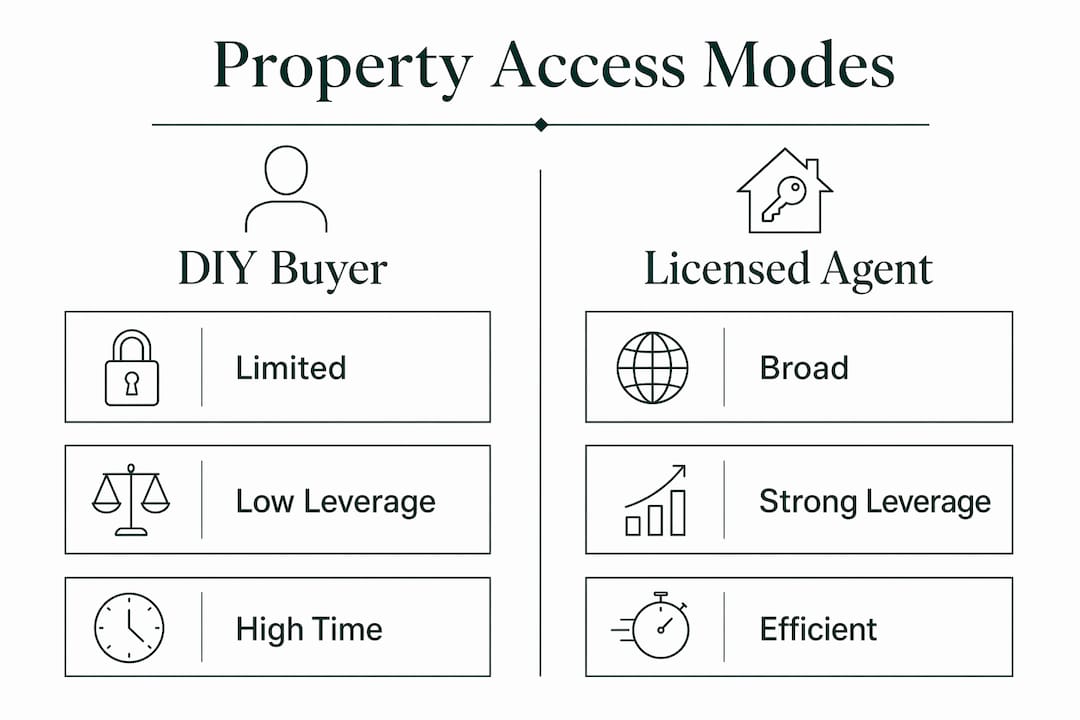
The cost-benefit case is straightforward. Sydney Property Buyers achieves an average saving of approximately 9% on purchase price for clients, and more than 30% of properties secured are off-market. On a $1.5 million property, a 9% saving represents $135,000. Buyer’s agent fees in Australia typically range from 1.5% to 3% of the purchase price, making the return on professional representation significant in most Sydney transactions.
Pro Tip: Ask any buyer’s agent you are considering what percentage of their recent purchases were secured off-market. A credible agent with genuine networks will have a clear, verifiable answer. Vague responses suggest limited access.
For buyers relocating from interstate, the off-market advantage is even more pronounced. The advantages for interstate buyers in Sydney are compounded by the fact that local agents are conducting inspections seven days a week, attending pre-market viewings, and building the relationships that generate exclusive access.
What negotiation expertise and risk management look like in practice
Negotiation in Sydney’s property market is not a single conversation. It is a process that spans offer strategy, due diligence coordination, contract review, auction bidding, and settlement management. A licensed buyer’s agent manages offer timelines, contingencies, and inspections with the discipline of someone who has done it hundreds of times, not the anxiety of someone doing it for the first time.
The specific risk management activities that licensed buyer’s agents handle include:
- Independent property appraisal. Establishing a defensible view of market value before making any offer, so you never pay above what the evidence supports.
- Building and pest inspection coordination. Identifying defects before exchange, not after, and using findings as negotiation leverage rather than post-purchase surprises.
- Contract condition management. Finance clauses, cooling-off periods, and special conditions are negotiated with the vendor’s solicitor before you sign, not after.
- Auction bidding strategy. Sydney auctions are high-pressure environments where emotional bidding regularly pushes prices beyond rational limits. A professional bidder removes that variable entirely.
- Settlement tracking. Deadlines are managed systematically, reducing the risk of default or penalty through missed obligations.
The structural value of buyer representation includes not only property search but also reducing decision friction through process support. For buyers purchasing in Sydney for the first time, or those who have had a previous purchase fall through, this process discipline is often the most valuable part of the service.
The types of search strategies a licensed buyer’s agent deploys also vary by buyer profile. An investor targeting rental yield in the Inner West requires a different approach to a family seeking a forever home in the Eastern Suburbs. A licensed agent with local market depth tailors both the search and the negotiation strategy accordingly.
How REBAA membership and professional standards affect your outcome
Holding a NSW real estate licence is the legal minimum. Professional membership organisations like REBAA (Real Estate Buyers Agents Association of Australia) set standards above that minimum. REBAA promotes trust through prompt communication, transparent fee structures, conflict-of-interest disclosure policies, and documented conduct standards that members are required to uphold.
The practical difference this makes to you as a buyer includes:
- Clear, written fee agreements before any work begins, with no hidden referral arrangements.
- Mandatory disclosure of any relationship with third parties such as mortgage brokers or conveyancers who might be recommended.
- Ongoing professional development, meaning your agent’s knowledge of market conditions, contract law, and negotiation practice is current.
- A formal complaints process if conduct falls below the required standard.
Trust in a buyer’s agent is earned through consistent professional behaviour, fee transparency, and clear conflict-of-interest policies. Not every licensed agent meets this standard, which is why verifying both licensing and professional membership is worth the five minutes it takes.
Key takeaways
A licensed buyer’s agent matters because they are the only party in a Sydney property transaction who is legally authorised, professionally obligated, and commercially incentivised to act solely in your interest.
| Point | Details |
|---|---|
| Licensing is the legal baseline | Only a NSW class 1 licensed agent can legally negotiate a property purchase on your behalf. |
| Exclusive representation removes bias | A buyer’s agent who never lists properties has no incentive to push you toward a higher price. |
| Off-market access expands your options | Up to 30% of Sydney properties sell without public listing; only licensed agents with strong networks reach them. |
| Professional negotiation reduces cost | Sydney Property Buyers clients save approximately 9% on average, often exceeding the cost of the agent’s fee. |
| REBAA membership signals higher standards | Professional membership adds fee transparency, conduct obligations, and formal accountability above the legal minimum. |
What I’ve learned from buying in Sydney’s most competitive markets
After securing more than 100 properties for clients across the Inner West, Eastern Suburbs, Lower North Shore, and Eastern Beaches, the pattern I see most consistently is this: buyers who try to navigate Sydney’s market without professional representation do not just pay more. They also buy the wrong property, because they are making decisions under pressure with incomplete information.
The licensing question is not abstract for me. I hold NSW Licence 20456819 and I operate under the same regulatory framework I have described in this article. When I tell a client to walk away from a property, my fee does not depend on whether they buy it. That is the only arrangement that produces genuinely honest advice.
What surprises most buyers is how much of the value comes from what does not happen. The overbid at auction that we avoided. The off-market property we secured before it hit Domain and attracted ten competing offers. The building inspection that revealed a significant defect and gave us grounds to renegotiate $40,000 off the price. None of those outcomes appear in a headline statistic, but they are the reason the importance of buyer’s agent representation is not marketing language. It is a measurable difference in outcome.
My advice for anyone selecting a buyer’s agent in Sydney is straightforward. Verify the licence. Check for REBAA membership. Ask for a clear written fee agreement. And ask specifically what percentage of their purchases in the past 12 months were secured off-market. The answers will tell you everything you need to know.
— Kristan
How Sydney Property Buyers can help you purchase with confidence
Sydney Property Buyers is a fully licensed buyers agency that represents purchasers exclusively across the Inner West, Eastern Suburbs, Lower North Shore, and Eastern Beaches. Whether you need support across the full purchase journey from strategy through to settlement, or professional negotiation on a property you have already identified, the agency provides licensed, conflict-free representation at every stage.

With a 5.0 Google rating, more than 100 properties secured, and an average purchase time of 54 days from engagement to settlement, Sydney Property Buyers brings the market access, negotiation depth, and process discipline that Sydney’s competitive property market demands. Contact the team on 1800 676 177 or at hello@sydneypropertybuyers.com.au to discuss your purchase.
FAQ
What licence does a buyer’s agent need in NSW?
A buyer’s agent in NSW requires a class 1 or class 2 real estate licence issued under the Property and Stock Agents Act 2002. This licence authorises the agent to represent buyers and negotiate property purchases on their behalf.
How do buyer’s agents access off-market properties in Sydney?
Licensed buyer’s agents access off-market properties through professional relationships with selling agents, developers, and property owners built over years of transacting in specific Sydney markets. These opportunities are not available on public portals such as Domain or realestate.com.au.
Is a buyer’s agent fee worth paying in Sydney?
For most Sydney buyers, the fee is worth paying. Sydney Property Buyers clients achieve an average saving of approximately 9% on purchase price, and buyer’s agent fees typically range from 1.5% to 3%, meaning the saving generally exceeds the cost of representation.
What is the difference between a buyer’s agent and a selling agent?
A selling agent is legally obligated to the vendor and is paid to achieve the highest possible price. A buyer’s agent is exclusively engaged by and obligated to the purchaser, with a fiduciary duty to protect the buyer’s interests, maintain confidentiality, and negotiate the best possible outcome for the buyer.
What does REBAA membership mean for a buyer’s agent?
REBAA membership requires agents to adhere to a code of conduct covering fee transparency, conflict-of-interest disclosure, and ongoing professional development. It signals a standard of practice above the legal minimum and provides buyers with a formal complaints pathway if conduct falls short.
Recommended
- Why a buyer’s agent suits interstate buyers in Sydney
- Service Areas Archive – Welcome
- Types of buyers agent search strategies in Sydney
- What is a full service buyer’s agent?