The tactics that win a Sydney negotiation are mostly decided before you speak to the agent: a ceiling set from recent sold prices, finance that is ready, an offer whose terms suit the vendor, and a calm, priced response to every counter. Do those four things and the haggling is the short part. A buyers agent does them every week, and we negotiate on your behalf so that the selling agent deals with a professional rather than a nervous buyer.
This guide walks through the tactics in the order you will use them, with the NSW rules that shape each step.
TL;DR
- Set two numbers before you contact the agent: a floor from comparable sold prices and a walk-away ceiling you never reveal.
- Price is only one lever. Settlement length, deposit and conditions can make a lower offer more attractive than a higher one.
- Read the counter-offer: a small move suggests room, a counter near the asking price suggests none.
- Use inspection findings as priced defects, not adjectives, and only for material issues.
- At auction there are no conditions and no cooling-off, so every check happens before you bid.
Table of Contents
- Start with evidence, not the price guide
- Know what the vendor wants
- Making the first offer
- Reading and answering counter-offers
- Turning inspection findings into price
- Auction negotiating is a different game
- When you are one of several offers
- A worked example
- Where a buyers agent changes the negotiation
- Get a professional on your side of the table
- FAQ
- Sources
Start with evidence, not the price guide
Negotiation in Sydney starts with a number you can defend. NSW Fair Trading tells buyers to research recent comparable sales rather than rely on the advertised price guide, and to get the contract of sale as early as possible and have a conveyancer or solicitor review it.
A comparable sale is a recent sold price for a similar property nearby: same suburb or street, similar bedrooms, land size, condition and aspect. Three or four solid comparables beat a dozen loose ones. Adjust for differences: a renovated kitchen, a north-facing backyard, a noisy main road. If you want a quick starting read on value, a tool such as AI-powered property appraisal and deal analysis can give you a figure to test against the sales you have gathered.
There is also a legal reason not to anchor on the guide. Underquoting, where an agent advertises a lower estimated selling price than the one agreed with the seller, is an offence in NSW, and agents can lose fees and commissions and be fined up to $22,000. Ask the agent to put their estimated selling price in writing. We cover what has changed in our guide to underquoting in NSW.
If finding and adjusting comparables is where you stall, our piece on how buyers agents use Valuer General comparables shows the method.
Your two numbers
Before any conversation, write down:
- Your floor: what the comparables say the property is worth. This is what you open near.
- Your ceiling: the most you will pay, including stamp duty, conveyancing, inspections, lender fees and moving costs. NAB’s offer guide lists these as part of your full budget, and notes that lenders mortgage insurance may apply if your deposit is under 20%.
Get finance pre-approved first. NSW Fair Trading lists pre-approved finance as a step before making an offer. A buyer who needs a long finance condition looks weaker than one who can sign.
Know what the vendor wants
The agent works for the vendor, and the vendor’s goals are not always the highest number. A vendor who has already bought elsewhere may value a short settlement. A vendor waiting on a sale may want a long one. An executor may want certainty above everything.
Property founder Michael Pell told realestate.com.au that matching the seller’s circumstances on settlement timing gives you leverage elsewhere in the negotiation. Ask open, friendly questions: how long has it been listed, what is the vendor’s timeframe, what interest has there been. Listen more than you talk. Every answer tells you which term costs you little and is worth a lot to them.
Off-market and pre-market deals
Leverage is strongest when fewer buyers are competing. Properties sold before a public campaign can be negotiated one-on-one rather than against a room. Over 30% of the purchases we have secured for clients were off-market, and you can read how access works in our guide to buyers agent access to off-market properties.
Making the first offer
An offer in NSW can be made verbally or in writing, and a written offer, such as an email, leaves a clear record. A good written offer states:
- the price;
- the deposit (commonly 10% on exchange);
- the settlement period;
- any conditions, such as finance or a building inspection;
- inclusions or exclusions;
- an expiry time.
The agent must pass every offer to the seller until contracts are exchanged, and the sale becomes binding once signed contracts are exchanged and the deposit is paid, according to the same Hindsight Legal guide.
Open below your ceiling, and not with your best offer
Negotiators quoted by realestate.com.au put it simply: your best offer should never be first. Opening near your comparables-based floor leaves you room to move. The opening offer should be credible, though. A figure that is insultingly low usually ends the conversation instead of starting it.
Offer terms are a second lever. A table helps show the trade-offs:
| Term | Helps the vendor when | Your trade-off |
|---|---|---|
| Longer settlement (e.g. 60 or 90 days) | They need time to buy or move | Your rent or bridging costs run longer |
| Shorter settlement (e.g. 30 days) | They want certainty and speed | You need finance and legal checks ready |
| Larger deposit | They want a committed buyer | More cash tied up early |
| No finance condition | They want a clean sale | You carry the risk if finance falls through |
Do not make the offer stronger than your real position. A 2026 BrokerList guide warns that an unconditional offer can appeal to a seller but exposes you if finance, valuation, building, pest or contract issues appear later. Our step-by-step on this is in how to make an offer on a Sydney property.
Use a deadline deliberately
A response deadline of 24 to 48 hours is common in written offers, according to Your Property Guide’s 2026 playbook. A deadline creates a decision point for the vendor, but a deadline you cannot keep to damages your credibility. We explain how to set one in our offer expiry strategy.
Reading and answering counter-offers
A counter-offer tells you how the vendor is thinking. According to Your Property Guide, if you offer $830,000 and the vendor counters at $865,000, the small gap suggests the real number is probably somewhere between $840,000 and $855,000. A counter close to the asking price suggests the vendor is not really negotiating.
That is a rule of thumb, not a law, but it is useful. Your options are:
- Make a meaningful step up within your ceiling, not a token $1,000. Small, repeated increments teach the agent that you will keep moving.
- Hold your number and let the deadline do the work.
- Walk away when the counter is above your ceiling. This is the tactic that matters most and the one buyers find hardest, because by this stage you are emotionally invested.
If an offer is rejected without a counter, ask the agent what number the vendor would accept. That question costs nothing and often gets an answer.
What not to say
The same guide gives the clearest warning for buyers. Never reveal your maximum budget. If pressed, give a range with your real ceiling at the top. And never reveal your motivation: a line such as “we’ve seen 30 places and this is exactly what we’ve been looking for” signals urgency and emotional commitment, and that can translate into a higher price.
This is the hardest discipline for a buyer negotiating on their own home. It is also the main reason owners hand the conversation to someone with no emotional stake. We handle the agent conversations so you never have to hold your poker face about a house you love. Our advice from an award-winning agent is collected in how to win Sydney property negotiations.
Turning inspection findings into price
In a private treaty sale you can usually commission a building and pest inspection before exchange, and findings can support a lower price. Our Sydney due diligence checklist explains how this fits within the 5 business day cooling-off period that applies to many private treaty contracts.
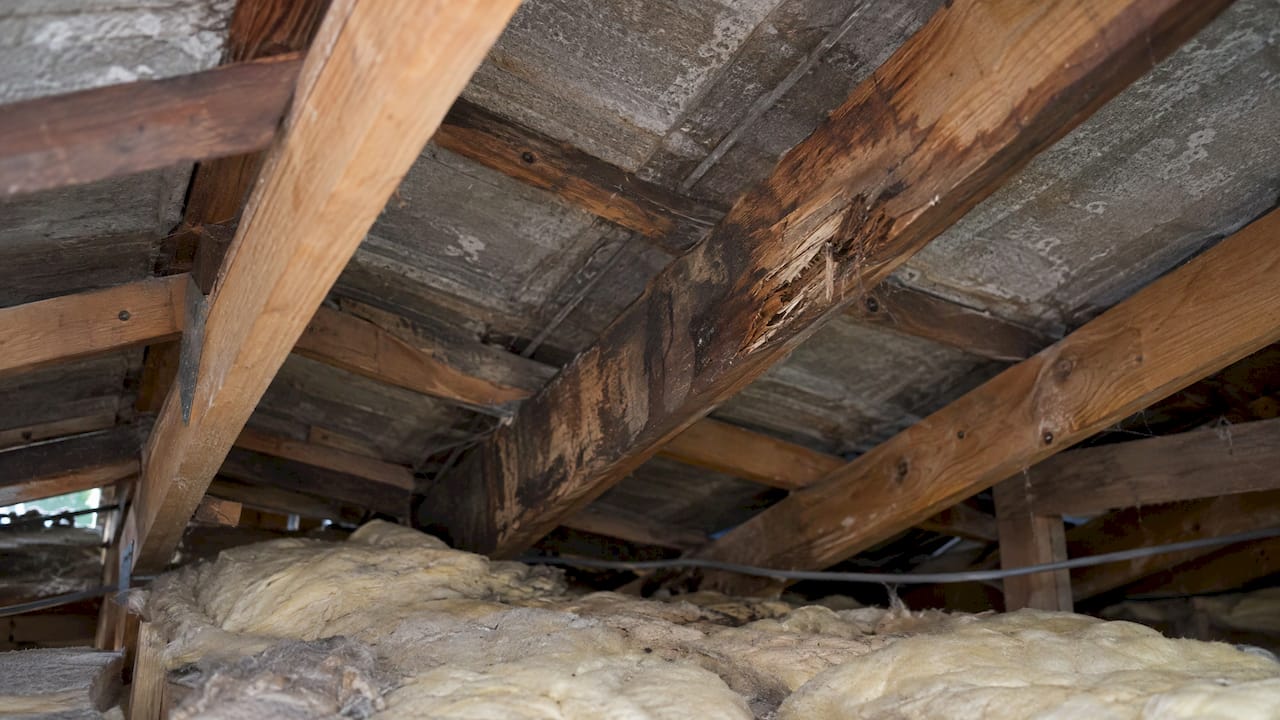
The rule that works: bring costs, not adjectives. Building inspector Adam Shaw argues that a report saying the roof void has water staining and decayed rafters is a finding, while a quote from a roofer and carpenter is a number the vendor can respond to. A specific reduction for a specific, priced defect is negotiable. A general feeling that the house is worth less is not.
Which defects to raise
The same source splits findings into tiers:
- Structural or safety issues (foundation movement, termite activity, decayed roof framing, unsafe electrical): your strongest ground.
- Significant functional defects (failed drainage, end-of-life roof): these move price because they are near-term costs.
- Cosmetic items: leave them out. A long list of minor items undermines your credibility on the serious ones.
Get independent quotes from licensed trades for anything you raise, and send the request to the selling agent in writing with one specific figure. Our building report negotiation packet shows how to lay this out on a single page, and the property inspection checklist helps you spot issues before you pay for a report.
Have your solicitor or conveyancer involved too. They can make sure the contract provides for repairs or a price adjustment, rather than leaving the agreement as an informal promise. See why a buyers agent reviews the contract.
Auction negotiating is a different game
At auction you do not negotiate in the usual sense. As Dot Legal explains in its NSW guide, bidding is unconditional and there is no cooling-off period, so finance should be fully approved and legal checks done before you raise your hand. In a private sale, by contrast, you can make an offer subject to finance, a building inspection or the sale of your own property.
Your tactics at auction:
- Fix your maximum bid in advance and write it down.
- Have the contract reviewed and inspections done before auction day. Our guide to building inspections before bidding explains the risks of skipping this.
- Understand increments. Bidding in large jumps can drain your budget, as covered in auction bidding tips and auction bidding increments.
- Know the etiquette. See auction bidder etiquette in Sydney.
- Consider a representative. A bidder who has no emotional stake is less likely to go past the ceiling. More in Sydney property auction bidding.
If the property passes in and the vendor negotiates with the highest bidder afterwards, you are back in a private negotiation, but with the vendor’s expectations now tested against the room.
When you are one of several offers
Competition changes the maths. If the agent says there are multiple offers, price is not your only lever: clean terms, a short or flexible settlement and a strong, finance-ready position can matter. Our guide on winning multiple offers on terms, not price goes through this in detail.
A worked example
Say a house in the Inner West is advertised with a guide of $1.6 million to $1.7 million. Your comparables suggest similar houses have sold for $1.55 million to $1.65 million, and your ceiling, after budgeting for costs, is $1.68 million.
- You get the contract and have a solicitor review it.
- The agent tells you the vendor has bought elsewhere and wants a quick sale. You offer $1.56 million, a 30-day settlement, a 10% deposit and finance already approved.
- The vendor counters at $1.69 million. That is above your ceiling and close to the top of the guide, so you hold at $1.58 million rather than chase.
- A second counter of $1.65 million arrives. The gap has halved, which suggests movement. You step up meaningfully to $1.62 million with a 24 hour expiry.
- The building report finds a failed drainage system with a quote of $14,000. You ask for a specific reduction, and settle at a price comfortably under your ceiling.
The numbers are illustrative, not a prediction. The sequence is the point: evidence, terms, patient counters, priced defects.
Where a buyers agent changes the negotiation
Each tactic above depends on information and nerve. Comparables need to be current and properly adjusted. The agent needs to hear nothing about your budget or emotions. Inspections have to be arranged quickly and the findings turned into one clear figure. At auction, someone has to hold the line when the room gets loud.
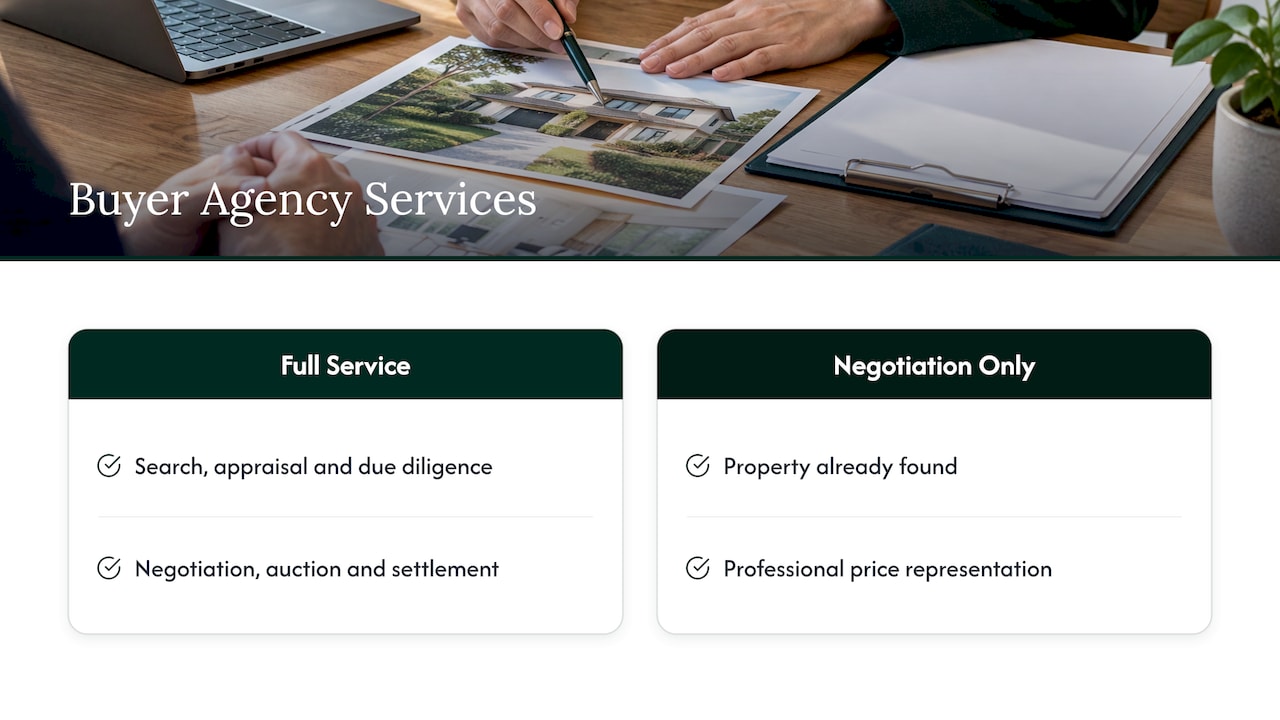
Our Full Service covers the entire purchase journey: strategy, on-market and off-market search, independent appraisal, due diligence, negotiation, auction bidding and settlement. Negotiation Only is for buyers who have already found the property and want professional representation on the price. Across the 100+ properties we have secured for clients, our average saving on the purchase price has been around 9%, and our average time from engagement to settlement is 54 days. You can see examples on our recent purchases page.
Our perspective
Most buyers think negotiation is about being tough. In our experience it is about being prepared and being boring. The agent should learn nothing from you except a credible number and clean terms.
We only ever act for buyers, never sellers, so every hour we spend is on your side of the table. We inspect properties seven days a week, independent of open home schedules, so we are not rushed into forming a view in a crowded twenty-minute inspection. We analyse capital growth potential and rental yield alongside price, because the cheapest purchase is not always the best one.
The best result is often the one the agent did not see coming: a property that never reached the portals, or an offer that suited the vendor’s timeline better than a higher one. That is why we put so much effort into off-market access and into reading what the vendor really needs.
Hold your ceiling, keep your feelings out of the conversation, and let the evidence make the case.
Kristan
Get a professional on your side of the table
If you want a licensed buyers agent to run the search, appraisal and negotiation, our Complete Purchase Solution and Auction Bidding services cover the full journey. If you have already found the property, Negotiation Only gives you representation on price. Call 1800 676 177 or email hello@sydneypropertybuyers.com.au, or visit our office at 79 New Canterbury Rd, Petersham NSW 2049.

We are a fully licensed Sydney buyers agency (NSW Licence 20456819) servicing the Inner West, Eastern Suburbs, Lower North Shore and Eastern Beaches.
FAQ
Should I make a verbal or written offer on a Sydney property?
Either is allowed in NSW, but a written offer such as an email gives you a clear record of what was proposed and what happened to it. Include price, deposit, settlement period, conditions and an expiry time. Your solicitor or conveyancer should review the contract before you sign.
How much below asking price can I offer?
There is no fixed percentage. Your offer should be based on recent comparable sales and the condition of the property, not on a discount rule. Our clients have achieved an average saving of around 9% on purchase price, but each result depends on the property, the vendor and the competition. Our guide on negotiating a Sydney house price explains how we approach it.
Can I negotiate after a building inspection?
Yes, in a private treaty sale, provided you raise material, priced defects with a specific figure and send the request through the selling agent. Cosmetic items weaken your case. Always get your solicitor involved so any agreement is written into the contract.
Can I negotiate at an auction?
Not in the same way. Bidding is unconditional and there is no cooling-off period, so finance and legal checks need to be finished before auction day. You can negotiate with the vendor before the auction if they agree to it, or after if the property passes in.
Sources
- Making an offer on a property, NSW Government
- How to Make an Offer on a Property in NSW, Hindsight Legal
- How to negotiate with real estate agents when buying a property, realestate.com.au
- How to make an offer on a house, NAB
- How to Make an Offer on a House in Australia, BrokerList
- How to negotiate property price in Australia, Your Property Guide
- Can You Negotiate After a Building Inspection?, A.S Building and Pest Services
- Guide to Buying Property in NSW, Dot Legal
- Reidy.ai property appraisal and deal analysis
Recommended
- 3–5% Off Asking? Negotiate Sydney House Price With NSW Safe Tactics
- What is a property negotiation strategy for Sydney buyers?
- Sydney Multiple Offers: US Buyers Can Win on Terms, Not Price
- How to make an offer on a Sydney property