A good rental yield in Sydney is lower than most overseas investors expect. Mozo’s March 2026 benchmark put Sydney’s gross yield at 3.1%, and the same guide treats a gross yield above 4% as solid for a capital city and above 5% as strong. The useful analysis does not stop at that number. It compares the property’s own rent and price, subtracts the real running costs, and sets the result against capital growth. That is the work a buyers agent does before you make an offer, and it is where Sydney Property Buyers starts with an investor.
TL;DR
- Gross yield is annual rent divided by price. Net yield subtracts running costs first, and it is the figure that tells you what you keep.
- Sydney is a low-yield, growth-driven market. Units generally yield more than houses, and the most expensive suburbs yield the least.
- A high yield alone is not a better investment. It can reflect weak price growth or a tired building.
- The US “2% rule” does not translate: Sydney yields are a fraction of it.
- Check every suburb figure against the specific property, its strata costs and its likely rent before you commit.
Table of Contents
- What rental yield measures
- What counts as a good yield in Sydney
- How yields differ by property type and suburb
- The costs that turn gross yield into net yield
- Why the US 2% rule does not apply
- Yield versus capital growth
- How to run a rental yield analysis step by step
- Where buyers go wrong
- Working with a buyers agent on yield
- FAQ
- Sources
What rental yield measures
Rental yield is the rent a property earns in a year, shown as a percentage of what the property is worth or what you paid for it. It lets you compare a $700,000 apartment with a $2 million house on the same footing.
There are two versions, and mixing them up is the most common mistake in Sydney listings and investor forums.
Gross yield = annual rent ÷ property price × 100. Rents in Australia are quoted per week, so annual rent is the weekly figure multiplied by 52, not by four weeks times twelve.
Net yield = (annual rent − annual running costs) ÷ property price × 100. This is the version that reflects what actually lands in your account before loan repayments. Mozo sets out both formulas and notes that mortgage repayments are not part of a standard yield figure. Debt costs belong in a separate cash flow check.
We publish a shorter walk-through with two examples in our rental yield formula guide.
A worked example
Take an illustrative two-bedroom apartment bought for $800,000 and rented at $600 a week. This is a sample calculation, not a listing.
- Annual rent: $600 × 52 = $31,200
- Gross yield: $31,200 ÷ $800,000 = 3.9%
Now the running costs, again illustrative:
| Cost | Annual amount |
|---|---|
| Property management (8% of rent) | $2,496 |
| Council rates | $1,800 |
| Strata levies (body corporate fees in the US sense of HOA dues) | $4,000 |
| Landlord insurance | $500 |
| Maintenance and repairs | $1,500 |
| Two weeks’ vacancy ($600 × 2) | $1,200 |
| Total | $11,496 |
Net income is $31,200 − $11,496 = $19,704. Net yield is $19,704 ÷ $800,000 = 2.46%. A property that looks like 3.9% on the portal delivers about 2.5% in your hands. That gap of nearly a point and a half is normal, and it is why net yield is the number to build a purchase decision on.
What counts as a good yield in Sydney
The answer depends on what you want the property to do.
Mozo’s guide treats a gross yield above 4% as solid for a capital-city investment and above 5% as strong, with a net yield of 3% or more as a reasonable income benchmark. Against its March 2026 Sydney benchmark of 3.1% gross, you can see that an average Sydney purchase does not reach the “solid” mark. Westpac says there is no universal threshold: yield varies with location, property type, rental demand and market conditions, and a higher yield can come at the cost of capital growth.
In practice, three working targets make sense:
- Income-focused buyer: aim for a gross yield of 4% or more and a net yield near 3%. In Sydney this usually means units rather than houses, and middle or outer-ring suburbs.
- Balanced buyer: accept 3% to 4% gross in a suburb with strong tenant demand and a history of price growth, and test that the cash flow is affordable.
- Growth-focused buyer: accept a lower yield, sometimes under 3% gross, in a location with scarce land, strong schools or transport, and demand from owner-occupiers. You are funding the gap from your own income, so the holding cost needs to be comfortable.
Because market figures move with each quarterly or monthly data release, treat any published average as a snapshot for its period. Your test is the specific property’s rent and price against the current data, not last quarter’s headline.
How yields differ by property type and suburb
Sydney’s yield pattern is simple: the more expensive the dwelling relative to the rent it can earn, the lower the yield.
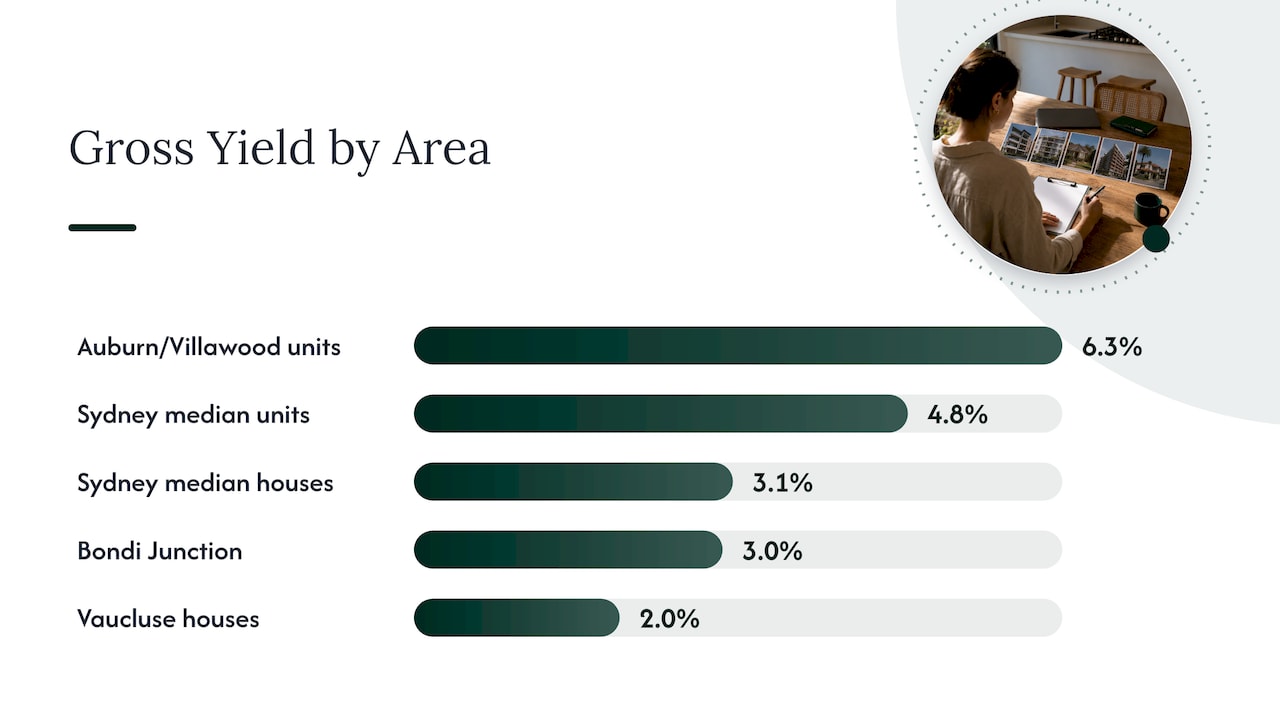
Domain data reported by the Sydney Morning Herald in May 2026 put the citywide median gross yield at 4.8% for units and 3.1% for houses. Auburn and Villawood led Sydney units at 6.3% on a median rent of $650 a week, while Vaucluse houses came in at 2.0%. Domain’s head of research, Dr Nicola Powell, explained in that coverage that asking rents and property values do not move in step, which is why premium locations show weak yields and outer suburbs lead.
Cotality’s Q1 2026 rental review shows the same split inside the premium end. Vaucluse had a median rent of $2,469 a week against a median value of $9,483,086, a gross yield of 1.6%. Bondi Junction showed 3.0% on $1,702 a week and a median value of $2,932,629.
| Example | Type | Gross yield | Source period |
|---|---|---|---|
| Auburn / Villawood | Units | 6.3% | Domain via SMH, May 2026 |
| Sydney citywide median | Units | 4.8% | Domain via SMH, May 2026 |
| Sydney citywide median | Houses | 3.1% | Domain via SMH, May 2026 |
| Bondi Junction | All dwellings | 3.0% | Cotality, Q1 2026 |
| Vaucluse | Houses | 2.0% | Domain via SMH, May 2026 |
Two cautions apply when you read tables like this. First, a suburb median blends old and new, large and small, and can rest on very few sales. It is a screening signal, not a valuation of the home in front of you. Second, the suburbs with the top yields are not automatically the ones where you would want to hold for ten years. That is where growth comes in.
If you are focused on the Inner West, our Inner West suburb comparison and Inner West property guide set out how prices and rents differ street by street.
The costs that turn gross yield into net yield
The cost list for a Sydney investment is longer than most overseas buyers assume. Mozo’s guide lists vacancy, property management, council rates, insurance, maintenance and repairs, water rates where the tenant does not pay them, and strata fees. Land tax can also apply to investment property.
Three of these deserve attention.
Vacancy. Mozo suggests allowing two to three weeks a year. Local vacancy conditions change that figure. Our note on Sydney rental vacancy covers how to read it before you buy.
Management fees. Mozo puts typical property management fees at 7% to 12% of gross rent. On a $31,200 annual rent that is $2,184 to $3,744, a swing of more than $1,500 a year from this single line.
Strata levies. For apartments, strata fees can be the largest cost. A unit with a 4.5% gross yield and heavy levies can net less than a house with a 3.5% gross yield. Always read the strata minutes and the sinking fund position, which the due diligence stage should cover, before treating a unit’s yield as real.
Turnover costs matter too. Cleaning between tenancies is a routine holding cost, and the role of professional cleaners in rental management shows where it fits into a landlord’s running budget.
One more point for readers coming from the United States: stamp duty (the NSW transfer tax), legal fees and inspection fees are usually left out of yield on purchase price, but they raise the cash you put in and so lower the return on that cash. Include them when you model your own total outlay.
Why the US 2% rule does not apply
US investors often arrive with the 2% rule: monthly rent should be at least 2% of the purchase price. BiggerPockets says it is very rarely achievable in today’s US market and warns against relying on it alone, because it ignores condition, location and net cash flow.
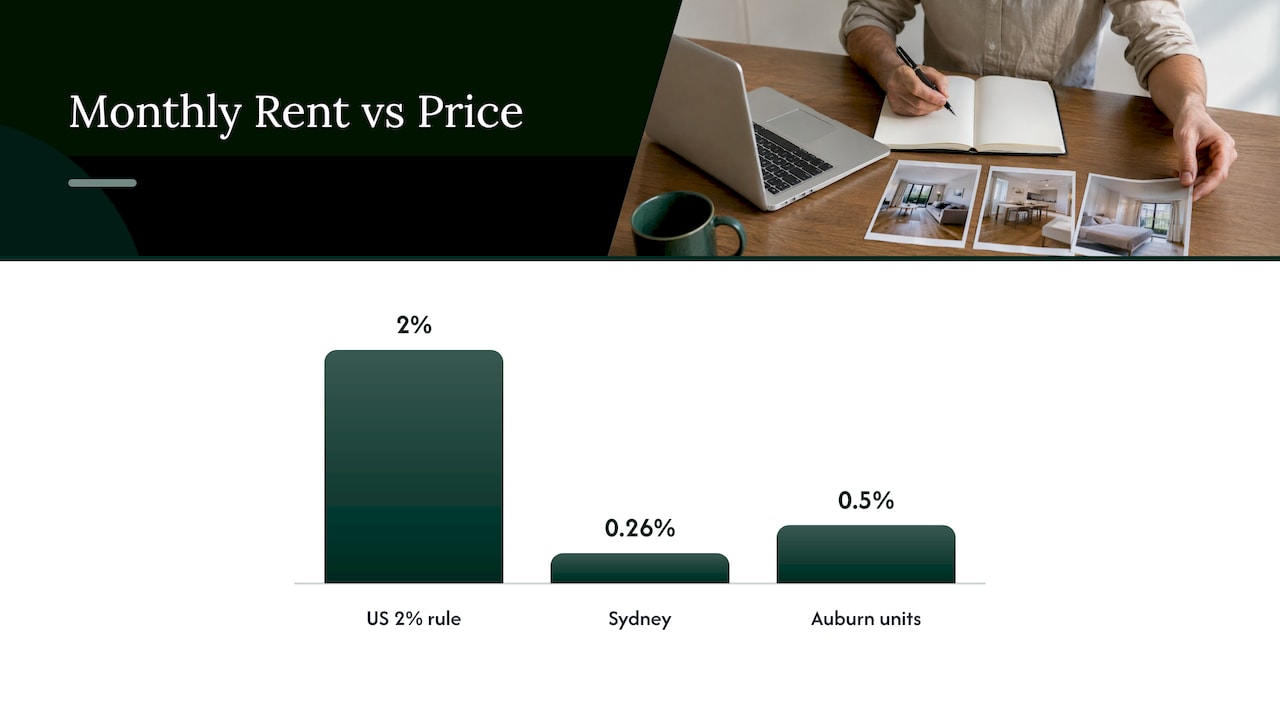
Sydney sits nowhere near it. A 3.1% annual gross yield is about 0.26% of the price per month. Even Auburn’s 6.3% unit yield is about 0.5% a month. Sydney investors accept this because they are buying mainly for land value growth, and because Australian tax settings and long-run price history have rewarded it. If you use a US screening rule, replace it with Sydney-specific numbers: a target net yield, a capital growth expectation and a cash flow figure you can carry.
Yield versus capital growth
Yield is one input. A high yield with falling prices is a warning, not a bargain, because yield rises both when rents rise and when prices fall. Westpac frames this as a strategy question: an income-focused buyer may prefer stronger yield, while a growth-focused buyer may accept a lower yield in a desirable or improving area.
A practical way to compare two candidates:
- Calculate net yield for each, using realistic costs.
- Work out the annual shortfall or surplus after loan interest. This is your cash flow.
- Look at how prices in that suburb have moved over several years, and what is driving demand: transport, schools, employment, supply limits.
- Ask whether you can hold the property through a flat or falling price period without being forced to sell.
Rent growth also helps. Cotality reported that Australian rent values rose 2.1% in the March quarter of 2026, and annual rent growth for the combined capitals was 5.6%. Rising rents lift yield on an existing purchase price over time, which is one reason a modest starting yield in a strong location can improve.
For growth-led thinking, see our guides to Sydney growth suburbs, capital growth suburbs and gentrifying suburbs on the 10 to 20 km frontier.
How to run a rental yield analysis step by step
- Set the goal. Decide whether the property must pay for itself, or whether you will fund a shortfall for growth. Everything else follows from that.
- Shortlist suburbs. Use yield and price data as a first filter, then read our guide on how to research Sydney suburbs. Treat a suburb median as a screen, not a forecast.
- Estimate achievable rent for the specific property. Use recent comparable leases of similar size, condition and street, not the listing’s optimistic line. This is where most online yield figures go wrong. In our full service, the independent appraisal and holistic investment analysis, including rental yield and capital growth potential, are part of the assessment before you commit.
- Build the net figure. Use your own cost lines: management, rates, strata, insurance, maintenance, vacancy, water and any land tax.
- Add finance. Mortgage interest sits in cash flow, not in yield. Model your actual loan.
- Stress test. Run the numbers with rent 10% lower, a month of vacancy and a strata special levy. If the property still works, it is a sound candidate.
- Negotiate on the result. A realistic net yield tells you the price at which the property meets your target. That is the figure to bring to the negotiation. See our guides on property price negotiation and negotiating a house price in Sydney.
Where buyers go wrong
- Using the portal’s “estimated rent” as fact. It is an estimate until a property manager or comparable leases support it.
- Comparing gross yields across different property types. A 5% gross on a small unit with high strata costs is not the same as 5% on a house.
- Ignoring the sample size. A suburb median can rest on a handful of sales.
- Chasing the top of the yield table. The highest-yielding areas are often those where prices are lower for a reason.
- Forgetting the buying costs. Stamp duty and legal costs lower the return on your cash.
We analyse yield on the specific property, not the suburb average. A suburb at 3.1% gross can contain a unit at 4.5% and a house at 2.2%, and the difference is usually in the details: strata costs, lease terms, condition, street.
Our work for investors is built around that detail. As a licensed agency that acts only for buyers, we assess capital growth potential alongside rental yield, inspect properties seven days a week regardless of open home times, and bring in off-market and pre-market opportunities. More than 30% of our purchases have been secured off-market, which matters for yield because a property bought before it reaches the portals often carries a better entry price. Our clients have saved about 9% on average against the purchase price, and the average time from engagement to settlement is 54 days.
A lower purchase price lifts yield directly. On the same $31,200 of rent, a $760,000 price instead of $800,000 raises gross yield from 3.9% to 4.1%. Negotiation is yield analysis put into action.
Kristan
Working with a buyers agent on yield
If you are buying in the Inner West, Eastern Suburbs, Lower North Shore or Eastern Beaches, we can handle the whole purchase through our Complete Purchase Solution: strategy, on-market and off-market search, independent appraisal, due diligence, negotiation, auction bidding and settlement. If you have already found a property, our Negotiation Only service puts a licensed agent across the table to negotiate the price.

You can see examples of what we have secured on our recent purchases page, or call 1800 676 177 to talk through your yield and growth targets. We are at 79 New Canterbury Rd, Petersham NSW 2049 (NSW Licence 20456819).
FAQ
What is a good rental yield in Sydney?
For a capital city, Mozo treats a gross yield above 4% as solid and above 5% as strong, with a net yield of 3% or more as a reasonable income benchmark. Sydney’s average gross yield is lower, around 3.1% in Mozo’s March 2026 benchmark. A lower yield can still suit a buyer targeting growth.
Which Sydney suburbs have the best rental yields?
Units in outer-ring suburbs such as Auburn and Villawood led Sydney at 6.3% gross in Domain data reported in May 2026. Premium suburbs such as Vaucluse sit near the bottom for houses. Rankings change with each data release, so check the latest figures and test the specific property.
Is gross or net yield more useful?
Net yield is more useful for a purchase decision because it deducts management, rates, strata, insurance, maintenance and vacancy. Gross yield is useful for a quick comparison across listings. Neither includes mortgage repayments, which belong in your cash flow analysis.
Does the 2% rule work in Sydney?
No. The rule asks for monthly rent of 2% of the purchase price, which would be a 24% annual gross yield. Sydney averages sit near 3% to 5%, so use Sydney-specific yield, cash flow and growth targets instead.
Sources
- Mozo: What is rental yield and how do you calculate it?
- Westpac: How to calculate rental yield
- Sydney Morning Herald: Sydney suburbs with the highest rental yields
- Cotality quarterly rental review, Q1 2026
- BiggerPockets: What Is the 2% Rule in Real Estate?
- The Role of Professional Cleaners in Rental Management
Recommended
- Quick Rental Yield Formula for Investors: 2 Examples & Agent Checklist
- Sydney Rental Vacancy: 3 Figures US Buyers Can Use to Time a Purchase
- Rental Appraisal Before Buying: A Sydney Investor’s Guide
- 10 Sydney Suburbs With Strong 2026 Growth for US Investors