An offer expiry is the date and time after which your offer lapses if the seller has not accepted it. A good strategy sets that deadline long enough to look reasonable and short enough to keep the seller’s attention. In the US, that usually means a window of 24 to 72 hours, set inside your state’s contract rules. In Sydney, where we work, the expiry matters differently because nothing binds either side until contracts are exchanged.
This guide covers both. You will see how US buyers choose a deadline, what happens when it passes, and how to handle counteroffers and extensions. Then we explain how the same idea plays out on a Sydney purchase, which is useful if you are an American weighing up a move or an investment in Australia.
TL;DR
- Many US offers use about a 24-hour response window, and buyers commonly choose 24 to 72 hours. A deadline of a couple of hours can look unreasonable.
- Once the stated time passes, the offer has expired. If the seller comes back later, you are generally free to change your terms.
- A seller’s change to any term is a counteroffer, not an acceptance, so the original deadline stops mattering.
- State contract forms differ on when acceptance takes effect and how days are counted. Read yours, or ask a local real estate attorney, before you write the deadline.
- In Sydney, an accepted offer is not binding until contracts are exchanged, so expiry is a negotiating tool, not a legal trap.
Table of Contents
- What an offer expiry actually does
- How to choose the length of the deadline
- Urgency without damaging the offer
- What happens when the seller does not respond
- Extending or withdrawing before the deadline
- When the seller counters near the deadline
- State rules to check before you write the deadline
- How offer expiry works in Sydney
- Our perspective
- Working with a buyers agent on an offer
- Common mistakes with offer deadlines
- FAQ
- Sources
What an offer expiry actually does
An offer is a proposal with a shelf life. The expiry says how long the seller has to say yes. Without one, an offer can usually lapse after a “reasonable time”, which is vague enough to cause arguments. The North Carolina Real Estate Commission explains that an offer may expire on its stated date, or within a reasonable time if no deadline is set, and that it ends if the seller sells or contracts to sell to someone else.
A deadline does three jobs:
- It protects you from being held to an offer indefinitely while the seller shops it around.
- It gives the seller a clear decision point.
- It signals how serious and organised you are.
The flip side is that a deadline is a promise about process. Researchers at the Texas Real Estate Research Center note that offer deadlines should be respected when they are used to collect competing offers, and that failing to follow a stated process can expose agents and sellers to claims of unfair treatment. So a deadline works best when everyone treats it as real.
How to choose the length of the deadline
There is no single correct answer, but there are sensible ranges.
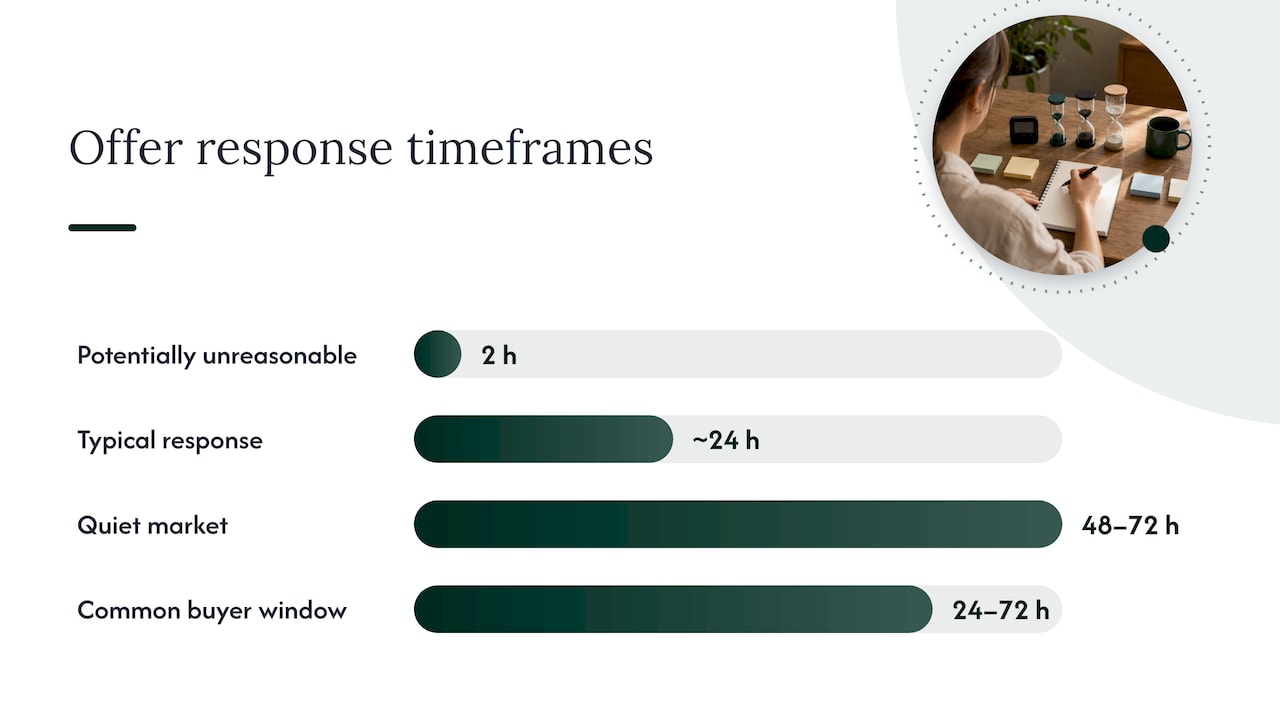
The American Society of Home Inspectors reports that many offers use about a 24-hour response timeframe and urges buyers to keep the period reasonable, noting that a two-hour deadline may be viewed as unreasonable. Rocket Mortgage says there is generally no fixed seller-response period unless the buyer sets one, and that buyers commonly use a 24 to 72 hour window, with local market conditions and contract terms able to change what is appropriate.
Use the table below as a starting point, not a rule.
| Situation | Typical approach | Reasoning |
|---|---|---|
| Quiet market, one interested buyer | 48 to 72 hours | The seller has time to consult family or an agent, and you keep goodwill. |
| Normal market, listing a few days old | About 24 hours | Short enough to keep momentum, long enough to be respectful. |
| Seller has announced an offer review date | Submit before it, expiring after the review | The seller already controls the timetable. Match it. |
| Hot market, several buyers | 24 hours or less, with a strong offer | Urgency is expected, but only works if price and terms are already competitive. |
A few practical rules sit behind the table.
- Count the seller’s reality. If the seller lives in another time zone, or the offer lands on a Friday evening, a Saturday morning deadline is pointless. Write the time zone into the expiry.
- State a clock time, not just a date. “Tuesday” can mean midnight or 9 am. Alabama’s REALTORS association points out that most offers include an expiration date, sometimes with a specific time, and that the original deadline is binding if the buyer does not extend or resubmit.
- Do not make the deadline the only lever. A short fuse on a weak offer just gets you a fast no.
Urgency without damaging the offer
The best deadlines feel like a courtesy rather than an ultimatum. Three habits help.
Pair the deadline with a clean offer. A seller who sees a reasonable price, a solid deposit and flexible settlement timing is more willing to work to your clock. A tight deadline attached to heavy conditions reads as pressure.
Give a reason where you can. “We are making decisions on two properties this week” is honest and gives the seller context. Never invent a competing offer. Misstating other interest is the quickest way to lose trust and, depending on your agent’s conduct rules, can cause real problems.
Know the cost of going early. Rocket Mortgage’s guidance is that an early or preemptive offer may reduce competition but can force you to act before fully evaluating the property, price and terms. If you set a very short expiry, make sure your inspection plans, finance and comparable sales work are done first. Otherwise the deadline is pressuring you, not the seller.
What happens when the seller does not respond
When the time passes, the offer has expired. Alabama REALTORS states that after the date and time pass the offer is expired, the seller may re-engage, but the buyer is then free to change the previously offered terms.
Silence is also common. Rocket Mortgage notes that sellers generally have no legal obligation to respond to an offer, so your options are to ask your agent for a status update, revise the offer, reset the deadline or move on.
A simple sequence works well:
- Ask your agent, a few hours before expiry, whether the seller has seen the offer.
- If there is interest but no decision, offer a short extension in writing.
- If the seller returns after expiry, treat it as a fresh negotiation. You may hold your original terms, improve them or lower them, depending on what you have learned since.
- If there is no sign of life, put your energy into the next property rather than waiting.
Extending or withdrawing before the deadline
Extensions are simple when handled in writing. The deadline stays binding unless you extend or resubmit, so do not rely on a phone call or a message that says “no problem”. Have the new time confirmed in the same form as the offer, usually through your agents.
Withdrawal is a state-law question. The North Carolina Real Estate Commission says a buyer may withdraw an offer at any time before the buyer or buyer’s broker is notified that the seller has signed it, even if the offer contains a response deadline. That is one state’s guidance. Your state’s form may define acceptance and notice differently, so confirm with a local attorney before relying on it.
When the seller counters near the deadline
A counteroffer is not a partial yes. North Carolina guidance says a seller’s change to any term rejects the original offer and creates a counteroffer, which the buyer may accept, reject or counter. That means your original deadline no longer matters, and you can no longer “accept the old offer” if the counter disappoints you.
When a counter arrives with your expiry looming:
- Read every changed term, not only the price. Deposit, settlement date and inclusions all count.
- Put a fresh expiry on your response. Do not leave it open-ended.
- Decide in advance your walk-away number so a 24-hour clock does not decide it for you.
State rules to check before you write the deadline
US offer rules are set state by state, and the standard purchase form does most of the work. Before setting a deadline, check:
- which standard form is used and how it describes expiry;
- when acceptance is effective (signature, or notice to you);
- the required delivery or notice method;
- how counteroffers are treated;
- whether days are calendar or business days;
- any agent communication duties.
Texas shows how specific this gets. Its real estate commission requires covered licensees to respond within two calendar days to specified transaction communications. North Carolina’s guidance, by contrast, covers withdrawal, communicated acceptance, expiry and competing offers. A local real estate attorney should read the actual contract before you rely on any general guide, including this one.
The Texas researchers also frame a review deadline as a process commitment rather than mere pressure: consistent treatment of every submitted offer helps avoid fairness and regulatory problems. As a buyer, that tells you something useful. If a seller announces a review date, an offer that arrives and expires on that timetable is treated as part of a fair process.
How offer expiry works in Sydney
If you are an American looking at Sydney property, the logic is the same but the legal weight is different. Our guides on how to make an offer on a Sydney property go further. Here are the differences that matter for deadlines.
Nothing binds until exchange. In NSW, an accepted offer is not legally binding until contracts are exchanged. Both sides can walk away before then, which is why a deadline is a signal rather than a contract term. It also means a seller can entertain a better offer after accepting yours, a risk Australians call gazumping.
Deadlines are often set by the agent. On private treaty sales, a selling agent may tell buyers that offers close at a set time, often in a multiple-offer situation. NSW Government guidance also sets limits on agent conduct: an agent cannot demand an offer by the end of the day straight after you inspect. If you are unsure about the pressure you are under, NSW Fair Trading is the body to contact.
Cooling-off is the safety net, and it is costly. Most existing residential contracts carry a five business day cooling-off period, and using it costs 0.25% of the purchase price. There is no cooling-off period when you buy at auction. So the real decision point is before you sign, not after, and that is why we want contract and building reviews done before you set any offer deadline. Our guide to the five business day cutoff explains the mechanics.
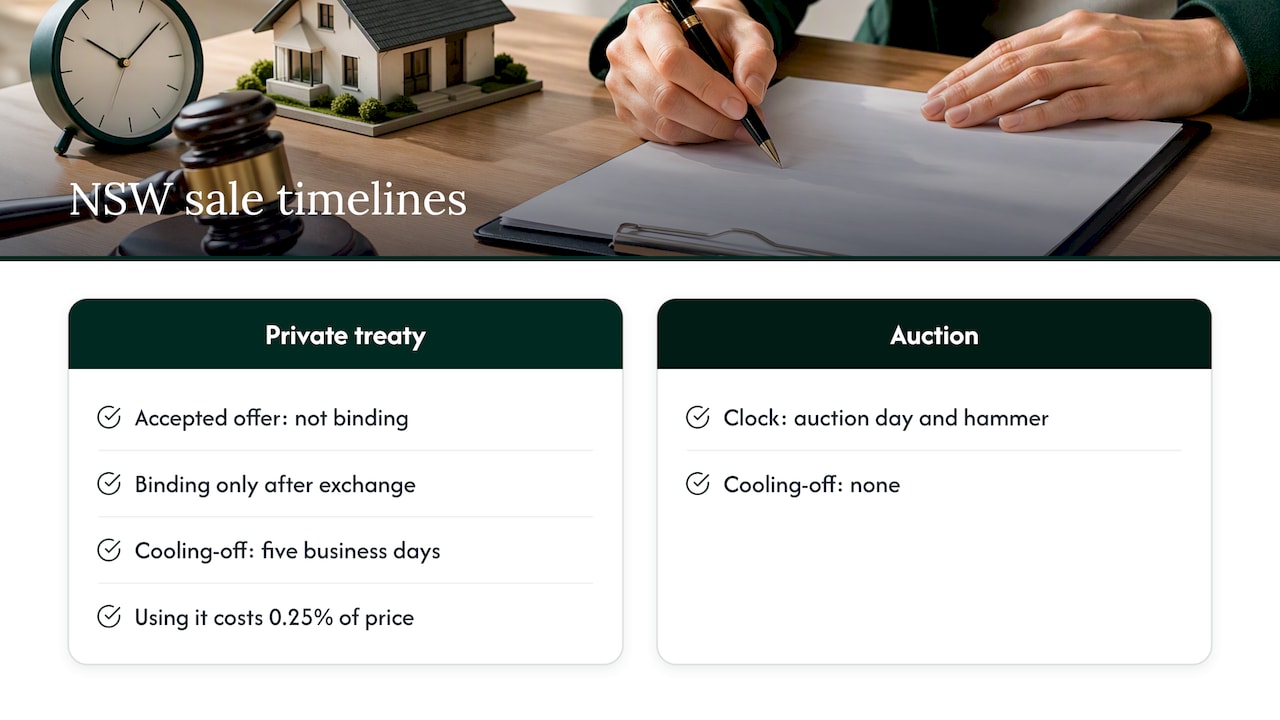
Auctions replace the deadline entirely. An auction has its own clock: the day and the hammer. Preparation matters more than expiry strategy. Our guides on pre-auction offers in Sydney and bidding with confidence show how to get ready.
A Sydney-style deadline in practice
Here is how we typically structure an offer that has a time limit:
- Inspect the property and have the contract and any building and pest reports reviewed first.
- Agree a walk-away price with the client in writing.
- Submit the offer with a clear expiry time, usually within 24 to 48 hours, and a short explanation of the buyer’s position.
- Confirm by phone that the vendor has received it, and keep the agent updated on any change.
- If the vendor counters, respond within the same day and set a new expiry.
Where multiple offers are on the table, terms often decide the contest rather than price. See our guides on handling multiple offers and winning on terms, not price.
Our perspective
Most buyers think of the expiry as the seller’s problem. We think of it as ours. A deadline is only as strong as the preparation behind it, and in Sydney that preparation is what separates a confident offer from a hopeful one.
Our approach rests on three habits. First, we do the homework before the offer exists: independent appraisal, contract review and inspections, which we run seven days a week rather than only at open homes. Second, we keep the vendor’s agent informed. A buyer who communicates clearly, and whose deadline is reasonable, tends to be taken seriously. Third, we never treat expiry as the main lever. Price, terms and credibility matter more, and a deadline should only nudge a decision that the offer has already earned.
It also helps to know that around 30% of our purchases are secured off-market, where there is often no formal deadline at all. In those cases the timetable is negotiated directly, and the buyer who is ready, with finance and checks done, usually has the advantage.
— Kristan
Working with a buyers agent on an offer
If you are buying in Inner West, Eastern Suburbs, Lower North Shore or Eastern Beaches Sydney, Sydney Property Buyers can run the whole process for you. Our Complete Purchase Solution and auction bidding service covers strategy, search, appraisal, due diligence, negotiation and settlement. If you have already found a property, our Negotiation Only service puts an experienced licensed agent between you and the vendor for the offer stage. We are a licensed buyers agency (NSW Licence 20456819) and we represent buyers only, never sellers. You can reach us on 1800 676 177.
Common mistakes with offer deadlines
- Setting a deadline with no time or time zone. Ambiguity helps nobody.
- Too short a window. It risks looking unreasonable, as the home inspectors’ guidance warns.
- Rushing diligence to meet your own clock. Finish inspections and contract review first.
- Verbal extensions. Put every change in writing.
- Assuming silence means yes. Silence usually means the offer is simply lapsing.
- Treating a counteroffer as an acceptance. It rejects the original offer.
FAQ
What does an offer expiration deadline mean when buying a home?
It is the date and time after which your offer lapses if the seller has not accepted. After that, the seller cannot accept the old offer, and you can change your terms if talks resume. State forms differ on exactly when acceptance takes effect, so check yours.
How long should my offer stay open?
In the US, buyers commonly choose 24 to 72 hours, and many offers use around 24 hours. Very short windows can look unreasonable. In a hot market, shorter is common, but only with a strong offer behind it.
Can I withdraw an offer before it expires?
Often yes, until you are notified that the seller has accepted, but this depends on your state’s rules and the contract wording. North Carolina’s regulator describes this approach. Ask a local real estate attorney before you rely on it.
Does an offer expiry matter in Sydney?
Less legally, more tactically. An accepted offer in NSW is not binding until contracts are exchanged, so the deadline works as a signal. The real protections are the contract review you do before signing and, for most private treaty purchases, the cooling-off period.
What if the seller replies with different terms?
That is a counteroffer and it ends your original offer. You can accept it, reject it or counter again. Set a new expiry on your reply.
Sources
- Questions and Answers on Offer and Acceptance, North Carolina Real Estate Commission
- Timelines and Deadlines for Purchase Agreements, Alabama Association of REALTORS
- Your Contractual Time Lines, American Society of Home Inspectors
- How long do sellers have to accept an offer, Rocket Mortgage
- Offer dates on real estate, Rocket Mortgage
- How to Comply With the New Response Time Rule, TREC
- Hot Markets, Cool Practices, Texas Real Estate Research Center
- Making an offer on a property, NSW Government
- How to make an offer on a property in NSW, Hindsight Legal
- Cooling-off period in NSW, Hindsight Legal
Recommended
- Sealed Bids on Sydney Property: How Best and Final Offers Work
- Be Contract Ready to Win Sydney Pre Auction Offers
- Why engagement timing matters with a buyer’s agent
- What is a property negotiation strategy for Sydney buyers?