Inner West auctions have cooled. Sydney-wide, Domain’s preliminary clearance rate fell to 46% in early October 2026, vendors are cutting reserves to sell, and buyers are bidding only where they see real value. That shifts negotiating power toward prepared buyers, though results still vary sharply from one street to the next.
This guide covers what the numbers say, what guide prices and sale prices show, what drives the softer conditions, and how to approach an Inner West auction, including if you are buying from the United States.
TL;DR
- Sydney’s preliminary auction clearance rate dropped to 46% in October 2026 as the cash rate rose for the fourth time this year, according to Sydney Morning Herald reporting.
- Some Inner West vendors are cutting reserves to sell. Others still achieve results above their guide when a home is well presented and priced.
- A reserve does not have to match the guide price, so the guide is a starting signal and never a ceiling.
- Inner West suburb medians vary widely, from about A$1.76 million to over A$4 million for houses.
- A softer market rewards buyers who have done their due diligence, set a firm limit and know their negotiating options before and after auction day.
Table of Contents
- What the latest Inner West auction trends show
- Guide price versus sale price: what buyers are actually paying
- Inner West suburb prices: where the entry points are
- What is driving Inner West auction results
- How to approach an Inner West auction in this market
- Buying from the United States
- Work with a buyers agent on Inner West auctions
- FAQ
- Sources
What the latest Inner West auction trends show
The Inner West is part of Greater Sydney’s auction market, and the clearance figures that Domain publishes each weekend are reported for Sydney as a whole. Suburb-level results are thinner, because a few dozen Inner West auctions on a Saturday can swing a local percentage wildly. The Sydney-wide number is still the best weekly read of the mood the Inner West sits in.
That mood has turned cautious. Early in September 2026, Domain recorded a preliminary clearance rate of 53% from 410 reported results. By the second weekend of October, the preliminary figure had slipped to 46%, and the same coverage tied the fall to the fourth cash rate increase of 2026.
A few points help you read these numbers properly:
- Preliminary rates get revised. Saturday night figures are based on results reported so far, and agents lodge more over the following days.
- Clearance rate is not a price index. A property can clear at a sharp discount to expectations, or fail to sell on the day and then sell privately a week later.
- Volume matters as much as the rate. A 46% rate from a few hundred reported results tells a different story from the same rate in a spring week with far more scheduled auctions.
We explain how to interpret these figures in more depth in our piece on why clearance rates matter for Sydney property buyers.
Why a low clearance rate is not a crash signal
A falling clearance rate describes how many auctions end in a sale on the day. It says little by itself about whether values are falling. When rates rise, more buyers hold back and wait for a better price. Vendors respond in one of three ways: they drop the reserve, withdraw the property and negotiate privately, or pass the property in and deal with the highest bidder afterwards.
For a buyer, each of those paths opens a different door. A passed-in property often becomes a negotiation, and the buyer with a clear price limit and a quick, clean offer is in the strongest position.
Guide price versus sale price: what buyers are actually paying
The gap between a guide and a result is where most buyers get confused. Two recent examples from reporting on Sydney auctions show the range of outcomes:
| Property | Guide | Result |
|---|---|---|
| Stanmore house | A$2.3 million to A$2.5 million | Sold for A$2.625 million |
| North Ryde house | A$2.4 million | Sold for A$2.25 million after the reserve was adjusted to A$2.25 million |
The Stanmore home sold above the top of its guide, while the North Ryde home sold well below its guide once the vendor lowered the reserve. Both happened in the same market, in the same season.
The same reporting notes that there is no legal requirement for a vendor’s reserve to line up with the property’s price guide. That is why a guide should never be treated as a ceiling or a prediction. Our explainer on guide price versus reserve sets out how the two interact on the day.
How to use this when you are bidding
- Decide your walk-away figure from comparable sales, not from the guide.
- Assume the reserve could sit above or below the guide, and be ready for either.
- Watch the bidding pattern. A property that stalls below the reserve may be passed in, and the vendor will usually talk to the highest bidder first.
- Know your bidding increments before the day. Our guide to auction bidding increments shows how to avoid overpaying on impulse.
Inner West suburb prices: where the entry points are
Price levels in the Inner West are far from uniform. As of October 2026, median house prices range from about A$4.10 million in Balmain East and A$3.29 million in Haberfield at the top end to about A$1.76 million in Tempe and A$1.79 million in Sydenham at the lower end. The same source puts the median unit price across typical Inner West suburbs at roughly A$955,000.
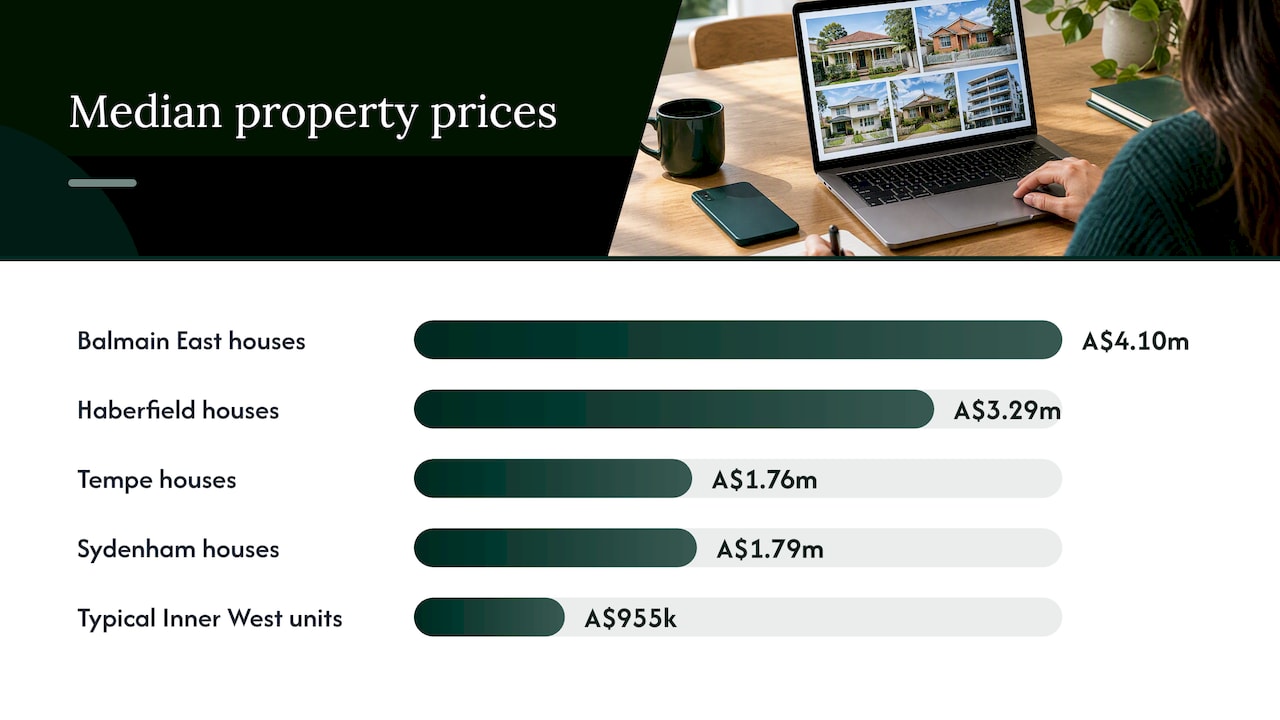
Those differences matter for auction strategy. A suburb with a tight pool of properties and a deep pool of buyers behaves differently from one where several similar homes are listed the same weekend. Neighbouring suburbs can have very different stock levels and very different results in the same month.
If you are weighing suburbs, two of our guides go into the detail:
- The Inner West suburb comparison for 2026 lines up prices, lifestyle and investment profile.
- Our look at Dulwich Hill versus Petersham shows how a short distance can mean a very large price difference.
What is driving Inner West auction results
Interest rates and buyer caution
The fall to a 46% clearance rate coincided with the fourth cash rate rise of 2026. Higher rates reduce borrowing capacity, and many buyers are also factoring in the chance of further increases. Coverage of the September market described it as “very patchy”: some homes perform well, while buyers want really good value and are anticipating what a property could be worth after a possible rate rise.
Presentation, price and competition
In a patchy market, the same suburb can produce a bidding war and a no-bid auction within a few weeks. The usual separators are:
- Realistic pricing. Homes priced to the market attract registered bidders. Overpriced ones tend to pass in.
- Condition and finish. Renovated homes with a clear story do better, but only when the price reflects the work.
- Stock levels. More listings in a suburb give buyers more choice and more patience.
- Vendor flexibility. Reserves are being lowered in some cases, which creates opportunity for buyers who show up ready.
Off-market and pre-market sales
When auctions get harder, some vendors avoid the public process altogether. Off-market and pre-market sales let a vendor test demand quietly. For buyers, that means a share of the best opportunities never reach the portals. More than 30% of the purchases we have secured for clients were off-market. Our guide to buyers agent access to off-market properties explains how that access works.
How to approach an Inner West auction in this market
- Set your limit before you inspect. Work back from your borrowing capacity, deposit and the true cost of purchase, including stamp duty and legal fees. Do not let the guide set it for you.
- Do the due diligence early. Order the building and pest inspection, and have a conveyancer review the contract, before auction day. Once the hammer falls, the sale is unconditional.
- Know the rules. NSW auctions have specific rules on deposits, bidding and cooling-off. Read our summary of the five NSW auction rules buyers must know so you do not put a deposit at risk.
- Practise the day itself. Bidding is a skill. Our guide to bidding with confidence and our note on bidder etiquette cover opening bids, pacing and body language.
- Plan for a pass-in. If bidding stalls below the reserve, be ready to negotiate straight away with a clear figure and a clear timeline. Our guide on setting an offer expiry is useful at this point.
- Consider not bidding in person. If you cannot attend, or you tend to get swept up in the moment, a representative can bid for you. Read about proxy bidding at Australian auctions.
Buying from the United States
Many American buyers are used to a very different process: negotiated offers, contingencies, and a long escrow. An Australian auction is closer to the opposite. The sale is unconditional on the fall of the hammer, a deposit is typically payable on the day, and the winning bidder signs the contract at once. That is why preparation happens before the auction, not after.
If you are relocating or investing from the US, a few practical points apply:
- Time zones. Auctions run on Saturdays in Sydney, which is Friday night or early Friday in much of the US. Plan who bids, and how, well ahead.
- Currency. Auction guides and reserves are in Australian dollars. Check your funding and exchange arrangements before you bid.
- Inspections. You will need trusted people on the ground to inspect, review reports and read the contract. Our guide to buying Sydney property sight unseen explains the process, and our 2026 guide for US buyers covers off-market and auction options.
- Reports. If a building report turns up problems, there is a method to turn them into a price reduction. See our building report negotiation packet.
For tax, visa, foreign buyer rules and lending, speak to a licensed Australian conveyancer or solicitor, a mortgage broker and a tax adviser who handles cross-border clients before you commit to a purchase.
Our view: soft markets reward prepared buyers
We only ever act for buyers, so we watch the Saturday numbers with one question in mind: where does a buyer gain leverage? A 46% clearance rate is not a warning to stay away. It is a sign that vendors are more flexible than they were a year ago, and that a careful buyer can negotiate on terms and on price.
What we see across the Inner West is that the headline rate hides a very patchy market. One house passes in with no bids, while another sells above its guide the same weekend. A buyer working alone struggles to tell the difference. We inspect seven days a week, outside the open home schedule, and we run an independent appraisal on every property so our clients know what a home is worth before the auctioneer starts.
We also treat auctions as only one route. More than 30% of the purchases we have secured were off-market, and our average purchase takes 54 days from engagement to settlement. When a vendor withdraws a property or it passes in, the buyer who already knows their limit and has their due diligence done is the one who gets the first conversation.
Our approach is to set a firm ceiling, bid or negotiate to it and not past it, and be ready with the next option. That discipline is how our clients have averaged around a 9% saving on purchase price.
Kristan
Work with a buyers agent on Inner West auctions
Sydney Property Buyers is a licensed buyers agency that represents purchasers only, never sellers. Our Complete Purchase Solution covers strategy, on-market and off-market search, independent appraisal, due diligence, negotiation, auction bidding and settlement. If you have already found a property, Negotiation Only gives you professional representation on price. We also bid at auction on your behalf.

See how each option works on our services page, look at properties we have secured for clients, or learn about buying in the Inner West. You can also call us on 1800 676 177.
FAQ
What is the current auction clearance rate in Sydney’s Inner West?
Domain publishes preliminary clearance rates for Sydney as a whole, and the Inner West sits within that figure. In early October 2026 the Sydney preliminary rate was 46%, down from 53% a few weeks earlier. Suburb-level rates swing more because fewer auctions are reported.
Is a low clearance rate good for buyers?
Often it is, because more vendors lower their reserves or negotiate after a pass-in. It does not mean every property is a bargain. Value still depends on the specific home, so independent appraisal and comparable sales matter more than the headline number.
Does the guide price tell me what a property will sell for?
No. There is no legal requirement for the reserve to match the guide, and recent results have landed both above and below guide ranges. Set your limit from comparable sales and your own budget.
Can I bid at a Sydney auction from the United States?
Yes. Buyers can bid by phone, online where the agent allows it, or through a representative. You still need your finance, contract review and building inspections completed before the auction, because a winning bid is binding.
Should I buy at auction or off-market?
It depends on the property and your timeline. Auctions are transparent but competitive and unconditional. Off-market sales can offer less competition and more flexibility. Many buyers keep both routes open.
Sources
- Sydney auctions: Abbotsford vendors cut reserve to sell waterfront home (Sydney Morning Herald, October 2026)
- Sydney auction market: no bids for renovated Rosebery house (Sydney Morning Herald, 2026)
- Sydney auctions: Upsizing family pay $2,625,000 for iconic Inner West house (Sydney Morning Herald, 2026)
- Sydney Inner West House Prices Map by Suburb (October 2026)
Recommended
- Inner West Buyers: Dulwich Hill or Petersham, $380,000 Trade Off
- Sydney inner west suburb comparison: 2026 guide
- Avoid Losing Your Deposit: 5 NSW Auction Rules Buyers Must Know
- Auction Bidder Etiquette in Sydney: A Buyer’s Guide