A guide price is the figure or range a selling agent publishes to signal where the vendor expects the property to sell. The reserve is the vendor’s confidential minimum, the price below which the auctioneer cannot sell. The two are linked but they are not the same number, and the gap between them is where most buyers get caught out. This guide explains both from a Sydney buyer’s point of view, and shows how they differ from the auction formats you may know from the United States.
TL;DR
- The guide price is public and indicative. The reserve is private and binding on the auctioneer.
- In NSW the vendor’s reserve must be given to the auctioneer in writing before the auction starts, so it is fixed before you bid.
- If bidding stops below the reserve, the property is usually passed in, and the highest bidder generally gets first chance to negotiate with the vendor.
- US auction formats (absolute, reserve, minimum bid, lender credit bids) use different rules, so do not carry US assumptions into a Sydney auction room.
- Treat the guide as a starting clue, not a budget. Set your own ceiling from comparable sales and the property’s real value to you.
Table of Contents
- What a guide price is, and what it is not
- What a reserve price is
- Guide price vs reserve at a glance
- Why the reserve stays hidden
- What happens when bids fall short
- Vendor bids and disputed bids
- How this differs from US auctions
- How to use the guide when you set your limit
- Our view: the reserve is a negotiation, not a wall
- Working with a buyers agent on auction day
- FAQ
- Sources
What a guide price is, and what it is not
In Sydney, a property listed for auction normally carries a price guide on the advertising. It may be a single figure or a range. Auction houses elsewhere describe it the same way: an indication of where the seller expects the lot to sell, and not a promise of the final price.
Three things follow from that.
- It is marketing as well as information. The agent wants enough buyers through the door to create competition. A guide that looks attractive draws crowds, and crowds create bidding.
- It can move. Agents revise guides during a campaign as feedback comes in from inspections and from buyers who have done their homework. A guide that rises over three weeks tells you something about demand.
- It is not your price. The guide tells you what the agent is saying publicly. It does not tell you what the property will make, and it does not tell you the reserve.
One UK auction house describes a guide as an indication of the seller’s minimum expectation, and says that where a single-figure guide is given, the reserve would sit within 10% above it. That is a UK convention. It is not a rule you can rely on at a Sydney auction, where agents quote guides in their own way and the vendor’s circumstances drive the reserve.
What a reserve price is
The reserve is the minimum the vendor will accept. Auction platforms in different countries define it in almost identical terms: if the top bid does not meet or exceed the reserve, the lot does not sell, even when that bidder is the highest in the room.
In NSW, the rule is specific. According to the state government, the vendor’s reserve price must be given in writing to the auctioneer before the auction begins. So by the time you register, the number exists on paper. The auctioneer does not decide it on the day, and the auctioneer cannot quietly lower it mid-auction without the vendor’s instruction.
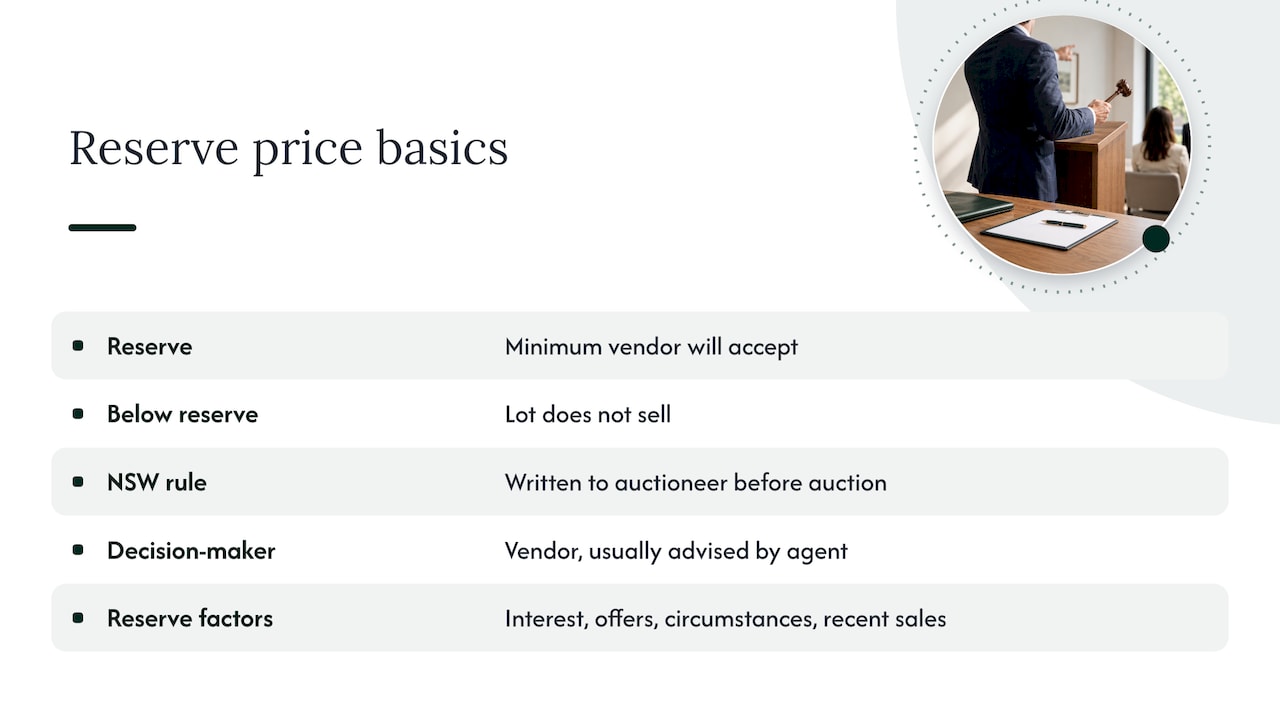
Who sets it? The vendor does, usually after advice from the selling agent. The factors vary: interest in the property, the vendor’s circumstances, whether offers came in before auction, and recent comparable sales. We cover the mechanics in more detail in our piece on the auction reserve price and how buyers can tell when it is met.
Guide price vs reserve at a glance
| Guide price | Reserve price | |
|---|---|---|
| Who sets it | Selling agent, with the vendor’s agreement | Vendor |
| Public? | Yes, in advertising | No, confidential between vendor and auctioneer |
| Binding? | No | Yes, the auctioneer cannot sell below it |
| Can it change? | Yes, during the campaign | Only on the vendor’s instruction, in writing |
| Purpose | Attract buyers and set expectations | Protect the vendor’s minimum |
| What it tells you | What the agent wants you to believe | Nothing directly, only the point where the property sells |
Why the reserve stays hidden
Buyers often ask why the reserve is not simply announced. Online auction platforms give a consistent answer. BidZoo, for one, says it hides reserves to keep auctions fair and competitive, and that a known minimum would anchor bids to that number rather than to what bidders think the item is worth.
There is a counterargument from the other side of the Pacific. Auction.com reported that among properties where the reserve was eventually met, the average number of bids rose 40% after it was met. The takeaway is that once buyers know the property will sell, they bid more freely. That is a US online foreclosure and bank-owned market, so treat it as a clue to buyer psychology rather than a Sydney statistic. In a Sydney room, the same effect shows up when the auctioneer declares the property “on the market”, which signals the reserve has been reached.
What happens when bids fall short
Here is the situation every buyer should plan for. Bidding stalls at a figure below the reserve. What now?
The NSW Government says that if bids do not meet the reserve, the property may be passed in or withdrawn, and the highest bidder generally has the first opportunity to negotiate with the vendor. In practice:
- The auctioneer pauses and the vendor’s agent speaks to the vendor.
- If the vendor is willing to move, the highest bidder may be invited to negotiate privately, often straight after the auction.
- If not, the property is passed in and may be re-marketed, sold privately later, or withdrawn.
This is the moment where a buyer agent earns their fee. Negotiating immediately after a pass-in means knowing what the property is worth to you, what the vendor is likely to accept, and when to stop. Our guide to negotiating a house price in Sydney walks through that conversation.
What if you are the only bidder?
Being the only bidder does not guarantee you a bargain. If your bid is below the reserve, the auctioneer cannot sell to you. The result is the same as above: a pass-in, with you as the highest bidder and so first in line to negotiate. If your bid meets the reserve, the property sells to you. What matters is the number you opened at and whether you are willing to move toward the vendor’s real minimum.
Vendor bids and disputed bids
Two other rules shape how the reserve plays out on the day. In NSW, the auctioneer may make one bid on behalf of the seller, and must announce it as a vendor bid. It is a single, declared bid, not a series of invisible ones. And if a bid is disputed, the same source says the auctioneer is the sole arbitrator and makes the final decision.
If you want to see how conduct at auction is regulated from the agent’s side, this explainer on vendor bids and auction conduct gives a useful picture of what agents must handle on the day. For your own preparation, our short list of five NSW auction rules buyers must know covers deposit and contract points, and how to register to bid covers what to bring.
How this differs from US auctions
Many readers searching this topic arrive from a US background, where “auction” can mean an online sale, a foreclosure sale or an estate auction. The same words mean different things.
- Absolute auctions. The National Association of Realtors describes these as sales to the highest bidder regardless of price, with no minimum. Sydney’s equivalent is rare: most Sydney auctions are with reserve.
- Reserve auctions on online platforms. On Auction.com, if bidding stalls below the reserve, the seller may still consider the highest bid for approval, and the system may place a seller counter bid that shows in the bidding history. A Sydney vendor bid is one declared bid called by the auctioneer, so the practice is narrower.
- Lender credit bids. In foreclosure scenarios, a credit bid acts as a minimum threshold set by the lender that bidders must beat to win. That is a mortgagee-driven structure and works differently from a typical Sydney private-vendor campaign.
- Guide prices. US listings carry a list price, not an auction guide. The nearest idea is a published opening or minimum bid. A Sydney guide is looser and more tactical.
The practical point: in a Sydney room, the sale is conducted live, on the day, with unconditional contracts, so you must have your finance, building checks and legal review done beforehand. Our piece on auction bidding increments for overseas buyers and the one on auction deposits cover the parts that surprise newcomers most.
How to use the guide when you set your limit
A guide is useful if you read it as one data point. Here is the method we recommend.
- Build your own value. Collect recent comparable sales in the same street or pocket, adjusted for condition, land size, aspect and renovation. This gives you a figure that does not depend on the agent.
- Compare it to the guide. If the guide sits well below your comparable-based value, the vendor’s reserve is probably above the guide. Expect to bid beyond it, or to find the property passes in.
- Track the campaign. Note whether the guide has risen, how many groups attend inspections, and whether the agent mentions offers. A rising guide and crowded inspections point to a strong auction.
- Set a ceiling and write it down. Decide your maximum bid before the day, including stamp duty and costs. Emotion at auction is real and a written limit helps.
- Plan for a pass-in. Decide what you would offer if the property fails to reach the reserve and you are the highest bidder. That is often where the best deals are done.
Bidding technique matters too. Jumping in with large increments can burn your budget quickly, which we explain in our beginner guide to auction bidding, and our article on how to bid with confidence at a Sydney auction covers opening bids, pacing and body language. If the vendor is open to it, a pre-auction offer can also work; see how to be contract ready for pre-auction offers.
Our view: the reserve is a negotiation, not a wall
We act only for buyers, never sellers, so we see the reserve from one side of the table. After more than 100 properties secured for clients, here is what we have learned about it.
First, the reserve is rarely as rigid as it looks from the back of the room. It is fixed in writing before the auction, but the vendor’s willingness to sell on the day depends on what the room delivers. A vendor who sees a single serious bidder only a little under their number will often move. That is why we prepare every client for the pass-in as carefully as for the bidding.
Second, the guide is a signal about the agent’s strategy, not about value. We form our own appraisal independently, then compare it to the guide. When the two diverge, we ask why, and the answer shapes our advice on whether to chase the property at auction, make a pre-auction offer, or walk away.
Third, a large share of good purchases never reach an auction at all. More than 30% of our purchases were secured off-market, where there is no guide and no reserve to decode, only a negotiation. Across our purchases, clients have saved around 9% on average against the purchase price, and the average time from engagement to settlement is 54 days. Those figures come from our own client records, and each purchase is different.
We also inspect properties seven days a week, independent of open home times, so we can assess a property, and the interest around it, before the campaign peaks.
— Kristan
Working with a buyers agent on auction day
If you are comfortable doing your own research but nervous about the room, our Auction Bidding service puts an experienced bidder at the front on your behalf, working to the limit you set. If you have a property in mind and want help with price and terms, our Negotiation Only option covers that. For buyers who want the whole journey, from strategy and search, on and off market, to due diligence and settlement, the Complete Purchase Solution covers it end to end.

You can see how each works on our services page, browse recent purchases, or call us on 1800 676 177. We are a licensed Sydney buyers agency (NSW Licence 20456819) based in Petersham, working across the Inner West, Eastern Suburbs, Lower North Shore and Eastern Beaches.
FAQ
What is a reserve price?
It is the minimum the vendor will accept for the property at auction. It is kept confidential between the vendor and the auctioneer. If bidding does not reach it, the property cannot be sold on the day at the bid price.
Is the guide price the same as the reserve?
No. The guide is a public, indicative figure set by the agent. The reserve is the vendor’s private minimum. They are often close, but the guide can be below, at or occasionally above where the reserve ends up, and agents revise guides during a campaign.
What happens if the highest bid does not reach the reserve?
The property is typically passed in or withdrawn. According to the NSW Government, the highest bidder generally has the first opportunity to negotiate with the vendor. That negotiation often happens straight after the auction.
Can the auctioneer bid for the seller?
In NSW, yes, but only once, and the auctioneer must announce it as a vendor bid. Any other bidding by or for the vendor is not allowed under the NSW rules described by the government. If you suspect a problem, raise it with the auctioneer, who decides disputed bids.
Do US auction rules apply in Sydney?
No. US formats such as absolute auctions, online reserve auctions and lender credit bids work differently. In Sydney, auctions are live, usually with reserve, and contracts are unconditional on the fall of the hammer, so your checks must be finished beforehand.
Sources
- Buying property at an auction, NSW Government
- Guide price vs reserve price: what’s the difference?, Lotwick
- The guide price, EIG Property Auctions
- What is a reserve price, and how does it affect my bid?, Auctim
- Why are reserve prices hidden?, BidZoo
- The Power of Reserve Met, Auction.com
- Bidding at Auctions, Auction.com Help Center
- Types of Auctions, National Association of Realtors
- Auction AML checks for Australian agents, AML Guard
Recommended
- Auction Bidder Etiquette in Sydney: A Buyer’s Guide
- Avoid Losing Your Deposit: 5 NSW Auction Rules Buyers Must Know
- Sydney property auction bidding: how to bid with confidence
- Auction Reserve Price: How Buyers and Sellers Tell When It’s Met