A semi-detached house shares one wall with a single neighbour. A terrace shares walls with neighbours on one or both sides, as part of a continuous row. In US terms, a Sydney terrace is closest to a row house or townhouse, and a Sydney semi is closest to a side-by-side duplex. The better buy depends on how much space, privacy and renovation freedom you want, and on what the title and the shared wall allow. We are a Sydney buyers agency, and we work through those checks with buyers before they commit.
TL;DR
- Semi: one shared wall, usually a side passage or driveway on the other side, and often a bit more room to extend.
- Terrace: a row of attached houses, often period-era, with courtyards or small gardens, and a stronger heritage character.
- US translation: terrace is roughly row house or townhouse. Sydney semi is roughly a side-by-side duplex, though most are sold as two separate homes.
- The shared wall matters most: it carries legal obligations to your neighbour, and it can limit what you build.
- Before you bid: confirm the title type, easements and any heritage overlay. Do this before you are locked in.
Table of Contents
- What the two terms mean in Sydney
- Translating Sydney terms into US terms
- Title: the part that surprises US buyers
- The party wall, in plain terms
- Heritage and renovation limits
- Semi or terrace: how they compare day to day
- What to check before you bid
- Buying from the US
- How we can help
- FAQ
- Sources
What the two terms mean in Sydney
The words are used loosely in listings, so start with the definitions that planners and housing guides use.
NSW Planning, the state’s planning department, describes a semi-detached dual occupancy as two dwellings on one lot sharing a common wall. It describes terraces as dwellings attached side by side in a row, each with front access to a primary road. That is the same thing the US calls row housing.
Domain, an Australian property portal, describes a semi-detached home as a single dwelling sharing one common wall with the house next door. It says semis were once the poor cousin of the freestanding house and are now often a more affordable option, with a smaller footprint and a backyard that may double as off-street parking. It also notes that many semis from around Federation (the early 1900s) have been updated while keeping their period features.
| Semi-detached | Terrace | |
|---|---|---|
| Shared walls | One | One or two, within a row |
| Typical look | Often a mirror-image pair | Uniform row, often Victorian or Edwardian |
| Outdoor space | Side access and a backyard, sometimes with parking | Front and rear garden or courtyard, usually compact |
| Storeys | Commonly one or two | One to four |
| Title | Usually its own title | Usually its own title in older rows, sometimes strata in newer ones |
Terraces range from one to four storeys and often have two to four bedrooms, according to Domain’s guide to house types.
Translating Sydney terms into US terms
US readers often get lost on vocabulary first. Here is the practical map.
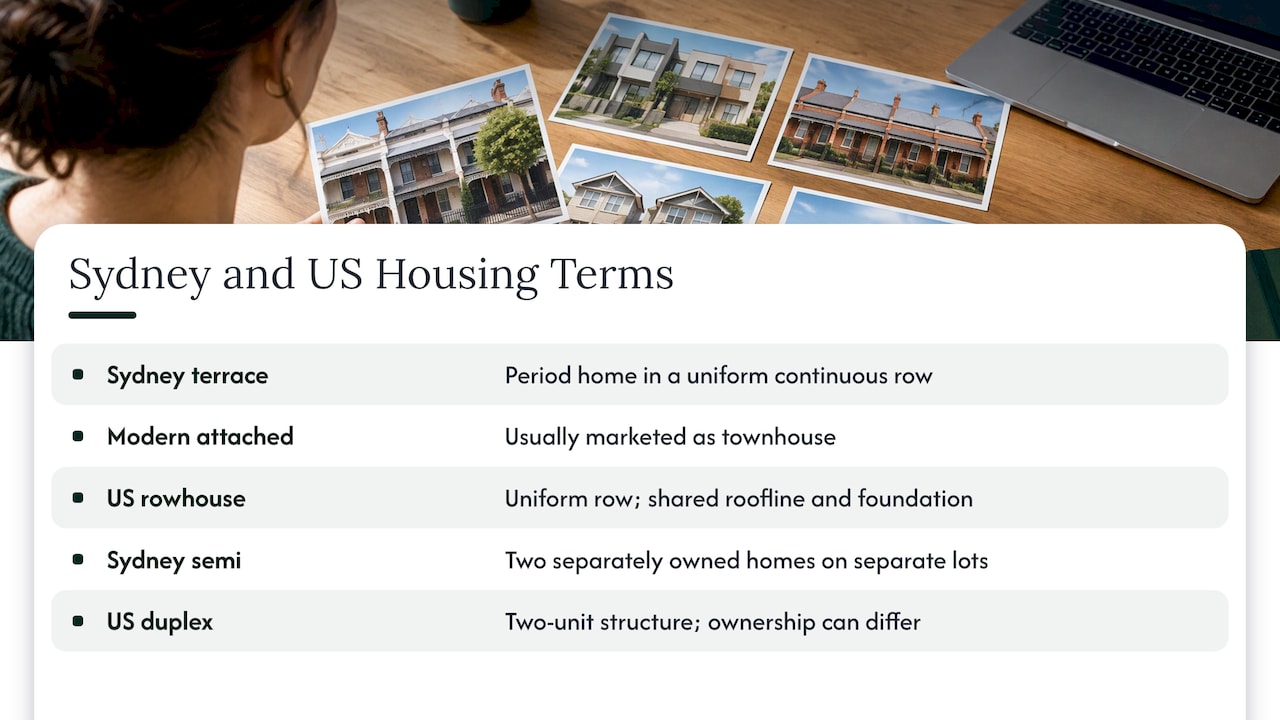
Terrace. In Australia, “terrace house” is a style of home built as part of a continuous row in a uniform style, popular in the late 1800s and early 1900s. Modern equivalents are generally called townhouses. So a Sydney terrace is usually a period home in an older inner-city suburb, such as Paddington, Newtown or Balmain. A new-build attached home in the same suburb is more likely to be marketed as a townhouse.
Row house and townhouse. The US Census Bureau defines a row or townhouse as an inner unit with two walls in common and a private ground-level entrance, and an end unit as one sharing only one common wall. Architectural Digest notes that rowhouses are a subset of townhouses forming a uniform row that shares a roofline and foundation. If you know Philadelphia, Baltimore or San Francisco’s Painted Ladies, you already have the right picture of a Sydney terrace.
Semi and duplex. The Census Bureau’s duplex definition is a two-unit structure. A Sydney semi looks like that from the street, but the legal arrangement is often different. Many semis are two separately owned houses on two separate lots, closer to a pair of attached single-family homes than to a US duplex owned by one landlord. Always check how the pair is titled. Our guide to duplex vs townhouse in Sydney covers the overlap in more detail.
An end terrace shares only one wall, like a US end-of-row unit. That makes it feel closer to a semi, with better light and often side access.
There is one more difference. US townhouses commonly come with a homeowners association. Many Sydney attached homes have no such body. Where there is one, it is a strata scheme, which we explain further below.
Title: the part that surprises US buyers
Most older Sydney semis and terraces are sold under Torrens title, the state register of land ownership. In practice it is freehold: you own the house and the land it stands on, with no body corporate (the Australian term for the owners’ body in a shared scheme) and no levies.
Newer developments, and some conversions, can be strata-titled instead. Under strata you own the inside of your unit plus a shared interest in common areas, pay regular strata levies, and have less freedom to renovate, as Contract Conveyancing explains. If you are weighing that route, see our explainer on how strata schemes work.
A separate Torrens title does not make the building independent. ConveyDirect’s guide to buying a semi or terrace makes the point that the party wall is relied on by both properties for structural support. A conveyancer, the licensed professional who handles the legal side of an Australian property purchase, should confirm the title type, easements and any heritage overlay before you commit. That is the right call here.
The party wall, in plain terms
The shared wall is the defining feature of both house types. The City of Sydney’s guidance on party walls says a party wall straddles two parcels of land, with the boundary running vertically through it. Each owner owns their side up to the boundary, each building is entitled to support from the whole wall, and the wall is protected by cross easements that benefit and burden both owners.
An easement is a legal right over land that stays with the property, not the owner. For a buyer, the consequences are concrete:
- You cannot simply knock the wall down or cut large openings in it. An easement prohibits alterations that damage neighbouring houses, as Contract Conveyancing notes.
- Where works involve the party wall, the City of Sydney typically imposes conditions that the works stay within your boundary. It also typically requires a dilapidation survey and a structural engineer’s certificate on the wall’s stability.
- The same guidance encourages getting the neighbour’s consent before lodging a development application.
A dilapidation survey is a recorded inspection of the neighbouring building’s condition before work starts. It protects both sides if cracks appear later.
The party wall also affects day-to-day life. Both house types share a wall, but a terrace in a long row may share two. If noise is a concern, ask for a second inspection at a different time of day, such as a weekday evening or a weekend morning.
Heritage and renovation limits
Period terraces often sit in heritage conservation areas or carry heritage overlays. ConveyDirect notes that heritage rules can limit changes to the street-facing elevation, materials or colour scheme. The back of the house usually has more scope, but the shared wall and heritage controls can compound each other. Title Finder advises confirming that council overlays don’t add to easement limits before exchange of contracts.
What counts as a dwelling, and what you can build, also changes between councils. A town planner quoted by Domain says dwelling definitions change from state to state and council to council. Check with the local council about what you are buying and what you can develop.
US buyers will recognise the pattern. Attached housing in historic US districts is also governed by local rules, and a DC rowhouse ownership guide shows how much the local rules can shape what a rowhouse owner can do. In Sydney, the equivalent rules are set by the council, so the same terrace type can behave differently in different suburbs.
Semi or terrace: how they compare day to day
Space and light. A semi usually has a side boundary with a passage or driveway, so you get windows and light on one full side. A terrace in the middle of a row has light only at the front and back. That is why period terraces are often built deep, with courtyards or skylights.
Parking. Domain notes a semi’s backyard may double as off-street parking. Many inner-city terraces were built before cars and rely on street parking, so check permit rules in the street you like.
Price and running costs. Semis are often described as having lower entry prices than detached houses and no levies, unlike townhouses and villas in strata. They also need less maintenance than a freestanding house, according to Domus Homes. Terraces in sought-after inner suburbs are priced for location and character, not size. Compare on a price per square metre of land and floor area, not on the type label.
Renovation freedom. A semi generally gives you more room to extend sideways or rearwards. A terrace gives you less, because of the row, the heritage controls and the shared walls. If you plan a major renovation, price the approvals and the neighbour process into your budget.
Location. Semis are commonly found close to the city and beaches in the Eastern Suburbs, the Lower North Shore and the Inner West, Domus Homes says. Our Inner West suburb comparison is a useful place to start narrowing down streets.
Which suits whom.
| If you want | Lean toward |
|---|---|
| More light, side access, parking potential | Semi |
| Period character and a walkable inner-city street | Terrace |
| Room to extend with fewer constraints | Semi |
| A low-maintenance base in a lock-up-and-leave location | Either, in a well-run row or pair |
| Strong rental appeal | End terrace or semi, where you can show separate access and light |
For an investor, the choice also comes down to capital growth potential and rental yield for the specific street, not the type alone. We analyse both when we assess a property.
What to check before you bid
This is the routine we would run for either type. Each step is a place where an overseas buyer is most likely to miss something.
- Confirm the title. Get a current title search and the survey plan, and see whether the property is burdened or benefited by easements. Title Finder advises that buyers obtain the deposited or strata plan and check the depth and width of service easements, not only scan for the word easement. Our six-step easement checklist walks through it.
- Check the party wall. Look for cracks, damp, past patching and signs of work by either side. Ask whether any alterations have been made and with what consent.
- Check heritage and zoning. Confirm any overlay with the council before you assume you can change the facade, roof or colours.
- Order inspections. A building and pest report is standard. For how to use the findings to negotiate, see our building report negotiation guide.
- Run due diligence inside the cooling-off window. Our due diligence checklist sets out what to complete before the window closes.
- Know how it will be sold. Many Sydney semis and terraces go to auction. Read our guide to Sydney auction bidding before you pick a bidding plan.
The legal checks above belong to your conveyancer or solicitor. The title, easement and contract review is theirs to do, and we work alongside them.
Buying from the US
Buying from overseas adds one more layer: you cannot attend every open home. Our guide for US buyers purchasing sight unseen covers how that works. Because we inspect properties seven days a week, independent of open home schedules, a buyer abroad does not depend on a Saturday viewing slot.
Our view
Most buyers ask whether a semi or a terrace is the better house. We think the better question is which one has the cleaner title, the more workable wall and the fairer price on its street.
A semi can be a very good buy: more light, often room to grow, and no levies. A terrace can be the best street in the suburb. Either can also hide an awkward easement, a tired party wall or a heritage constraint that changes what you can do with it. The type label tells you very little. The title, the wall and the council overlay tell you a lot.
That is why we run due diligence and a independent appraisal on every purchase, and why we look at capital growth and rental yield together. We also find that the most competitive homes often never reach the portals: more than 30% of our purchases are secured off-market. For a sought-after Inner West or Eastern Suburbs terrace, early access can matter as much as negotiation.
Our clients have saved about 9% on average against the purchase price, and the average time from engagement to settlement is 54 days. Both come from handling the search, the checks and the negotiation as one process.
Kristan
How we can help
Sydney Property Buyers is a licensed Sydney buyers agency (NSW Licence 20456819) that acts for buyers only, never sellers. Our Complete Purchase Solution covers strategy, on-market and off-market search, independent appraisal, due diligence, negotiation, auction bidding and settlement. If you have already found the house, Negotiation Only gives you professional representation on price. We act across the Inner West, Eastern Suburbs, Lower North Shore and Eastern Beaches.

See our services, or talk to us about a semi or terrace purchase.
FAQ
What is the key difference between a semi-detached and a terrace house?
A semi shares one wall with one neighbour. A terrace is part of a continuous row and shares walls with neighbours on one or both sides. Terraces also tend to be older, with more heritage character, and semis often have side access and more room to extend.
What is a terrace called in America?
In the US, a terrace house is generally called a townhouse or, in older cities, a row house. The US Census Bureau describes a row or townhouse as a unit with a private ground-level entrance and walls in common with its neighbours.
Is a terrace house the same as a townhouse?
Often, but not always. In Australia, “terrace” usually means a Victorian or Edwardian-era row home, while newer attached homes are generally called townhouses. Townhouses are also more likely to be strata-titled, which brings levies and by-laws. Our villa vs townhouse guide explains the difference.
Can I renovate a semi or terrace in Sydney?
Yes, within limits. Works that involve the party wall usually need your neighbour’s consent and sometimes a dilapidation survey and engineer’s certificate. Heritage controls can also restrict changes to the street-facing side, as the City of Sydney’s party wall guidance explains. Check the council’s rules for the specific property before you buy.
Sources
- Unpacking low-rise housing, NSW Planning
- House types explained, Domain
- What is a terrace house in Australia, Domain
- General Housing Characteristics, US Census Bureau
- What Is a Townhouse, Architectural Digest
- Torrens title, strata title and other land titles, Contract Conveyancing
- Buying a Semi-Detached or Terrace House, ConveyDirect
- Party walls, City of Sydney
- Easements on NSW Property Titles, Title Finder
- House vs Townhouse vs Duplex Explained, Domus Homes
Recommended
- Duplex vs Townhouse in Sydney: Which Should You Buy?
- Villa vs Townhouse: What the Difference Means in Sydney
- Eastern Suburbs Rental Demand: What US Buyers Should Know
- Inner West Property Guide: Suburbs, Prices and Buying Rules