In Sydney, a duplex is two homes on one lot, usually with no body corporate, while a townhouse is one of three or more homes in a complex, usually under strata with levies. The duplex generally gives you more land and control. The townhouse generally gives you a lower entry price and less upkeep. Which is better depends on your budget, your plans for the land and how much shared ownership you can live with.
This guide is written for buyers weighing the two in Sydney, including US buyers whose idea of these words is slightly different. We cover how NSW defines each type, how title works, what it costs, how rent and growth compare and what to check before you sign.
TL;DR
- A duplex (dual occupancy) is two dwellings on one lot. A townhouse is one of three or more dwellings on a lot, usually with shared common property.
- A duplex often sits on Torrens title, so you own the land outright and avoid strata levies. Townhouses are more often strata-titled.
- Townhouses usually cost less to buy than a house. Duplexes can cost more but give you a bigger land share and two incomes.
- Land drives long-run growth in Sydney, so the land share of either type matters more than the label.
- Read the strata records, planning controls and title before you bid. This is where most surprises hide.
Table of Contents
- The difference at a glance
- How NSW defines each type
- Title and ownership: Torrens or strata
- If you are a US buyer: the same words mean different things
- What each costs to buy and hold
- Rent, yield and growth
- Which suits which buyer
- Our perspective
- Checks before you make an offer
- Work with a buyers agent on your Sydney purchase
- FAQ
- Sources
The difference at a glance
| Duplex | Townhouse | |
|---|---|---|
| Number of dwellings on the lot | Two | Three or more |
| Typical title in NSW | Often Torrens, sometimes strata | Often strata |
| Shared common property | Usually little or none | Usually driveways, gardens, services |
| Body corporate (owners corporation) levies | Often none | Usual |
| Land share | Typically larger | Typically smaller |
| Planning pathway for builders | Often faster | Usually a full development application |
These are tendencies, not rules. Title and layout decide what you actually own, so every individual property needs checking.
How NSW defines each type
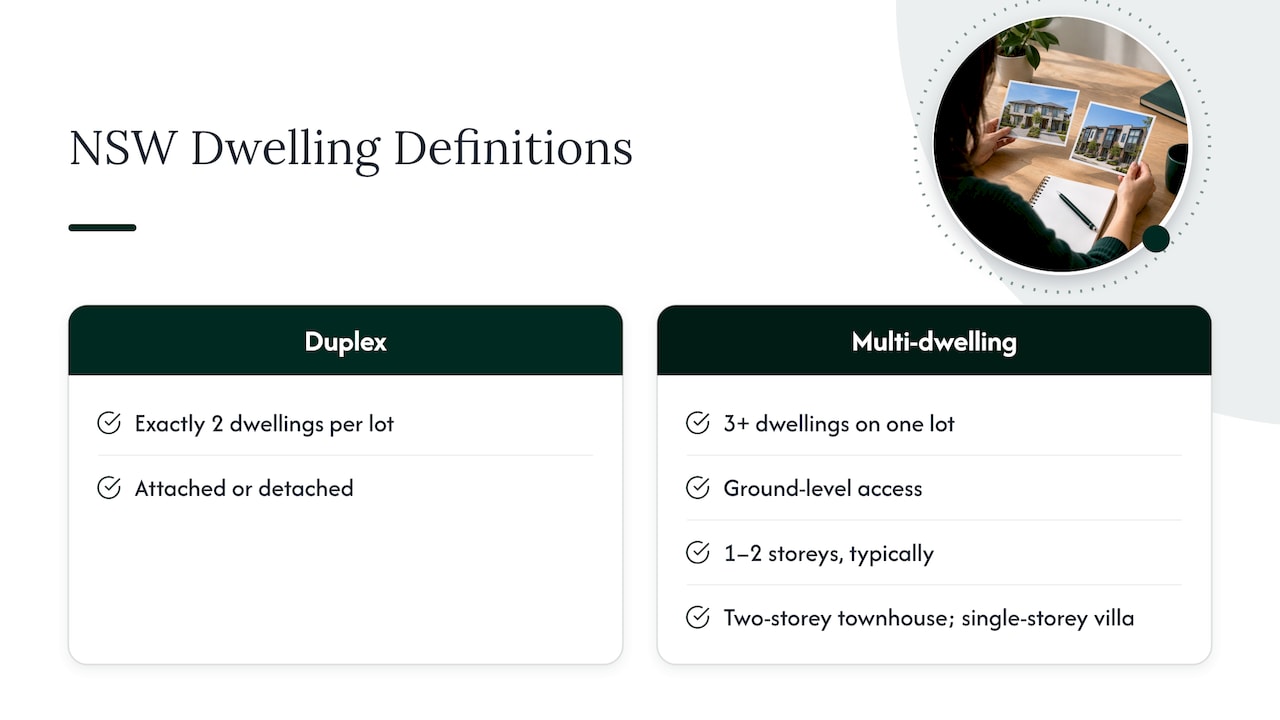
NSW Planning describes multi-dwelling housing, the planning category that covers townhouses, as three or more dwellings on one lot, each with access at ground level. They are typically one to two storeys and arranged around an internal street or lane. Two-storey forms are called townhouses and single-storey forms are called villas.
A duplex is a dual occupancy: exactly two dwellings on one lot, either attached by a common wall or detached from each other. One builder’s guide notes it is permitted in R2 Low Density and R3 Medium Density zones in most Western Sydney councils, with a typical minimum lot size of 450 to 600 sqm. Councils differ, so treat that as a starting point.
Planning rules have also been moving. The July 2024 Low and Mid-Rise Housing reforms expanded where townhouse-style development can happen in NSW, but implementation varies by council. If you are buying a block next to a house that might one day become a townhouse complex, check the current controls for that street.
Duplex, semi-detached and dual occupancy
You will see these terms used loosely in listings. A semi-detached home is typically one half of an attached pair. A duplex is the building or the pair as a whole, and in NSW the formal term is dual occupancy. If an advertisement says duplex, ask whether you are buying one half or the whole building, because that changes the price, the title and the finance.
Title and ownership: Torrens or strata
This is the real dividing line between the two types, more than the number of front doors.
Torrens title means you own your lot and the building on it outright. Strata title means you own a lot within a scheme and share common property with other owners through an owners corporation. Our guide to what a strata scheme is walks through how that works in NSW.
In Victoria, a duplex can be Torrens-titled with each dwelling on its own lot and no shared common property, or it can sit under an owners corporation. Townhouse developments of three or more dwellings almost always involve shared common property and are typically subdivided with an owners corporation. NSW uses its own legislation and terms, but the pattern is similar: the more shared driveways and services, the more likely strata is involved.
Three practical consequences follow:
- Control. With Torrens title you decide on repairs, renovations and insurance for your own lot, within council rules. In a strata scheme, decisions on common property go to the committee and the owners.
- Rules. Strata schemes have by-laws covering pets, noise, renovations and parking. Read our summary of strata by-laws in NSW before assuming you can do what you like.
- Whole-property purchase. If a Torrens duplex is sold as a single property, you buy both dwellings together. One Australian finance guide says finance is then assessed on the whole value, with rent from the dwelling you do not live in typically counted at 70 to 80% toward borrowing capacity. Lenders set their own policies, so confirm yours with a broker.
If you are a US buyer: the same words mean different things
Many of our clients are Americans buying in Sydney, and the vocabulary trips them up. In the US, a duplex is a single building with two units, each with its own entrance, kitchen and bathroom, on one parcel with one owner. That is close to the Australian meaning.
The townhouse is where it diverges. In the US, a townhouse is typically a row of three or more separately owned homes, each on its own lot, and the owner holds title to the lot and the structure. Communities are often run by a homeowners association, and its scope varies widely, from minimal to nearly condo-level.
In Sydney, a townhouse is more often strata-titled, so expect an owners corporation and levies rather than a US-style HOA. The levy pays for shared insurance, maintenance and a sinking fund. That is why strata documents are central to a Sydney townhouse purchase. Our article on strata levies and property value is written for exactly this transition.
What each costs to buy and hold
Prices vary by suburb and condition, so use these as orientation only. One builder’s guide published in October 2025 puts Sydney’s median house price at $1.49 million and the median townhouse at $855,000 to $868,000. The same guide gives a range of $800,000 to $1.4 million to build a new duplex, and strata fees for a townhouse of $400 to $1,000 per quarter.
The table below shows how that translates into holding costs.
| Cost | Duplex | Townhouse |
|---|---|---|
| Purchase price | Usually between townhouse and house, depending on land | Usually lower than a house |
| Strata or body corporate levies | Often none on Torrens title | Typically yes |
| Building insurance | Your own policy | Usually part of the levy |
| Repairs | You pay and arrange them | Common property repairs funded by the scheme |
| Special levies | Not applicable on Torrens title | Possible if the scheme needs major works |
Deposit and lenders mortgage insurance
Australian lenders generally treat a 20% deposit as the clean path on an investment loan, avoiding lenders mortgage insurance. A broker’s guide says a 10 to 15% deposit is achievable with LMI, which it puts at $6,000 to $15,000 or more on a $560,000 loan. Our article on what Sydney house deposits buy puts the numbers in a Sydney context.
If you are buying a townhouse, add the cost of a strata report. We break that down in what a strata report costs in Sydney.
Rent, yield and growth
Both types can work for investors, but they earn their return differently.
A duplex, a building containing two houses typically on the same title, can provide higher rental income from two units and lower fees than townhouses and units, with no body corporate. Townhouses may offer good rental yields and lower maintenance than a house, but body corporate fees can be higher and capital growth is usually not as strong as for a house.
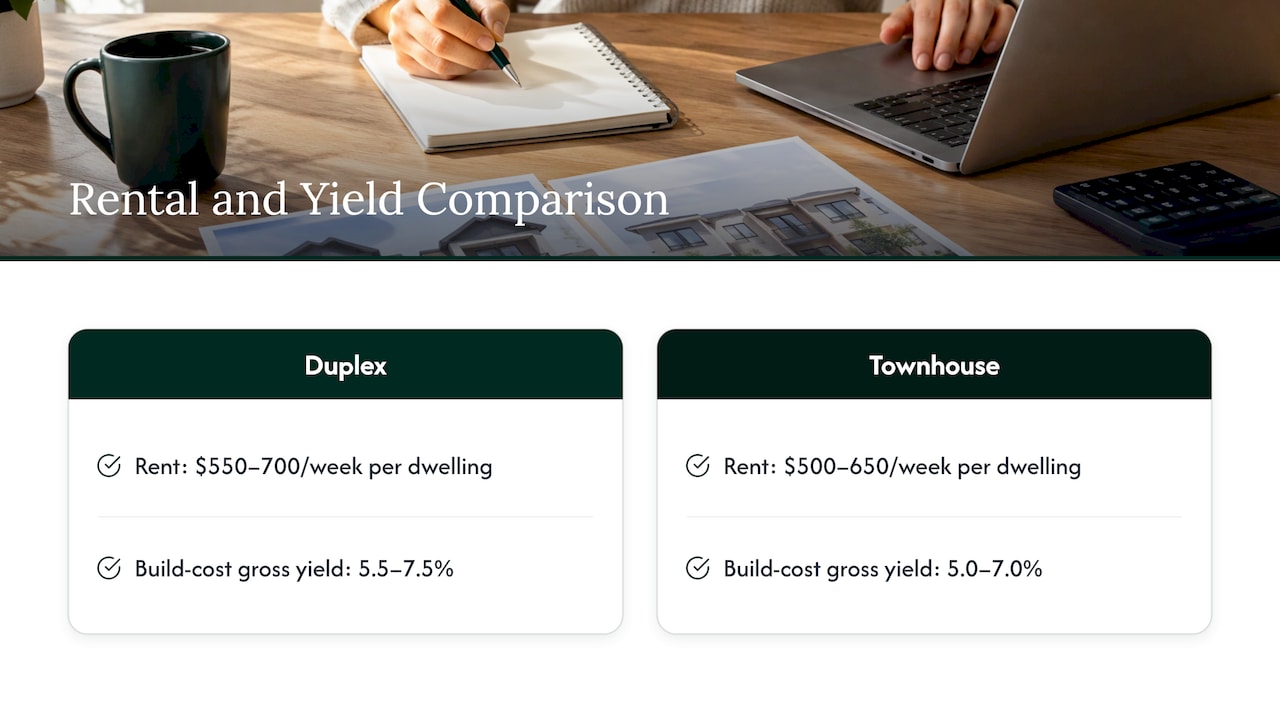
On the numbers, a Western Sydney builder comparison for 2026 reports a three-bedroom duplex renting for $550 to $700 a week per dwelling, against $500 to $650 for a townhouse. Its gross yields on construction cost are 5.5 to 7.5% and 5.0 to 7.0%. Those are build-to-rent figures on development cost. A different Sydney guide says a completed duplex on a well-located block typically yields 3.5 to 4.5% gross across both dwellings. The gap between the two shows why you should calculate yield on the price you actually pay, not on a headline figure.
Growth comes from the land
Over the long run, the land under a property appreciates while the building slowly depreciates. Analysts at one Australian property site say houses sit on the most land and have historically grown strongest, with townhouses and villas that have a meaningful land share tending to outperform apartments. One builder’s analysis claims Torrens title carries a 12 to 18% premium over strata for the same internal floor area in Sydney. Treat that as one estimate, but the direction is consistent: more land and cleaner title tend to be valued more highly.
This is why a townhouse on a large lot in a strong suburb can beat a cramped duplex on a weak one. If you are choosing between areas, our inner west suburb comparison and our guide to researching Sydney suburbs show what to compare.
Does the 1% rule work in Sydney?
In the US, the 1% rule says combined monthly rent from both duplex units should be about 1% of the purchase price. It is a fast screening tool, not a substitute for proper underwriting. In Sydney, the rule rarely applies. One Australian analysis puts Sydney’s gross yield for houses at around 2.8%, well below the 12% annual target the rule implies. Sydney investors usually buy for growth and accept a lower yield, so run your own cashflow with your actual loan rate and costs.
When you fit out a rental, durable finishes matter in either type. If you are planning a refresh, a guide to kitchen cabinets for rental properties shows how material choice affects long-term wear.
Which suits which buyer
Choose a duplex if you want more land, no levies and control over your own lot. It also suits families wanting multi-generational living or two incomes, and one Australian guide notes buyers often get a decent land share at a lower price than a full house. Be ready for the full upkeep bill and a larger purchase if you are buying both dwellings.
Choose a townhouse if you want a lower entry price, less maintenance and a neighbourhood with a shared structure. It suits first-home buyers, downsizers and lock-up-and-leave investors who accept levies and by-laws in return for convenience.
Be careful with either type if the title is unclear, the land share is small or the scheme is under-funded. Those are the cases where a label hides the real risk.
Our perspective
We buy for clients in the Inner West, Eastern Suburbs, Lower North Shore and Eastern Beaches, and we are asked about duplex versus townhouse constantly. Our answer is that the label matters less than the title, the land and the paperwork behind it.
A well-located duplex on Torrens title can behave like a house: strong land value, no levies and flexibility. A townhouse in a well-run scheme can be a smart, affordable way into a premium suburb. A poorly run scheme or a thin land share can undo either advantage.
That is why we look at capital growth potential and rental yield together, commission an independent appraisal and read the strata records before a client commits. Our inspections run seven days a week, so clients are not limited to open home times, and more than 30% of our purchases have been secured off-market, where competition is thinner and negotiation is calmer.
If you have found a property and want a firm negotiator, we can act on that alone. If you want us to run the whole search, we handle strategy through to settlement.
Kristan
Checks before you make an offer
- Confirm the title. Ask your conveyancer or solicitor whether it is Torrens or strata, and what is shared.
- Read the strata records. Minutes, financials, sinking fund and any proposed special levies show how the scheme is run. See why a buyer’s agent checks strata records.
- Check planning controls. Council zoning and the recent reforms can change what can be built next door.
- Order building and pest reports. Use findings to adjust your price. Our building report negotiation packet shows how.
- Plan your bidding. If the property is going to auction, review auction bidding increments and auction deposit expectations beforehand.
If you are buying a strata property in another state, rules differ. In Queensland, for example, a disclosure statement with the body corporate’s financials, levies and insurance should be attached to the contract, according to a professional property guide. In NSW, ask your solicitor which documents you need.
Work with a buyers agent on your Sydney purchase
Sydney Property Buyers is a licensed buyers agency that represents purchasers only, never sellers. Our Complete Purchase Solution and auction bidding cover strategy, on-market and off-market search, independent appraisal, due diligence, negotiation and settlement. Our clients have averaged 54 days from engagement to settlement.
Already found a duplex or townhouse? Our Negotiation Only service puts a licensed negotiator on your side. To see the kinds of properties we secure, browse our recent purchases or call 1800 676 177.
FAQ
What is the difference between a townhouse and a duplex?
A duplex is two dwellings on one lot, attached or detached. A townhouse is one of three or more dwellings on a lot, each with ground-level access. In Sydney, duplexes are more often on Torrens title and townhouses more often under strata.
Is a duplex or a townhouse a better investment in Sydney?
Neither wins every time. A duplex on Torrens title with a strong land share can offer two rents and no levies. A townhouse can cost less to enter and be easier to hold. Compare the land share, the title and the net yield on your purchase price.
Do townhouses have strata fees in Sydney?
Most do, as they typically share common property. One builder’s guide cites $400 to $1,000 per quarter in Sydney. Always read the scheme’s financials and any planned works before you buy.
Is a duplex the same as a semi-detached home?
They overlap. A semi-detached home is typically one half of an attached pair, while a duplex is the two-dwelling building or pair as a whole. Check what the contract actually sells you.
Does the US 1% rule apply to Sydney property?
Not usefully. Sydney gross yields sit well below the level the rule implies, so investors typically weigh growth and run a cashflow forecast instead of relying on that screen.
Sources
- Unpacking low-rise housing, NSW Planning
- Duplex vs Townhouse Development in Sydney
- Townhouse vs Duplex Investment 2026
- Torrens Title vs Strata Title for a Duplex or Townhouse
- Buying a Duplex in Australia
- What Is a Duplex? Definition, Pros and Cons vs Townhouse
- Condo vs Townhouse HOA: Key Differences for Buyers
- What Is a Duplex? A Complete Guide
- Investment Property Loans Australia guide
- Investment property types compared
- Builders of Duplex Homes Sydney guide
- House vs Townhouse vs Unit vs Apartment
- What Is the 1% Rule for Duplex Investing
- One Percent Rule in Australian Property
- Australian Property Guide, July 2024
- Kitchen cabinets for rental properties that last
Recommended
- Inner West Buyers: Dulwich Hill or Petersham, $380,000 Trade Off
- Sydney inner west suburb comparison: 2026 guide
- $70 a Week: Newtown vs Marrickville, Inner West buyers agent tips
- How to research Sydney suburbs property in 2026