A reserve price is the minimum amount a seller will accept for a property at auction, agreed privately with the auction house before bidding starts. The property cannot sell under the hammer until bidding reaches that figure. For buyers, this means the highest bid on the day doesn’t guarantee a sale. For sellers, it’s the floor protecting them from an underpriced result.
TL;DR:
- Bidders should monitor auction increments closely, as bids typically increase in smaller amounts near the reserve, signaling the minimum price needed for sale.
- The “on the market” declaration is crucial, as it indicates the seller is legally bound to sell to the highest bidder once the reserve is met.
- Buyers can bid below the reserve, but their highest bid only becomes binding if the reserve price is ultimately reached during bidding.
- Sellers often review and may adjust the reserve in the final days before auction, based on open inspection demand and contract interest.
- If the auction passes in without meeting the reserve, the highest bidder usually has the first opportunity to negotiate privately with the seller.
Table of Contents
- How a reserve price is set and revealed during bidding
- Reserve price versus guide price versus no-reserve auctions
- What buyers should do about the reserve
- How sellers should approach setting a reserve
- Reading the room: a buyers agent’s take on reserve signals
- Where to check the rules yourself
- Sources
How a reserve price is set and revealed during bidding
The vendor sets the reserve, usually on the advice of their selling agent, and it’s typically locked in shortly before auction day once the campaign has run its course and buyer interest is clearer. It stays confidential. Bidders don’t get told the number, and in most cases neither does the auctioneer’s assistant calling for bids from the crowd.
What buyers do get is a public guide price, an estimate meant to attract interest, which is a separate figure from the private reserve and can sit above or below it depending on how the vendor and agent have read the market.
Once bidding reaches the reserve, the auctioneer declares the property “on the market.” That phrase is the single most important signal in the entire process. It means the vendor is now legally obliged to sell to whoever bids highest from that point on, and the sale becomes binding at the fall of the hammer.
If bids stall before reaching that number, the auctioneer has a few moves available:
- Pause and confer privately with the vendor about accepting a lower figure
- Call for a “vendor bid” to nudge the price towards reserve
- Declare the property “passed in” if no agreement is reached
Pro Tip: Listen for the auctioneer’s tone shift. Many will visibly relax or change phrasing the moment a property goes “on the market” because the tension of chasing the reserve has passed. It’s a reliable tell if you’re watching from the crowd.
Vendors can adjust the reserve right up until auction begins in most Australian states, often revising it downward after a quiet campaign or upward if there’s been unexpected interest. Once the hammer falls above reserve, though, that flexibility disappears. The contract is formed.
Reserve price versus guide price versus no-reserve auctions
Confusing these three trips up more bidders than any other auction concept. A guide price is a public estimate designed to draw enquiries. A reserve price is the private minimum the vendor will actually accept, and the two figures rarely match exactly. Then there’s the no-reserve, or absolute, auction, where there’s no vendor floor at all.
- Guide price: advertised, indicative, often set to generate foot traffic at inspections
- Reserve price: confidential, binding, the true minimum for sale
- No-reserve auction: the property sells to whoever bids highest, full stop
Sellers choose no-reserve auctions when they want to stimulate aggressive bidding or when market conditions are strong enough that they’re confident the result will beat their expectations anyway. The trade-off is real: without a floor, a thin field of bidders on the day can mean selling well under value. A reserve auction protects against that outcome but risks a pass-in if demand doesn’t materialise.
What buyers should do about the reserve
You can bid below where you think the reserve sits, and in practice most bidding starts well under it. Auctioneers expect this and will often push for higher increments once the price nears the figure they know is required. Being the highest bidder doesn’t mean you’ve bought the property unless the reserve has actually been met.
Here’s how to work the process to your advantage:
- Read the guide and the campaign. Strong open-inspection numbers and multiple contract requests usually mean the reserve sits close to or above the top of the advertised range.
- Start with a probing bid. A lowball opener sometimes reveals how far off the mark you are, based on the auctioneer’s reaction.
- Watch the increments shrink. Auctioneers often drop from $10,000 rises to $1,000 as a property nears reserve, a subtle but consistent tell.
- Note the “on the market” call. Once you hear it, every bid from there on is a genuine contest for the property.
- If it’s passed in, ask immediately. As the highest bidder, you typically get the first right to negotiate privately with the vendor before the agent approaches anyone else.
Pro Tip: If a property passes in and you’re the highest bidder, don’t wait for the agent to call you. Walk up and open the conversation on the spot. Vendors are often at their most flexible in the ten minutes right after a disappointing result, before they’ve had time to recalibrate their expectations.
Bidding tactics matter just as much as reading the reserve correctly. Our guide to Sydney property auction bidding and our breakdown of bidding increments both go deeper into the mechanics of holding your nerve once the room heats up.
How sellers should approach setting a reserve
Vendors set a reserve to guarantee they never sell below a number they can live with, and a good agent will base that figure on genuine comparable sales rather than wishful thinking. The risk cuts both ways. Set it too high and you risk a pass-in that signals weakness to every buyer who was in the room. Set it too low and you leave money on the table if the auction only draws one serious bidder.
- Too high: fewer bidders reach the mark, higher chance of a public pass-in
- Too low: you sell fast but potentially well under what a proper contest would have delivered
- About right: enough bidders stay engaged that competition pushes the price past the floor
Most agents recommend reviewing the reserve in the final days before auction, once open-inspection numbers and contract requests give a clearer read on real demand. If the campaign has been quiet, adjusting downward can be the difference between a sale and an empty room going through the motions.
If the auction doesn’t clear the reserve, vendors generally have three paths: negotiate privately with the highest bidder, relist with a revised price and strategy, or hold and wait for a stronger market. None of these outcomes needs to be a defeat. A pass-in with a strong crowd still tells the vendor plenty about where real value sits.
Reading the room: a buyers agent’s take on reserve signals
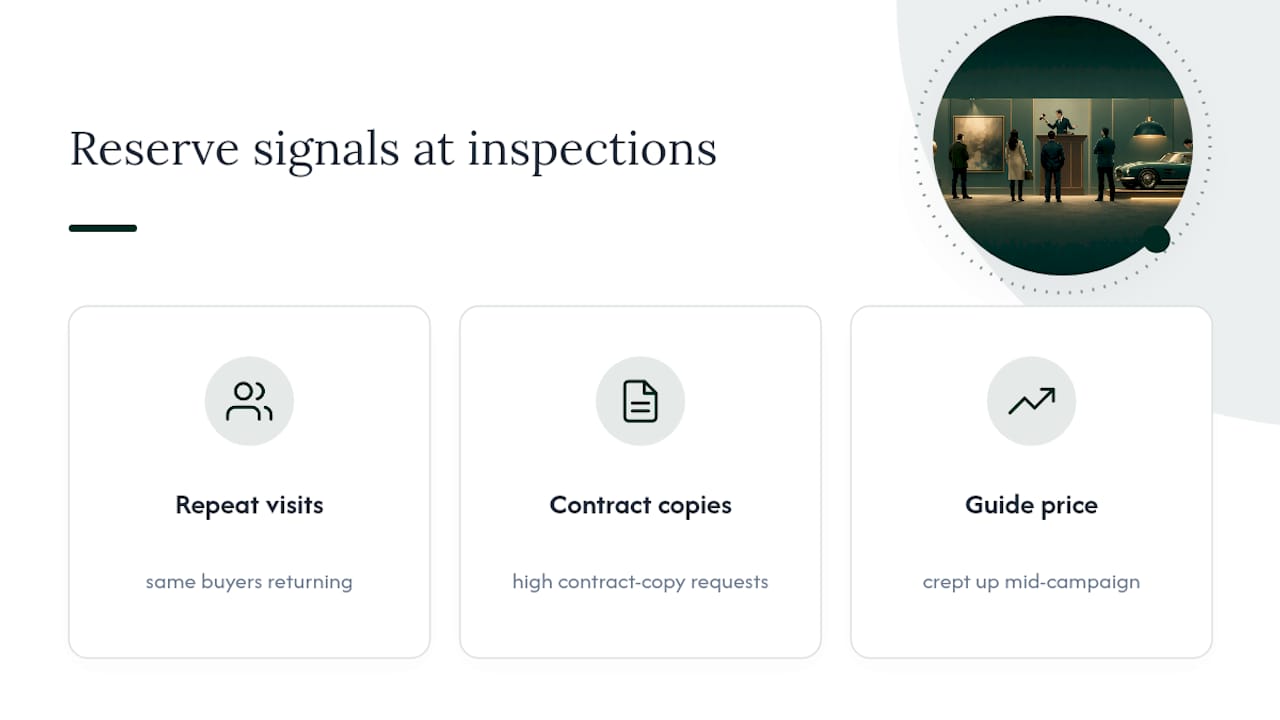
Attendance at open inspections tells you more than most people realise. When we see repeat visits from the same buyers, high contract-copy requests, and a guide price that’s crept upward mid-campaign, that combination usually points to a reserve sitting near the top of the range or above it.
The value of a buyers agent shows up most clearly in situations of ambiguity. Reading a vendor’s body language, an agent’s phrasing, and a room’s energy takes repetition most buyers never get the chance to build. That’s often the better outcome: skipping the guessing game around reserve altogether.
— Kristan
Where to check the rules yourself
For the legal detail behind these terms, the NSW Government’s guide to buying property at auction covers vendor obligations and passed-in procedure. Christie’s explainer on reserve prices gives a global auction-house view, while Investopedia’s reserve price definition frames the concept in plain financial terms.
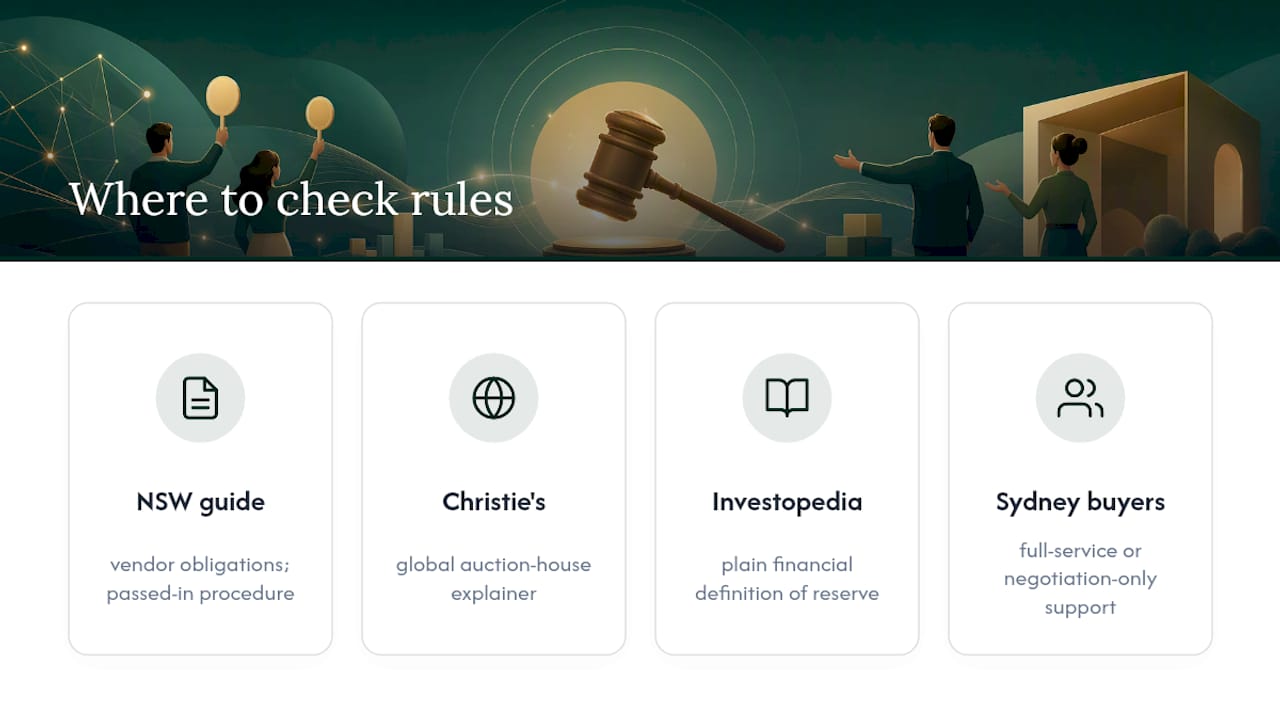
Before you step into your next auction, get a clear read on your buying position. Sydney Property Buyers offers full-service representation from strategy through to settlement, plus negotiation-only support if you’ve already found the property and just need someone sharp in your corner on the day.
Sources
Recommended
- Auction Bidding Increments: How US Buyers Win Without Overpaying
- Auction deposit percentage for US buyers: what to expect
- Sydney property auction bidding: how to bid with confidence