A property is passed in at a Sydney auction when bidding stops below the vendor’s reserve price, so the auctioneer does not sell it on the day. NSW Government guidance says the property may be passed in or withdrawn when bids do not meet the reserve. For a buyer, that is often the start of the real negotiation, not the end of the opportunity. This guide explains what happens next, how to approach a passed-in home, and what US-based buyers need to check first.
TL;DR
- Passed in means the highest bid did not reach the vendor’s secret reserve, so no sale was made at auction.
- The highest bidder generally gets the first opportunity to negotiate with the seller afterwards.
- There is no cooling-off period on an auction sale, or on a contract exchanged the same day a property is passed in, so prepare before you negotiate.
- Overseas buyers face a temporary ban on buying established dwellings in Australia unless an exception applies, so confirm your eligibility before you bid or negotiate.
- A buyers agent can run the post-auction negotiation for you, and that is where we focus our work.
Table of Contents
- What “passed in” means at a Sydney auction
- What happens straight after a pass-in
- Why more Sydney homes are passing in
- How to approach a passed-in property
- If the property goes to private treaty
- What US buyers must check first
- How a buyers agent helps with a passed-in property
- Our perspective
- Work with us on your Sydney purchase
- FAQ
- Sources
What “passed in” means at a Sydney auction
Every auction has a reserve: the lowest price the vendor will accept. The reserve is set with the agent before the auction and is not announced. If the top bid falls short, the auctioneer declares the property passed in. The NSW Government explains that a passed-in property is one where bidding did not meet the vendor’s reserve.
A few points are worth separating, because the terms get mixed up:
- Passed in means the auction ran, but the reserve was not met.
- Withdrawn means the vendor pulled the property before or during the auction, often because of low interest.
- Sold prior means a buyer made an offer the vendor accepted before auction day.
- Sold under the hammer means bidding met the reserve and the property sold on the day.
US readers sometimes assume a passed-in home is a failed listing that nobody wants. That is rarely the whole picture. A passed-in result usually means the market price and the vendor’s expectations did not match on the day. The gap between them is the negotiating room.
What happens straight after a pass-in
The moment the auctioneer declares the pass-in, the agent will usually approach the highest bidder. The NSW Government says the highest bidder generally has the first opportunity to negotiate with the seller. That is the single most valuable position in the process.
The vendor then has options. According to NSW Government guidance on selling, the vendor may negotiate a price with interested bidders or put the property back on the market. In practice the sequence tends to run like this:
- Negotiation with the highest bidder. The agent takes the vendor’s counter-position to that bidder, often within minutes of the pass-in.
- Negotiation with other registered bidders. If the first conversation stalls, the agent can open talks with others who showed interest.
- Private treaty relisting. If nothing is agreed, the property is commonly re-marketed with a price guide and a negotiated sale is sought over the following weeks.
A buyer who was not the highest bidder is not locked out. Anyone can make an offer on a passed-in property, but the agent has to deal with the top bidder first.
Why more Sydney homes are passing in
Pass-ins rise and fall with market conditions. In 2026 The Age reported on more Sydney properties passing in and what happens to them afterwards. Two details from that reporting matter for buyers. Agents often recommend vendors of passed-in homes get extra attention, such as more open for inspections, to keep a sale on track. And a property still sitting on the market two months or more after being passed in tends to prompt questions from other buyers.
That second point is useful to you. The longer a property lingers, the more a vendor’s position usually softens, but you should not treat that as a guarantee. Some vendors hold firm and relist at the same price. Reading the vendor’s motivation, rather than just the days on market, is the skill that decides the outcome.
How to approach a passed-in property
The buyers who do well here have prepared before auction day. Here is the order of work we follow.
Before the auction: set your ceiling
Decide your maximum price from comparable sales and your own budget, not from the auction atmosphere. Our guide to Sydney auction bidding with confidence covers how to build that number, and the page on bidding increments shows how small jumps can quietly push you past it.
If you intend to bid, know the formalities. Our article on NSW auction rules buyers must know explains the deposit and contract obligations, and the auction bidder etiquette guide covers how to conduct yourself in the room.
On the day: be the highest bidder, or stay close to them
Being the last bidder at a pass-in is a strategic position, not a loss. You bid up to a level that is sensible and stop. If the reserve is beyond your ceiling, you stop and let the property pass in. Then you negotiate from the position of the party who showed real money without overpaying.
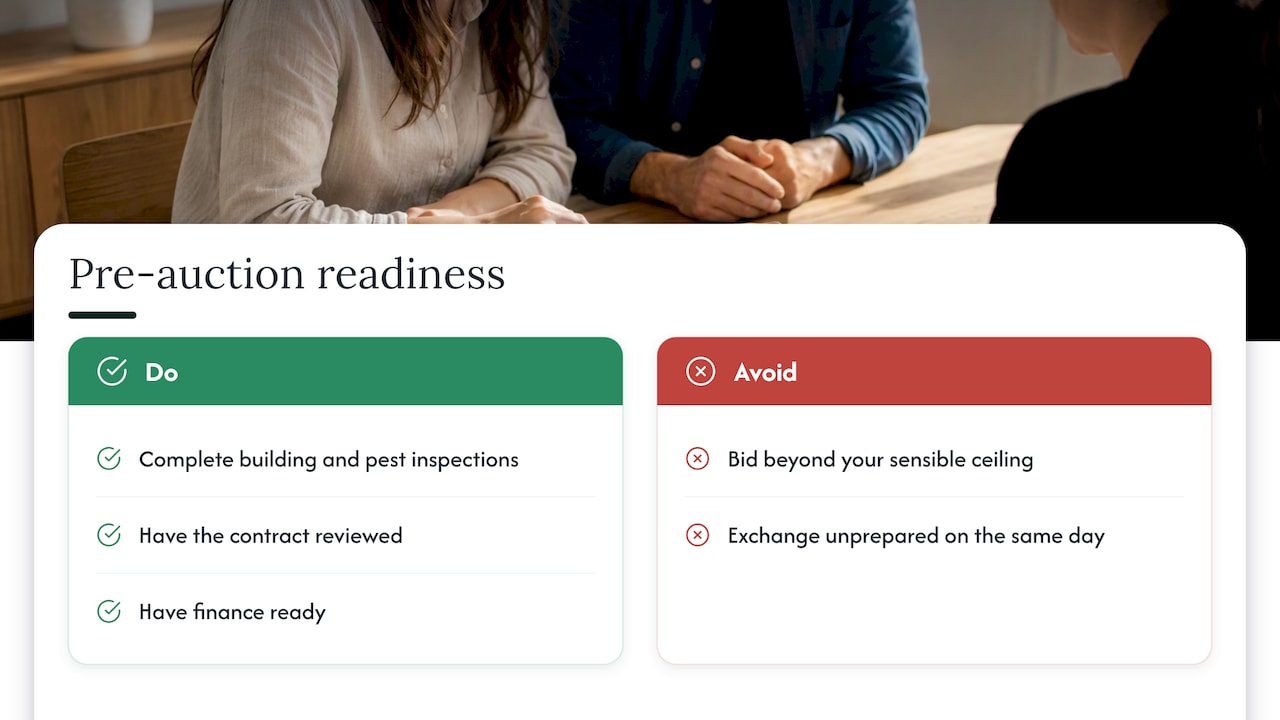
One caution on cooling-off. The NSW Government states that there is no cooling-off period for property sold at auction, or for contracts exchanged on the same day an auction property is passed in. If you agree a price in the minutes after a pass-in and exchange contracts that day, you are committed. Your building and pest inspections, your contract review by a solicitor or conveyancer, and your finance should all be done before you walk in. Our page on auction deposit percentages outlines what deposit to have ready.
After the pass-in: negotiate calmly
The first offer after a pass-in sets the tone. Rather than jumping to the reserve, we usually test the vendor’s position with a structured offer and a clear expiry. Three ideas help:
- Lead with certainty. Clean terms, a confirmed deposit and a settlement period that suits the vendor can matter as much as the headline number. Our piece on winning on terms, not price explains this.
- Use a deadline. A time limit keeps other buyers from drifting in and gives the vendor a reason to decide. See our offer expiry strategy.
- Let evidence do the arguing. Building defects, comparable sales and the passed-in result itself are all fair grounds for a lower price. Our 48 hour building report negotiation packet shows how to present them.
For the mechanics of putting a figure in writing, read how to make an offer on a Sydney property, and for the wider approach, property price negotiation in Sydney.
If the property goes to private treaty
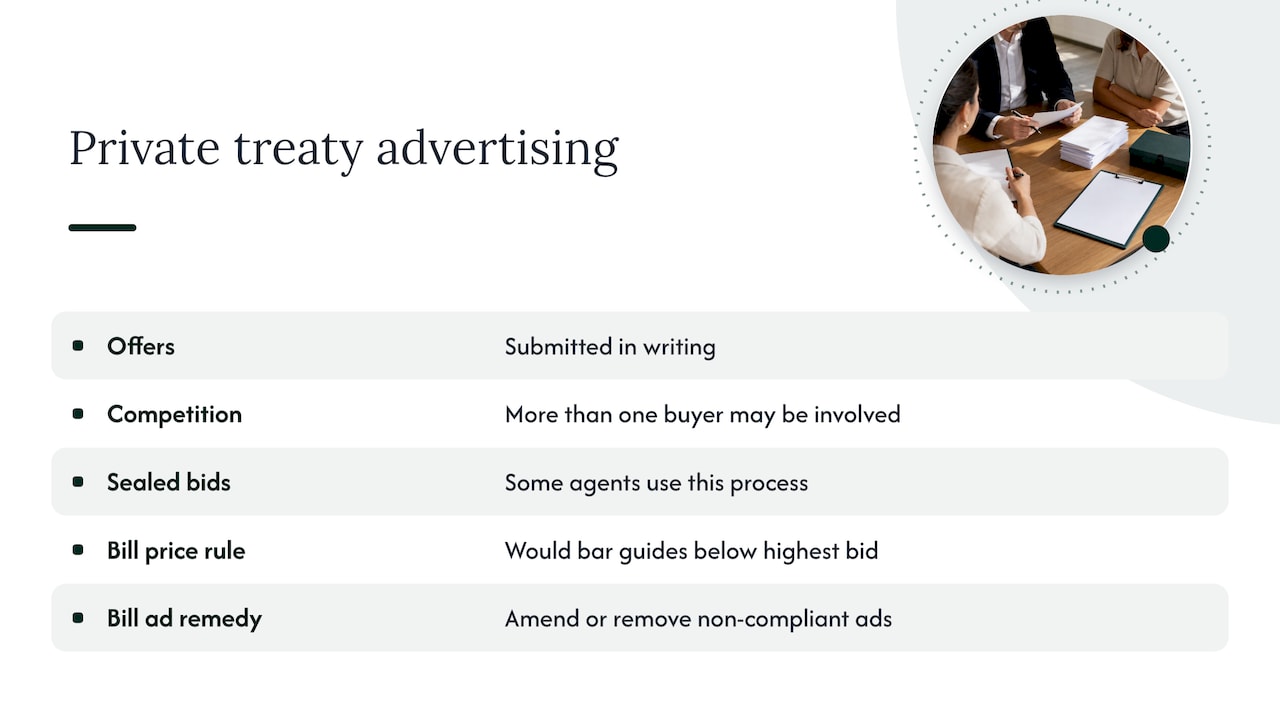
When talks with the bidders fail, the property usually comes back to market for private treaty sale. Offers then arrive in writing, and more than one buyer may be in play. How that works is covered in how a buyers agent handles multiple offers in Sydney. Some agents also run a sealed-bid process, explained in our guide to sealed bids and best and final offers.
Watch the advertising. Price guides on passed-in homes are a known pressure point. A 2026 NSW Parliament Bill, the Property and Stock Agents Amendment (Underquoting and Other Matters) Bill, would prohibit agents from advertising a price lower than the highest bid made by a registered bidder at an auction where the property was passed in. It would also require agents to amend non-compliant advertisements after a pass-in, or remove them. It is a Bill, so check the current status of the law before relying on it. Either way, the highest bid is a useful signal of where the market sits.
What US buyers must check first
This is the part that changes everything for a reader in the United States. Passed-in properties are a negotiating opportunity, but you can only take it if you are legally allowed to buy.
The Australian Government announced that from 1 April 2025, foreign persons are temporarily banned from purchasing established dwellings unless an exception applies. The Australian Taxation Office notes that the ban, originally due to end on 31 March 2027, has been extended. The same page explains that foreign persons investing in residential property must pay a fee when applying for approval to purchase, or for an exemption certificate.
The government has also said the ATO and Treasury will run an audit program and strengthen compliance to target land banking by foreign investors.
What this means in practice:
- Check your status and any exception before you register to bid or make an offer on a passed-in home.
- Do not sign a contract on the day of a pass-in without confirming approval requirements, given there is no cooling-off safety net.
- Take professional advice from a solicitor or conveyancer and, where relevant, the official foreign investment authority.
Our article can a foreign buyer purchase Sydney property in 2026 walks through the eligibility questions in plain language. If you are an Australian citizen or permanent resident living in the US, different rules may apply, so confirm your status first.
How a buyers agent helps with a passed-in property
A pass-in compresses a lot of decisions into a few minutes. Having someone represent only you changes the odds in several ways:
- Pre-auction homework. Independent appraisal, contract review coordination and building inspections are done before the auction, so you can act within the no cooling-off reality.
- Bidding discipline. An agent bids to your ceiling and stops, which protects you from emotion.
- Immediate negotiation. If you are the top bidder, the agent starts talks with the vendor’s agent while the property is still fresh in everyone’s mind.
- Reading the vendor. Knowing whether a vendor is relocating, has already bought elsewhere or is simply testing the market shapes your first offer.
- Remote execution. For overseas clients, someone local can inspect, bid and negotiate while you are in a different time zone.
Our guide to negotiating a house price in Sydney and the overview of a negotiation strategy for Sydney buyers go deeper on the tactics.
Our perspective
We act only for buyers, never sellers, so a pass-in looks different from our side of the table. To a vendor it can feel like a setback. To a prepared buyer it is a chance to deal without the crowd.
What we see is that most buyers lose the advantage in the first five minutes, because they have not settled their numbers, their finance or their contract review. The buyers who do well decide their maximum before the auction, bid to it, and then negotiate calmly from that position. Our team inspects properties seven days a week, independent of open home schedules, so we are rarely meeting a property for the first time on auction day.
We also look beyond the price. Capital growth potential and rental yield matter as much as the discount, particularly for investors, and a good deal on the wrong property is still the wrong property. Our clients have secured over 30% of their purchases off-market, which is one reason we do not rely on auction days alone.
— Kristan
Work with us on your Sydney purchase
Sydney Property Buyers is a licensed Sydney buyers agency (NSW Licence 20456819) that represents purchasers only. If you want help from search through to settlement, our Complete Purchase Solution and Auction Bidding service covers strategy, on-market and off-market search, independent appraisal, due diligence, negotiation, bidding and settlement. If you have already found a property, including one that has just passed in, our Negotiation Only service puts a licensed negotiator on your side. We work across the Inner West, Eastern Suburbs, Lower North Shore and Eastern Beaches.

You can see properties we have secured for clients, or call 1800 676 177 or email hello@sydneypropertybuyers.com.au to talk through your situation.
FAQ
Is a passed-in property a bargain?
Not automatically. It means bidding did not reach the vendor’s reserve, which tells you the market and the vendor disagreed on the day. That gap can create room to negotiate, but the outcome depends on the vendor’s motivation and on other buyers. Compare recent sales before assuming a discount.
Can I still buy a property after it has passed in?
Yes. The highest bidder generally has the first opportunity to negotiate, according to the NSW Government. If that fails, the vendor may speak to other interested buyers or relist the property, so other buyers can still make offers.
Do I get a cooling-off period if I buy right after a pass-in?
Not if contracts are exchanged on the same day. The NSW Government states that there is no cooling-off period for auction sales or same-day exchanges after a pass-in. Get your contract reviewed by a solicitor or conveyancer, and your finance and inspections in order, before you negotiate.
Can a US citizen buy a passed-in property in Sydney?
Only if the foreign investment rules allow it. Foreign persons are temporarily banned from buying established dwellings unless an exception applies. Check your eligibility and any approval or fee requirements before you bid or make an offer.
How long should I wait before making an offer on a passed-in home?
There is no fixed rule. If you are the top bidder, the first conversation usually happens straight after the auction. For other buyers, a property still unsold two months or more after passing in tends to attract questions, which can shift the vendor’s expectations.
Sources
- Buying property at an auction, NSW Government
- Steps to selling a property, NSW Government
- More Sydney properties are passing in, The Age
- Property and Stock Agents Amendment (Underquoting and Other Matters) Bill, NSW Parliament
- Changes to foreign purchases of established dwellings, Foreign Investment
- Residential fees for a foreign person, Australian Taxation Office
Recommended
- How to make an offer on a Sydney property
- Section 32 explained: what Sydney buyers need to know
- Sydney property auction bidding: how to bid with confidence
- Buyers agent post-purchase support in Sydney: 2026 guide