Buying below market in Sydney means paying less than a property is genuinely worth, and it rarely happens by luck. It comes from three things: finding sellers who need to move (a distressed sale, a deceased estate, a stale listing), proving value with real comparable sales rather than an agent’s price guide, and negotiating or bidding with discipline. If you live in the United States, there is a fourth step first: confirm that you are legally allowed to buy.
This guide covers all four, in the order you will meet them.
TL;DR
- Sydney prices have softened: as of September 2026 the median dwelling value was about A$1,198,596, down 7.0% over the year, so sellers are more willing to negotiate than they were.
- Genuine bargains come from motivated sellers, off-market and pre-market deals, and well-run negotiation, not from an advertised price guide.
- Judge value with recent comparable sales and the free NSW Valuer General tools. Auction guides are often set low.
- From 1 April 2025 to 31 March 2027, foreign persons are generally banned from buying established dwellings in Australia, with limited exceptions. Check your status before you search.
- Do due diligence before you bid. There is no cooling-off period at an NSW auction.
Table of Contents
- Is Sydney actually a buyer’s market right now?
- Where below-market Sydney property comes from
- How to tell if a price really is below market
- Due diligence on a discounted property
- Auctions: where discounts are won or lost
- Can you buy at all? Foreign buyer rules
- Our perspective
- Working with a Sydney buyers agent
- FAQ
- Sources
Is Sydney actually a buyer’s market right now?
More than it was. Figures compiled to September 2026 put Sydney’s median dwelling value at roughly A$1,198,596, a 7.0% fall over twelve months. The same data has the median house value at A$1,466,060, down 8.2% on the year, after a 1.6% drop in September alone.
In a softer market, homes can sell under their guide. A recent report described a Darlinghurst terrace selling below its guide, the kind of result that happens when sellers accept lower bids to secure a sale.
Two cautions. First, a falling median does not mean every suburb or every property is cheap. Sydney is a collection of very different micro-markets, and a well-presented family home in the Inner West behaves differently from an older unit with a strata problem. Second, a market-wide dip does not hand you a discount automatically. You still have to find the seller who needs to sell and prove the price is right.
Where below-market Sydney property comes from
Discounts tend to come from a handful of situations. Each has a different process and a different risk profile.
Distressed and motivated sellers
“Distressed sale” covers several circumstances: a mortgage default, a divorce, a deceased estate, or an owner who has bought elsewhere and must sell. If you want to understand the seller’s side, this overview of what a distressed homeowner is explains the common situations and why those owners accept lower offers.
The most formal version is a mortgagee sale. In NSW, a lender may take possession of and sell a property when a borrower defaults on repayments and fails to remedy the default. The lender’s goal is to recover the debt, not to extract the highest price, which is why these properties can sell for less. Under the Real Property Act 1900, a registered mortgagee may apply for foreclosure after six months’ default, and that application requires a public auction where the highest bid was not enough to cover the secured debt and sale expenses.
That last point matters to you as a buyer. A property that has been passed in at auction below the owner’s or lender’s expectations is one of the clearest signals of a seller who may now deal.
Be realistic about volume. Truly distressed stock is a small slice of the market, and Legal Aid NSW advises struggling homeowners to sell early rather than wait for enforcement, which means many motivated sellers list as ordinary sales long before a lender steps in. Those are the ones worth finding.
Searching for distressed listings
A specialist property data provider, SQM Research, publishes a distressed property report searchable nationally and by suburb. It looks for wording such as mortgagee in possession, divorce, forced sale, deceased estate, must sell, price slashed and selling below value, and its entries can show the first-advertised date, the initial asking price and last sale details. A listing that has sat for months with two price cuts tells you a lot about the seller’s position.
Keyword scanning only catches what is advertised in those words. Many motivated sellers never use them, and the best opportunities may not be advertised at all.
Off-market and pre-market deals
Some Sydney homes sell before they ever reach a public portal. A seller who wants privacy, speed or no marketing costs may agree a sale quietly through an agent’s network. Less competition can mean a better price, because the property has not been put in front of dozens of buyers at open homes.
This is a large part of what we do. More than 30% of the purchases we secure for clients are off-market. If you want the mechanics, our guides on buying off-market in Sydney and how a buyers agent gets access to off-market properties explain how these deals are sourced and why they are not listed.
Stale listings and negotiated discounts
The most common source of below-market buying is the ordinary listing where the seller will take less than the guide. This is where negotiation skill pays. Our average saving across clients is around 9% on the purchase price, which is our own figure for our own work, and it varies property by property. If you want to see how the process works, read our guide to negotiating a Sydney house price.
How to tell if a price really is below market
A “bargain” is only a bargain against something. The most common mistake we see from interstate and overseas buyers is comparing a Sydney price with the price of a home back in the US, or with the advertised guide. Neither tells you what the property is worth.
Start with comparable sales
The NSW Government’s advice is to check recent comparable sales and treat an advertised price guide only as a guide. Compare like with like: same suburb or street, similar land size, bedrooms, condition and aspect, and sales from the last few months rather than the last few years.
NSW also provides free tools. Buyers can use the Valuer General Valuation Portal to search land values and property sales information without charge, and pay for deeper database searches if they want them.
Do not trust a low auction guide
Sydney auction guides have a track record of running low. The Guardian’s analysis found that 20% of Sydney sales exceeded the highest pre-sale guide by more than 10%, rising to almost two-thirds of Sydney houses sold at auction. In the same analysis, the final price beat the guide for 92% of Sydney auction sales but beat an automated valuation estimate for 44%, which suggests the guide was the weaker measure of value.
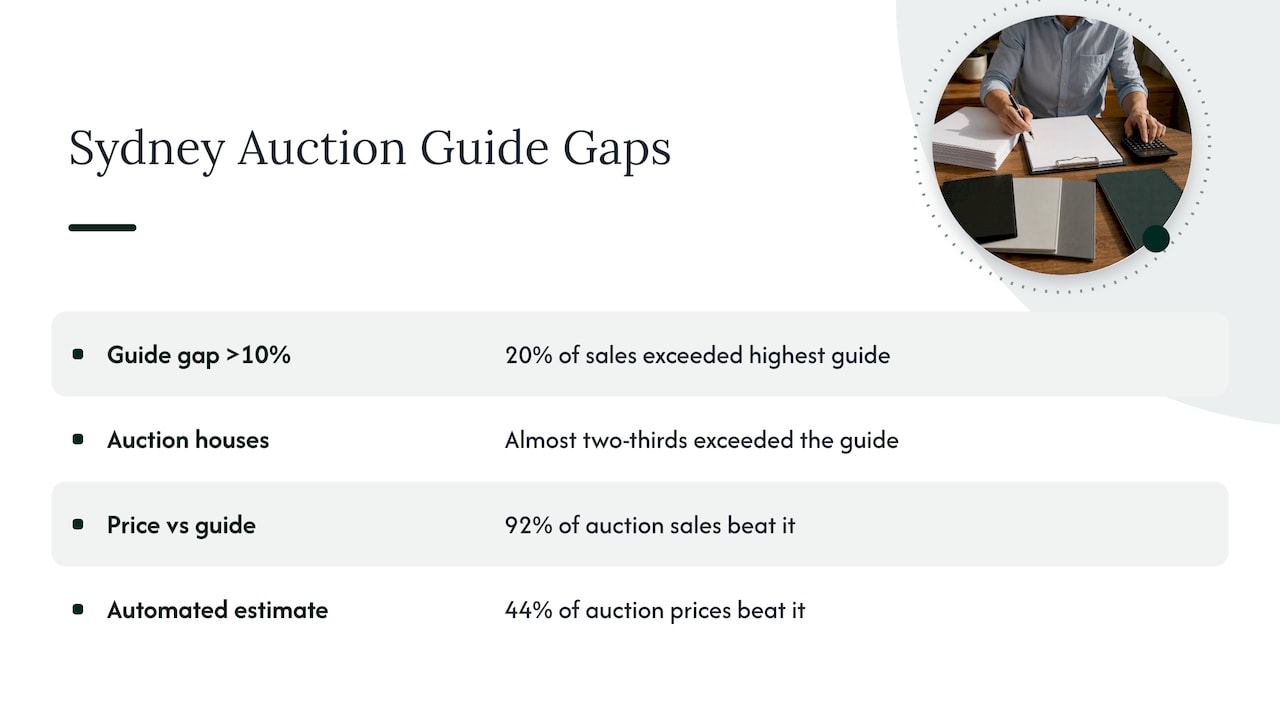
The practical lesson: if a house is guided at A$1.4 million and comparables say A$1.6 million, the guide is the outlier. Do not assume you can buy at the guide, and do not call something “below market” because it is below its guide.
A simple three-step value check
- Pull five to eight genuinely comparable sales from the past three to six months.
- Adjust for differences: a renovated kitchen, a bigger block, a main road, a poor floor plan.
- Set your own ceiling price before the auction or negotiation starts, and treat it as final.
If you want an independent view, an appraisal from a buyers agent who does not sell property is one way to get it. Our Full Service includes an independent appraisal before we negotiate or bid.
Due diligence on a discounted property
A discount can disappear fast if the property has a hidden problem. Distressed and mortgagee properties in particular may have been neglected, and you may have little information from the seller.
Before bidding, the NSW Government advises buyers to obtain building and pest reports, review strata reports where relevant, and have a solicitor or licensed conveyancer review the contract. In practice, that means:
- Building and pest inspection. Structural movement, damp, termites and illegal works are the usual discount killers.
- Strata records, for units and townhouses. Look for special levies, sinking fund shortfalls, and any building defect disputes.
- Contract review. Your solicitor or licensed conveyancer checks title, easements, zoning and the special conditions. In a mortgagee sale, the lender typically gives very limited warranties, so this step matters more, not less.
- Finance. The NSW Government advises buyers to have finance pre-approved before making an offer.
Our own guides go deeper on what due diligence means for buyers and a Sydney due diligence checklist. If a building report turns up defects, there is also a way to turn them into a price reduction, covered in our piece on building report negotiation.
Auctions: where discounts are won or lost
If the property goes to auction, you need to know the rules before you register, because mistakes here cost real money.
At an NSW auction there is no cooling-off period. Once the hammer falls, the successful bidder must sign the contract and exchange. The deposit, usually 10% of the purchase price, is paid on the spot. That is why inspections, reports and legal review must be finished before auction day, not after.
A few other points for US buyers:
- You can bid by proxy if you are overseas. Our guide to proxy bidding at Australian property auctions explains how.
- Bidding increments are different from what you may expect. See auction bidding increments for US buyers.
- Registration is required before you can bid: how to register in NSW.
- Understand the rules on deposits and conduct in our summary of NSW auction rules buyers must know, and the etiquette in our bidder etiquette guide.
A property passed in at auction is often the best negotiating position a buyer gets. The seller has tested the market, found the ceiling, and may now deal with the highest bidder. Our guide to auction bidding with confidence covers that moment.
Can you buy at all? Foreign buyer rules
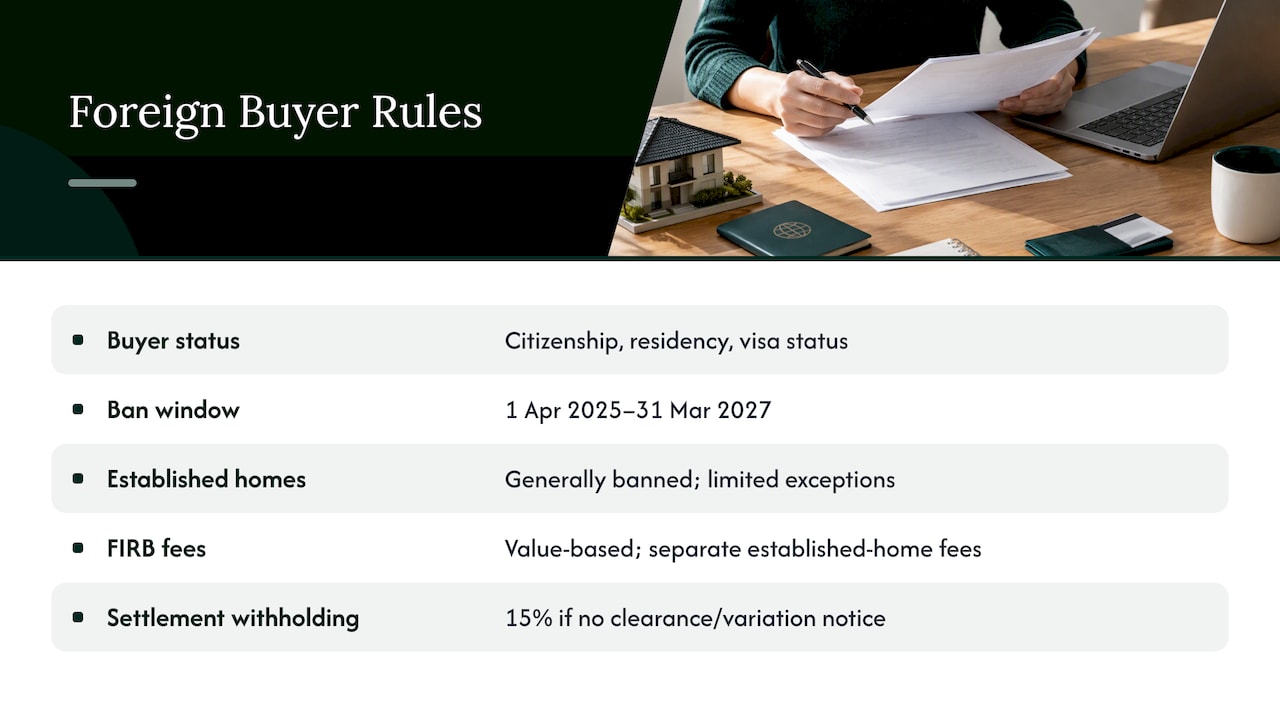
This is the part many US-based searchers skip, and it comes first. From 1 April 2025 to 31 March 2027, foreign persons are generally banned from purchasing established dwellings in Australia, subject to limited exceptions. That window is set to run until 31 March 2027, so check the official Foreign Investment Review Board (FIRB) site for what applies when you are ready to buy.
Whether you count as a foreign person depends on your citizenship, residency and visa status, not on where you currently live. Confirm your position with FIRB or an Australian solicitor before you commit to a search. Where approval or an exemption certificate is needed, the Australian Taxation Office says application fees are generally based on property value, with separate fees for established dwellings.
There is also a tax step at settlement. For contracts signed on or after 1 January 2025, if the seller does not provide a clearance certificate or variation notice, the buyer must withhold 15% of the sale price and pay it to the ATO. Your solicitor or conveyancer will handle this, but it affects the cash you need at settlement.
We are a buyers agency, not a migration or tax adviser. We work alongside your solicitor and accountant on these questions.
Our perspective
Most people who search for a below-market Sydney property are really asking one question: how do I stop overpaying? The honest answer is that the discount is rarely sitting in a listing waiting to be found. It is made in three places: access, evidence and nerve.
Access means hearing about the right property before the crowd does. Over 30% of our purchases for clients are off-market, because sellers who value speed and privacy often prefer a quiet sale. We inspect seven days a week, not just at open homes, so we can see properties on our clients’ timetable and often speak to the selling agent before a campaign launches.
Evidence means pricing the property on comparable sales, not on a guide. We appraise independently, and we look at capital growth potential and rental yield together, because a cheap purchase in a weak location is not a bargain.
Nerve means holding the line. A calm, prepared bidder or negotiator is the buyer who walks away with a saving. Our clients have averaged around 9% off the purchase price, and our average time from engagement to settlement is 54 days. That is our experience, not a promise, because every property and seller is different.
For buyers overseas, the biggest risk is acting on a hunch from a long distance. Have someone on the ground who represents only you, never the seller.
Kristan
Working with a Sydney buyers agent
Sydney Property Buyers is a licensed buyers agency that represents purchasers only, never sellers. Our Inner West, Eastern Suburbs, Lower North Shore and Eastern Beaches focus means we know what recent sales are really achieving in those suburbs. We have secured more than 100 properties for clients and hold a 5.0 Google rating.
There are two ways to work with us. Our Complete Purchase Solution and Auction Bidding covers strategy, on-market and off-market search, appraisal, due diligence, negotiation, bidding and settlement. If you have already found a property, Negotiation Only gives you professional representation on price. For a plain explanation of the role, see what a buyers agent does and whether you need one at all.

To talk it through, call 1800 676 177 or email hello@sydneypropertybuyers.com.au. We are at 79 New Canterbury Rd, Petersham NSW 2049 (NSW Licence 20456819).
FAQ
What counts as a distressed sale in Sydney?
It is a sale where the owner is under pressure to sell, such as a mortgage default, divorce, deceased estate or a forced sale. In NSW, a lender can take possession and sell when a borrower defaults and does not fix it. Many motivated sellers list as ordinary sales before it reaches that stage.
Is a property sold under its price guide a bargain?
Not necessarily. Analysis of Sydney sales has found that many auction guides sit below the final price, so selling under the guide does not mean selling under market. Compare recent comparable sales and set your own ceiling price.
Can I buy property in Sydney from the United States?
Possibly, but check your status first. From 1 April 2025 to 31 March 2027, foreign persons are generally banned from buying established dwellings, with limited exceptions. Confirm whether you count as a foreign person with FIRB or an Australian solicitor before you start searching.
Is there a cooling-off period at an NSW auction?
No. The successful bidder signs the contract and pays the deposit, usually 10%, on the spot. Complete building, pest and legal checks before the auction. For private treaty sales, see our guide to the five business day cooling-off rules.
Sources
- Sydney property market data, trends and forecasts 2026-2027
- Darlinghurst terrace home sells below guide amid Sydney market
- What is a mortgagee in possession in NSW?
- Real Property Act 1900, section 61
- Legal Aid NSW, Mortgage stress handbook, chapter 8
- SQM Research, distressed property reports
- NSW Government, making an offer on a property
- NSW Government, working out what home to buy and where
- The Guardian, where property underquoting is rife in Australia
- NSW Government, buying property at an auction
- Foreign investment guidance note 14, residential compliance and penalties
- ATO, residential fees for a foreign person
- ATO, capital gains withholding when selling and purchasing property
- What is a distressed homeowner? A 2026 guide
Recommended
- Benefits of buying off-market in Sydney: 2026 guide
- Buyers’ Agent Tactics with Valuer General Comps: Sydney for US Buyers
- US Buyers: Buy Sydney Property Sight Unseen Without Getting Burned
- Save 9%: Best Time to Buy in Sydney Is When You Have Leverage