Title insurance in Australia is a one-off policy, bought around settlement, that covers losses from problems with a property or its title that already existed and that you did not know about. It is optional, it is much less central than in the United States, and whether it is worth buying depends on the property, the searches done before you sign and the exclusions in the policy wording. If you are buying in Sydney, the better question is how many of those risks can be found and priced before you commit. That is what due diligence is for, and it is the part of a purchase we handle for buyers at Sydney Property Buyers.
TL;DR
- Title insurance is not compulsory when buying property in Australia, and it works differently from the US version that most American buyers are used to.
- NSW has a state-guaranteed land title system (Torrens), so a registered owner already has strong protection. Insurance targets gaps, such as unapproved building work or boundary problems.
- For a A$750,000 home, one insurer’s schedule lists a NSW premium of A$719.50, paid once and held for as long as you own.
- Policies only cover what was unknown at the time. A problem found during due diligence is a negotiation point, not an insurance claim.
- The strongest protection is a thorough pre-purchase check of the contract, title, easements, building and strata records.
Table of Contents
- Why Australian title insurance is not the American product
- What the Torrens system already gives you
- What title insurance covers in Australia
- What it does not cover
- What title insurance costs in NSW
- Is title insurance worth it?
- The bigger risk is the one you can find
- Perspective
- How we can help with your purchase
- FAQ
- Sources
Why Australian title insurance is not the American product
If you come from the United States, title insurance is part of almost every home purchase. A lender typically requires a policy, and the premium is a standard closing cost. In Australia the starting point is different. The legal system for recording land ownership does a lot of the work that private insurance does in the US, and the policy is an optional extra rather than a closing requirement.
That matters because the word “title” covers a different set of risks in each country. When you buy in Sydney, Australian law applies, specifically New South Wales law, and the rules of the state where the property sits decide what is protected. Nothing you know about US policies, lenders’ requirements or closing practice carries across directly. A Sydney purchase also follows its own sequence: a contract of sale, a cooling-off period for most private treaty purchases, exchange of contracts, and then settlement. Our due diligence checklist for Sydney buyers shows where each check sits in that timeline.
What the Torrens system already gives you
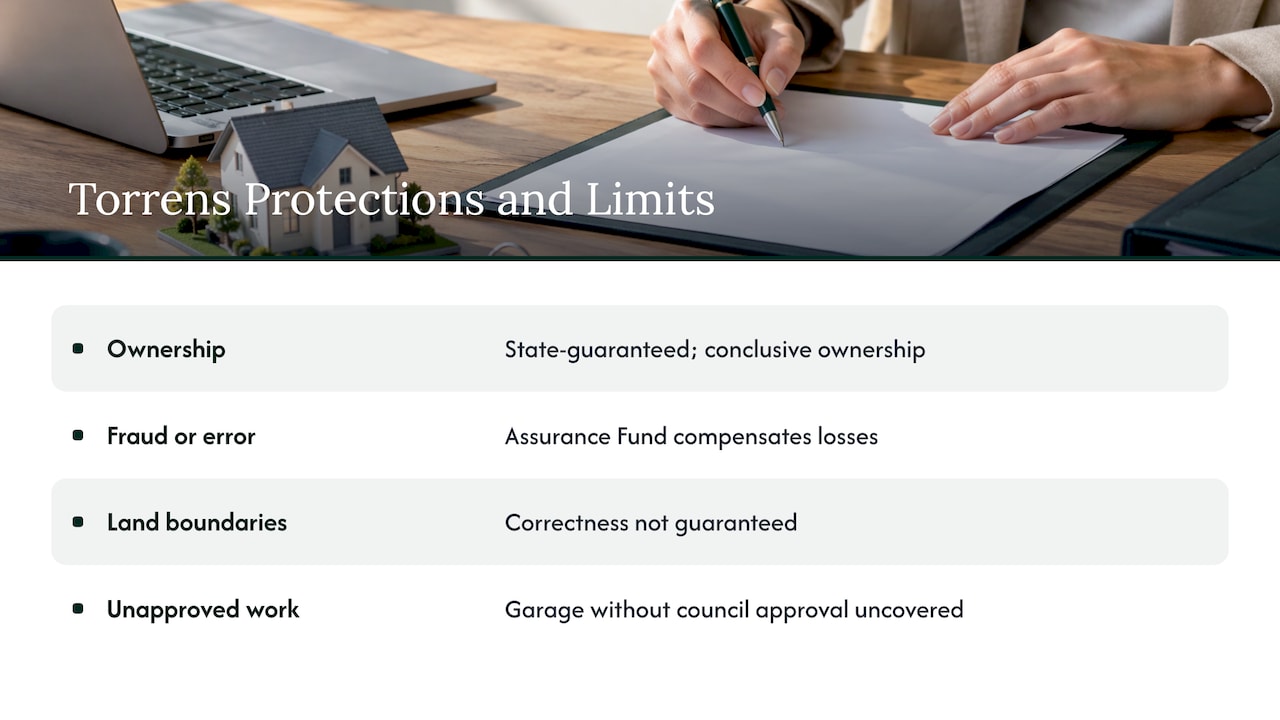
Australia uses the Torrens system, devised in South Australia in 1858. The Intergovernmental Committee on Surveying and Mapping explains that it records all interests in a single Certificate of Title that the State guarantees, so the register is conclusive evidence of ownership. This is called indefeasibility of title. The same page notes that the guarantee does not extend to the boundaries of the land shown on the title being correct.
That boundary gap is one of the main reasons title insurance exists at all. Law firm Baker McKenzie describes Australia’s title by registration system as giving indefeasibility to the registered holder, with exceptions that include fraud, misdescription of boundaries and unconscionable conduct, which vary by state. It also says no separate title insurance is required to support ownership of land interests.
In NSW there is a compensation backstop too. The Registrar General says the State guarantee is backed by the Torrens Assurance Fund, which compensates people who lose out through fraud or error in registration. The levy that funds it for 2026/27 is A$5.35 and is adjusted each year by CPI (the consumer price index). So a NSW buyer already has a government-backed protection for registration errors. What the fund is not designed to do is cover a garage that the previous owner built without council approval.
What title insurance covers in Australia
Policies are written by private insurers and the wording differs between them. Canstar’s guide lists the kinds of risk a policy can cover, noting that features vary between policies and insurers. Typical cover includes:
- illegal or non-compliant building work by a previous owner
- council or conveyancer errors in reporting charges such as outstanding rates and land tax
- boundary errors and encroachments
- incorrect public records for easements, drainage, sewerage and heritage listings
- fraud, forgery or improper signing and registration
- lack of legal access to the property
- unregistered restrictive covenants
- zoning violations and subdivision law errors
One insurer’s home owner brochure, published by Stewart Title Australia, describes cover for fraud, forgery and identity theft, enforcement action over illegal building work, survey and boundary defects, and planning and title defects such as unregistered easements. It also says a single premium protects you for as long as you own the property, with no excess on claims.
What a claim can look like
First Title’s guide gives examples of past claims: A$100,000 for a garage and carport built illegally by a previous owner, and A$18,000 where a neighbour’s wall encroached on the policyholder’s land. Those are the kinds of problems a clean title search will not reveal. A search confirms who owns the land and which interests are registered. It does not tell you whether the patio was approved or whether the fence sits on the boundary.
In NSW the unapproved work scenario is common in older suburbs. First Title explains that where retrospective approval is obtained for unauthorised building work, title insurance can cover the associated costs, though risks that arise after you take out the policy are excluded.
What it does not cover
This is where most misunderstandings start. Canstar lists common exclusions: known risks before settlement, risks that cause no financial loss, damage a building inspection could find, buildings that do not comply with the Building Code of Australia, and environmental contamination. The Australian Institute of Conveyancing and Settlement Agents adds that title insurance does not cover pest and building inspections and does not replace a competent conveyancer.
Two practical points follow.
- Known problems are yours to price. If your searches or inspection reveal unapproved work, the insurer will treat it as known. You deal with it through the contract, the price or a decision to walk away.
- Policies have limits. Individual policies cap certain cover, restrict some property types and may exclude particular risks, such as problems with strata external cladding. The policy documents decide what is covered, not the headline description.
A home and contents policy is a separate product again. Title insurance deals with the legal and compliance history of the property, not storm damage or theft.
What title insurance costs in NSW
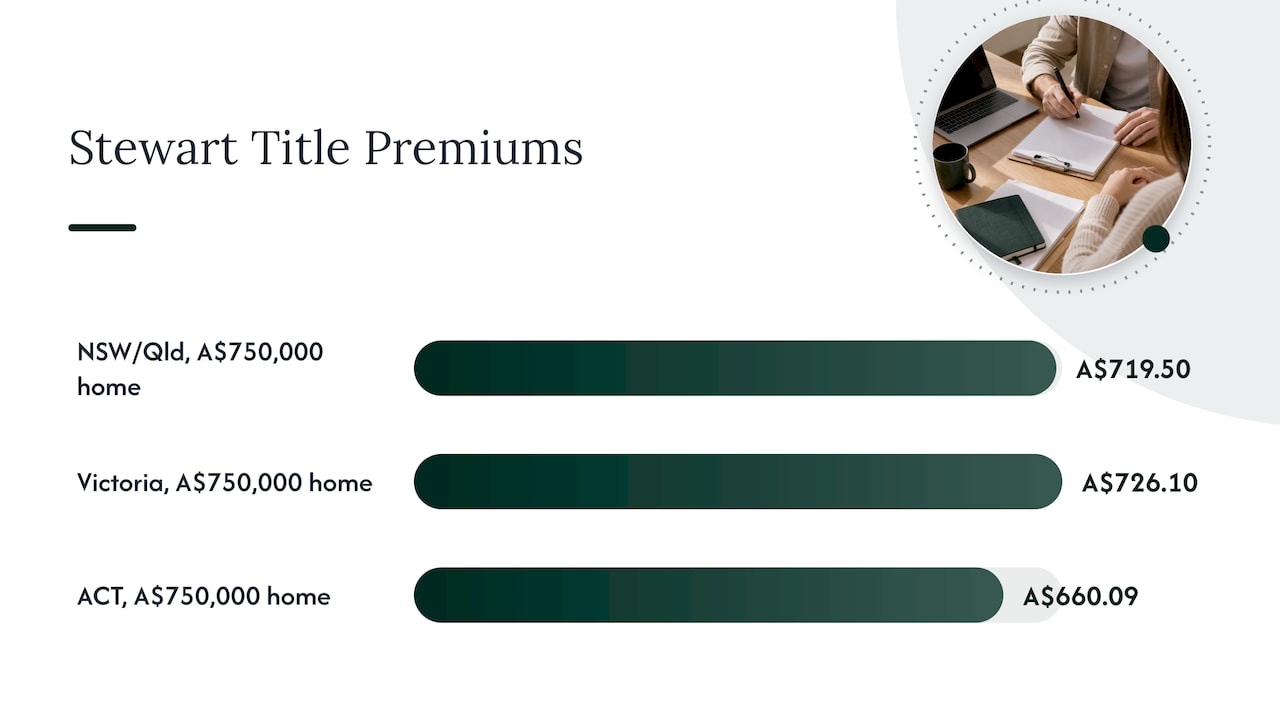
Premiums are a one-off payment and vary with property price and location. Canstar reports that, for a A$750,000 residential home, the Stewart Title premium schedule lists A$719.50 in NSW and Queensland, A$726.10 in Victoria and A$660.09 in the ACT. Treat that as an example from one insurer’s published schedule, not a quote. Your price depends on the insurer, the purchase price and the property type, and schedules are revised from time to time.
There is no annual renewal and no excess on claims for the policies described above, so the cost is paid once at settlement. Compared with the purchase price, stamp duty and legal fees on a Sydney home, it is a small line item. Compared with the cost of retrospective approvals or a boundary dispute, the sums in First Title’s examples are much larger. That is the logic buyers weigh.
Is title insurance worth it?
There is no single answer, and the honest advice from professionals is to look at the specifics. Canstar says it depends on individual circumstances and recommends speaking with a solicitor or conveyancer and reading the product disclosure statement. A Queensland conveyancing firm, Somners, argues that because Torrens title already protects registered owners strongly, the policy should be examined carefully rather than accepted or dismissed. It suggests measuring value against five questions:
- Is the risk plausible for this property?
- Has that risk already been investigated?
- Do the exclusions limit the cover?
- Is the cap meaningful relative to the property’s value?
- Do you understand the difference between an insured risk and an ordinary property risk?
In our experience of how Sydney purchases are structured, the properties where these questions bite hardest are older houses with additions, renovated terraces in the Inner West and Eastern Suburbs, and homes with shared walls, rear lanes or easements. Where a house has been extended over decades, the history of approvals is exactly the kind of thing a title policy is written around. Where you buy a new apartment in a recently registered strata plan, the risks look different and your own checks on the building and the strata records carry more weight.
A simple way to decide
- Do the searches first. Start with a property title search to confirm ownership, registered interests and any caveats.
- Check easements and covenants. A registered easement can limit where you build or give a neighbour access. Our easement checklist for NSW buyers walks through what to look for before exchange.
- Inspect the building and approvals. Order a building and pest inspection and compare what stands on the block with what council has approved. See why a building inspection before bidding matters.
- For strata, read the records. Minutes, sinking fund and defect history show problems no policy will insure once you know about them. Here is why we check strata records, and what to know about building defects in NSW strata.
- Ask your solicitor or conveyancer about a policy. They review the contract and can tell you whether a policy suits the specific property. Ask before settlement, because cover has to be arranged in time and anything found before then is treated as known.
- Read the wording. Look at the cap, the exclusions and the definitions of covered loss before you pay.
If, after those steps, the remaining risk is unknown rather than identified, a one-off premium of a few hundred dollars is a reasonable thing to consider.
The bigger risk is the one you can find
Most expensive surprises in a Sydney purchase are not hidden legal defects. They are visible problems that were never priced: an unapproved extension, a leaking balcony, a special levy in the pipeline, a drainage easement running under the planned extension. These are discoverable, and once discovered they have value in negotiation. Our guide to negotiating from a building report explains how findings turn into a price conversation, and the pre-settlement inspection checklist covers what to confirm in the final days before you complete.
For overseas and interstate buyers the gap is wider, because you cannot walk the property, speak to neighbours or judge the street. If you are weighing a purchase from abroad, read how buying sight unseen in Sydney works in practice.
Perspective
Buyers often ask us whether title insurance is the safety net that makes a purchase safe. In our view it is a useful last layer, not the foundation. The foundation is knowing what you are buying before you sign.
We represent buyers only, never sellers. Our Full Service covers the whole purchase: strategy, search, independent appraisal, due diligence, negotiation, auction bidding and settlement. We inspect properties seven days a week, independent of open home times, so we can look closely at the things that matter: the extension nobody mentions, the boundary, the strata records.
When that work turns up a problem, it becomes leverage. We use it to negotiate a better price or to advise a client to step away. Across our clients, our average saving on purchase price is about 9%, and our average purchase takes 54 days from engagement to settlement. A buyer who has done this work properly can then decide on a title policy knowing which risks are left, rather than buying cover in the dark.
Kristan
How we can help with your purchase
If you are buying in Inner West, Eastern Suburbs, Lower North Shore or Eastern Beaches Sydney, our Complete Purchase Solution takes you from strategy and search, including off-market properties, through independent appraisal, due diligence, negotiation and settlement. If you have already found a property, our Negotiation Only service puts a licensed agent across the table for you. Over 30% of our purchases have been secured off-market, and we have secured more than 100 properties for clients. Our office is at 79 New Canterbury Rd, Petersham, and you can reach us on 1800 676 177.

We are fully licensed in NSW (licence 20456819), and Kristan Johnson was named 2024 Outstanding Buyers Agent of the Year at the Inner West Local Business Awards.
FAQ
Is title insurance compulsory in Australia?
No. Baker McKenzie says no separate title insurance is required to support ownership of land interests under the Torrens system. A lender may have its own conditions, so check your loan documents. Otherwise the decision is yours.
How much does title insurance cost in Australia?
It is a one-off premium that varies by insurer, property location and price. Canstar reports that one insurer’s schedule lists A$719.50 for a A$750,000 home in NSW. Ask your solicitor or conveyancer for a current quote for your purchase.
Is title insurance worth it for a Sydney property?
It depends on the property and on what your searches find. Older homes with additions, shared boundaries or easements carry more risk the policy is designed for. Policies exclude problems already known before settlement, so thorough due diligence comes first.
Does title insurance replace a building inspection or conveyancer?
No. The Australian Institute of Conveyancing and Settlement Agents says it does not replace a competent conveyancer and does not cover pest and building inspections. You still need the contract review, title searches and inspections.
Can a US buyer rely on American title insurance for a Sydney purchase?
No. A Sydney property is governed by NSW law, and cover for it is written under Australian policies. Speak to a NSW solicitor or licensed conveyancer about your own purchase.
Sources
- Systems of ownership and registration, Intergovernmental Committee on Surveying and Mapping
- Real Estate Law, Australia, Baker McKenzie
- Title Guarantee, NSW Registrar General
- What is title insurance and is it worth it? Canstar
- Title insurance for home owners, Stewart Title Australia
- The Complete Title Insurance Guide, First Title
- Buying a House with Unapproved Renovations? First Title
- Title Insurance, AICSA
- What is Title Insurance? A Queensland Guide, Somners
Recommended
- How Buyers Saved 9% on Sydney Tenanted Purchases: NSW Legal Checklist
- Section 32 explained: what Sydney buyers need to know